5. The landscape:
How does the Nordic Ocean Economy landscape look like today?
Now that we have defined the Ocean Opportunity, explained why the timing is right, and shown why the Nordics have a strong position, the next step is to map out the current landscape of the Nordic Ocean Economy. This means identifying where innovation is happening, which sectors are most active, and how companies cluster together.
Step four in the investment thesis framework involves answering the key question:
The goal of this step is to provide a structured and factual overview of the Nordic Ocean Economy ecosystem today. However, this is not yet about identifying the best investment opportunities—that will be covered in the final step, where we will analyze which areas offer the strongest potential for long-term growth and returns. Before assessing where capital should be allocated, we first need to understand what solutions exist today and how different sectors are evolving.
To build this landscape, we analyzed over 500 ocean-based companies founded in the Nordics between 2000 and 2024. From this pool, we filtered down to around 200 startups that demonstrated strong innovation, novelty, and market traction. We then categorized these companies by sector, based on the core problems they aim to solve, and by country, to capture regional differences in activity.
This mapping exercise helps us visualize where deal flow is strongest and the main areas of innovation in the Nordic Ocean Economy and this understanding sets the stage for the next chapter, where we will analyze which of these areas present the best investment opportunities.
5.1 Nordic Ocean Economy Landscape by sector
To understand where innovation is happening in the Nordic Ocean Economy, we mapped companies based on the solutions they are creating rather than traditional industry classifications. This solutions-first approach aligns with our definition of the Ocean Economy as a system that creates value from ocean assets to address human needs. By focusing on how ocean assets are transformed into valuable solutions, we can better identify clusters of innovation, emerging technologies, and the areas driving the most advancement.
The Nordic Ocean Economy Landscape infographic illustrates this ecosystem by grouping 200 of the most promising ocean startups into eight key solution areas, each further divided into subcategories based on specific types of innovation. This method helps us see not just which sectors are active, but also how different innovations are interconnected.
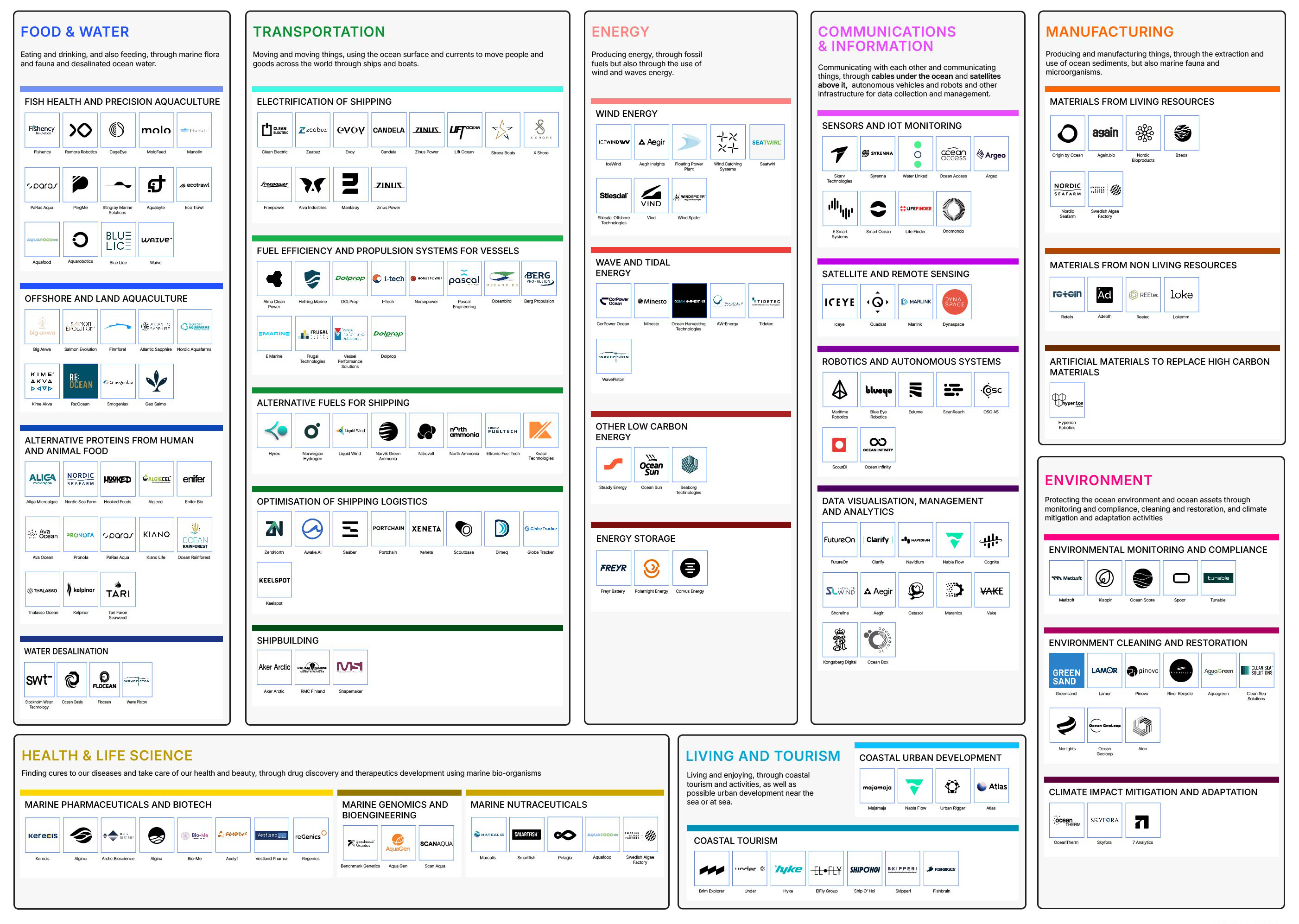
Key solutions areas from Ocean Assets emerging in the Nordic Ocean Economy:
FOOD & WATER for eating and drinking, and also feeding, through marine flora and fauna and desalinated ocean water. Companies in the Nordic seafood sector are focused on improving the efficiency and sustainability of food production. Fish health and precision aquaculture is a major area of activity, with companies developing data-driven farming solutions to optimize feed, monitor fish populations, and reduce resource waste. Offshore and land-based aquaculture is expanding, with businesses creating controlled farming environments that minimize environmental impact while increasing production capacity.Beyond traditional seafood production, alternative proteins from marine flora are emerging as a high-growth sector, with companies developing algae and seaweed-based proteins as substitutes for fish feed and human consumption. In the water sector, desalination and water recycling technologies are attracting company activity, with solutions designed to improve water security in coastal regions and industrial applications.TRANSPORTATION for moving and moving things, using the ocean surface and currents to move people and goods across the world through ships and boats. The Nordic shipping sector is undergoing a significant shift, with companies focusing on reducing emissions and improving operational efficiency. A growing number of businesses are working on electrification of shipping, developing battery-powered and hybrid vessels for short-haul transport. Fuel efficiency and propulsion system innovations are also a major focus, with companies improving vessel performance through AI-driven optimization and new engine designs.The development of alternative fuels for shipping, including hydrogen and ammonia, is another area where companies are clustering, working to create scalable fuel solutions for long-haul maritime transport. Meanwhile, companies in the digitalization of shipping logistics are emerging, using real-time tracking and AI-driven platforms to optimize fleet management and port operations.ENERGY for producing energy, through offshore fossil fuels but also through the use of wind and waves energy . The Nordic region has a long history of offshore oil and gas extraction, but in recent years, innovation has shifted toward cleaner energy solutions. Offshore wind is a major area of activity, with companies developing floating and fixed wind farms to expand renewable energy capacity. Wave and tidal energy are also gaining traction, with businesses working on technologies to harness ocean currents for power generation.Beyond direct energy production, companies are advancing low-carbon marine technologies, including floating solar installations and hybrid energy systems designed for offshore environments. The energy storage sector is also growing, with businesses developing battery and grid integration solutions to stabilize and optimize offshore renewable power supply.Communications & Information for communicating with each other and communicating things, through cables under the ocean and satellites above it , autonomous vehicles and robots and other infrastructure for data collection and management. As the demand for real-time ocean intelligence and automation grows, Nordic companies are clustering around solutions that improve monitoring, security, and operational efficiency. Businesses specializing in sensors and IoT monitoring are developing new ways to track ocean conditions, vessel movements, and environmental changes.The satellite and remote sensing sector is also expanding, with companies working on ocean surveillance, maritime logistics tracking, and environmental monitoring. Autonomous systems and underwater robotics are another area of high company activity, with businesses developing AI-driven drones and remotely operated vehicles for industrial inspections, research, and infrastructure monitoring. Data analytics companies are also emerging, providing insights that help optimize fisheries, shipping, and offshore energy operations.Health & Beauty for finding cures to our diseases and taking care of our health and beauty, through drug discovery and therapeutics development using marine bio-organisms. Nordic companies are developing new health and beauty applications by utilizing marine bio-organisms. In pharmaceuticals, researchers are extracting bioactive compounds from marine life to develop new drugs, particularly in areas where existing treatments are limited. The nutraceutical industry is commercializing algae-based supplements and functional foods, responding to growing demand for natural health products.Beyond medicine and nutrition, marine genomics and bioengineering are advancing aquaculture, genetic research, and biomaterials. Companies are exploring marine-derived ingredients for skincare and medical applications, using nature’s own chemistry to improve treatments, enhance nutrition, and develop new industrial solutions.
Manufacturing for producing and manufacturing things, through the extraction and use of ocean sediments, but also marine fauna and microorganisms. The Nordic manufacturing sector is seeing growing interest in ocean-derived materials as companies seek alternatives to fossil-based inputs. One major area of innovation is bioplastics made from algae and seaweed, which offer a renewable and biodegradable alternative to petroleum-based plastics. These materials are being developed for packaging, textiles, and industrial applications.Beyond marine flora, companies are also researching non-living ocean resources, such as ocean sediments and deep-sea minerals, to explore their potential in construction, electronics, and energy storage. At the same time, advances in synthetic marine materials are helping replace high-carbon industrial inputs, providing more sustainable solutions for manufacturing processes across industries.Environment for protecting the ocean environment and ocean assets through monitoring and compliance, cleaning and restoration, and climate mitigation and adaptation activities. Nordic companies are expanding efforts to protect ocean environments by focusing on monitoring, restoration, and pollution control. Businesses in environmental compliance are developing tools to track emissions, pollution levels, and industry impact, ensuring adherence to regulations.Marine habitat restoration projects are targeting seagrass replanting, coral reef recovery, and contamination removal to maintain healthy ecosystems. The waste management sector is advancing plastic removal technologies and large-scale industrial cleanup solutions. Meanwhile, companies working on carbon storage and coastal protection are developing offshore CO₂ sequestration methods and strengthening coastal defenses against environmental changes.Living & Tourism for living and enjoying, through coastal tourism and activities, as well as possible urban development near the sea or at sea. Nordic businesses are advancing coastal infrastructure, tourism, and marine-based living. Sustainable urban development near the sea includes modular cabins, airflow-optimized designs, floating residences, and tailored planning tools, meeting population and industrial needs while addressing climate challenges. Coastal tourism and travel feature silent boat tours, underwater dining, ferries, electric aviation, yacht rentals, boat-sharing, and fishing communities, merging commerce with eco-conscious exploration. Ferry networks and water-based transit enhance connectivity between coastal hubs and tourist spots. As maritime lifestyles gain traction, these efforts improve sea access and enrich coastal living while preserving nature.
5.2 Nordic Ocean Economy Landscape by country
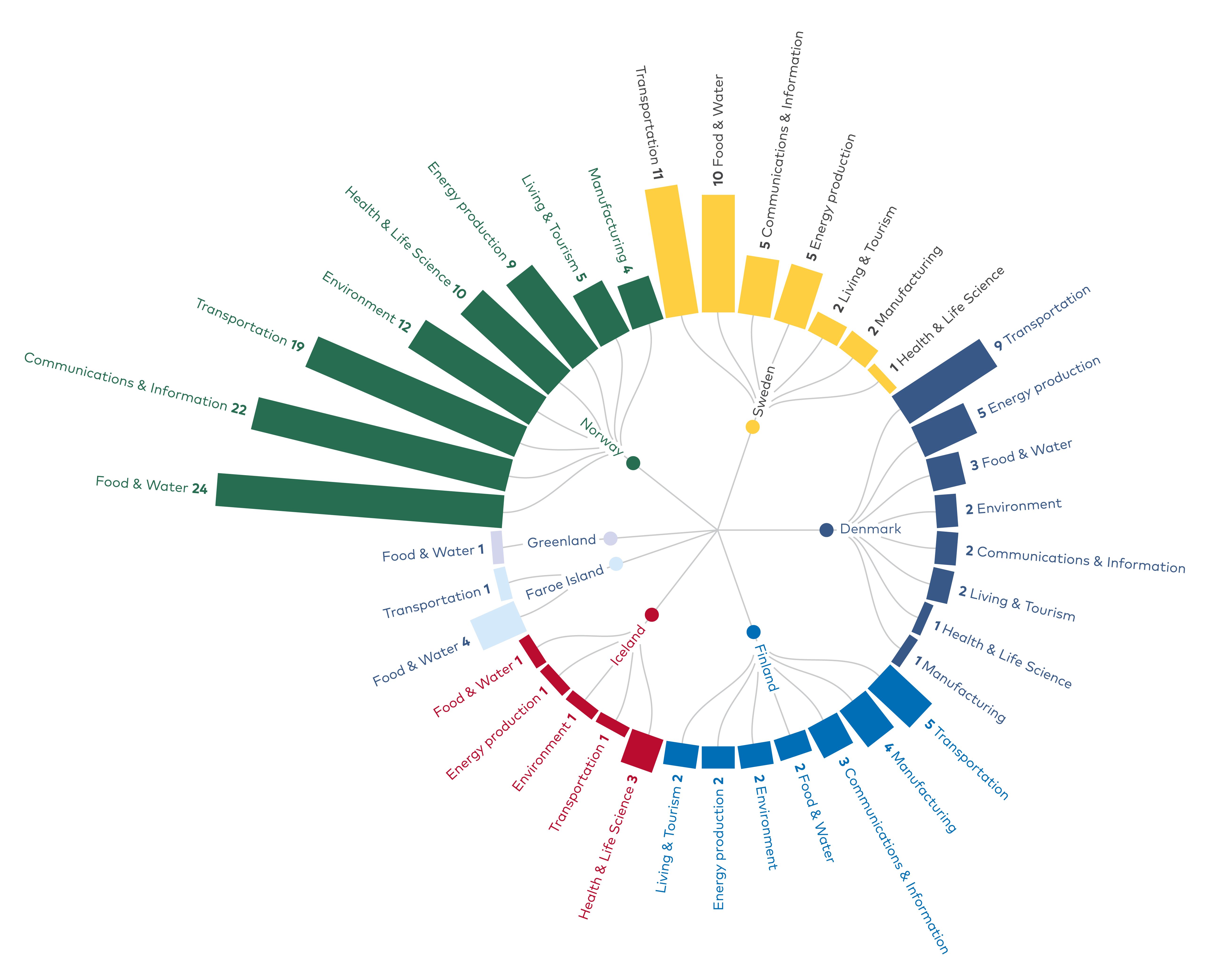
Innovation in the Nordic Ocean Economy is not evenly distributed, with certain countries developing strong industry clusters that drive regional growth, shaping together a diverse and complementary ecosystem. By mapping the 200 most promising ocean startups by their country of origin, we identified clear patterns in company distribution. Norway leads with around half of these companies, while the rest are spread across the other 6 countries.
This analysis highlights where startups are emerging, which industries dominate in each country, and how each nation contributes to innovation in the ocean space. While all Nordic countries engage across multiple sectors, each has distinct strengths that reinforce the region’s leadership in ocean-based industries. Instead of competing, these strengths complement each other, reinforcing the Nordics as a global leader in ocean innovation.
Norway leads in the Ocean Food industry, driven by its expertise in aquaculture and precision fisheries, particularly salmon farming. Companies are developing advanced farming techniques, optimized feed solutions, and technology-based systems to improve efficiency and reduce resource waste. Norway is also at the forefront of shipping innovation, developing battery-powered vessels, alternative fuels like hydrogen and ammonia, and advanced propulsion technologies to cut emissions. The country has made notable progress in Communications & Information, with marine IoT systems and satellite monitoring improving operational safety and logistics. Additionally, Norway is leveraging its offshore expertise to expand beyond oil and gas, making significant advancements in offshore wind and other emerging energy solutions.Sweden plays a key role in Maritime Transportation and the Ocean Food & Water industry, focusing on logistics, propulsion technologies, and improved shipping efficiency. The country is also developing alternative protein sources from algae, seaweed, and other marine ingredients to diversify food and feed options. In the Energy sector, Sweden is advancing wave and tidal energy solutions, harnessing ocean currents for power generation. Additionally, Sweden is active in manufacturing, particularly in developing bio-based materials from ocean resources to support industrial applications and reduce reliance on traditional materials.Denmark leads in offshore wind energy, driving advancements in turbine technology and offshore infrastructure, strengthening its position in global energy markets. In Transportation, Denmark is improving shipping efficiency by developing cleaner fuels and more effective propulsion systems. The country is also advancing the Food & Water sector, working on alternative proteins and precision aquaculture to enhance seafood production. Additionally, Denmark is active in the Environment and Living & Tourism sectors, focusing on coastal development, urban expansion, and tourism projects that integrate economic growth with long-term resource management.Finland stands out in Maritime Transportation and ocean-based Manufacturing, with a strong focus on shipbuilding, advanced vessels, and propulsion systems that improve efficiency and lower emissions. In Energy, Finland contributes to ocean-based power solutions, including wave energy converters and thermal storage systems. The country is also involved in Food & Water, innovating in aquaculture, resource management, and new protein sources from marine environments. Additionally, Finland is making strides in ocean data capture, defense, and surveillance technologies, integrating monitoring, satellite systems, and maritime security advancements to address operational and geopolitical challenges.Iceland is a leader in Marine Health & Life Sciences, where marine biotechnology is driving breakthroughs in therapies, nutraceuticals, and protein extraction from ocean resources. The country also contributes to Energy by combining marine and geothermal resources to develop tailored energy solutions. Additionally, Iceland plays a role in the Environment sector, focusing on ecosystem protection, resource efficiency, and responsible ocean management.Faroe Islands’ ocean economy centers on established marine industries with emerging innovation. In the Food & Water sector, seaweed cultivation is gaining momentum, with startups exploring new uses for food, biofuels, and industrial products. Fisheries and aquaculture, key economic drivers, are seeing incremental advancements in sustainable practices and efficiency, building on the islands’ expertise. In the Energy sector, tidal energy is an area of interest, leveraging the region’s strong currents, though development remains in early stages.Greenland ’s ocean-related activities are modest but deeply tied to its core industries. Living & Tourism and Transportation are intertwined, relying on sea-based travel due to limited inland infrastructure. The region offers unique Arctic wildlife tours and cultural experiences rooted in its ocean heritage. In the Food & Water sector, aquaculture and fisheries remain economic drivers, with increasing efforts to enhance sustainability and resource management.