2. The opportunity :
What is The Ocean Economy Opportunity?
Step one in the investment thesis framework is to identify and assess what is the market opportunity worth pursuing and what are the factors contributing to making it a compelling investment opportunity.
In the context of this work, that means assessing the value and potential of the overall Ocean Economy. In this section, we will examine the projected value of the ocean and its assets, define what the Ocean Economy is, explore how the Ocean Economy is creating value today from the ocean, and articulate what we believe is the Ocean Economy Opportunity.
Ultimately, we aim to answer the key question:
Let's start by understanding the value of the ocean and its assets.
2.1 The projected value of the Ocean and its assets
The Ocean and its assets
The ocean is the single largest feature of our planet, covering about 70% of our planet’s surface and holding over 90% of its total water—an immense volume estimated at 1.386 billion cubic kilometers. This vast body of water is also home to roughly 80% of all life on Earth, highlighting the ocean’s essential role in sustaining our planet’s biodiversity and climate. Stretching across about 360 million square kilometers, the ocean reaches an average depth of 3,682 meters, with trenches plunging over 10,000 meters below the surface. It also has around 1.16 million kilometers of coastline—equivalent to traveling to the Moon three times—where 40% of the global population is estimated to live.
Yet, the ocean is far more than just water and coastlines. It is home to a vast array of marine life, from microscopic plankton—key producers of the oxygen we breathe—to some of the largest animals on Earth, like whales. Scientists have identified around 242,000 marine species, with about 2,300 new species discovered each year. However, millions of species are believed to remain undocumented, as 91% of known ocean species have yet to be thoroughly classified. Estimates suggest there could be between 700,000 and 1 million species in total.
The ocean holds vast geological resources, with seabed deposits like manganese nodules, cobalt-rich crusts, and polymetallic sulfides containing high concentrations of cobalt, nickel, copper, and gold—often surpassing land-based reserves. Manganese nodules alone span millions of square kilometers and hold significant quantities of critical metals, including cobalt, compared to roughly 15 million tons of global land reserves. Offshore resources also contribute significantly to global energy production, accounting for nearly 30% of the world’s oil and a substantial share of natural gas output, with geologists predicting that 40% of all new petroleum discoveries will be offshore.
Finally, the ocean’s dynamic movements and climate interactions play a pivotal role in regulating our planet’s environment. Scientists estimate that 50–80% of Earth’s oxygen is produced by oceanic plankton—tiny drifting plants, algae, and bacteria that convert sunlight into energy. The ocean also absorbs nearly 30% of human-produced carbon dioxide (CO₂) emissions and contains about 60 times more carbon than the atmosphere. By storing heat, circulating nutrients, and driving weather patterns, the ocean shapes the climate and supports life on a global scale.
The projected value of the Ocean and its assets
Despite its scale, significance and importance, the ocean remains largely mysterious. Countless species, minerals, and natural processes are still poorly understood or completely unknown, making the ocean one of humanity’s greatest frontiers for discovery and innovation.
As of June 2024, only 26% of ocean seafloor has been mapped.
Importantly, this estimate is based on a very limited understanding of the ocean, as more than three-quarters of it remains largely unexplored. If only a small portion of the ocean that we know today is already valued at US$32 trillion, then it is reasonable to assume that the full value of the ocean, including the vast areas that remain unknown, is significantly higher. Even with a highly conservative approach, assuming that the unexplored portion holds at least three times the value of what is currently known, the total estimated worth of the ocean would exceed then US$128 trillion. To put this number into perspective, this is comparable to the total value of all the world’s stock markets, which are currently valued at around US$127 trillion.
These estimates, while not exact, help us illustrate the ocean's immense untapped potential, the scale of opportunities it offers to the global economy, and why unlocking its value could represent one of the biggest investment opportunities of our time. This simple projection allows us to understand how large the Ocean Economy could become and emphasize the importance of continued exploration and sustainable use of ocean resources. As we map its depths, study its ecosystems, and uncover practical applications, the discoveries we make can transform industries, drive economic growth, and address critical global challenges. Simply put, beneath the waves lies one of the greatest mysteries of our planet, holding resources and possibilities yet to be realized.
With this understanding of the ocean's value potential, let’s now explore what the Ocean Economy is, how it is currently creating value from the ocean and its assets, and the opportunities it holds for the future.
2.2 The Ocean Economy as a system to create value from Ocean assets
Defining the Ocean Economy
When people talk about the ocean economy, most of the time, they think about two things:
- What we can take from the ocean, like fish, oil, or gas.
- Activities that happen in or near the ocean, like shipping, coastal tourism, or even people enjoying the beach.
This is how the OECD defines the ocean economy:
This definition is useful because it captures much of what we currently associate with the ocean economy today. However, it is also limiting as it overlooks many emerging and innovative ways in which the ocean can generate value. The ocean economy is more than just a collection of industries, and it is not solely about resource extraction or transportation. It is a dynamic system where the ocean’s raw elements—its water, ecosystems, seabed, and natural movements—are transformed into products and services that meet human needs and create significant economic value.
To fully understand the Ocean Opportunity, we need to approach the Ocean Economy with a broader perspective. Instead of focusing solely on extracting resources or traditional activities near the ocean, we should consider the ocean's fundamental assets—such as its water, the life within it, the seabed, and its depths or and its tides and currents—and explore how these assets can be used to create value. For example using the ocean’s wind and waves to generate energy, studying its ecosystems to develop medicines, or relying on its data for navigation, weather prediction, and industry improvements.
Building on this broader perspective, we propose an extended definition:
Let’s break down the elements in this definition:
We define the Ocean Assets as the natural features, resources, and processes of the ocean that enable economic activities. These assets are the natural components of the ocean—its physical features, movements, biodiversity, and resources—that provide the foundation for economic activity. We have boiled them down into four main Ocean Assets:
Physical features : Marine life and ecosystems: Geological and chemical components: These are the non-living resources found in the ocean, both in the water and on the seafloor. Geological resources include minerals, sediments, oil, gas, and sand, which are valuable for industries like energy, construction, and technology. Chemical resources include dissolved elements like salt and nutrients, which are essential for marine ecosystems and global processes such as the carbon cycle. These components are critical for both economic activity and the functioning of marine life.Movement, dynamics, and climate interactions: These are the natural processes that keep the ocean in motion and connect it to the planet. Movements like waves, tides, currents, and streams are driven by forces such as wind, the moon’s pull, and differences in temperature and salinity. They also include global cycles like the carbon cycle, where the ocean stores carbon, and the heat cycle, where it transfers energy to the atmosphere. Together, these systems regulate Earth’s climate, drive weather, and distribute nutrients, making them essential ocean assets.
Ocean assets are the foundation and building blocks of the Ocean Economy, but their value depends on how they are used. For instance, sediments in the ocean have little inherent value on their own. However, when transformed into materials like concrete for construction, they become essential resources for solving human problems and meeting needs. This ability to transform and utilize ocean assets is what makes ocean assets as value creators.
|
| 1 Ocean physical features | 2 Marine life & ecosystems (Living resources) |
|
|
|
| 4 Movements, dynamics & climate interactions | 3 Geological & chemical components (Non living resources) |
|
|
To understand the ocean assets as value creators, we need to see the Ocean Economy as a source of solutions for many problems and needs, where ocean assets realize their value when they are transformed or utilized to meet these needs and solve problems. These assets often have multiple uses, depending on how they are leveraged within the Ocean Economy. The Ocean Economy acts as the system that enables this transformation, creating value through innovative or different uses of these natural components. For example:
Fish for food or fertilizers: Fish in the ocean have limited inherent economic value, but they become valuable when fishermen catch them, seafood processors prepare them, and retailers sell them as food. Additionally, fish byproducts can be processed into fertilizers or animal feed, supporting agriculture and livestock industries. These are just two examples of how fish can be utilized, with other applications spanning pharmaceuticals, cosmetics, and more.Ocean water for drinkable water or energy production: Saltwater cannot be consumed directly, but desalination plants transform it into drinkable water to regions in the world with water scarcity. It can also be harnessed for energy generation, such as tidal power or wave energy systems. Beyond these uses, ocean water can play a role in industrial cooling, aquaculture, and even the extraction of minerals.Ocean surface for shipping or renewable energy: The ocean surface serves as a transportation route for global shipping and trade. Additionally, it provides space for renewable energy projects, like offshore wind farms or floating solar panels. These are just a few of the ways the ocean surface is utilized, as it also supports tourism, military operations, and scientific research.
These examples are just a few of the many ways ocean assets can be transformed and utilized. Through value chains and transformation processes, these assets are converted into solutions that address human needs, making them contributors to economic activity and value creation.
The Ocean Economy includes all business activities that directly or indirectly utilize ocean assets to solve problems and generate value. It is not limited to activities that directly extract or use ocean resources, such as fisheries, shipping, or wave energy production. Instead, it also encompasses the broader system of businesses and technologies that support, transform, or enable value creation from ocean elements. This perspective expands the scope of the Ocean Economy to include:
Direct utilization of ocean elements: Enabling value creation: These are businesses that do not directly derive value from ocean resources but are essential to the process of creating value from them. They provide the tools, technology, and services that support, optimize, or enable direct ocean-related activities. Examples include satellite systems for ocean monitoring, digital tools for shipping logistics and safety, and marine equipment manufacturing. These examples highlight the wide array of enabling activities that support the creation of value from the ocean.
This broader definition highlights the interconnected nature of the Ocean Economy, where both direct users and enablers contribute to solving human problems and creating value from ocean assets. Understanding this broader scope is key to fully recognizing and exploring the ocean’s potential.
Now that we understand the Ocean Economy as the system for creating value from ocean assets, let’s explore how value is being generated today and the additional opportunities for value creation—what we call the ocean opportunity.
2.3 How the Ocean Economy is creating value today and its growing importance
While the Ocean Economy is creating significant value today, it still represents only a small fraction of the global economy’s added value. Estimates suggest that the Ocean Economy generates between USD 3 trillion and USD 6 trillion annually, contributing just 3%–5% of global GDP.
How the Ocean Economy is creating value today
Despite its small GDP contribution to the global economy, the Ocean Economy plays a critical role today in meeting fundamental human demands, such as energy production, food supply, and global transportation. The four most important Ocean Economy sectors today are:
Maritime trade: Around 90% of global goods by volume—valued at USD 14 trillion annually—are transported by sea.From raw materials like oil and metals to consumer goods like electronics and clothing, shipping routes ensure the smooth operation of supply chains that connect continents and drive global commerce. Energy production: It is estimated that the ocean provides 18% of the world’s energy supplies, 28% of natural gas production, and over 30% of crude oil output.As the world transitions to low-carbon energy, the ocean’s role is expanding. Offshore wind capacity, while currently contributing less than 1% of global energy, is projected to supply 13% of global electricity by 2050. Food production: Nearly 20% of global animal protein consumption and 7%–8% of total protein intake come from marine resources. Aquaculture, which has grown by over 300% since 2010, is emerging as a critical solution to meet rising global demand for sustainable seafood. Seafood accounts for about 17% of the world’s protein intake, with the figure reaching as high as 50% in parts of Asia and Africa. Coastal tourism: Coastal and marine tourism represents at least 50% of total global tourism, a $9.5 trillion revenue industry that generates 1 in 11 jobs worldwide.For many small island developing states, it is their largest economic sector, driving local economies and creating significant employment opportunities. Activities such as beach tourism, diving, and cruise travel attract millions of visitors globally, underscoring the vital role coastal tourism plays within the Ocean Economy.
How the Ocean Economy can create value tomorrow
Perhaps the most compelling aspect of the Ocean Economy is not how it creates value today, but how much more value it can generate in the near future. As the global population grows and purchasing power rises, the demand for ocean solutions will increase to meet the world’s needs for food, energy, and transportation. At the same time, as the value of ocean assets becomes more widely recognized, global competition for access to these resources will intensify, driving the emergence of new industries focused on the exploration, utilization, and protection of these resources, completely transforming the Ocean Economy landscape as we know it today. The ocean’s present and future solutions are becoming more important than ever. Key reasons for this include:
- Meeting global demand for food, energy, and transportation. With the world’s population projected to reach 10 billion by 2050,
the need for sustainable food sources, renewable energy, and efficient transportation systems will grow exponentially. The ocean offers unique solutions, from aquaculture to offshore wind energy, and remains a critical artery for global trade and logistics.
- Reducing pressure on land resources. As land becomes increasingly scarce, more activities will move to the ocean. Coastal regions, home to 40% of the world’s population,
will need expanded infrastructure and solutions. For instance, floating cities, offshore energy platforms, and seawater desalination plants could address challenges like urban density, resource shortages, and clean water access.
- Discovering new materials and resources. The ocean holds untapped reserves of minerals like manganese, cobalt, and rare earth elements, essential for electronics and clean energy. It also provides bio-products for pharmaceuticals, cosmetics, and biodegradable materials. With rising demand and limited land-based options, the ocean will be a key source of critical resources.
- Strengthening defense and security. Geopolitical tensions and increasing trade reliance on maritime routes will drive nations and corporations to invest in ocean defense and security. Protecting trade corridors, critical infrastructure, and natural resources will become paramount, amplifying the strategic importance of the ocean economy.
- Combating climate change and protecting ecosystems. The ocean is central to mitigating the effects of climate change, from carbon sequestration to regulating the planet’s temperature. Innovative solutions like carbon capture through ocean ecosystems, wave energy, and coastal restoration will play critical roles in safeguarding the environment while creating economic opportunities.
These factors highlight why the Ocean Economy is more important than ever and how its assets will play a crucial role in addressing tomorrow’s global challenges. We will explore these and other related factors in detail in Section 3 (Emerging Trends).
In summary, while the Ocean Economy provides significant value today, it is underdeveloped and far from realizing its full potential. The real Ocean Opportunity and its true potential lies in exploring how ocean assets can be used in new ways to solve global challenges or in the development of new solutions that can improve how value is being created today from the ocean. Let’s dive into what is the actual Ocean Economy Opportunity.
2.4 The Ocean Economy Opportunity as the discovery of new ways to create value from Ocean assets
If the Ocean Economy is the system for creating value from Ocean Assets, and these assets are among the most valuable yet underutilized resources on our planet, then the heart of the Ocean Economy Opportunity lies in finding new and better ways to use these assets and capture more value from them. The Ocean Economy Opportunity is about exploring how we can use Ocean Assets in innovative ways to solve problems or improve how value is created today and it is a chance to enhance existing businesses or develop entirely new ones. This requires mapping, observing, and exploring the ocean more thoroughly to generate solutions for human needs, open new markets, and sustainably expand the global ocean economy.
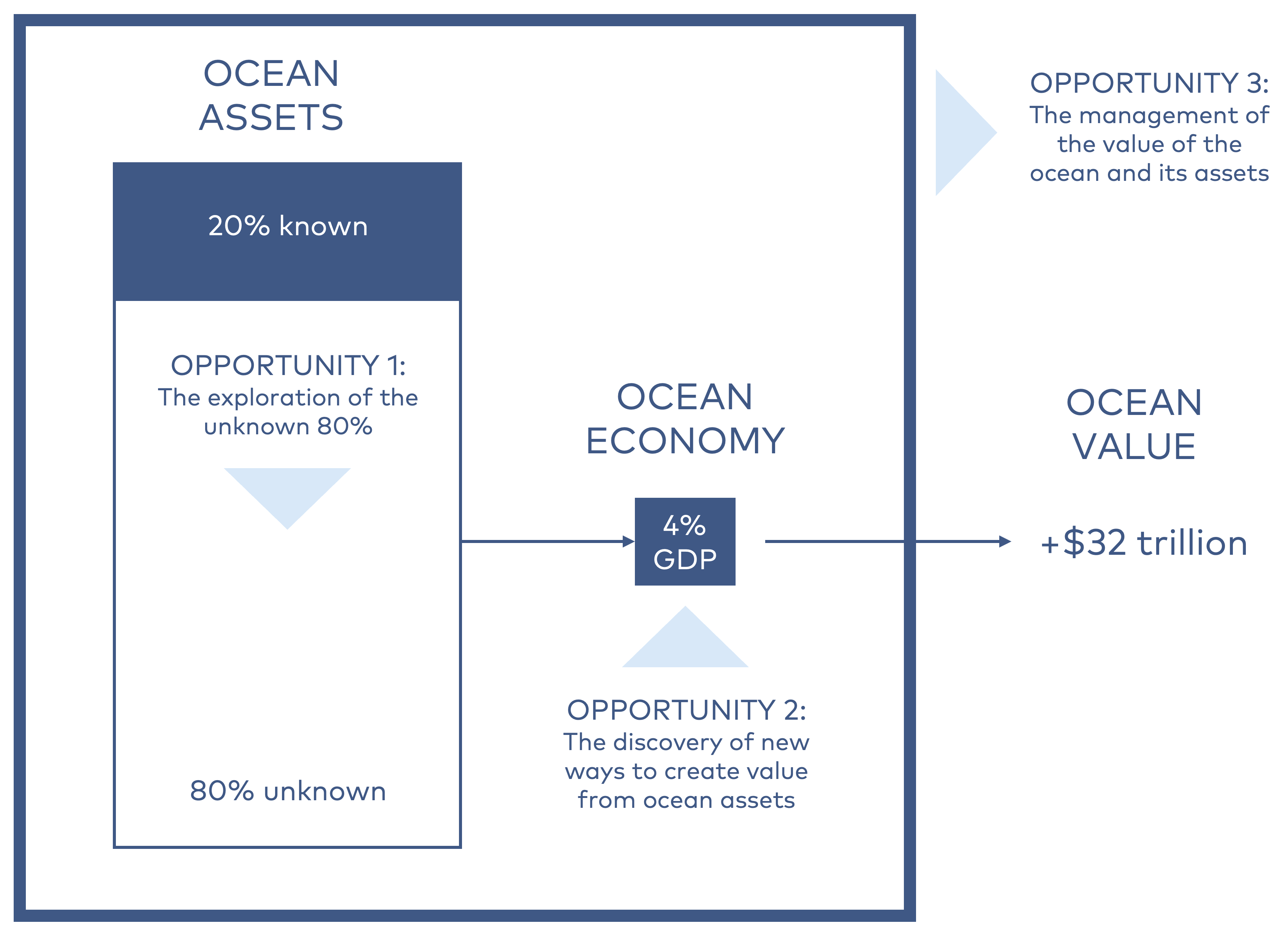
The opportunity ahead then is to fully map, observe, and explore the ocean’s potential—to get to know the ocean better— to discover new ways of creating value from it, and to manage and protect its growing value. This opportunity will unfold through three main pillars or pathways:
If a significant portion of the ocean remains unexplored, and the more we explore, the more value we can generate from ocean assets while increasing the ocean’s intrinsic value, then one of the biggest opportunities is the exploration of the unknown 80%. This is not a distant possibility—it is already happening. A new global race is underway to explore and better understand the ocean, uncovering its value and the opportunities it holds. We call this the
This opportunity will drive advancements in maritime infrastructure, enabling deeper exploration and expanding ocean activities. It will accelerate science and research, improving our understanding of marine ecosystems, biodiversity, and resources. It will also lead to the development of better data capture and analysis technologies, using AI, sensors, and satellites to monitor and predict ocean conditions. Engineering technologies will continue to evolve, pushing the boundaries of deep-sea exploration, resource extraction, and ocean-related industries. In essence, anything that will allow humans to understand the ocean more and engage more with it will play a role in shaping its future economic and scientific potential.
If the ocean is the largest resource on Earth, but the ocean economy—the system that creates value from ocean assets—only contributes 3–5% of global GDP, we can conclude that most of its economic potential remains unrealized and its assets are underutilized.
With so much room for growth, then another obvious investment opportunity is to find new ways to generate value from ocean assets—either by discovering new applications or optimizing existing industries. This opportunity will translate into an unparalleled new wave of ocean innovation dedicated to:
Finding new applications and innovative ways to create value from the Ocean Assets we know today and those yet to be discovered. Improving the way value is being created today from Ocean Assets through the optimization of existing ocean activities.
If we recognize the ocean as a valuable asset with enormous potential, and the more we explore it, the more value it holds and the more value we can generate from it, then the third clear opportunity lies in preserving and managing this value.
This represents a paradigm shift in how the ocean is perceived, where it is no longer considered just a vast natural resource but an asset that requires active management to preserve and grow its value. This shift is leading to the development of a comprehensive system dedicated to ocean value protection, preservation, and generation—essentially forming what we have called a new "Ocean Asset Management" industry. This shift will lead to the development of structured frameworks for managing and protecting ocean assets, ensuring they are used responsibly and remain valuable over time. It will create new value chains focused on preservation and restoration, securing key ocean assets for future generations while enabling continued economic growth. It will also drive the rise of an industry dedicated to maintaining and increasing ocean value, attracting investment into sustainability, marine biodiversity protection, and resource optimization.