PARENTAL LEAVE IN FINLAND
Johanna Lammi-Taskula
Introduction
Like the other Nordic countries, Finland has often been seen as a country representing the dual earner-dual carer model in comparative studies on the reconciliation of paid employment and childcare (e.g. Gornick & Meyers, 2008). Family policy in Finland is however a somewhat contradictory combination of defamilisation and familism. On the one hand, many policy measures introduced since the 1970’s are defamilising i.e. they underline public childcare responsibility and support possibilities for paid employment outside the home for both mothers and fathers, thus promoting gender equality in the labour market and in the family. On the other hand there are still today also familistic policy measures that focus on parental responsibilities combined with families’ freedom of choice in childcare arrangements, which in practice reproduces a more traditional gender division of labour (Haataja, 2004; Hiilamo & Kangas, 2009; Salmi & Närvi, 2017; Ciccia, 2022; Saarikallio-Torp et al., 2024).
The dual earner-dual carer family model and gender equality in both unpaid work in family life and paid work is supported by relatively well-paid parental leave with quotas for both parents, followed by a universal right of all children to early childhood education and care (ECEC) services. The main familistic childcare policy measure is the Home Care Allowance (HCA) which gives parents the option to choose to stay home with the child after parental leave and until the child is three years old as an alternative to using ECEC services (Mahon, 2002; Sipilä et al., 2012; Lammi-Taskula et al., 2023).
During the past three decades, the parental leave scheme in Finland has been reformed several times. Most reforms involve an increase in leave rights for fathers or taking family diversity more into account. For example, leave rights of single parents, adoptive parents and same-sex parents have become more equal to those of heterosexual, biological parents (Moring & Lammi-Taskula, 2021). In addition to gender equality, the motivation for introducing longer and more flexible parental leave quotas for fathers has been to encourage fathers to take more responsibility for childcare, thus supporting their parenthood in the long run as well as the wellbeing of both parents and children (Räsänen et al., 2022).
Due to the importance of the freedom of choice, and the familistic path-dependency of family policy in Finland, the non-transferable leave quota for fathers was introduced later than in the other Nordic countries (Lammi-Taskula, 2022). The freedom of choice has been used as an argument against leave quotas and keeping a longer transferable parental leave period (Salmi, 2017). After several small adjustments of the leave scheme to promote gender equality such as lengthening paternity leave, compensating leave costs to employers, and increasing the flexibility of leave use, a more profound leave policy reform with symmetric leave quotas for both parents took place in 2022, more than two decades after similar reforms in Sweden, Norway and Iceland.
While the parental leave reform can be considered a relatively radical step towards gender equality, the familistic policy is still strong as the cash-for-care benefit HCA has remained untouched - despite of repeated critique during the past decades (Sipilä et al., 2012; Salmi & Närvi, 2017; Närvi et al., 2024).
Present policies
Length of leave
Before the most recent parental leave reform in 2022, the leave system in Finland included an almost one-year-long parental leave with an income-related benefit, followed by a two-year childcare leave with a flat-rate benefit (Home Care Allowance). The leave was divided into a 4 months’ mother’s quota, a 9 weeks’ father’s quota and 7 months of shareable leave. After parental leave the parents could then divide a two-year childcare leave between them. Relatively inflexible parttime options were available for parental leave as well as childcare leave (Miettinen et al., 2021.)
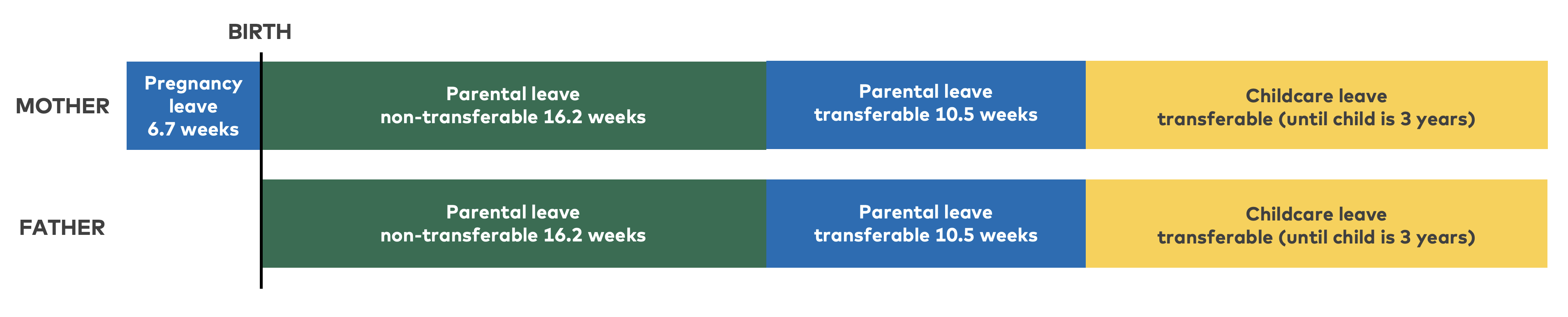
Since the reform, each parent, regardless of their or their partner’s gender, is entitled to an individual parental leave quota of almost 27 weeks (6.4 months) of which 15.5 weeks are non-transferable while up to 10.5 weeks can be transferred to the other parent (see Figure 1). Parents can only be simultaneously on parental leave for a maximum of three weeks. In addition, the birth-giving parent has a right to a 6.7 weeks’ pregnancy leave that can start 14 to 30 days prior to the due date. In the case of multiple births, the length of parental leave is extended by 14 weeks for each additional child, distributed equally between parents. In case of a couple where the birth parent starts their pregnancy leave early and the other parent does not use their quota the maximum leave period is nine months. If the birth parent starts their pregnancy leave later and both parents use all of their quotas with no simultaneous leave taking the maximum leave period is almost 14 months. Single parents can use the whole leave period. The childcare leave with the flat-rate HCA remained unchanged in the reform (Miettinen et al., 2024).
Figure 1. Parental leave scheme in Finland, 2024
Eligibility to leave
Residence is the primary basis for entitlement to all income-related parental benefits in Finland. Those regularly living in the country are insured under the Finnish Health Insurance Act and thus entitled to parental benefits, and therefore also to leave during the benefit period (Miettinen et al., 2024).
A pregnant/birthing parent is entitled to a pregnancy benefit after 22 weeks. A parental benefit is available to biological or adoptive parents and to any legal guardian of a child. Same-sex couples have the same leave and benefit rights as different-sex couples. Both parents are entitled to a parental benefit even if they are not cohabiting provided that they take leave from work and are responsible for childcare. One can claim the parental benefit while studying during parental leave as long as one is able to take care of the child. Single parents can use the whole parental leave if the other parent has not been acknowledged and confirmed; is not the child’s legal guardian; is not insured under the Finnish Health Insurance Act; or is, due to illness or injury, unable to take care of the child. A single parent can also transfer leave to another person (Miettinen et al., 2024).
The Home Care Allowance (HCA) can be paid to any parent – whether or not they are on leave from work – as long as their child is not in a childcare service provided or funded by the local authority. An employed parent is entitled to partial childcare leave (i.e. a reduction in working hours) if they have been working for the same employer for at least six months during the past 12 months. The reduction of hours should be negotiated with the employer, but at the minimum the employee has the right of reducing their working hours down to 30 hours per week. Parents who reduce their working hours and take partial care leave can receive a flat rate benefit to compensate for their loss of income. The Flexible Care Allowance is paid to parents with children under three (two options depending on working hours), and the Partial Care Allowance to parents whose child is in first or second class at school (one option regardless of working hours) (Miettinen et al., 2024).
Benefits
The Parental leave benefit is calculated on the basis of one’s annual income in the preceding 12 months or last three months of the 12-month period. If the estimated due date of the new baby is before a previous child turns three years old, the parental benefit can be based on the same income that was used for the previous child. The income-related parental benefit is regressive, i.e. the compensation rate is higher for lower earnings. Parental benefits are not paid for days when one is working more than five hours in paid employment. However, as parental benefits are not paid on Sundays one can work more than five hours then as well as on midweek holidays while claiming parental benefits. As in all benefits paid by the sickness insurance, there is no ceiling for the parental benefit in Finland (Miettinen et al., 2024).
In 2024, the parental benefit was 90 per cent for annual earnings between €10,665 and €67,296, and 32.5 per cent for earnings above this level. Parents who have not been employed or have had annual earnings below €13,712 get a minimum flat-rate allowance of €32 per day (about €800 per month). Many collective agreements include full pay during pregnancy leave and part of parental leave for both parents, which means that parents included in such agreements get a higher compensation during leave compared to those who are not included. During periods of full pay, the benefit is paid to the employer (Miettinen et al. 2024).
The Home Care Allowance consisted in 2024 of a basic payment of €377 per month, with an additional €113 for every other child under three years of age and €72 for every other pre-school child plus a means-tested supplement (up to €202 per month). In addition, some municipalities pay a supplement to the HCA. According to a report by the association of Finnish local and regional authorities, one in five municipalities, most commonly the bigger ones, paid such a supplement in 2022. The supplement ranged from of €50 to €350 per month, often with specific conditions such as home care for all children below school age in the family (Lahtinen & Svartsjö, 2022; Miettinen et al., 2024).
For parents who reduced their working hours because of childcare, the monthly amount of Flexible Care Allowance in 2024 was €179 if the weekly working hours were 80 per cent of the normal full-time hours, and €269 per month if the weekly working hours were 60 per cent of the normal full-time hours. The amount of Partial Care Allowance was €108 per month (Miettinen et al., 2024).
In 2023, the average parental benefit paid to fathers was €98 per day (€2,460 per month) and to mothers 74 per day (€1,867 per month). The average HCA paid to parents was €451 per month; about 23 per cent of HCA recipients received means-tested supplements and 15 per cent received municipal supplements. The average flexible care allowance was €202 per month, and the average partial care allowance was €108 per month (Kela, 2024).
Parental benefit, the child Home Care Allowance, the Partial Care Allowance and the Flexible Care Allowance are all taxable income. The tax for income-related parental benefit is similar as in salaries, the minimum tax rate being 25 per cent. For the flat-rate benefits, the minimum tax rate is 20 per cent. Pension is accumulated during the parental benefit and HCA periods. In 2024, pregnancy and parental leave accumulate the beneficiary’s pension based on 121 per cent of the annual earnings from which the benefit is calculated. These earnings accumulate the pension at 1.5 per cent per year. For those with no income from paid employment, as well as during the HCA period the pension is accumulated as if the earnings were €857 a month (Miettinen et al., 2024).
Income-related parental benefits are part of the Social Insurance scheme, financed by contributions mainly from employers and employees. In 2024, employers paid 47 per cent and employees 40 per cent of the total costs. The remaining parental benefit costs are funded from state taxation. (Miettinen et al., 2024).
The flat-rate benefit promoting child home care after parental leave (Home Care Allowance) as well as the benefits compensating for lost income during temporarily shortened working hours (Partial Care Allowance and Flexible Care Allowance) are funded by municipalities who are also responsible for providing childcare services (see section on childcare) (Miettinen et al., 2024).
Flexibility
With the 2022 reform, the use of parental leave with income-related benefit became more flexible than before. Before the reform, only fathers could use parental leave until the child turned two, but now this is possible for both parents. Parents can no longer receive (minimum) parental benefit while working full time, but they can combine part time work and partial parental benefit. Parental leave can be taken part-time if the daily working time is no more than five hours per day. One day of partial parental leave decreases the leave by half a day, and the benefit is half of that for full-time leave. Parents can also take partial parental leave simultaneously. Employed parents can take parental leave in four parts per calendar year, or more often if the employer agrees. The minimum duration of leave is two weeks, but leave can be shorter – minimum one day - if agreed by the employer (Miettinen et al., 2024).
After parental leave, parents can take childcare leave in two parts, the minimum length being one month. Parents can alternate the use of childcare leave (with the Home Care Allowance) and parental leave in the case that one parent (usually the father) uses their parental leave quota later. (Miettinen et al., 2024),
After parental leave, parents can also choose to take partial childcare leave and work reduced working hours for at least one month, until the end of the child’s second year at school. Both parents can take partial childcare leave during the same period but not during the same hours of the day. Parents of children under three years of age are entitled to Flexible Care Allowance (see section on benefits). Flexible Care Allowance can be paid to both parents at the same time if they take care of the child during different hours of the day or different days of the week. Parents can receive Flexible Care Allowance even if the child attends municipal ECEC (Miettinen et al., 2024).
Parents can take temporary childcare leave when a child under ten years of age falls ill. Also, parents with joint custody are entitled to the leave even if they do not live with the child. The length of leave is up to four days per illness. Payment is dependent on collective agreements, typically the employer pays full salary during three or four days at a time (Miettinen et al., 2024).
Other work and care policies
Childcare
It is the municipalities’ responsibility to provide Early Childhood Education and Care (ECEC) services for all children living in the municipality, in accordance with the needs of the respective families. According to the Early Childhood Education Act (2018), it is up to each municipality to decide the specific forms of ECEC services it provides. ECEC is typically provided in day care centres or family day care, but also in open activities such as playgrounds and children’s clubs. Municipalities can either provide ECEC services themselves or in co-operation with private service producers. A bachelor’s degree in education is required from ECEC teachers, and a vocational degree from care assistants in daycare centres. A vocational degree is needed in family day care.
There is no gap between parenting leaves and ECEC services: From the age of nine months the child is entitled to a place in childcare. An application for a place must be submitted four months before the starting day, but if there is a need for service due to an unexpected change of employment, education or relocation the application period is two weeks. A parent is allowed to take up to 13 weeks of parental leave after the child has started in ECEC, without the child losing its place.
In general, the maximum length of the service per day is ten hours, but extended hours must be provided for families with shift work or other irregular working hours. The fee paid by parents is based on the family size and income, along with the length of the child’s stay. In 2024, the maximum monthly payment for full-time service (minimum 35 hours per week) was €311 for the youngest child of the family. For the next older sibling it was 40 per cent of that, and for consequent siblings 20 per cent. If the child spends between 20 and 34 hours the payment is according to hours and if the child spends less than 20 hours per week the payment is 60 per cent of the full-time payment. For very low-income families the ECEC is free of charge.
If a child is taken care of in a private (for-profit or non-profit) day care centre, by a private nanny, or another person employed by the family and accepted by the local authority, the family is entitled to Private Day Care Allowance (€192 per month per child in 2024) with an addition based on the size and income of the family (up to €266 in 2024). Municipalities also offer service vouchers for private day care services.
The Private Day Care Allowance is used by 2-3 per cent of families with children under three years of age (Miettinen et al., 2024). A service voucher for private ECEC is more common: it is offered by more than third of the municipalities (Lahtinen & Svartsjö, 2024). Altogether less than one in five children are in private ECEC.
The participation rate of children in ECEC has been lower in Finland than in the other Nordic countries. In recent years however the rate has been increasing, especially among younger children. In 2015, 30 per cent of children in the age group 0-3 participated in ECEC whereas in 2023 the proportion was 42 per cent (Tilastokeskus, 2024).
Most parents think children are ready to start in ECEC at the age of 18-24 months, which means they prefer a period of child home care after parental leave rather than enrolling children in daycare. There are some gender differences in these opinions as well as socio-economic differences. Fathers find a lower starting age more acceptable than mothers, as well as those with a higher education and income level. This is also reflected in the childcare choices of parents: highly educated parents use shorter periods of HCA and return sooner to paid employment (Saarikallio-Torp et al., 2024).
In surveys with parents whose children participate in ECEC, the level of satisfaction is typically high (e.g. Suomen Vanhempainliitto, 2024). The main determinants of parental satisfaction with ECEC are resources such as number, stability and education level of personnel, and practices such as clear pedagogical principles, guided activities and support for child development (Saranko et al., 2021). Today, many parents are worried about the lack of resources that could lead to personnel shortage and thus risk the wellbeing of children. Still, in 2022 only 12 per cent of mothers reported doubts about the quality of ECEC as a motivation for using the Home Care Allowance (Miettinen & Närvi, 2024).
Leave reforms
For decades, leave reforms in Finland have been negotiated between three parties: Employers’ central organisations, employees’ central organisations, and the state. The negotiations were originally part of larger compromises about working conditions, salaries and social security measures. More recently governments have initiated reforms in the government programs. Final decision of each reform must be taken by the parliament (Lammi-Taskula & Takala, 2009; Varjonen, 2011).
The reforms during the past two decades have mainly increased leave possibilities for fathers, with the aim to encourage fathers to take more independent childcare responsibility and thus to promote gender equality in families and in the labour market (Saarikallio-Torp et al., 2024). While the HCA has been widely criticized, it has not been reformed. The HCA allows parents – in practice mothers - to stay at home with the child and outside the labour market much longer than do policies in the other Nordic countries (Duvander & Ellingsaeter, 2016). This has a negative impact on the employment rate and career development of women – especially immigrant mothers – and is an important factor in the persistence of the gender pay gap (Koskenvuo, 2016; Kosonen, 2014; Napari, 2007; Österbacka & Räsänen, 2022).
Following the example of the other Nordic countries, a leave quota for fathers was created in Finland in 2003 (Lammi-Taskula, 2022). The first Finnish version of the quota was called father’s month and consisted of 2+2 weeks – the latter two weeks were a bonus given to fathers who used two weeks of the sharable parental leave (Salmi & Lammi-Taskula, 2003). The quota was later lengthened to six weeks and its use was made more flexible. In 2007, fathers could use their leave quota until the child turned 1.5 years (Saarikallio-Torp & Haataja, 2016).
The supporters of the father’s quota have included employee central organisations as well as leftist, liberal and green political parties. In addition, employers in the female-dominated service sector have argued for the promotion of father’s parental leave use in order to equalize employer costs related to parenthood. The proponents of the quota wanted to guarantee an independent leave period that would strengthen the father-child relationship, improve the position of fathers as equal parents in the family, while influencing attitudes towards fathers in working life. As a biproduct of this development, women’s position in the labour market would improve. The quota was resisted by conservative parties, as well as the central organization of private sector employers. The main argument of resistance has been the urge to protect the families’ freedom to choose but employers have also resisted any additional costs (Varjonen, 2011).
During the 2010’s, employment goals became more important than before in reforming the parenting leave policy (Elomäki et al., 2020). There was a growing concern about the employment rate of mothers of young children rather than about meeting the diverse needs of families in childcare arrangements (Kaarakainen et al., 2022). As the conservative government did not plan any leave reforms, at the end of the 2010’s various leave models were presented by several political parties as well as the social partners (employers’ and employees’ organisations). Most models suggested longer quotas for fathers, either by increasing the total length of leave or by dividing the existing leave period more equally between parents, and increased flexibility of leave use. Some suggested cuts to the length of the HCA period as it is used mainly by mothers, while others insisted that the HCA should be preserved (Lammi-Taskula, 2022).
The models proposed by the central labour market organisations (private sector employers as well as trade unions) and the centre-right and social democratic parties included a slightly longer parental leave with income-related benefit, a somewhat longer quota for fathers, shorter shareable parental leave period and considerably shorter HCA period with higher flat-rate benefit and equal quotas. The political parties with the most liberal gender ideologies were in favour of the 6+6+6 model with considerably longer parental leave quotas for both parents, somewhat shorter shareable parental leave period, and shorter HCA period with quotas. The more conservative centre-right party proposed a model with somewhat longer father’s quota, and a longer shareable parental leave period. They wanted to keep the HCA period but increase the benefit amount for children under two with lower benefit for the remaining year (Salmi, 2017).
In 2013, a non-conditional father’s leave quota of parental leave was introduced by the government with six political parties from left to right. Fathers were still entitled to nine weeks leave - now called paternity leave - of which three weeks could be taken simultaneously with the mother and six weeks were to be taken after the (mother’s) parental leave period. The use of leave became more flexible as fathers could now use their leave quota until the child turned 2 years (Salmi & Lammi-Taskula, 2013).
In order to encourage parents to return to work sooner, the partial leave scheme was reformed by the same government in 2014. The flat-rate partial care allowance was now available for parents with children starting school (first or second class), and a new flexible care allowance was introduced for parents with children under three years of age. The flexible care allowance is higher for shorter part-time and lower for longer part-time work. The flexible care allowance did not meet much popularity among parents of young children who seem to prefer either full-time leave or full-time employment (Pekkarinen & Tuomala, 2019).
Fathers who do not reside with the child and the mother got a right to paternity leave and benefit in 2017. Before this reform, introduced by a centre-right conservative government, fathers who lived in another household than their child could only use the shareable parental leave if they were responsible for childcare (Närvi et al., 2024).
The parental leave reform in 2022, introduced by a left-green government, brought many changes to the leave scheme. The gender specific terminology – “maternity leave” and “paternity leave” – were replaced by gender-neutral “parental leave” that is equally divided between the “birth parent” and the “other parent” and can also be transferred to other legal guardians of the child. With the reform, the length of the leave period with an income-related benefit increased with about seven weeks. The non-birth parents’ (in practice usually the father) quota became longer while the length of parental leave for birth parents (mothers) stayed the same as before. The use of leave was made more flexible. Each parent – not just the father - can now take several spells of leave until the child turns two years. Leave can also be taken part-time in a more flexible manner as part-time parental leave no longer requires that both parents take it simultaneously (Miettinen et al., 2024).
Due to the increased flexibility in leave use, two years needed to pass for it to be possible to observe the reform’s full initial impact. Statistics from the Social Insurance Institute show an increase in the number of parental leave days taken by fathers (see next section on the use of leave).
Leave use
In Finland, practically all mothers previously used the 17.5 weeks maternity leave and most of the shareable parental leave of about 26,5 weeks. Today, mothers continue to use the 6.5 weeks’ pregnancy leave combined with their 16 weeks parental leave quota. Two weeks of leave before and two weeks after the birth are obligatory. Very few mothers work during this leave period.
A majority of fathers have used some of the weeks of paternity leave that can be taken simultaneously with the mother (maximum three weeks), typically taken right after the birth of the child. Today, this leave is part of the father’s quota of parental leave. Before the 2022 reform, about one in five fathers did not take any paternity leave. Non-use was more typical among fathers with low education and/or income level; non-users were often students or unemployed (Saarikallio-Torp & Miettinen, 2021).
The use of the fathers’ leave quota (previously six weeks of paternity leave to be taken after the shareable parental leave period, now 16 weeks of parental leave) has slowly increased since it was introduced (Figure 2). Before the 2022 reform, about 45 per cent of fathers took this leave, the average length was five weeks. Almost half of these fathers took the leave when the child was 1.5-2 years old (Miettinen & Saarikallio-Torp, 2020).
Figure 2. Children born and take-up of leave by fathers in Finland 1980-2022
Source: Statistical yearbooks of the Social Insurance Institution
Note: The figure shows number of persons. The same fathers can be included in various leave groups
In the beginning of the 2000’s, the share of all parental leave benefit days taken by fathers was less than five per cent. The share increased slowly as the fathers’ quota was introduced and more fathers started using it: in 2010 fathers used seven per cent of parental leave and in 2015 ten per cent (Figure 3). After the 2022 reform that introduced a longer leave quota for fathers, fathers’ share of all parental benefit days has increased from 12.5 per cent in 2021 to 20.9 per cent in 2024 (Kela, 2025). Fathers of children born in 2022, after the reform, took on average 13 weeks compared to little over seven weeks taken by fathers of children born in 2021, and parents used leave in a more flexible manner, taking several shorter leave periods and more part-time leave than before (Kela, 2024).
Figure 3. Percentage of parental benefit days paid to mothers and fathers in Finland 2000-2024
Source: Statistical Yearbooks of the Social Insurance Institution.
A very small group of fathers have taken the shareable parental leave and childcare leave. Before the reform, only about three per cent of parental leave days were taken by fathers (Saarikallio-Torp & Miettinen, 2021), and about eight per cent of all home care allowance recipients were men (Kela, 2022).
Highly educated fathers and those with a highly educated and/or high-income spouse have been more likely to use the father’s quota, the shareable parental leave as well as the childcare leave.
The most common motivation of leave use reported by fathers is the wish to spend time with the child. More than two thirds of fathers who have used their quota think taking parental leave is self-evident and that parenthood is a shared responsibility. These justifications are reported more by highly educated and high-income fathers than those with lower education and/or low-income level (Saarikallio-Torp et al., 2024.)
Research on leave use in Finland has shown persistent socio-economic diversities in father’s use of parental leave (Lammi-Taskula, 2007; Salmi & Närvi, 2017; Närvi, 2018; Saarikallio-Torp & Miettinen, 2021; Saarikallio-Torp et al., 2024). Highly educated fathers and those in higher white-collar occupational positions use their parental leave quota more often (Figure 4) and take longer leave periods than fathers with lower education level. Fathers’ use of parental leave is also closely related to the mother’s socio-economic status and position in the labour market (Figure 4), as mothers with higher education level and upper white-collar position are less keen on using the childcare leave (supported with the Home Care Allowance) after the parental leave period.
Figure 4a. Use of leave by mothers (has used or plans to use childcare leave/HCA) in 2022, according to socio-economic position
Figure 4b. Use of leave by fathers (has used or plans to use his parental leave quota) in 2022, according to socio-economic position
Source: Parental Leave Survey, 2022, Kinnunen et al., 2024
The childcare leave and homecare allowance (HCA) have been used by the majority of families (90 per cent) at least for some months after parental leave (Miettinen & Saarikallio-Torp, 2023). These policies are, like the parental leave, also used mainly by mothers. In 2021 less than ten per cent of recipients of the HCA were men (Kela, 2022). Longer HCA periods are taken by women with low education level and/or precarious position in the labour market (Närvi 2017; Österbacka & Räsänen, 2022; Miettinen & Saarikallio-Torp, 2023). Mothers with low socioeconomic status and low opportunity costs at the labour market choose child home care more often than mothers with high socioeconomic status. The latter, in turn re-enter the labour market faster after childbirth and are more likely to use private childcare (Räsänen 2023). However, as the HCA benefit is low, family economy is an obstacle for HCA use especially if one has a low-income partner (Miettinen & Närvi, 2024).
Labour market attachment before childbirth affects the length of childcare leave, but so do also higher, locally paid supplements for the Home Care Allowance. Women who are outside the labour force or unemployed are more affected by the increases in the HCA especially when the first or second child is less than two years old (Räsänen, 2023).
The leave use of mothers and fathers is interrelated. Shorter HCA periods are taken by mothers whose spouse also takes parental and/or childcare leave (Miettinen & Närvi, 2024), and the most typical obstacle for leave use reported by fathers is the mother’s HCA benefit period (Saarikallio-Torp et al., 2024). During the past years HCA periods have on average become shorter and attitudes towards younger children’s participation in ECEC have become somewhat more positive (Miettinen & Saarikallio-Torp, 2023). More mothers have returned to employment or studies while the father is taking leave (Miettinen & Närvi, 2024).
Research has pointed to negative effects of the HCA on gender equality as it reduces mothers’ employment, income development and pensions (Napari, 2007; Kosonen, 2014; Kuitto et al., 2019; Koskenvuo, 2020; Österbacka & Räsänen, 2022). Also, the negative impact of the HCA on children’s educational outcomes has been discussed, especially for those coming from more vulnerable background such as immigrant families (Karila et al., 2017; Karhula et al., 2017; Huttunen & Kosonen 2018; Gruber et al., 2022).
Discussion: Parental leave in country context
Gender equality, combined with socio-economic dimensions of equality, is a major driver of social sustainability. While the reforms of parental leave policies have, during the past decades, aimed at promoting gender equality, some positive development can be observed in Finland. General attitudes towards gender division of labour within the family have become more egalitarian (Attila et al., 2018), and the participation of fathers in unpaid childcare and household work has increased (Miettinen & Rotkirch, 2012; Statistics Finland, 2022). As fathers’ share of parental leave use has increased, so has the labour market participation rate of mothers of young children (Tilastokeskus, 2023). That being said, mothers are still largely seen as main carers for young children and their use of the shareable parental leave, and the cash-for-care HCA has been seen as self-evident (Mattila, 2019; Repo, 2012; Terävä et al, 2018).
While the longer-term impacts of the most recent parental leave reform cannot yet be fully evaluated, it seems that the policy goals with regard to gender equality will realize, to some extent, as the fathers seem to be taking an increased share of all parental leave days. There are, however, persistent socio-economic disparities in leave use. Parental leave is more equally shared in families where both parents are highly educated. Thus, the positive development in gender equality has been more prominent in the highly-educated, white-collar population, while a more unequal division of paid and unpaid work and responsibilities is more common among those in a more vulnerable socio-economic position.
While the parental leave has been reformed, the HCA has remained untouched in Finland despite ample research evidence showing negative consequences of long leave periods on mothers as well as on children, especially those that were in a more vulnerable position to begin with. A majority of mothers in Finland have used the HCA for at least some months after parental leave. Recently, HCA periods have become somewhat shorter than before, but socioeconomic disparities prevail also in childcare choices of families (Miettinen & Närvi 2024). Longer childcare leaves taken by mothers with lower education level reproduce their precarious position in the labour market while creating by, disparities among children’s participation in early education (Välimäki et al 2024). Also, while the fertility rate has fallen quite dramatically during the past decade, childlessness is highest among the lower educated women and men (Jalovaara et al., 2021).
It seems that familistic values have a strong hold in Finland alongside support for gender equality (Blum et al., 2020). A majority of children are in home care longer than the parental leave period, mainly with their mothers. While there has been increase fathers’ time use in childcare, the division of paid and unpaid work is still gendered (Tilastokeskus, 2021b). Due to time spent in unpaid childcare work, women in Finland lose years of employment when children are small, along with cumulative labour earnings (Lorenti et al., 2023). Longer-than-average childcare leave results in a greater child penalty in wages and thereby contributes to the gender pay gap even ten years after the first childbirth. Majority of the earnings gap is explained by reduced fulltime employment and increased part-time work among mothers (Räsänen, 2023).
The leave policy measures to promote gender equality started later in Finland than in the other Nordic countries and development has been slow. After several smaller steps toward increasing fathers’ leave rights and increased flexibility, the most recent parental leave reform in 2022 can be characterized as a leap toward a dual-earner, dual-carer family model. However, the socio-economic disparities in leave use as well as falling fertility rate are still major challenges for equal rights and social sustainability in Finland.
References
Attila H., Pietiläinen, M., Keski-Petäjä, M., Hokka, P., & Nieminen, M. (2018). Tasa-arvobarometri 2017. <Gender equality barometer>. Sosiaali- ja terveysministeriön julkaisuja 8/2018. https://julkaisut.valtioneuvosto.fi/bitstream/handle/10024/160920/STM_08_2018_Tasa-arvobarometri%202017_net.pdf
Blum, S., Correia, S., Nygård, M., Rakar, T., & Wall, K. (2020). Social investment in an age of austerity: A comparison of family policy reforms in four European countries. Revija Za Socijalnu Politiku. 27(3). https://doi.org/10.3935/rsp.v27i3.1563
Ciccia, R. (2022). Locating parenting leaves in gender and welfare state analysis. In I. Dobrotic, S. Blum, and A. Koslowski (Eds.). Research handbook on leave policy: Parenting and social inequalities in a global perspective (pp. 27–39). Edward Elgar.
Gornick, J. C., & Meyers, M. K. (2008). Creating gender egalitarian societies: An agenda for social reform. Politics & Society 36(3), 313–349. https://doi.org/10.1177/0032329208320562
Gruber, J., Huttunen, K., & Kosonen, T. (2022). Paying moms to stay home: Short and long run effects on parents and children. VATT Working Papers 151. https://www.doria.fi/handle/10024/186210
Huttunen, K., & Kosonen, T. (2018). Kotihoidon tuen vaikutus lapsiin. Talous ja yhteiskunta 2/2018. https://www.doria.fi/handle/10024/162813
Jalovaara, M., Andersson, L., & Miettinen, A. (2021). Parity disparity: Educational differences in Nordic fertility across parities and number of reproductive partners. Population Studies, 76(1),119–136.
Karhula, A., Erola, J., & Kilpi-Jakonen, E. (2017). Home sweet home? Long-term educational outcomes of childcare arrangements in Finland. In H. Blossfeld, N. Kulic, J. Skopek, and M.Triventi (Eds.), Childcare, early education and social inequality – A cross-national perspective (pp. 268-285). Edward Elgar.
Kela. (2024). Kelan lapsiperhe-etuustilasto 2023 [Social Insurance Institute statistics on child and family benefits]. Suomen virallinen tilasto. http://urn.fi/URN:NBN:fi-fe2024053041581
Kela. (2025). Isät käyttivät jo yli viidenneksen vanhempainpäivärahapäivistä vuonna 2024. [Fathers used already more than one in five parental benefit days in 2024]. https://tietotarjotin.fi/uutinen/1168680/isat-kayttivat-jo-yli-viidenneksen-vanhempainpaivarahapaivista-vuonna-2024
Lorenti, A., Nisén, J., Mencarini, L., & Myrskylä, M. (2023). Gendered parenthood-employment gaps in midlife: A demographic perspective across three different welfare systems. (pp. 1-46). Max Planck Institute for Demographic Research. https://doi.org/10.4054/MPIDR-WP-2023-013
Napari, S. (2007). Is there a motherhood wage penalty in the Finnish private sector? Etla Discussion Papers 1107.
Närvi, J., Salmi, M., & Lammi-Taskula, J. (2020). Home care and early childhood education in Finland: Policies and practices of childcare. In K. Repo, M. Alasuutari, K. Karila, and J. Lammi-Taskula (Eds.) The policies of childcare and early childhood education. Does equal access matter? (p. 133–151). Edward Elgar.
Närvi, J., Miettinen, A., Kinnunen, A., Lammi-Taskula, J., & Saarikallio-Torp, M. (2024). Muuttuvat perhevapaat, moninainen työelämä – lähtökohtia pienten lasten vanhempien työn ja perheen yhteensovittamiselle [Changing family leaves, diverse working life – premises to work-family reconciliation among parents of young children]. In A. Kinnunen, J. Lammi-Taskula, A. Miettinen, J. Närvi, and M. Saarikallio-Torp (Eds.) Perhevapaat ja työn ja perheen yhteensovittaminen muuttuvassa työelämässä [Family leaves and work-family reconciliation in changing worklife] (pp. 11-35). Sosiaali- ja terveysturvan tutkimuksia 165. Kela 2024.
Lammi-Taskula, J., & Takala, P. (2009). Negotiating tripartite compromises. In P. Moss and S. Kamerman (Eds.), The politics of parental leave policies. Children, parenting, gender and the labour market. Policy Press..
Lammi-Taskula, J., Miettinen, A., & Närvi, J. (2023). Finland country note. In S. Blum, I. Dobrotić, G. Kaufman, A. Koslowski, and P. Moss (Eds.), International Review of Leave Policies and Research 2023. https://www.leavenetwork.org/annual-review-reports/
Mattila, A. (2019). Ansiotöitä vai lapsenhoitoa? Valinnanvapaus ja reunaehdot pienten lasten äitien valinnoissa. [Paid employment or childcare? Freedom to choose and preconditions of choices by mothers of young children]. Valtiotieteellisen tiedekunnan julkaisuja – Publications of the Faculty of Social Sciences 123. Helsingin yliopisto. https://helda.helsinki.fi/items/b8241b77-92a2-4784-b01f-41a185f59d41
Miettinen, A., Salmi, M., Närvi, J., & Lammi-Taskula, J. (2021). Finland country note. In A. Koslowski, S. Blum, I. Dobrotić, G. Kaufman, and P. Moss (Eds.), International Review of Leave Policies and Research 2021. https://www.leavenetwork.org/annual-review-reports/
Miettinen, A., Närvi, J. & Lammi-Taskula, J. (2024). Finland country note. In I. Dobrotić, S. Blum, G. Kaufman, A. Koslowski, P. Moss, and M. Valentova (Eds.), International Review of Leave Policies and Research 2024. https://www.leavenetwork.org/annual-review-reports/
Miettinen, A., & Närvi, J. (2024) Äitien kotihoidon tuen käyttö. [Mothers’ Use of Home Care Allowance]. In A. Kinnunen, J. Lammi-Taskula, A. Miettinen, J. Närvi, and M. Saarikallio-Torp (Eds.) Perhevapaat ja työn ja perheen yhteensovittaminen muuttuvassa työelämässä [Family leaves and work-family reconciliation in changing worklife] (pp. 91-116.). Sosiaali- ja terveysturvan tutkimuksia 165. Kela 2024.
Nisén, J., Erlandsson, A., & Jalovaara, M. (2023). Gendered relationship of childbearing with earnings accumulated by midlife in two Nordic countries. INVEST Working papers 75/2023, FLUX 14/2023.
Räsänen, T. (2023). Empirical studies on family economics. The Social Insurance Institution of Finland, Studies in social security and health 162. http://urn.fi/URN:NBN:fi-fe2023053049502
Räsänen, T., Miettinen, A., & Saarikallio-Torp, M. (2022). Father’s quota and maternal mental health. SSRN Electronic Journal, artikkeli 4153436. https://doi.org/10.2139/ssrn.4153436
Saarikallio-Torp, M., & Haataja, A. (2016). Isien vanhempainvapaiden käyttö on yleistynyt. Ketkä isät vapaita käyttävät ja ketkä eivät? [Fathers’ use of parental leave has increased. Which fathers use leave and which ones do not?] In A. Haataja, I. Airio, M. Saarikallio-Torp, and M. Valaste (Eds.) Laulu 573 566 perheestä: Lapsiperheet ja perhepolitiikka 2000-luvulla [A song about 573 566 families: families with children and family policy in the 2000’s]. Kela.
Saarikallio-Torp, M., Närvi, J., Miettinen, A., & Kinnunen, A. (2024). Neuvottelu lapsen hoivan jakamisesta. [Negotiations of sharing childcare responsibility]. In Kinnunen, A., Lammi-Taskula, J., Miettinen, A., Närvi, J., and Saarikallio-Torp, M. (Eds.), Perhevapaat ja työn ja perheen yhteensovittaminen muuttuvassa työelämässä. [Family leaves and work-family reconciliation in changing worklife] (pp 117-137.). Sosiaali- ja terveysturvan tutkimuksia 165. Kela.
Saarikallio-Torp, M., Lammi-Taskula, J., Kinnunen, A., Miettinen, A., & Närvi, J. (2024). Perhevapaiden sukupuolistuneita ratkaisuja ja perinteisen työnjaon murtumia. [Gendered solutions of parental leave use]. In Kinnunen, A., Lammi-Taskula, J., Miettinen, A., Närvi, J., and Saarikallio-Torp, M. (Eds.), Perhevapaat ja työn ja perheen yhteensovittaminen muuttuvassa työelämässä. Sosiaali- ja terveysturvan tutkimuksia 165. Kela. https://helda.helsinki.fi/items/7d8f738a-46d6-413a-8610-2dbe045e34cc
Salmi, M., & Lammi-Taskula, J. (2003). Leave policies and research in Finland. In F. Deven and P. Moss (Eds.), Leave policies and research. Reviews and country notes. CBGS-Werkdocument 2005/3, Brussel.
Salmi, M., & Lammi-Taskula, J. (2013). Finland: country note. In P. Moss (Ed.), International review of leave policies and research 2013. http://www.leavenetwork.org/lp_and_r_reports/
Saranko, L., Räikkönen, E., Makkonen, M., & Alasuutari, M. (2021). Äitien palvelutyytyväisyyden rakentuminen ja yhteistyökokemukset varhaiskasvatuksessa. Journal of Early Childhood Education Research 10(2), 1–27.
Sipilä, J., Rantalaiho, M., Repo, K., & Rissanen, T. (2012). Rakastettu ja vihattu lasten kotihoidon tuki [Beloved and resented child homecare allowance]. Vastapaino.
Suomen Vanhempainliitto (2024). Vanhempien barometri, Varhaiskasvatus ja esiopetus. [Parental barometer, early childhood education and preschool]. https://vanhempainliitto.fi/wp-content/uploads/2024/05/Vanhempien_barometri_varhaiskasvatus_ja_esiopetus.pdf
Tilastokeskus (2021). Ajankäyttö [Time use]. Tilastokeskus [Statistics Finland]. https://stat.fi/julkaisu/cku2d1we88fu70b506ua4x5tp
Tilastokeskus (2023). Työvoimatutkimus [Labour Force Study]. Tilastokeskus [Statistics Finland]. https://stat.fi/julkaisu/cln0594mjl9xu0cutcq51bc6c
Tilastokeskus (2024). Varhaiskasvatus [Early Childhood Education and Care]. Tilastokeskus [Statistics Finland]. https://stat.fi/julkaisu/cln2tn5dg2xie0bvz67v1dkhh
Varjonen, S. (2011). Äidin hoiva, jaettu vanhemmuus – ja vapaus valita. Perhevapaiden uudistamisen argumentointi 1970-luvulta 2000-luvulle. [Mothercare, shared parenthood – and possibility to choose. Argumentation in family leave reforms from 1970’s to 2000’s] Kela., Sosiaali- ja terveysturvan tutkimuksia 118.
Välimäki, S., Lammi-Taskula, J., Mesiäislehto, M., & Närvi, J. (2024). Growing inequality and diverging paths in early childhood education and care: Educational disparities in Europe. SocArXivPapers 2024. https://doi.org/10.31235/osf.io/8fbgm
Österbacka, E., & Räsänen, T. (2022). Back to work or stay at home? Family policies and maternal employment in Finland. Journal of Population Economics, 35(3), 1071-1101. https://doi.org/10.1007/s00148-021-00843-4