PARENTAL LEAVE IN DENMARK
Tine Rostgaard
Introduction
In the last two decades, the Danish parental leave system has shown remarkable consistency in its course of providing relatively (in a Nordic setting) short leave periods with no particular gender equality incentives, supplemented with extensive Early Childhood Education and Care (ECEC) service provision from early age. According to the current Danish legislation on leave, the aim of the parental leave is to ensure that parents with labour market attachment can take leave of absence and receive a parental benefit in the case of pregnancy, birth and adoption.
In comparison with the other Nordic countries, gender equality as an ideological foundation has been (and seems still to be) of a more symbolic nature and receiving somewhat unenthusiastic political support in Denmark (Borchorst & Dalerup, 2003) where political manifestation of gender equality has mainly focussed on women’s labour market opportunities. In accordance, the parental leave legislation does not mention gender or gender equality (Retsinformation, 2022).
The observed imbalance in men’s and women’s take-up of leave has not been voiced as a general concern in the political debate or in the public agenda but has in recent years been raised by employer’s organisations. Rather than addressing gender imbalances in terms of use of leave, Denmark has instead maintained the focus on early return to the labour market for mothers, facilitating in particular the dual-earner side of the egalitarian dual-earner/dual-carer ideal (Gornick & Meyers, 2009) in the pursue of full employment. Gender equality in parental leave use has in recent years mainly gained political focus in Denmark as a consequence of the 2022 EU Directive on parental leave which obliged Member States to introduce leave quotas. In contrast to the Danish leave legislation, the Directive clearly states the aim of contributing to gender equality by promoting women’s labour market participation, encouraging a more gender equal distribution of care between men and women and reducing gendered income differences (EU Commission, 2019).
This is not to say that Denmark has not at (transitory) times been inspired by the gender equality agendas and policy instruments which were introduced in the neighbouring Nordic countries. Most important has been the short period of the two weeks’ father’s quota which was introduced by a Left-Centre coalition government in 1998 as a response to the fact that mainly mothers used the parental leave (which amounted to 10 weeks then) and up to 26 (low-paid) childcare leave weeks. The weeks were added to the total leave length and could thus in the public eye be seen as an extended right for leave. The quota was proposed and passed in Parliament after a record short time of one month and generally gained little public or political awareness. However, the quota only had a four-year life span and was abolished by a new Conservative-Liberal coalition government in 2002. It was argued by this government that voluntary workplace agreements were sufficient for ensuring a gender-balanced take-up of leave, and that the quota constituted state coercion of what was essentially a private family matter. In accordance, it was argued that the decision of who should take up leave should be entirely made by the parents. Again, it went under the radar of both public and political debates, smoothed perhaps by an extension in leave length of an additional 10 weeks, which totalled the parental leave period to transferable 32 weeks. Also, the reform came with improvement in leave entitlements, such as full pay for public employees and the right to take part-time leave. However, the 2002 reform abolished the low-paid childcare leave of 26 weeks, which in effect shortened the total period of leave available for parents and their children (Eydal & Rostgaard, 2011; Rostgaard & Lausten, 2015).
In the years that followed, quotas were instead introduced in various labour market agreements, in both the private and public sectors. This positioned fathers and their families somewhat different as the right to non-transferable leave was no longer a social right but depended on one’s labour market status and sector. A new centre-left wing coalition government in 2011 attempted to re-introduce the quota but was unsuccessful. It seemed at the time difficult to produce a rhetorical frame that presented the lack of a father’s quota as an urgent policy problem and the window of opportunity for (re-)introducing the quota seemed lost (Rostgaard & Ejrnæs, 2024). A ‘freedom to choose‘ agenda seemed generally prevalent, also when in 2017 the new EU Directive on work-life balance was being prepared which would require Member states to introduce quotas of 2 months for each parent. Despite initial opposition across most political parties, a minimum requirement model of the Directive was agreed upon and was implemented in August 2022, giving fathers a right to additional 9 weeks of non-transferable parental leave as part of the 32 weeks.
Currently, the leave rights are discussed vis-a-vis falling quality and take-up of childcare and considered in the political and public debate with regards to the imbalance between work and family life with consequences for falling fertility rates and parental burn out. And this is despite that Denmark is ranked 2nd in the OECD work-family score card, which measures total family friendly policies, only superseded by Italy (OECD, n.d., Better life idex on work-family balance) (see also section on the proportion of children cared for in child care).
Present policies
Length of leave
Following the implementation of the EU Directive, parents now have a total of 52 weeks of paid leave, including maternity leave before and after birth, paternity leave straight after birth and parental leave (Figure 1).
Of the 52 weeks, the statutory rights entitle the mother to 4 weeks of maternity leave before birth. It should be noted that in addition to the statutory rights, collective agreements may provide extra weeks. For instance, collective agreements entitle employees in municipalities and regions 8 weeks before the birth and entitle employees working in the state sector 6 weeks.
After birth, and as part of statutory rights, each parent has a 2-week earmarked leave, followed by 8 weeks of transferable maternity/paternity leave, then 9 earmarked weeks of leave and lastly 5 weeks of transferable leave (Figure 1). In the previous scheme, the father also had two non-transferable weeks straight after birth. The real change is therefore that the father has gained an additional right of 9 weeks of non-transferable leave. Therefore, the rights for non-transferable leave ensured in the legislation now provides better entitlements than the previous rights in the various collective agreements, and positions fathers working in various job sectors and employment situations equally.
Figure 1. The leave model in Denmark, weeks available for mother and father, 2024
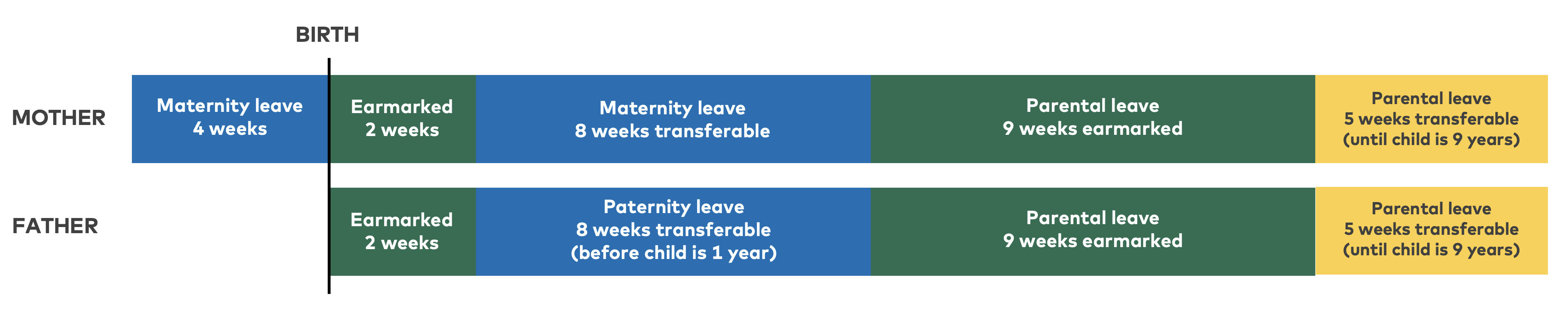
Another important change is the recognition of non-biological parents, while single parents still have a shorter total leave than two-parent families: As of January 1st, 2024, the total 13 weeks of leave which are transferable can also be transferred to so-called social parents (non-biological co-parents), and near family member of single parents. This new entitlement positions LGBT+ families better, as they can now also transfer leave to the non-biological parent. With just one period of 2 weeks non-transferable leave just after birth, single parents, by their status as having full custody over the child, have a total of 50 weeks of leave, and thus 2 weeks less than two-parent families.
Eligibility
Eligibility to full compensation of the parental benefit for an employee is based on a period of work of at least 160 hours in the 4 months preceding the paid leave, i.e., regardless of the partner’s labour market situation. Workers must also have worked at least 40 hours per month in 3 of those 4 months, and they must be working up to the 1st day of the leave. Workers with temporary contracts are included if they are eligible for unemployment benefits. In addition, the father should be in a recognised partnership with the other parent.
Eligibility for the parental benefit for self-employed parents (including helping a spouse) is based on at least part-time professional activity for at least six months within the last 12-month period, of which one month immediately precedes the paid leave. Likewise, the company must produce a profit. Eligibility also requires that the person is caring for the child on a daily basis. If the individual has recently started their company and has been self-employed less than 6 months, they can count regular paid work (not including various forms of public benefits) as work.
Unemployed people who receive unemployment benefit, are entitled to parental benefits from unemployment insurance or similar benefits (activation measures), under the same conditions as employed parents. Persons outside the labour market who receive social assistance, continue to receive this benefit under the leave period. Parents on sickness benefit also continue to receive this benefit. Mothers who have a child while studying are entitled to a total of up to 12 months’ extra study grant. Male students are entitled up to 6 months extra study grant. Students can also apply for extra monthly study grants, as well as a postponement of their study. In the current political attention to the declining fertility rates and the problem of balancing work and family life, it has been proposed to give students on leave the sickness benefit instead, as this represents a higher monetary value and could incentivise earlier fertility (DM, n.d.).
Finally, people who have just completed a vocational training course for a period of at least 18 months, or who are doing a paid work placement as part of a vocational training course, are also eligible for the parental benefit.
In order to receive full earnings under leave instead of receiving the parental benefit, a number of collective agreements and work contracts have the requirement that the employee must have been employed in the company for a certain period, for instance 18 months. This positions young people poorly in regard to their right to full pay but also for taking up work elsewhere (Politiken, 2023).
The percentage of the total Danish workforce that is covered by collective agreements is, 82 per cent (2018) but fewer in in the private sector, 74 per cent (DA, 2020). Coverage is typically lower among younger people, which means that they are less likely to be ensured to leave under collective agreements.
Benefits
The legislation ensures that all employees and self-employed parents are entitled to a daily parental benefit based on former earnings, and up to an upper limit of DKK4,695 [€629] per week for full-time employees, before tax. The same amount is paid for unemployment and sickness benefit. The payments are taxed, typically within the range of 38 to 41 per cent.
Only parents who are entitled to social security in Denmark, can receive the parental benefit. The entitlement to social security is automatic if the person is working in Denmark. If only one parent has this entitlement, he/she can apply for transfer of up to 13 weeks of leave from the non-eligble parent.
Under collective agreement and/or work contracts, full earnings may be paid during leave, i.e., the employer supplements the state benefit up to full normal earnings.
Flexibility
Except for the first two weeks after birth, which are non-flexible, the parental leave scheme in Denmark is rather flexible but the flexibility is somewhat dependent upon one’s employer (and, in some cases, also the other parent’s employer). The following eight weeks can be postponed, for instance if she/he returns to part-time work but this leave has to be taken within the first year of the child’s life. As regards the 9+5 parental leave weeks, depending on the employer’s agreement, the leave can be taken part-time, as single days or single weeks. Everyone eligible for parental leave can postpone five weeks of leave and use it anytime until the child is nine years old. Subject to agreement with the employer, more weeks can be postponed. If leave is transferred to the other parent, the employer of the first parent must agree to postpone these leave weeks until after the child is one year. Both parents can be on leave at the same time.
It is possible to return to work on a part-time basis, with a reduced benefit payment spread over this extended period of leave. This is also subject to agreement with the employer.
Financing
The parental leave scheme is funded by the state from general taxation, except for the initial 8 weeks when municipalities bear half of the cost. Private employers receive compensation up to the maximum level of the leave benefit from the state and are obliged to be a paid member of a public or private compensation fund, which refunds the difference between parental leave benefits and full earnings.
Other work and family policies
Childcare
The relatively short leave period is complemented with extensive ECEC provision, enabling the dual-earner model. ECEC for the 0-5 years is provided by the local municipality, and parental fees take into account the household income to ensure that ECEC is affordable across income groups. In 2000, a ECEC guarantee was introduced, giving children from the age of 26 weeks the right to a place in either family day care or a ECEC institution. And it used to be that one in five children under the age of one was cared for outside the family, a record high even within the Nordic region. While Denmark for many years therefore took the lead in the provision of ECEC for the youngest age group, take-up rates have dropped in recent years for the youngest children, aged 0-2 years old, from 66% in 2015 to 54 % in 2021 (Figure 2).
Figure 2. Share of children using ECEC, 0-2- and 3–5-year-olds, 2015-2021, Denmark
Note: Includes for the 0–2-year-olds: family day care, creches and age-integrated institutions.
3–5-year-olds: kindergartens and age-integrated institutions. Source: Bureau2000, 2022
3–5-year-olds: kindergartens and age-integrated institutions. Source: Bureau2000, 2022
This drop in take-up rates may be explained by parents’ increasing concern over the quality of care in the ECEC institutions, caused by shortage of (trained) staff and increasing child:staff ratios. Municipalities have struggled to keep up with demand from a rising number of children in the recent decade, and with living up to the ECEC guarantee. A recent study also found substantial differences in levels of quality across the ECEC provisions for the 0–2-year-olds (Lindeberg et al., 2023).
Parents have not surprisingly reacted to the mounting reports about the quality concerns: A representative survey from 2023 found that 24 % of Danish parents of children under nine years had prolonged their leave period in order to postpone the use of extra-familial childcare, giving the poor quality of ECEC on offer as the reason why. The survey also found that the lack of quality had led 19% of parents to cut their working hours in order to reduce the time their children spend in ECEC (Epinion, 2023). In other words, parents’ impression of declining quality of care has led not only to a drop in take-up rates but has also affected their labour market participation. The staff also identify the lack of quality as an issue: in another survey, 38% of ECEC staff say that more children show signs of poor well-being compared to five years ago. Asked to the reason behind, 74% of these respondents quote the lack of staffing as a reason (Bureau2000, 2023). The situation of the shortage of staff has changed will change in the years to come with the already experienced drop in fertility (from 1.7 in 2020 to 1.5 in 2023), which is expected to remain stable or even decline further. Just one year ago, the prospective was of a shortage of 5.0000 trained pedagogues in 2035 (Finansministeriet, 2023), while updated figures on the fertility rate now indicate an excess of 1.000 pedagogues by the same year (Finansministeriet, 2024).
Other absentee and leave rights
Caring for sick children is an often-debated issue in Denmark and there are no statutory rights for parents to take time off from work in such situations. Most collective agreements include the right to take at least one day off from work with full pay if the child is ill and on the first day of illness. Public employees have the right to take up to 2 days off, given that the child is under 18 years and resides with this parent. It is mainly the mother who take these days. Women on average take 1.5 days annually, and men 0.9 days (2019). The biggest difference is found in the state sector where women took half a day more than men, and lowest in the municipal sector where the gendered difference was only 0.2 days annually. Absence due to the child’s illness is lowest in the private sector, where men take on average 0.8 days and women 1,2 days – likely because employees in this sector have less extensive rights (Statistics Denmark, 2020).
Parents as well as co-parents and adoptive parents also have the right to 2 annual care days per child under 7, residing with the respective employee. The days can be passed on to the following year.
Work hours are stipulated not in the legislation but in the work contract or collective agreement. Typical work hours are 37 hours per week. It is possible as an employee to make an individual agreement about reducing work hours, but this is not a statutory right.
Should a parent/parents lose a child under 18 years, a so-called sorrow leave can be granted of up to 26 weeks for both parents. Collective agreements ensure full pay during this period.
In addition, a care leave of 5 working days can be granted annually to provide care for own children, parents, spouse/partner, or a person residing in the abode if they need support due to severe illness or functional limitation. It can be taken as a full period of consecutive days or as individual days.
Unlike in the other Nordic countries, there is no cash for care scheme following the parental leave period.
Leave reforms
In comparison to the Nordic neighbours, it is the non-reforms of parental leave policies during recent decades which are of most interest in Denmark. Unlike the changes which took place in the other Nordic countries between 1990s and 2000s (see www.leavenetwork.org for detailed developments in each Nordic country), which most importantly resulted in the introduction of a father’s quota, the Danish government has until recently withheld its‘ opposition to the re-introduction of this particular policy. Instead, it has been the labour market partners representing employers and wage earners who have been pushing for the re-introduction of the father’s quota in this period.
In Denmark, parental leave is not only regulated via national legislation but also via collective agreements between labour market partners (in addition to company-specific local agreements). These labour market rights ensure full wage compensation during leave and in some cases also provide the right for a father’s quota. The quota is then contingent on certain conditions, such as the father using his quota and taking certain weeks of the parental leave period. The state does not guarantee these entitlements, however; they depend on being in employment and in a job covered by the collective agreement.
While most political parties have argued against re-introducing the father’s quota which was in place 1998-2002, the financial sector in the private labour market sector was actually the first to introduce the quota as a labour market right in their collective agreement, with the introduction of a 4-week father’s quota with full pay.
The father’s quota has also been included in collective agreements in other traditionally male-dominated private sectors, such as the industrial sector, where a paid 3-week father’s quota with full pay was introduced in 2007. This sector represents 18,000 private sector employers encompassing more than 300,000 employees (two-thirds of whom are men) nationwide, mainly within production (Statistics Denmark, n.d.-a). The number of weeks has been prolonged on multiple occasions (five weeks in 2017and at the renegotiation of the collective agreements in 2020, the father’s quota was extended to eight weeks in the industrial sector). As regards the public sector, a 6-week father’s quota was introduced in 2008, and an additional week was added in 2015, thus lagging behind the private sector (Rostgaard & Ejrnæs, 2023).
This development illustrates that fathers over time have been positioned differently with different leave rights according to which job sector they belong. Also, parental leave continues to be used by mothers. There have been only few political attempts to address this situation, except by the coalition of political parties consisting of the Social Democrats, Social Liberals and Socialist People’s Party (Socialistisk Folkeparti) who stood together for election in 2011. Their party program aimed to re-introduce the father’s quota, and this time of 12 weeks. However, once in office, the Social Democrats took a different position, concerned that the introduction of the father’s quota would curtail women‘s right to take a long leave and have consequences for the family‘s freedom to organise their time, here replicating arguments previously applied by the right-wing government (Rostgaard and Lausten, 2015). In the words of the then Prime minister:
If we are going to earmark parental leave for men, then we ought really tell women that they can have less time together with their children. This would mean that we would go to the families and tell them that we will decide how they should take up parental leave
This rhetorical position was held by the Social Democratic Party as well as the organisations representing employers (Dansk Arbejdsgiverforening, DA) and unions (3F) in the years to follow, also when learning in 2017 that a new EU Directive on work-life balance was being introduced. Denmark voted against the directive, arguing for the case of national sovereignty and the need to let labour market partners decide on such matters, in accordance with the Danish labour market model.
When the directive in 2019 was decided within the EU, Denmark initially wanted to apply for exemption and proposed to instead introduce 16 weeks of parental leave for each parent but without any use-it-or-lose-it strings. In addition to the argument of state paternalism, a concern was raised that the directive would mean that some families would not use their full leave period, resulting in a shorter time at home with the family for the child (Børsen, n.d.). However, just 2 days after announcing the intention to apply for exemption, the Danish government agreed to implement the directive, having realized that the exemption would violate the aforementioned EU directive.
In the years to follow, many of the major labour market and trade organisations (Dansk Industry and Dansk Erhverv) expressed their support for the directive, pointing to the success of the quota in the other Nordic countries. Also in recognition of the need to strengthen gender equality in the work place and in the management corridors (ibid). Similarly, once a national model for implementation was agreed in 2021, two out of three political parties in the coalition government (The Social Democratic Party and the Liberals) expressed their support for what they saw as important gender equality steps that would strengthen the father’s rights and the general well-being of the child (ibid). And in August 2022 a minimum requirement model of the EU Directive was introduced, meaning that Denmark is currently the Nordic country with the shortest quota of 11 weeks for each parent.
Leave use
Before the implementation of the EU directive in 2022, parental leave used to be taken predominantly by mothers. Since then, fathers have increased their take-up, especially in the average number of leave days taken by fathers. Looking at the parents’ take-up of the parental benefit, in 2015, fathers entitled to this benefit on average took 30.2 days. In the following years this rose slightly, with 37 days in 2021 just before the implementation of the EU Directive in August 2022. Already by the end of 2022, the average number of leave days had increased for fathers to 48 days (Figure 3). Mothers’ average number of leave days remained stable around 340 days until 2022, where it dropped to 323 days, as a consequence of the increase in fathers’ days. As indicated in the figure, there has been a slight drop in total leave days, from 377 days in 2021 to 371 days in 2022. Likewise, fathers’ share of total leave days increased in the same period, from 8.1% to 13.0% (Figure 3). There is no data on whether and how many parental leave days parents do take together, so that they are at home at the same time. However, generally, parents seem to split up the leave days, also in order to use the leave most efficiently.
Figure 3. Average number of leave days taken by mothers/fathers and fathers’ take-up rate as % of total leave days, 2015-2022, Denmark
Source: Statistics Denmark, Statistikbanken, Barsel11.
Note: cohabiting parents entitled to the benefit and taking it up. Includes weeks for mothers before birth.
Note: cohabiting parents entitled to the benefit and taking it up. Includes weeks for mothers before birth.
There has also been a change in the proportion of fathers who take up leave (Figure 4). Among those eligible for the parental benefit and co-habiting, there has been an increase from 80 to 88% of fathers who take leave in August 2022 when the EU Directive was implemented.
Figure 4. Share of parents entitled to the benefit who took leave, %, 2019-2022, Denmark
Source: Statistics Denmark, Statistikbanken, barlov1. Nyt fra Danmarks Statistik, 2024.
Note: Includes all who have taken 1 day or more; only for parents of children born in the period Aug-Dec.
Note: Includes all who have taken 1 day or more; only for parents of children born in the period Aug-Dec.
Across the educational divide, there seems to be some differences in leave take-up: the higher their educational level, the shorter leave mothers take (Figure 5). To exemplify, mothers with no education take on average a total of 361.0 days, while mothers with tertiary education take 291.5 days. This suggests that there are also differences in leave take-up across income levels. The difference according to education is found for the leave taken before birth as well as after birth.
For the fathers, there is – and perhaps not surprising – opposite patterns: with increasing educational level, more fathers take leave (Figure 6). Fathers with no education take on average 32.5 days compared to 65.5 days on average for fathers with tertiary education. This implies that the share of leave is more equally balanced in families where the father has a higher education. And again, this indicates that fathers with higher incomes take longer leave periods.
Figure 5. Mothers use of leave days according to educational background, average number of days, 2022
Source: Statistics Denmark, Statistikbanken. Note: mothers entitled to the benefit.
Figure 6. Fathers’ use of leave days according to educational background, average number of days, 2022
Source: Statistics Denmark, Statistikbanken. Note: fathers co-habiting with mothers and entitled to the benefit.
Beyond the educational divide, there may be a number of reasons why fathers do not take leave or take less than they are entitled to. A representative survey conducted among 2,500 men who became fathers after the reform of the parental leave showed that 24% took less than the 11 weeks (Mødrehjælpen, 2024). The study was conducted in August 2023, and thus one year after the reform. It revealed a mix of economic and attitudinal reasons preventing the fathers from taking leave but also that the partner has superior leave rights and a job situation that more accommodated taking up leave: The main reason was financial concerns (50%), that the mother wanted to take leave (26%), having insufficient leave rights (22%), the work situation did not allow it (22%), the child needs a mother (for instance breastfeeding) (22%), would negatively affect my career (11%), the mothers leave rights are superior to mine (10%), the mother is best fit to care for the child (9%), the child is better of with its mother (9%), other (17%).
Discussion: Parental leave in country context
Overall, the leave reform has indeed affected the situation so that more fathers today take leave and spend time with their young child. The reform has also meant a more gender balanced take-up of leave, with fathers lengthening the period of leave and mothers shortening theirs. This can have a positive effect in society in furthering gender equality in practice in the home and in the workplace, enabling women to better make use of their competences in the labour market and generally furthering a male role model that can embrace also care work. The reform may in this way contribute to societal sustainability.
However, the reform has also affected the legislation so that the total leave length is today a bit shorter. The drop in total leave length is minor but nevertheless mirrors a societal concern voiced before the introduction of the father’s quota, that some families would refrain from taking leave or take shorter leave, eventually affecting the time that the very young child is cared for in the family and potentially affecting the child in a longer perspective.
Previous research using Danish data has shown that the child may not be affected in physical health by the length of the parents’ parental leave (Beuchert et al, 2016) but more recent research suggests that shortening the leave period may affect the child’s well-being and development. A recent study using Danish register data and following children whose parents have taken leave prior to the reform suggests that a shorter leave period has effects for the child when they reach 13-15 years, in terms of their socio-emotional skills and how well they thrive in the school setting (Gensowski, 2023). Following up on this issue, early research of the register data shows that the drop in total leave days following the reform is more frequent in families with low income and educational level, indicating a social class gradient (Gensowski et al., 2024).
The small drop in leave length which is reported for 2022 may also be reversed when statistics for the take-up in 2023 become available. At least, and as reported earlier in this report, parents seem to have reacted to concerns over quality of care in the ECEC provision by expanding their leave period. With the current data, we do not know if these strategies have a social gradient.
But as shown above we do know that a more gender balanced take up of leave where fathers take longer leave seems to be more prevalent in families where one or both have a higher education, reflecting most likely attitudinal preferences and perhaps also the work situation. This indicates that the economic effect of taking leave may also have a social gradient: previous research using Danish data has shown that mothers earn more when the father take more leave, while the father’s wage is not affected or may actually increase slightly (Andersen, 2017). When mothers with low education continue to take the bulk of the leave, they may also be negatively impacted in in terms of their wage levels.
The relationship between the parents may also be affected by how long leave each take. A recent Danish study combining survey and register data shows that both parents are more satisfied, the longer leave the father take (Niss et al, 2019). A small but significant and positive effect from fathers’ increasing the length of leave is also their involvement with the child later on, such as their frequency of activities with the child, as well as their overall attachment to the child. The study argues that this may have a spill-over effect on the father’s health, quality of life but also his legal position in the case of a marital break-up – similar to what Ottesen (2015) found in a previous Danish study. In a more long-term perspective, Niss et al. (2019) find an association between fathers’ use of leave and the male children’s grades in mathematics in school, especially among boys with fathers who have a long, further education. Fathers’ use of leave also spill-off in their share of household tasks and who stays at home from work when the child is ill. Finally, the survey data indicates that fathers find that taking leave has had a positive effect on their wages and career, while mothers find it has had a negative effect. The longer leave, the more positive effect according to fathers, and the more negative effect according to the mothers.
The gendered uptake of leave has to some degree been modified in that more fathers take up leave and for longer period. However, this is mainly in families with higher education and the traditional gendered uptake continues as a general trend. This may have an impact on social sustainability, in terms of labour marked participation, lifetime earnings, division of house and care work, and eventually also on the social norms of gendered parenting.
References
Andersen, S. H. (2017). Paternity leave and the gender wage gap: New causal evidence. The ROCKWOOL Foundation Research Unit, Study paper No.118, 2017.
Beuchert, L. V., Humlum, M. K., & Vejlin, R. (2016). The length of maternity leave and family health. Labour Economics, 43, 55–71. https://doi.org/10.1016/j.labeco.2016.06.007
Borchorst, A. (2006). The public‒private split rearticulated: Abolishment of the Danish daddy leave. In A. L. Ellingsæter & A. Leira (Eds.), Politicing parenthood: Gender relations in a Scandinavian welfare state design (pp. 101–120). The Polity Press.
Bureau2000 (2022). Udviklingstendenser i dagpleje og daginstitutioner [trends over time in family day care and childcare institutions]. https://www.bureau2000.dk/CustomerData/Files/Folders/7-seneste-nyheder/1113_udviklingstendenser-i-dagpleje-og-daginstitutioner-2022.pdf
Børsen (n.d.). Et "ægte løftebrud" eller "kæmpe fremskridt"? Se, hvad der er sagt om øremærket barsel gennem årene. https://borsen.dk/nyheder/profinans/et-aegte-loftebrud-eller-kaempe-fremskridt-se-hvad-der-er-sagt-om-oremaerket
Cedstrand, S. (2011). Från idé till politisk verklighet. Föräldrapolitiken i Sverige och Danmark [From idea to reality. Parental politics in Sweden and Denmark]. Boréa förlag.
DA (2020). I Danmark er flest dækket af overenskomst, Dansk Arberjdsgiverforening https://www.da.dk/politik-og-analyser/overenskomst-og-arbejdsret/2018/hoej-overenskomstdaekning-i-danmark/ (accessed Oct 8th 2024)
DM (n.d.). Flere partier vil lette presset på studerende med børn [Several political parties wish to make life easier for students with children]. https://dm.dk/akademikerbladet/aktuelt/2024/oktober/flere-partier-vil-lette-presset-paa-studerende-med-boern/
EU Kommissionen (2019). Direktiv om balance mellem arbejdsliv og privatliv for forældre og omsorgspersoner. https://eur-lex.europa.eu/legal-content/DA/TXT/PDF/?uri=CELEX:32019L1158&from=DA
Eydal, G.B. & Rostgaard, T. (2011). Gender equality re-visited: Changes in Nordic child-care policies in the 2000s. Social Policy & Administration, 45(2), 161–179.
Finansministeriet. (2023). Rekruttering af velfærdsmedarbejdere nu og i fremtiden. Økonomisk analyse. Finansministeriet.
Finansministeriet. (2024). Svar på uddannelses- og forskningsudvalgets spørgsmål nr. 368 (Alm. del) af 10. september 2024 stillet efter ønske fra Lise Bertelsen (KF). Finansministeriet, https://www.ft.dk/samling/20231/almdel/ufu/spm/368/svar/2075846/2917086.pdf
Houmark, M. A., Jørgensen, C. M. L., Kristiansen, I. L., Gensowski, M. (2022). Effects of extending paid parental leave on children's socio emotional skills and well-being in adolescence. IZA Discussion Paper No. 15421. Berlin IZA.
Gensowski, M., Ingólfsdóttir, I. S., and Jonassen, A. B. (2023). Foreløbige konsekvenser af øget øremærkning af barselsdagpenge [Preliminary analysis of the father’s quota in parental leave], Rockwool fonden analyse, feb. 2024. Rockwool Fonden.
Lindeberg, N. H., Hansen, A. T., Vixø, K., Madsen, D. C., Bjerre, L. B., Lundby., A., & Lautrup, M.F. (2023). Kvalitet i dagtilbud – National undersøgelse af kvalitet i pædagogiske læringsmiljøer og rammer i kommunale daginstitutioner og dagplejen for 0-2-årige børn. VIVE og EVA.
Mødrehjælpen. (2024). De nye barselsreglers indflydelse på familielivet. Analysenotat nr. 14. Mødrehjælpen. https://moedrehjaelpen.dk/wp-content/uploads/2024/01/MoedrehjaelpenTema_14Januar_2024_De-nye-barselsreglers-indflydelse-paa-familielivet16.01.24.pdf.
Niss, N. K., Ellegaard, C., Bühring, T., Thomsen, S. C., Saaby, M., Egedsø, P. J., Skovsgaard, C., Daysal, N. M., & Transdafir, M. (2019). Undersøgelse af effekterne af fædres brug af Orlov. SDU and Oxford Research.
Ottesen, M. H. (2015). The long-term impact of early paternal involvement in childcare in Denmark. In G.B. Eydal and T. Rostgaard (eds), Fatherhood in the Nordic Welfare States: Comparing Care Policies and Practice (pp. 251-276). Policy Press.
Rostgaard, T., & Lausten, M. (2015). Gender equality incentive policies and their consequences for men’s and women’s take-up of Parental Leave in Denmark. In G. Eydal and T. Rostgaard (eds), Caring fathers in the Nordic welfare states: Policies and practices of contemporary fatherhoods (pp. 227-301). Policy Press.
OECD (n.d.). Work life balance. https://www.oecdbetterlifeindex.org/topics/work-life-balance/
Politiken (3 March, 2023). Vil virksomheder helst undgå unge kvinder med planer om at blive mødre?
Retsinformation. (2022). Bekendtgørelse af lov om ret til orlov og dagpenge ved barsel (barselsloven), https://www.retsinformation.dk/eli/lta/2022/1391
Statistics Denmar.k (2020). Kvinder passer oftere syge børn [women more often take care of sick children], Nyt fra Danmarks Statistik, nyhedsbrev 395 https://www.dst.dk/da/Statistik/nyheder-analyser-publ/nyt/NytHtml?cid=32036