Appendix D: Sweden
D.1 Country specific remarks
According to the Swedish Miljäbalk (SFS nr 1998:808), the main rule in Sweden is that municipalities are responsible for collection and treatment of MW. An exception is made for MW covered by EPR schemes, for this waste the responsibility lies with the producer or the liable PRO.
Packaging waste, WEEE, battery-waste, car tires, end of live vehicles, medicines. Neither car tires nor end of live vehicles are classified as MW in Directive 2008/98/EC.
Municipalities may work individually or in collaboration with other municipalities to manage their responsibility. Municipalities are free to decide if the waste is handled by municipal services, a local statutory joint municipal authority, a municipally owned company, or to outsource the task to a private contractor. In the latter case, the private contractor will compile data on collected waste and pass this data on to the municipalities. Municipalities are responsible for reporting on collected amounts of MW within their responsibility to the Swedish EPA.
There are a total of 290 municipalities in Sweden which vary in population, from 2 300 to 989 000 inhabitants, and a population density varying from 0,2 to 6,441 inhabitant per square kilometer (Statistics Sweden, n.d.). Sweden is an elongated country with most of its population living in the southern parts, or along the coast in the north of Sweden, which influences waste management and the ability to treat waste efficiently due to long transportation to treatment facilities in some area.
The Swedish Avfallsförordning (SFS nr 2020:614) enforces obligations of source sorting for some MW-fractions (as well as non-MW) i.e. bio-waste, packaging waste, textile waste, hazardous waste, newspaper and other similar paper waste, WEEE and batteries.
D.1.1 Definition of Municipal Waste Affected the Responsibility for the Waste
The EU common definition of MW was implemented in national legislation in 2020, replacing the previous term household waste. The MW definition is broader than Sweden’s previous interpretation of household waste also including similar waste from other sources and deviates from previous legal practices. This change expanded the municipalities’ responsibility to include all waste falling within the definition of MW, except for MW handled within EPR schemes.
The new MW definition also affected the legal responsibility of waste management between private and public actors, including reporting obligations. Some private actors (not contracted by municipalities) may still handle MW from other sources, which is not reported as MW, leading to a potential underestimation of generated MW. Sweden is aware of this issue and is actively working on adjusting current waste legislation. Changes in waste collection and reporting responsibilities for MW are expected, likely to result in more MW from other sources being included in the reporting.
The situation in Sweden highlights the potential time lag in implementing new definitions and waste management in practice, and the relevance to keep this in mind when comparing data between countries. When some legal adjustments are expected in the future, actors may hold their investments until the legal framework has been clarified.
D.2 The Waste Management in Sweden
In addition to the above-mentioned changes regarding MW other major changes are also affecting the waste management in Sweden. As of 1 January 2024, the responsibilities of the municipalities changed to also include separate collection (but not treatment) of packaging waste from households. PROs are still responsible for the recycling, financing and reporting of data on all packaging waste covered by the EPR, which is used for MW statistics and packaging statistics. Sorting requirements for textile and bio-waste have also been introduced.
Today, the collection of MW from households is mainly done by curbside collection for residual waste and food waste. Packaging waste, such as glass-, metal-, paper- and plastic packaging, and paper waste can be either collected via curbside collection or dropped off site, at unmanned recycling stations
Recycling stations are small, unmanned sites for recyclable packaging and newspapers, conveniently located across public areas. Sweden has a total of 5,800 recycling stations.
Bulky waste, textile waste, WEEE and hazardous waste are normally transported by households to manned recycling centers
Recycling centers are municipal drop-off facilities, where individuals and businesses can leave of various types of waste. Approximately 600 recycling centers exist across Sweden.
The collection of MW from other sources differs for several reasons. Residual waste, food waste and paper waste should be handled by the municipalities. The individual business is responsible for leaving packaging waste to PRO, which can be done by a contractor that collects packaging waste, or the business themselves can leave packaging waste at a collection site. Businesses close to households could join the municipality's collection scheme for packaging waste. Bulky waste and hazardous waste from businesses can also be left at manned recycling centers.
Since the municipalities decide how waste management should be organized in the municipality, the level of service varies. For example, some municipalities may offer curbside collection of more fractions or other types of collection schemes. Some municipalities collect waste from households in colored bags that are sorted at a sorting facility instead of separate bins. Even though the main system in Sweden is based on source separation, there is a couple of sorting NIR-scanner facilities (NIR= Near Infra-Red) for pre-sorting before incineration to further separate plastics and metals from residual waste.
D.3 Producer responsibility schemes in Sweden
Municipal packaging waste, WEEE and battery waste is covered by producer responsibility within EPR schemes. The reporting within the EPR schemes is used as a data source for producer responsibility-specific statistics, but also for MW reporting to EU. For some EPR schemes, there is one or several producer responsibility organizations (PROs). For the Swedish reporting of MW, it is important to note that the data source varies depending on whether the waste is covered by an EPR schemes or not.
D.4 Collection of data on municipal waste in Sweden
D.4.1 The Swedish Digital Registers, System and Actors
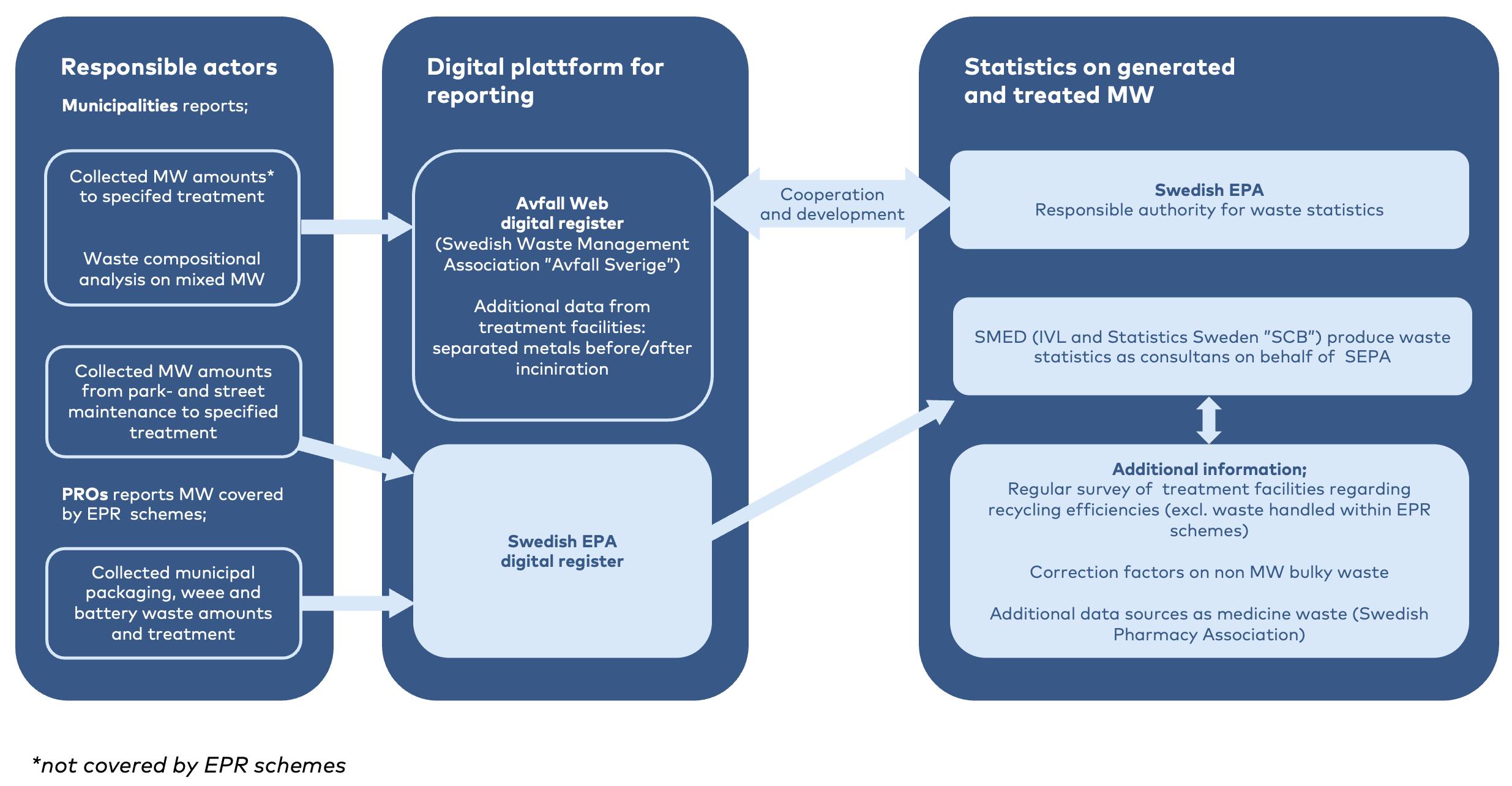
The Swedish EPA is the responsible authority for waste statistics including the reporting of MW to EU. As a part of the SMED consortium (Svenska MiljöEmissionsData), consultants from the Swedish Environmental Institute (IVL) and Statistics Sweden (SCB) produces MW statistics on behalf of the Swedish EPA. In Sweden, MW statistics is a result of collaborative efforts involving several organizations and data sources.
For MW not covered by an EPR scheme, municipalities report on the collected amounts of waste, split into different waste types and intended treatment. Additionally, they report results from compositional analyses of residual waste from households. The intended treatment is used for calculation of the treated amount, together with occasional surveys on average loss rates for a specific waste fraction (based on measurements of losses).
The branch organization Swedish Waste Management Association “Avfall Sverige”, representing Swedish municipalities, has been collecting data for a number of years from municipalities in a digital register called Avfall Web. The Swedish EPA has a formal collaboration with Avfall Sverige so that the register can be used by the municipalities to fulfil their reporting obligation to the authority, to avoid a double reporting burden as well as to improve data collection.
The municipalities report MW for which they have collection and treatment responsibilities through the register. The MW amounts reported to Avfall Web consists of waste from households and other sources. Municipalities directly report MW from park maintenance and street cleaning activities to the EPA digital register.
For MW covered by EPR, PROs report the collected amounts of MW and final treated amounts of waste. MW-streams under producer responsibility schemes (packaging, WEEE, batteries) are reported digitally to EPA digital register. A transitional solution with a statistical survey has been used for packaging waste.
See Figure D1 for an overview of the different reporting actors, digital reporting register, relevant actors and additional information that is gathered to produce Sweden’s statistics on generated and treated MW.
Figure D1: Overview of the actors and data-portals relevant for data on MW in Sweden. Light blue boxes mean registers and surveys owned or implemented by the Swedish EPA.
D.4.2 Information Collected for Calculating the Generated and Treated Amounts of Municipal Waste in Sweden
Collected waste amounts (weight), both mixed and separate collected, is used for the calculation of generated amounts. The material breakdown of residual waste is updated annually based on the latest available results from compositional analyses performed by the municipalities, typically from the past two years.
The municipalities and PROs report the following information to the digital platforms as described above, after gathering the information needed from waste collectors and treatment facilities:
Type of waste | In Avfall Web specific “Input codes” are translated to LoW codes by the Swedish EPA or SMED. PROs report due to specific categories within EPR schemes. Results of the waste compositional analysis on mixed/residual waste. |
Quantity of waste | Weighted or estimated in ton. Hazardous waste is reported in kg. |
Origin of waste | Municipalities report data collected amounts within the municipality. PROs report national data on collected and treated amounts. |
Type of waste treatment | Collected amounts are generally reported with the intended treatment. For the municipalities the categories are specified in Avfall Web. PROs report final treatment and shall follow the regulatory calculation point of recycling. PROs even report waste that is not recycled (including non-target material/losses). |
Additional information (not reported to digital platform, but is used for calculating generated and treated MW) | Regular survey of treatment facilities regarding recycling efficiency (excl. waste handled within EPR schemes). Correction factors for the share of bulky waste that are not classified as MW. Additional data sources, for instance, medicine waste left by consumers in pharmacies. |
D.4.3 Generated Municipal Waste
The reported data on generated amounts of MW is not reported by waste actors in LoW codes. Instead, municipalities use register-specific input codes in the digital register Avfall Web. There are about 33 different input codes relevant for MW in the register. The Swedish EPA categorizes the input codes within the accurate LoW code and give instructions to municipalities regarding how to report in Avfall Web. The aim is to allocate each input code to a component of MW, which is then reported to Eurostat.
Some register-specific input codes may cover several LoW codes. An exact match between LoW codes and their national equivalent is not required for accurate MW reporting as long as it covers LoW codes in the same component (for example, the code I43 covers 20 01 10 and 20 01 11, both under the component “textiles”). When collecting data from municipalities in the EPA digital register on green waste from park maintenance and street cleaning residues, LoW codes are given as instruction on what to be reported by the municipalities.
The same principle applies to waste within the EPR schemes, generally with EU-defined categories and waste treatment operations for packaging statistics or statistics on WEEE. Packaging waste respondents, i.e. PROs, are also asked to estimate and report the share of the total amount of packaging waste to be classified as MW. Actors collecting packaging waste from other sources than households will be subject to the same requirement, starting with the 2025-data collection.
Table D1 below shows how the collected data corresponds to the data reported to Eurostat.
Table D1: Overview showing the compliance between Sweden’s collected data and the reported data to Eurostat.
Collected data | Data reported to Eurostat / LoW codes | |||
National code | Description in the national data system | Comments | LoW code | Municipal waste |
Avfall Web, code I16 | Non-packaging metals (metal scrap) | 20 01 40 | Metals | |
EU categories | Metal from packaging waste classified as MW | EPA digital register | 15 01 04 | |
- | No national equivalent. | 15 01 11 | ||
Avfall Web, code I38. | - | Window-glass excluded as C&D. | 20 01 02 | Glass |
EU categories | Municipal glass from packaging waste | EPA digital register | 15 01 07 | |
Avfall Web, code I39 | Non-packaging plastic "bulky plastic" | 20 01 39 | Plastics | |
EU categories | Plastic from packaging waste classified as MW | EPA digital register | 15 01 02 | |
Avfall web, code I19 | Paper waste | 20 01 01 | Paper and cardboard | |
EU categories | Paper from packaging waste classified as MW | EPA digital register | 15 01 01 | |
Avfall web, code I1a, Å4, Å5, Å19, Å7 | Separate collected food waste to composting, bio digestion, processed in WWTP and home composting. | 20 01 08 | Bio-waste | |
Avfall web, code Å33 | Separate collected waste fat | 20 01 25 | ||
Avfall web, code S9 | Waste fat from grease separator | |||
Avfall Web, codes: Å2, Å6, Å6a, and Å6b | Garden waste left at recycling centers to incinerate, bio digestion, pyrolysis and composting. | 20 02 01 | ||
20 02 01 | Green waste from park maintenance | EPA digital register | ||
- | Impregnated wood excluded as C&D | 20 01 37* | Wood | |
Avfall Web, code I13 | Wood waste (non-impregnated wood) | 20 01 38 | ||
- | Wood pallets, excluded. | 15 01 03 | ||
Avfall Web, code I43 | Textile waste for recycling | No distinction between clothes and other textile waste is made | 20 01 10 | Textiles |
Textile waste for recycling | 20 01 11 | |||
- | No textile packaging is reported | 15 01 09 | ||
EU categories | Consumer electrical and electronic equipment | EPA digital register | 20 01 21 | Electrical and electronic equipment |
20 01 23 | ||||
20 01 35 | ||||
20 01 36 | ||||
EU categories | EPA digital register | 20 01 33 | Batteries | |
20 01 34 | ||||
Avfall web, codes: I14, I42 and I53. | Bulky waste fractions not included in other fractions ( | Combustible bulky waste and other bulky waste for material recycling or prepared for reuse. | 20 03 07 | Bulky waste |
Avfall Web, code I1b | Mixed/residual waste (combustible) | 20 03 01 | Mixed waste | |
- | No national equivalent. | 15 01 06 | ||
Avfall web, codes: F2, F3, F10, F23 and F24 | Household chemicals, hazardous waste containing oils, other hazardous waste and water, solvent based paints. | No data available on 20 01 31* Cytotoxic drugs and chemotherapy | 20 01 13*, 20 01 14*, 20 01 15*, 20 01 17*, 20 01 19*, 20 01 26*; 20 01 27*, 20 01 28, 20 01 29* 20 01 30 | Other – Hazardous waste |
Medicines | The Swedish Pharmacy Association | 20 01 32 | Other - medicines | |
- | No national equivalent. | 20 01 41 | Other – waste from chimney sweeping | |
20 03 03 | EPA digital register | 20 03 03 | Other – street-cleaning residues | |
- | No national equivalent. | 20 01 99, 20 03 99 | ||
- | Composite packaging is reported as separate materials. Hazardous packaging waste is reported as such. | 15 01 05, 15 01 10* | ||
Collected data | Data reported to Eurostat / LoW codes | |||
National code | Description in the national data system | Comments | LoW code | Municipal waste |
Avfall Web, code I16 | Non-packaging metals (metal scrap) | 20 01 40 | Metals | |
EU categories | Metal from packaging waste classified as MW | EPA digital register | 15 01 04 | |
- | No national equivalent. | 15 01 11 | ||
Avfall Web, code I38. | - | Window-glass excluded as C&D. | 20 01 02 | Glass |
EU categories | Municipal glass from packaging waste | EPA digital register | 15 01 07 | |
Avfall Web, code I39 | Non-packaging plastic "bulky plastic" | 20 01 39 | Plastics | |
EU categories | Plastic from packaging waste classified as MW | EPA digital register | 15 01 02 | |
Avfall web, code I19 | Paper waste | 20 01 01 | Paper and cardboard | |
EU categories | Paper from packaging waste classified as MW | EPA digital register | 15 01 01 | |
D.4.4 Treated Municipal Waste
The data available to calculate treated amount differs depending on whether it is waste that is managed and reported by the municipalities or within EPR schemes.
Waste covered by reporting from municipalities: The calculation is based on (a) the amount collected for different intended treatments, as reported by municipalities and (b) occasional survey of actors treating this waste, from which measurement-based average treatment rates are calculated. A typical waste fraction intended for recycling will be coupled with an average recycling efficiency (% effectively reaching the calculation point), as well as average treatment rates for different relevant treatment operations (% preparation for reuse, % incineration with energy recovery, % other recovery, % disposal, of which % landfilling). The term average treatment rates better reflect this approach than the more imprecise “average loss rates". For example, the estimated losses occurring during the pre-treatment and recycling of “non-packaging plastic intended for recycling” are reported as energy recovery.
Waste covered by EPR schemes: PROs and other producers covered by EPR schemes report treated amounts. Losses occurring before the calculation point are reported under the relevant treatment, often energy recovery, but other treatments such as other recovery or disposal/landfilling can occur.
The 15 disposal operation codes and 13 recovery operation codes in the WFD (also called R/D-codes) are not used in Sweden for reporting directly or indirectly related to MW. Sweden uses coarser categories than those in the WFD. Possible categories being often: recycling, preparing for reuse, energy recovery, other recovery, disposal (landfill is not reported separately). Some categories may be missing in some reporting. Still, the method described above is compatible with the treatment/operations used in the Joint Questionnaire or the material breakdown. The treatment/operations provided in the format for the reporting of data in Annex V(A) of Implementing Decision (EU) 2019/1004 are not referring either to R-codes. D-codes are only relevant for the Joint Questionnaire. The calculation of recycling is further elaborated in Section D6.
Table D2: Overview showing the compliance between Sweden’s collected data on collected amount and treatment options, the actual treated amounts and what is reported to Eurostat.
Data on collected and treated amounts | Data reported to Eurostat | |||
Categories of collected amounts | Treatment | Categories of treatment | Comment | |
Collected for preparing for reuse | The actual amount prepared for reuse. Losses during preparation for reuse are not reported as preparation for reuse and instead reported under relevant treatment. | Preparing for reuse | Equals ‘actual amount prepared for reuse’ | RECOVERY |
Collected for recycling | Actual recycled amount. Losses occurring before the calculation point are not counted as recycled and instead reported under their relevant treatment (often incineration). | Recycling material | Equals ‘actual recycled amount’ | |
(of which Metal recycling after incineration) | Share of metals sorted out after incineration allocated to MW. | |||
Recycling by composting and digestion | The amount of bio-waste ‘actual recycled’ | |||
(of which recycling of bio-waste at source) | Number of notified home composting units (food waste only), in combination with an estimate of the amount per household. | |||
Collected for incineration | Actual incinerated amount, excluding waste sorted out of residual waste before incineration | Energy recovery | Equals ‘actual incinerated amount’ since all incineration facilities use energy recovery | |
Collected for backfilling or other recovery | Actual backfilled amounts or actual amounts treated as other recovery. | Other recovery | Equals ‘actual backfilled amount’ or ‘actual amounts treated as other recovery’ | DISPOSAL |
Disposal – Incineration | Not reported and, to the best of our knowledge, not relevant in Sweden. | |||
Collected for landfill | Actual landfilled amount | Disposal − Landfilled | An estimate of ‘actual landfilled amount’. Landfill is only ~1% of the total MW. | |
Collected for other disposal | Technically: difference between amounts reported as disposal and estimated or reported landfilling, but the actual treatment is not known. | Disposal − Other disposal | Used as technical post. Small amounts. | |
D.4.5 Quality Assurance of the Data
Municipalities and PROs are responsible for submitting information to the Swedish EPA and for ensuring that this information is correct. Verification processes, such as cross-checks, time-series checks, and audits are used to some extent, but the use varies between different components within the reporting. Automatic checks in Avfall Web indicate when the input value deviates more than 50% from the previous year's value by highlighting the input field in yellow. The accuracy of the data is also reviewed by Avfall Sverige.
D.5 The Swedish Delimitation of Municipal Waste
When delimiting what is MW and what is not, Sweden has based its assessment on the definition in the WFD and Recital 10 of Directive (EU) 2018/851. The Directive states, among other things, that waste from certain activities and waste that falls under certain chapters in the list of waste should be included. In some cases, Eurostat Guidance has been used including the special cases document.
D.5.1 The Swedish Method to calculate Municipal Waste from Other Sources
Since all MW should be collected by municipalities by law, except if handled within EPR schemes, Sweden does not use a method to estimate how much waste from industry, etc., which is “similar waste from other sources” and therefore should be included in the total MW. In addition, the Swedish EPA offers specific guidance on the EU common definition on MW, which further clarifies municipalities’ responsibilities in Sweden, including reporting.
An unknown proportion of MW from other sources, under the responsibility of municipalities, is handled by contractors without any agreement with the municipality. This means no reporting of this waste is made as MW, which leads to underreporting. Due to the previous practice and the change of legislation, this is probably the case, to some extent, in most municipalities across the country. Further changes to the legislation are expected, and it is thought that some actors await these future changes before fully implementing the new responsibility for MW in Sweden. For the Swedish EPA, being responsible for waste statistics, there is no point in developing complicated estimates of non-reported waste from other sources, as the situation is transient. Private actors collecting MW are expected to be covered by reporting obligations in the future.
Also, PROs include MW from other sources within their reporting (WEEE, batteries and packaging). In the case of packaging waste, it is a rough estimate and underreporting is expected. New and clearer reporting obligations concerning packaging waste collected from other sources will take effect from 2025.
D.5.2 Estimates on Share from Construction and Demolition Waste
Bulky waste (e.g. non-packaging metals, plastics and wood waste) collected at recycling centers in Sweden is also usually gathered from small construction companies. C&D-waste, also from households, is not MW. Therefore, Sweden estimates the portion of C&D-waste based on waste compositional analyses and subtracts it from the total collected amounts of the relevant fractions.
D.6. The Swedish Approach to the EU Methodology on Recycling
When Sweden receives reports on collected amounts of MW from municipalities’ average treatment rates are applied to the reported amounts to estimate recycled amounts and amounts for other operations. These rates are derived from occasional surveys of sorting and recycling plants. The PRO (i.e. packaging, WEEE and battery waste) reports the amount of waste actually recycled (i.e. excluding non-target material). It is systematically measured and reported by actors collecting or recycling waste within EPR schemes.
Next, Sweden calculates the amount of recycled MW for each specific “waste fraction” (e.g., plastic packaging and non-packaging plastic), then aggregates these amounts for each component (e.g., plastic) of the material breakdown, and then to the total amount of recycled MW. In the following section the method is elaborated.
D.6.1 Data from Municipalities (ALR)
To estimate the actual recycled amount for a specific waste fraction, data on losses from a subset of sorting and recycling plants is used to calculate a flow-weighted recycling efficiency. This is applied nationally to known separately collected amounts of each MW fraction to determine recycled quantities. A specific treatment for losses is also determined. The calculation is made according to the following equation:
‘Recycling’ refers to the amount of MW actually recycled, ‘separately collected amount' to the waste separately collected by municipalities for recycling and ‘measured losses’ to the measured or estimated amounts of losses occurring at the pre-treatment, sorting and recycling facilities, until the calculation point. ’Inputs into sorting/recycling facilities’ are the amounts of MW accepted at the investigated sorting, pre-treatment, and recycling facilities up to the calculation point. The investigations aim to capture all possible losses from collection to the calculation point. Due to non-response, the flow-weighted average recycling efficiency of the waste may be measured on a subset of the waste stream.
The method applies for bio-waste (food waste and green waste from gardens and parks), plastic (non-packaging), metal (non-packaging), textiles, paper from newspaper, advertising and similar non-packaging papers, hazardous waste (other than WEEE and battery-waste), other bulky waste to recycle (unspecified) and waste collected for preparation for re-use.
D.6.2 Data from PROs (Recycled)
PROs obtain and report the amount of recycled waste (or average loss rates) from their business partners in charge of recycling waste (waste recyclers). The Swedish EPA generally does not have knowledge regarding which method is used by the different actors in order to estimate and exclude non-target material. Regarding packaging waste, actors are asked to exclude dirt and non-packaging waste that has been wrongly disposed in containers for packaging waste.
Reporters for packaging waste are also requested to provide specific data on municipal packaging waste, including collected amounts and treatment. The data is then used as the basis for MW reporting. The use of specific municipal packaging waste leads to a lower recycling rate in Sweden compared to if all packaging were reported as MW, as packaging waste from other sources may by underreported as well as it generally has a higher recycling rate. The distinction between municipal and total packaging waste is probably highly uncertain and an overly narrow interpretation of municipal packaging waste is most likely made.
To the extent of authorities’ knowledge, actors reporting under EPR schemes do not estimate of ALRs based on compositional analysis. The reporting of treated amounts for WEEE nonetheless relies on a sampling of collected small EEE to estimate the share of different types of EEE in the total amount of small EEE collected (as different types of EEE undergo different treatments).
D.6.3 Exported waste
Waste treatment outside Sweden is also included in data from PROs, and in estimates on losses used for ALR on data from the municipalities. There is a legal requirement for PROs to report the country or area where the waste was treated. However, this applies only for waste within EPR, such as packaging waste, WEEE and battery waste. In these cases, it is the actors reporting to authorities which have the responsibility to obtain information about the effective recycling rates (or percentage of non-target material) and on the rate of energy recovery, other recovery and/or disposal.