Appendix B: Iceland
B.1 Country-Specific Remarks
The magnitude of tourism in Iceland, relative to its population size, could be a significant factor in assessing the volume of MW in the country. Since 2010, tourism has been rising in Iceland and peaked in 2018 with 2.3 million tourists. This is a high amount seen in the light of the Icelandic population being approximately 380,000. The waste that tourists generate is primarily MW. The correlation between tourism and MW was made evident during the Covid-19 pandemic when a decline in tourism led to a 12% drop in MW per capita in 2020 compared to 2019, the year before the pandemic. As tourism bounces back to pre-pandemic levels, this factor becomes significant when benchmarking Iceland's MW against other countries. Tourism has an effect on the generated waste in the other countries to some extent, as they are also popular vacation destinations, but their generated waste did not show such a clear impact during the Covid-19 pandemic as it did for Iceland.
Due to Iceland being an island the import and export of waste is easily traceable as it goes through customs. There is no reported import of MW into Iceland, but considerable amount is exported for treatment. A large majority of recyclable waste is exported for recycling.
B.2 Waste Management in Iceland
Waste in Iceland is sorted and collected accordingly:
- Separately collected at households: Mixed waste, paper and cardboard, plastic and bio-waste.
- Waste producers bring to a neighborhood collection station: glass, metals, textile and single-use beverage packaging.
- Waste producers bring to a recycling station for waste: All other waste that is not separately collected or brought to neighborhood collection stations.
Legally, the Icelandic municipalities are responsible for waste collection and waste management within their jurisdiction, which commonly is outsourced to private waste entities (Lög um meðhöndlun úrgangs, 2003). However, this arrangement has led to an information gap in waste generation and origin. The private waste actors, responsible for reporting to the Icelandic Environmental Protection Agency's waste data portal, often neglect to report collected waste data. This issue is amplified when waste collection is outsourced to entities that service multiple municipalities, as data on waste origin often gets lost. Consequently, this creates reporting challenges for final waste actors to the Icelandic EPA.
Only gathering data from the final waste actors, thus effectively only gathering data on treated waste, has created significant weaknesses in the Icelandic waste data. Two main weaknesses can be highlighted as follows:
- The traceability of waste is challenged, which causes issues in identifying the origin of the waste, whether it was produced by households or other sources. In addition, the municipality the waste originates from is also unclear.
- The Icelandic EPA is effectively using treated amounts of waste to calculate generated waste. This is an issue since it makes correct calculations of recycling rates according to EU Commission Implementing Decisions, impossible as well as compliance with the targets. It also makes it unclear what the loss is between generated waste and treated waste in Iceland.
In 2024, a total of 94 waste actors reported waste to the Icelandic EPA and those are only the final waste actors. The waste law in Iceland states that all waste actors, e.g. collectors, sorting facilities etc., must report waste data to the Icelandic EPA. However, the Icelandic EPA has not had the capacity to enforce this law and thus has focused on collecting data from the final waste actors.
It is the future vision of the Icelandic EPA to address these issues by collecting all waste data nationwide, intending to provide municipalities with accurate data on collected waste in their areas, and to improve the national waste data on the origin of the waste.
B.3 Producer Responsibility Schemes in Iceland
In Iceland, the EPR schemes is overseen by the Icelandic Recycling Fund (IRF) and not individual producer responsibility organizations. The Icelandic Recycling Fund collects recycling fees directly at import (through customs) and from domestic producers of EPR goods (through tax authorities). It then pays the waste actor to deliver the waste to the final treatment of waste, upon receipt of confirmation of the final treatment. The MW fractions that are currently covered by the EPR schemes are: plastic-, paper-, cardboard-, glass-, metal and wood packaging, single use beverage packaging, electric- and electronic waste and batteries and accumulators. There are also some hazardous waste steams under EPR (acids, bases, solvents) that should be reported as MW, but since all hazardous waste is currently excluded as MW in Iceland, it is not reported as MW data. Hazardous waste is excluded from MW in Iceland due to how the waste fractions for Iceland were defined and the hazardous waste fractions were deemed to be mostly from other sources and not households. This situation is not optimal and will be sought to be corrected in future improvements.
EPR packaging fractions collected at source (either households or from other sources) are mixed with other MW fractions of the same material. Plastic packaging is sorted and collected with other plastic MW and paper- and cardboard packaging with other paper- and cardboard MW. Wood packaging is also mixed with other wood waste at the recycling stations. The Icelandic Recycling Fund uses estimates to produce data on how much packaging waste there is within the collection at source of plastic and paper and cardboard waste. Regarding plastic packaging waste, the IRF pays the waste actor once the confirmation on actual recycling rate arrives from the facility. Regarding paper and cardboard packaging, IRF pays the waste actor for packaging based on estimates from mixed paper and cardboard waste collection ratio. That data is handed to the Icelandic EPA by the Icelandic Recycling Fund.
In January 2023, metal-, glass- and wood packaging became a part of the EPR scheme so the effects on that are not yet present in the Icelandic waste data.
B.4 Collection of Data on Municipal Waste in Iceland
B.4.1 The Icelandic Waste Register, the Icelandic Waste Data Portal and Waste Actors
The Icelandic EPA collects data on all waste in Iceland, industrial waste and MW. The Icelandic EPA has a digital platform for collecting data referred to as the waste data portal. The Icelandic waste data portal receives reports from:
- The final waste treatment facilities,
- Actors responsible for recycling of waste (including composting),
- Actors responsible for the final disposal of waste (landfill or incineration), and
- Exporters of waste for further treatment (recycling, other recovery such as incineration with energy recovery).
Figure B1: An overview of the Icelandic system and actors involved in reporting waste data on MW.
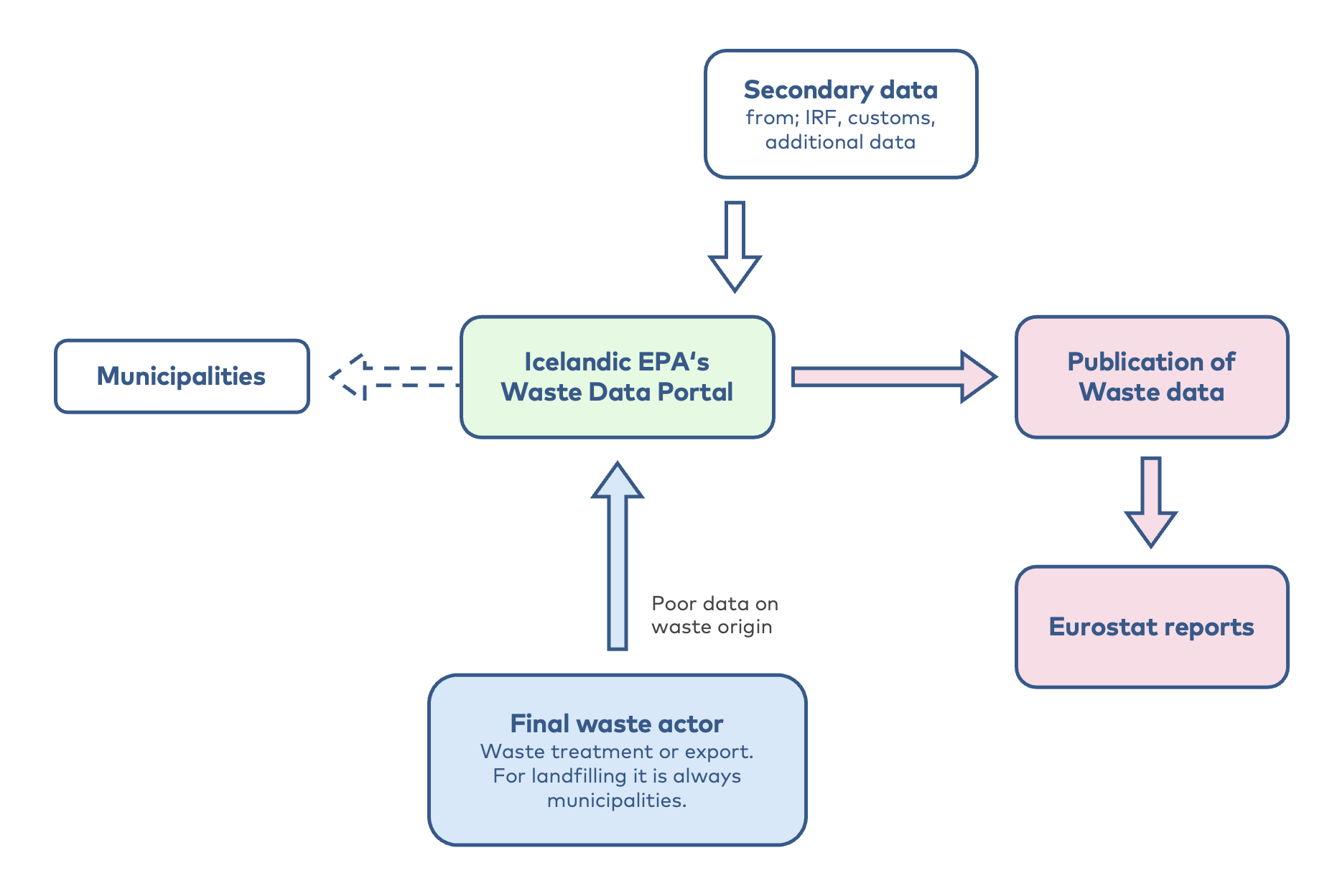
In other words, the “final” actor is responsible for the waste in Iceland and will therefore hereafter be referred to as the final waste actor. Thus, the final actor makes the final treatment or exports the waste for further treatment.
The final waste actors report annually to the Icelandic EPA’s waste data portal. It is possible to report by manually filling out a digital form or by uploading a csv file. Currently the Icelandic EPA is working on the option to transfer data automatically and digitally from the waste actor to the portal through an API connection. Most waste actors report with a digital form, as many are relatively small entities and have simple reports. Others hand in csv-files that may cover all transactions over the year spanning many tens of thousands of lines. The 10 largest waste actors in Iceland report around 80–90% of all treated waste.
The collection of waste data is both for the purposes of informing the public, municipalities and other interested parties, on waste in Iceland as well as to fulfill legally required reporting to Eurostat.
B.4.2 Information Collected for Calculating the Generated and Treated Amounts of Municipal Waste in Iceland
The waste actors report the following information to the Icelandic EPA’s digital reporting system:
Type of waste | In EWCstat4 waste code (or WStatR code) through a corresponding Icelandic item number. |
Quantity of waste | Weighted or estimated in ton |
Origin of waste |
|
Type of waste treatment | In Iceland’s own 7 categories for treatment |
Additional information | It should be noted that the data collected by the waste actors varies from an advanced digital system to handwritten notes. |
B.4.3 Specifications on Generated Municipal Waste
The Icelandic EPA collects data from the waste actors in Icelandic Item number, which corresponds to EWCstat4 codes. As described earlier, Iceland does currently only collect data on treated MW and not generated amounts of MW.
Iceland estimates the generated amount of MW by summing up the total amount of treated MW.
The total amount of MW treated (same as generated) is based on the reported fraction codes, that is, certain fractions codes have been defined as MW codes. All waste reported as the predefined fractions codes are what the total amount of MW consists of. Iceland implemented 72 fraction codes, adding 21 codes to the 51 from the EWCstat4 codes, to better represent specific Icelandic circumstance. From the 72 fraction codes, 13 of them were defined as MW and are listed in Table B1 below, along with the relevant LoW codes. The Icelandic EPA is aware that the defined MW codes do not account for all LoW codes in Chapters 20 and 15. The missing LoW codes are also represented in Table B1, with N/A as the national code number. They do, however, in most cases, have a specific national code number, but they are not included as MW in the Icelandic waste management system. The reason being that they were concluded to include mostly waste from other sources, and currently there are no means of distinguishing between the origin (knowing how much comes from other sources and from households) of the specific waste fractions. However, in some cases, the waste is correctly reported as a MW fraction code, as no waste actor reports into the system through LoW codes but reports directly into the specific Icelandic fraction codes (with corresponding EWCstat4 codes). Another aspect of how MW is defined in the Icelandic system that needs to be revised is all the waste from other sources that is within the MW codes and thus is reported as MW even though it should be excluded. Examples include wood pallets (transport packaging) under wood packaging and agricultural haybale plastic under plastic packaging.
Table B1: Overview showing the compliance between Iceland’s collected data and the LoW-codes reported to Eurostat.
Collected data | Data reported to Eurostat / LoW codes | |||
National code Item number | Description in the national data system | Comments (EWCstat4 code) | LoW code | Municipal waste |
N/A | 20 01 11 | Metals | ||
15 | Metal packaging | 06.31 | 15 01 04 | |
N/A | 15 01 11 | |||
N/A | 20 01 02 | Glass | ||
17 | Glass packaging | 07.11 | 15 01 07 | |
N/A | 20 01 02 | Plastic | ||
23 | Plastic packaging | 07.41 | 15 01 02 | |
21 | Paper and cardboard, not packaging | 07.23 | 20 01 01 | Paper and cardboard |
20 | Paper and cardboard packaging | 07.21 | 15 01 01 | |
41 | Food waste from kitchens and stores | 09.12 | 20 01 08 20 01 25 | Bio-waste |
42 | Garden waste, horticultural and forestry waste | 09.21 | 20 02 01 | |
N/A | 20 01 37 | Wood | ||
26 | Wood waste, not packaging | 07.53 | 20 01 38 | |
25 | Wood packaging | 07.51 | 15 01 03 | |
30 | Textile waste | 07.6 | 20 01 10 20 01 11 15 01 09 | Textiles |
34 | Electric- and electronic waste | 08.2 | 20 01 36 | Electrical and electronic equipment |
N/A | 20 01 21 20 01 23 20 01 35 | |||
N/A | 20 01 33 | Batteries | ||
36 | Batteries and generators | 08.41 | 20 01 34 | |
N/A | 20 03 07 | Bulky waste | ||
44 | Mixed MW - waste collection, waste collection centers, bulky waste | 10.11 | 20 03 01 | Mixed waste |
N/A | 15 01 06 | |||
N/A | 20 01 13*, 20 01 14*, 20 01 15*, 20 01 17*, 20 01 19*, 20 01 21*, 20 01 23*, 20 01 26*, 20 01 27*, 20 01 28, 20 01 29*; 20 01 30, 20 01 21*, 20 01 32, 20 01 41, 20 01 99, 20 02 03, 20 03 02, 20 03 03, 20 03 99, 15 01 05, 15 01 10* | Other | ||
B.4.4 Specifications on Treated Municipal Waste
It is the final waste actors who are responsible for the actual final treatment of the waste, or the exporters of the waste, who report waste data to the Icelandic EPA’s waste data portal. Besides reporting on the EWCstat4 codes as described, the reporter also has seven options for reporting treatment based on R and D codes, which means that the Icelandic EPA has pooled some of the R&D codes together in order to have 7 categories for reporting on treatment. The connection between the R&D codes and the Icelandic codes can be seen in Table B2.
Two treatment options worth mentioning that are missing from the Icelandic treatment methods are preparation for reuse and other disposal. For this reason, it is not an option to report these treatments into the system. Originally, they were not considered sufficiently important when the system was implemented, but work has already begun on how to include them.
The data reported is all treated amounts, gathered (mostly) at the correct calculation points according to (EU) 2019/1004. This is because domestically the data is reported by the final waste actors at their site where the waste undergoes final treatment, recovery or disposal. For exported EPR waste fractions the exporters report the exported amount to the Icelandic EPA, and then the Icelandic EPA gets confirmation on actual treatment through the Icelandic EPR scheme (the IRF). Corrections are made on “sent to recycling” vs. “actually recycled” and other treatment. Non-EPR fractions exported are expected to end up in incineration with energy recovery.
The Icelandic EPA uses reported data on treated amounts without any adjustment unless there are some corrections needed (if the amount is in kg instead of tons or if the treatment option is obviously wrong). As the Icelandic EPA doesn’t gather any data on collected waste (even though the IRF does) they do not directly make any corrections using average loss rates, but data reported from the IRF might include ALR. Some data from other reporting waste actors might also include ALR but this is not systematically logged.
In Iceland, the waste actors who report waste data, have no other option than to fill it in using the waste categories from regulation (EC) No 2150/2002, previously mentioned as EWCstat4 codes or WStatR codes. Each one of those codes is connected to an Icelandic item no, from 1–72, and is really that item no that is used when a reporter uses the option of a csv-file upload. There is a simplification reason for this Icelandic 1–72 item no system. Because the EWCstat4 codes can be the same for hazardous and non-hazardous and therefore need that clarification but the Icelandic item no is only one number option. For example, End of life vehicles are both 08.12 (one containing 16 01 06 the other 16 01 04*) but in the Icelandic system the EWC code is 08.1 for both items nos. "32" (16 01 06) and "33" (16 01 04*). This means that instead of having to enter “08.1” or “08.12” and “hazardous” or “non-hazardous” into the csv-file, you only need to enter 32 or 33 and that translates into the correct EWCstat code (or sometimes the Eurobase codes, shorter/more expansive version of the EWCstat4 codes). It is also the case that some EWCStat codes were “broken up” into several Icelandic Item nos. to create the specific/earmarked MW codes that do not include industrial waste fractions, such as C&D wood waste. The EWCstat is 07.53 for both other wood wastes 17 02 01 (C&D) and other wood wastes 20 01 38 (MW). But these were broken up into four different Icelandic item nos. 26. (MW -non-hazardous), 27. (Industrial -hazardous), 28. (C&D -non-hazardous) and 29. (C&D -hazardous).
The waste actors, who categorize their waste data into List of waste codes, translate those into EWC-stat4 codes (and their respective Icelandic item no) according to official conversion tables provided on the Eurostat website or by the Environment agency of Iceland, before handing in the data to the waste data portal. It has been discussed if the portal should also be able to allow reporting using LoW codes and automatically convert it into the correct EWCstat4 or item no.
The Icelandic definitions of preparing for reuse and backfilling are exact translations from the Waste Framework Directive (WFD) 2008/98/EC. Other recovery (referred to in Eurostat reports as “other material recovery” code RCV_OTH), however, is not specifically defined in the WFD or in Icelandic waste law. This recovery option has been found to be hard to pair into the Eurostat reports. The list in Annex II of the WFD is difficult to use, both due to a lack of clarity and the fact that it is non-exhaustive. In many regards, “other recovery” has been used as a treatment option for processes where it is not considered disposal but does not fulfill criteria to be considered any of the following: preparing for reuse, composting and digestion, other recycling, backfilling or incineration with energy recovery. This has led to the treatment option “other recovery” (option no. 5) to include many various operations. An argument can be made about some of those operations that should rather be categorized as backfilling or even other recycling. However, views on this vary among advisors at the Icelandic EPA. The Icelandic EPA has asked Eurostat twice to advise/give clarification on certain treatment operations to help solve issues with treatment reporting. When waste is reported into the wrong treatment operation, it is mostly due to the waste actor’s (reporter’s) lack of knowledge on how to categorize specific waste operations, not a lack of knowledge on what becomes of the waste. This issue can be solved by offering more guidance. Today, the Icelandic EPA believes that it catches and corrects a vast majority of these errors in their quality checking of the data (inbuilt in the waste data portal as well as manual reviewing).
Table B2: Overview showing the compliance between Iceland’s collected data on treatment options and the Icelandic conversion of this for the reporting to Eurostat.
Collected data on actual treated amounts of MW | Data reported to Eurostat | ||||
R/D-codes | National code system | Categories | |||
R/D-codes | Description /Name | National code | Description in the national data system | ||
R5, R12 | - | NA | Preparing for reuse | RECOVERY | |
R3, R4, R5 | Other recycling | 2 | Other forms of recycling (excluding composting) | Recycling -material (of which Metal recycling from incineration bottom ash) | |
R3 | Composting | 1 | Composting and digestion | Recycling composition and digestion (of which Separate collection and recycling of biowaste at source) | |
R1 | Incineration with energy recovery | 3 | Incineration with energy recovery | Energy recovery | |
Other recovery | 5 | Recovery other than energy recovery – except backfilling | Other recovery | ||
R3, R10 | Backfilling | 4 | Recovery other than energy recovery – backfilling | Backfill | |
D10 | Incineration without energy recovery | 7 | Incineration without energy recovery | Incineration | DISPOSAL |
D1, D5 | Landfilling | 6 | Landfill | Landfill | |
D9 | - | NA | Other disposal | ||
B.4.5 Quality assurance of the data
The Icelandic EPA collaborates with other public agencies like Customs and the Icelandic Recycling Fund to gather data for assuring the quality of reported waste data. The Icelandic EPA also uses the Icelandic Recycling Fund’s data on the collected amounts of certain waste fractions for the annual Eurostat reports. The waste data portal includes automatic checks that flag significant variations in reported data, aiding reporters in reviewing their submissions. The Icelandic EPA's waste statistics team utilizes these checks for manual data review.
Exported waste data undergoes a quality check, comparing it with Customs data to detect discrepancies and ensure that waste exporters fulfill their reporting obligations. Though treatment facilities occasionally report incorrect treatment types, manual quality assurance usually rectifies these errors. To further ensure data quality, the Icelandic EPA communicates with individual waste actors if reported information appears questionable or lacks sufficient detail.
B.5 The Icelandic Delimitation of Municipal Waste
As described in the chapters regarding generated and treated MW, Iceland defines MW through EWCstat4 codes (also referred to as WStatR codes) corresponding to waste item numbers, where specific codes are categorized as MW in the Icelandic data system. The delimitation of MW is kept at this level. Thus, the Icelandic method does not differentiate between MW and non-MW covered by the same item number or EWCstat4 code. For instance, if unsold goods from supermarkets are sorted into fractions that are categorized within the EWCstat4 codes (marked as MW), the waste will be counted as MW.
The primary issues in order to differentiate in more detail are:
- Difficulties with securing data on the origin of the waste, since the Icelandic EPA only collects data from the final waste actor
- The waste actors who report do not use LoW codes but have their own system for categorizing waste which do not take into account to differentiate between municipal and non-MW
- Lack of manpower/capacity to investigate how much waste comes from the household vs other sources, for both waste fractions that are included as MW and waste fractions that are excluded
There are examples for both waste fractions that are included as MW that include waste that should not be MW and excluded waste fractions that include waste that should be counted as MW
Therefore, the Icelandic EPA primarily focuses on the waste stream (in other words which EWCstat4 code the waste is covered by) rather than using the waste’s origin to categorize if the waste is MW or not. Meaning Iceland assumes that all waste that is reported as certain EWCstat4 codes is always MW. Instead of relying on LoW codes, NACE or other origin data to determine if it is MW or non-MW.
The Icelandic EPA has tried to minimize this issue for waste streams that usually have a higher amount of non-MW by introducing more codes for the reporter in order to divide MW and non-MW from each other. However, this has also resulted in some errors, so this issue is still up to being solved in a more efficient manner.
Only non-hazardous waste from electrical and electronic equipment and batteries and accumulators are considered as MW in Iceland. There is no estimation of MW share in mixed waste from industry, no exclusion of non-target materials, exclusions of waste from wholesale etc.
B.5.1 The Icelandic Method for Calculating Municipal Waste from Other Sources
At this point the Icelandic methodology of calculating MW is not able to exclude non-MW from large commerce and industry. This implies that all waste collected from large commerce and industry are calculated as MW. Iceland therefore highly suspects that this results in an overestimation of municipal waste since there is a significant amount of waste from large commerce and industry, which should not be counted as MW.
B.6 The Icelandic Approach to the EU Methodology on Recycling
To calculate the recycling rate of MW in Iceland, the Icelandic EPA takes the total amount of the specific “earmarked” MW EWCstat4 codes reported as recycled to serve as the numerator. This is the sum of MW reported into (1) Composting and digestion and (2) Recycling – material (where the EPR waste fractions have been corrected for actual recycling and not just collected for recycling). This amount is then divided by the sum of all reported MW waste into all treatment options (denominator). To sum up, the recycling rate is calculated according to the following equation (the treated amount is the same as the generated amount, as described in Section B.4.3):
The addition in the denominator is mostly mixed MW going to landfill (or now increasingly being exported for incineration with energy recovery) along with recovery of separately collected fractions.