Appendix C: Norway

C.1 Country Specific Remarks
In Norway, the Pollution Act states that the municipalities are responsible for collecting household waste (Forurensningsloven, 1981: ch. 5 § 30). Household waste is defined as the waste generated by the households (ibid., §27a.) and, in contrast to MW, includes C&D-waste when the households themselves do the demolition, building and renovation work. Collection of similar waste generated by public institutions such as nursing homes, kindergartens, etc. is not the municipalities’ responsibility, neither is collecting waste similar to household waste from offices, stores or other businesses. These actors are responsible themselves for having the waste collected (ibid., §32).
Cross-financing between household waste and non-household waste (waste from public institutions, businesses, and enterprises) is prohibited in Norway by law (Forurensningsloven, 1981: ch. 5 § 34). However, whereas the municipalities are allowed to collect waste similar to household waste from these establishments, the municipalities are required to register amounts and associate finances separately between the two waste sectors. On the one hand, this provides an advantage when collecting statistics regarding household waste. On the other hand, since only some of the similar waste from other sources is collected together with the household waste, it does not provide sufficient statistics regarding waste similar versus household waste.
In addition, the waste classification standard, NS 9431:2011 applicable to Norway does not fully align with the LoW codes presented in the European legislation defining MW. This leads to challenges when it comes to determining what waste to include in the MW reporting and developing necessary adjustment methodology to be able to report according to this legislation.
A structural factor potentially impacting Norway's MW data is the significant geographical distances between business waste disposal sites in certain areas. This may lead businesses to use municipal collection sites. Additionally, the higher disposal fee for business waste at recycling centers might incentivize businesses to categorize their waste as household waste. This most commonly occurs among small crafting businesses, posing as household customers. However, measures have been implemented to prevent businesses from disposing of their waste at recycling centers as household waste, by registering the customers and controlling the amounts of waste received over time. The Norwegian EPA acknowledges this may have some impact on MW data but does not believe it alters it significantly.
In urban areas private companies are known to collect waste from households. Container rentals, big bags, and waste taxi services are known concepts. However, this activity is only permitted if the municipality has granted approval (Forurensningsloven, 1981: ch. 5 §30). Through the approval process companies are requested to report the waste fractions and amounts to the municipality which then includes this in the waste statistics reporting to Statistics Norway.
Despite this requirement, some companies have still been collecting waste without prior approval. A 2017 study estimated that up to 10% of household waste may have been collected illegally in this way (Amland et al., 2017). This would indicate an underestimation of the MW amounts from households. However, much of the waste collected in this way is known to be C&D-waste, which somewhat offsets the underreporting of household waste. Additionally, at the time, it was not common practice for companies to file applications for approval. Since 2017, measures have been introduced to address illegal waste collection. In 2021, the municipal employers' organization released templates for applications and regulations to support implementation and better enforcement of an approval process. While the current status of legal versus illegal waste collection is unclear, these measures are believed to have reduced the underreporting of household waste and thus also MW.
Although the structural premises described in the three previous sections impact the amounts of Norwegian MW, the impact and margin of error resulting from the methodology described in the upcoming paragraphs, used for preparing the Norwegian waste data to meet the criteria of the EU MW reporting, is assessed to be larger, but still within acceptable boundaries.
C.2 Waste Management in Norway
Source sorting of waste has been practiced for many years in Norway and the most common sorting scheme is curb side collection of food waste, plastic packaging, paper and cardboard (including beverage carton), glass- and metal packaging and residual waste. In addition, the municipalities operate recycling centres receiving sorted bulky waste in a number of fractions including electric and electronic equipment, batteries, and hazardous waste. In addition, producer responsibility finances return of electric and electronic equipment and batteries at the establishments where the products may be bought, at no cost for the customer. NGOs collect textiles at several sites near shops and at parking facilities around the municipalities.
Until January 2023, it was optional to sort out plastics and food waste, but most municipalities did it anyway. As of 1 January 2023, this became mandatory. As of January 2025, additional mandatory requirements were enforced on source sorting of textiles, paper and cardboard, glass- and metal packaging and park- and garden waste (Avfallsforskriften, 2004: Ch. 10a). This means that it will take a couple of years until source sorting is completely implemented in all of Norway.
Collection of hazardous waste from households is publicly financed up to a limit of 1,000 kg per year per household (ibid., §11-10), resulting in households potentially handing in their hazardous waste for free. This implies a high collection rate of the generated hazardous waste from households. The collection and treatment of hazardous waste from other sources is financed by the source generating the waste. Digital declaration of hazardous waste is mandatory, and the amounts are registered by source for non-households. This documentation may be requested during inspections, which encourages proper delivery of waste.
Hazardous waste from households is declared by the MW collectors, for each municipality.
Most waste is sorted and separated at the source, both household waste and waste similar to household waste from other sources. Some municipalities, on the other hand, have established mechanical sorting facilities, sorting residual waste using NIR-scanners (NIR= near infra-red) sorting out plastics by reading the waste composition at a molecular level, and sorting out non-magnetic and magnetic metals by means of eddy-current technology and band magnets. This is counted as a separate collection. These municipalities still source separate food waste, glass and metal packaging, including paper and cardboard, but leave plastic packaging in the residual waste. More sorting facilities like these are planned and under construction.
Handling of waste originating from other sources than households is the responsibility of the institution, firm or enterprise that generates the waste. They buy their services from private collectors, and in some municipalities, they are allowed to buy the services from the same service collecting the household waste and also use the municipal recycling centers. As described in Section C.1, the finances from households and other sources are kept separate.
C.3 Producer Responsibility Schemes in Norway
Packaging, beverage packaging, batteries, electric and electronic equipment, wooden transport packaging, windows containing PCB, discarded vehicles, and tires are covered by EPR schemes in Norway.
Miljodirektoratet (n.d)
The PROs are private companies and registered at the Norwegian EPA's website. They report their results on collection, recycling rates and rates on the other treatment options to the Norwegian EPA. An EPR scheme regarding textiles and textile waste is also being discussed and will probably be established in the near future.
The reported amounts of metal, glass, plastic, and paper and cardboard all contain a share of packaging. Packaging is collected by the same waste collectors as other waste and to some extent alongside other waste of the same/similar material. For instance, paper and cardboard from households is collected and reported together. Also, the amounts from other sources are reported by material, not differing between e.g. packaging cardboard and office paper. The PROs provide details on the treatment results of all packaging. For reporting purposes, the collection of packaging is assumed to be a part of the other waste collected by the waste collectors. Although some might be collected separately, the extent of this is assumed to be limited. Hence, the packaging is reported according to the PROs reported results, and the rest of the respective materials are reported as non-packaging with the corresponding corrections due to treatment results, using ALRs.
C.4 Collection of Data on Municipal Waste in Norway
C.4.1 The Norwegian Waste Registers, the Norwegian Waste Data System and Waste Actors
In Norway, the MW statistics is a result of collaborative efforts involving several organizations and data sources. The Figure C1 below illustrates the organizations involved in the flow of waste data, and different platforms for reporting.
Figure C1: Overview of actors responsible in the chain of data reporting.
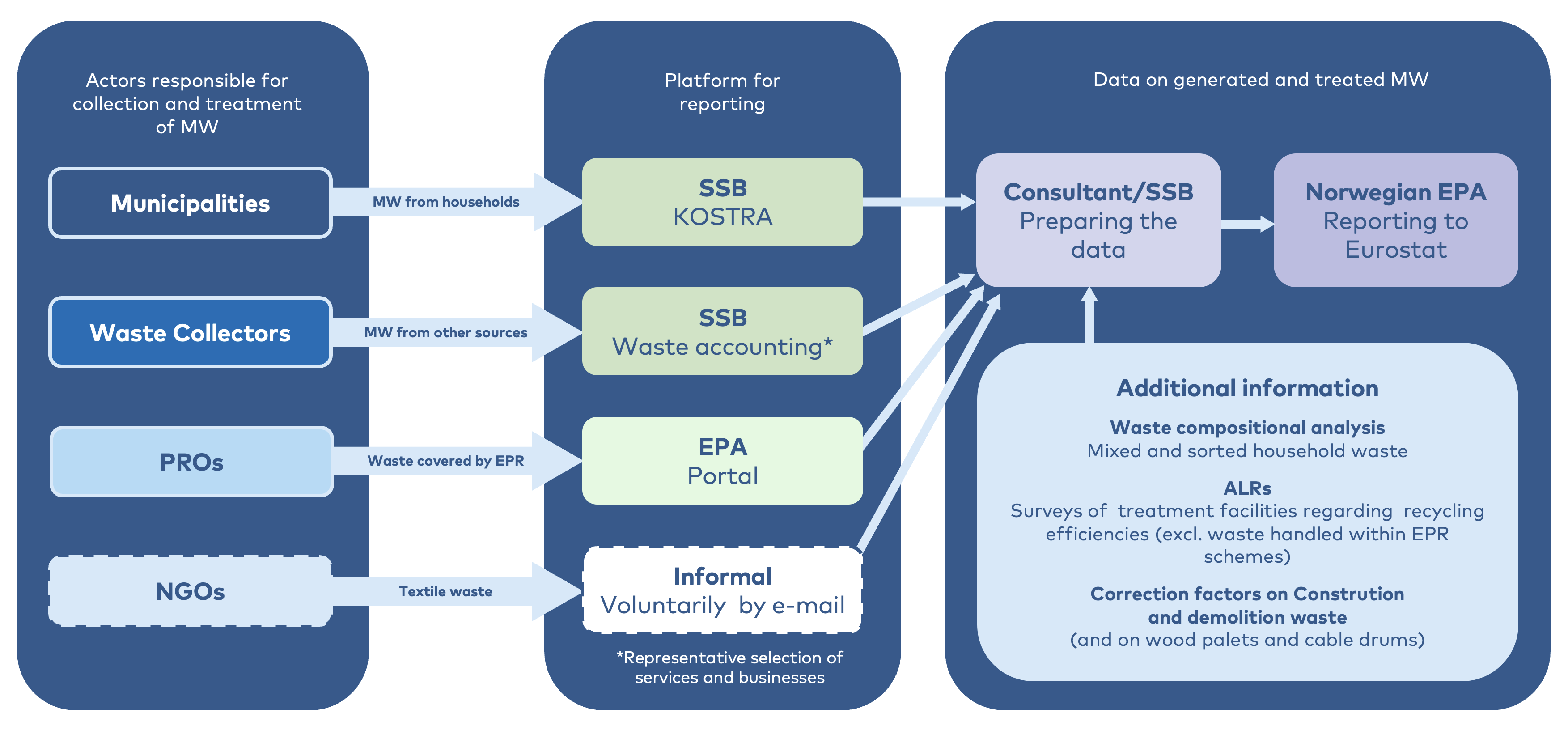
Note: The overview includes the waste collectors having the firsthand data, illustrating the platforms for reporting and the actors receiving this data, and finally the process of preparing the data for reporting, including the collection and use of supplementary data. Each entity involved in data collection and reporting is presented in different colors.
Statistics Norway (SSB) collects the data on both MW from households and on similar waste from other sources.
MW from households is reported by the municipalities to Statistics Norway in a digital form online. This is a full count of the collected waste, with two exceptions:
- the amount of plastic beverage bottles covered by the deposit-refund system (DRS) is reported by the pledge organization (Infinitum) and added to the separate collected plastics; and
- textiles which are not systematically collected by the municipalities yet, thus, the reported amounts are based on data from the NGOs who are collecting the textiles. The consultant assisting the Environment Agency in the reporting has so far collected data from the NGOs on the textiles.
The waste collectors report the waste from other sources. Statistics Norway organizes this data collection as a survey among a representative selection of actors within relevant service and business sectors through a web-platform (Altinn). The waste collectors report on their customer lists on the selected actors in excel/csv-formats, giving information about the number of employees. The waste data is reported in a template-spreadsheet (excel) specifying what waste to report, categorized by the waste codes and treatment codes, described in C.4.3 and C.4.4 respectively. Based on this reporting, the national MW amounts are estimated based on scaling up the reported data, as described in detail in Section C.5.
The PROs report to the Norwegian Environment Agency. The agency also has its own designated portal for this purpose. The PROs report in an excel spread sheet template on collected and treated amounts of household packaging and packaging from other sources separately.
For 2020 and 2021, all the collected data, both from Statistics Norway and from the Norwegian Environment Agency, was handed over to the consultant assisting the agency with the reporting to Eurostat. The consultant prepared the data by performing the necessary assessments and adjustments required for the reporting, according to the new calculation point. This also includes the collection of additional data on waste composition and on recycling results at the treatment facilities needed for establishing correction factors and ALRs to do these adjustments by. Since 2024 (2022 amounts), Statistics Norway has been assisting the Norwegian Environment Agency in preparing the data for reporting, using the same methodology developed and handed over by the consultant. The consultant gives assistance and guidance where needed in order to maintain consistency in the reporting, and to obtain additional updated data as a basis for the adjustments.
C.4.2 Information collected for calculating the generated and treated amounts of municipal waste in Norway
The waste actors report the following information to the digital reporting systems:
Type of waste | Materials and fractions according to Norwegian standard codes NS 9431:2011 |
Quantity of waste | Weighed (primarily) or estimated in tons |
Origin of waste |
|
Type of waste treatment | Treatment options according to the Norwegian standard NS 9431:2011 |
Additional information (not reported to a digital platform, however, is used for calculating generated and treated MW) | Waste compositional analysis: mixed and sorted household waste. Regular survey of treatment facilities regarding recycling efficiencies (excl. waste handled within the EPR schemes) Correction factors on construction and demolition waste (and on wood pallets and cable drums) derived from compositional analyses. |
In Norway the responsibility of collecting the MW from households and the MW from services and businesses are distinctively divided due to cross-financing being prohibited. Hence, the municipalities do not systematically collect MW from other sources. For this reason, the municipalities do not have complete data on waste from other sources, which explains the need for a separate methodology to collect data and to calculate the amount of MW from other sources and why this distinction is made when describing the Norwegian method.
Norway has two main data sources:
- Household waste: The data is reported by the municipalities
- All the municipalities report to Statistics Norway
- Service and business sector: Data is reported by those who collect waste
- Statistics Norway does yearly representative selections on which companies the reporting should be included for. Public institutions such as nursing homes, schools and kindergartens are a part of this sector.
As for MW from households, either the municipalities themselves or the inter-municipal companies administrating the collection of household waste report the collected amounts of waste directly to Statistics Norway. The reporting instructions entail reporting the different kinds of waste/materials intended for the various treatment options without withdrawal of losses. The municipalities have firsthand knowledge of the delivered waste, and it is therefore assessed that this kind of reporting will be as consistent as possible.
Information on MW from other sources than households is reported by waste collectors who report the collected amounts of waste, including the relevant data as described above in Section C.4.1, based on the yearly representative selection of companies. The data is used to estimate the total amounts based on upscaling the amount of waste per employee by all the employees in the relevant NACE-sectors, cf. Section C.5.
The data on packaging is reported by the PROs to the Norwegian EPA in an online form and contains information about origin (household/other sources), material, collected amounts and treated amounts.
The generated waste amounts are determined by weight-registers: The collected waste is weighed by material and waste code at the receiving facilities both when re-loaded and when it is delivered for treatment.
C.4.3 Specifications on Generated Municipal Waste
In Norway, the waste is classified according to a national standard NS 9431:2011. It consists of 16 waste series, each waste series describing several subcategories. The translating of the collected data from the national codes to MW and LoW codes involve both the waste collectors, Statistics Norway and the municipalities. The waste collectors register the waste and report the waste according to the reporting guidelines provided. The guidelines are provided by the Norwegian authorities, explaining which waste codes to include in the reporting, and the waste collectors assess the waste according to these. In addition, consolidations and adjustments are done to this data in several steps by the municipalities, Statistics Norway and the consultant assisting with the reporting, as described in more detail in Section C.5. A comparison of the Norwegian coding system on categorizing waste with the LoW system is done in Table C1 below.
In Norway, waste data is primarily based on collected waste. At the first weighing, the origin of the waste is known, and all data is registered. When the waste has entered the waste facility it will be mixed with waste from other sources and the traceability is lost. Thus, the Eurostat reporting is based on data from separately collected waste, and the total of generated waste is the sum of the separately collected waste of each waste category.
Table C1: Overview showing the compliance between Norway's collected data and the LoW codes reported to Eurostat.
Collected data | Data reported to Eurostat / LoW codes | ||
National code | Description in the national data system | LoW code | Municipal waste |
1411 | Metal packaging1 | 15 01 04, 15 01 11* | Metals |
1447 | Pure magnetic metal | 20 01 40 | |
1451 | Pure non-magnetic metal | ||
1452 | Mixed metals | ||
1499 | Mixed metals with other materials | ||
1311 | Clear glass packaging1 | 15 01 07 | Glass |
1312 | Colored glass packaging1 | ||
1321 | Clear glass packaging with metal1 | ||
1322 | Colored glass packaging with metal1 | ||
1351 | Decorative and utility glass | 20 01 02 | |
1399 | Mixed glass | ||
1711 | Folies and packaging | 15 01 02 | Plastics |
1721 | Rigid plastic packaging | ||
1712 | Other folies | 20 01 39 | |
1722 | Other rigid plastic | ||
1729 | Mixed plastics | ||
1799 | Mixed plastics – non packaging | ||
1231 | Packaging carton | 15 01 01 | |
1241 | Beverage carton | ||
1211 | Newspapers and magazines | 20 01 01 | |
1221 | Brown paper | ||
1251 | Office paper (printers, envelopes, etc.) | ||
1299 | Mixed paper and cardboard | ||
1111 | Kitchen and food waste from small and large households | 20 01 08, 20 02 01 | Bio-waste |
1132 | Park and garden waste | 20 01 25 | |
1141 | Untreated wood | 20 01 38 | Wood |
1142 | Treated wood | ||
1149 | Mixed wood | ||
20 01 37* | |||
- | N/A | 15 01 03 | |
1911 | Textiles and leather2 | 20 01 10 | Textiles |
1912 | Furniture and inventory | 20 01 11 | |
- | N/A | 15 01 09 | |
- | 20 01 21* | Electrical and electronic equipment | |
- | 20 01 23* | ||
1508 | Lighting equipment3 | 20 01 35*, 20 01 36 | |
1512 | Electric and electronic tools3 | ||
1519 | Audio and video equipment3 | ||
1520 | Lightsources3 | ||
1599 | Mixed electric and electronic waste3 | ||
2311 | Batteries3 | 20 01 34, 20 01 33* | Batteries |
- | N/A | 20 03 07 | Bulky waste |
9911 | Mixed household waste | 20 03 01 | Mixed waste |
9912 | Mixed waste from businesses | ||
9913 | Unsorted waste for incineration | ||
9914 | Residues from sorting | ||
9915 | Residues from sieving | ||
9916 | Street sweepings4 | ||
- | N/A | 15 01 06 | |
- | Other waste | 20 01 13*, 20 01 14*, 20 01 15*, 20 01 17*, 20 01 19*, 20 01 21*, 20 01 23*, 20 01 26*, 20 01 27*, 20 01 28, 20 01 29*; 20 01 30, 20 01 21*, 20 01 32, 20 01 41, 20 01 99, 20 02 03, 20 03 02, 20 03 03, 20 03 99, 15 01 05, 15 01 10* | Other |
7000 | Hazardous waste | ||
1 Glass and metal packaging, from both households and businesses are collected in the same bin. By sorting, the glass and metals are separated in different fractions. A key-figure from the PRO is used to separate between glass and metal for reporting to the Statistics Norway.
2 Not regularly in use in Norway but will probably be implemented as new legislation regarding mandatory collection of textiles is entered into force.
3 Non-hazardous.
4 The municipalities are responsible for collection, but not the same division as MW, which results in this waste not being reported to the Statistics Norway as a separate fraction, but as a part of other residual waste. Estimated to weigh about 716 tons.
C.4.4 Specifications on Generated Municipal Waste
The waste collectors report waste treatment categories according to the same Norwegian standard NS 9431:2011, which is the same standard used for categorizing the waste. It describes 16 treatment options, seven of which are relevant to the MW reporting. They are presented and compared with the R/D-codes in Table C2.
Table C2: Overview showing the compliance between the Norwegian waste treatment options (description and code) and the representative R/D-codes from the WFD. Only the national code system is used in Norway.
Collected data on actual treated amounts of MW | Data reported to Eurostat | ||||
R/D-codes | National code system | Categories | |||
R/D-codes | Description /Name | National code | Description in the national data system | ||
R5, R12 | 0013 | Reuse1 | Preparing for reuse | RECOVERY | |
R2, R4, R5 R6, R9 | 0014 | Recycling | Recycling -material (included Metal recycling from incineration bottom ash) | ||
R3 | Recycling/reclamation of organic substances which are not used as solvents (including composting and other biological transformation processes) | 0009 | Aerobic, biological treatment | Recycling, composting and digestion (including separate collection and composting of bio-waste at source) | |
0010 | Anaerobic, biological treatment | ||||
R1 | 0007 | Incineration with utilization of energy2 | Energy recovery | ||
- | NA | Other recovery | |||
D10 | Incineration on land | 0008 | Incineration without utilization of energy | Incineration | DISPOSAL |
D1 | Deposit into or on to land (e.g. landfill, etc.) | 0011 | Landfill | Landfill | |
D9 | - | NA | Other disposal | ||
1 The reported amounts of textiles are the sorted amounts sorted, sold and used in markets abroad.
2 A handful of the Norwegian incineration plants do not meet the R1-reqirements and are reported under “Other disposal”.
The waste collectors report which treatments the waste undergoes according to their agreements, contracts and practice. For the collected waste, all the treatments are reported for each waste category in a similar manner as in the Eurostat reporting form. The waste collectors report the household waste to the municipalities, according to Section C.5.1, and waste from other sources to Statistics Norway, according to Section C.5.2.
Please note that Norway uses a category 0016 "Other treatment”, which is not coherent with the category “Other recovery” from the Eurostat Joint Questionnaire. The waste registered in this “Other treatment” category is assessed and reported according to the material and the respective and most probable R/D-codes.
C.4.5 Quality Assurance of the Data
Statistics Norway performs an automated quality assurance on every reporting. This ensures that the same methodology is used every time. The data on waste from other sources than households is compared with earlier reported data and the amounts per employee are assessed. Outliers and reported data differing from reasonable expectations are kept out when scaling to the national levels, see the scaling procedure in Section C.5.
A similar procedure is followed assuring the data on household waste; however, this reporting involves a full count and thus is not scaled. The party responsible for obviously flawed reporting is contacted to correct and redo the reporting.
If inexplicable changes in data compared to earlier years are identified during the preparations for the Eurostat reporting, attempts will be made to clarify a potential error in the data. Otherwise, there is no further quality assurance of the data at this stage.
The Norwegian EPA performs similar procedures for quality assurance on the EPR scheme data from the PROs.
C.5 The Norwegian Delimitation of Municipal Waste
As previously stated, Norway’s waste management is based on origin and distinguishes between household waste and waste from businesses in accordance with the legislation on preventing cross-financing. Waste from both sources covers waste outside the scope of MW. In addition, the waste codes differ from the LoW codes, as described in Section C.4. This necessitates an interpretation according to European legislation and reporting guidelines, which will be described in this section.
C.5.1 The Norwegian Delimitation of Municipal Waste from Households
Municipalities or inter-municipal companies manage the collection of household waste, collate the reports from waste collectors, and annually report the total collected amounts to Statistics Norway, focusing on materials rather than waste codes. The report is based on the weighting data from the waste collectors. Most of the material categories align with those included in the MW reporting, but some fractions, such as construction and demolition waste, are included in some of the household waste and need to be excluded through calculation before reporting to Eurostat. The subtraction is based on waste composition analyses giving information on the relative content of different kinds of wastes and impurities in the analyzed fraction. So far, the number of analyses of relevant waste is low, resulting in the quality of the data used to make the corrections being sub-optimal, in that the few existing analyzes are not statistically representative for all waste.
The wood fraction is one example containing both a large part of construction and demolition waste and some transport packaging like pallets and cable drums, mainly pallets. Only 13% of the collected wood waste is considered to be MW and included in the Eurostat reporting.
Glass- and metal packaging is collected together in the same bin, resulting in the need to divide this into separate fractions before reporting it. This joint collection is not regarded as a separate collection but is allowed under the exceptions laid out in the Directive (EU) 2018/851 Article 10(3). The municipalities divide the amounts between glass- and metal packaging according to national guidelines, 90% and 10%, respectively.
Mixed metal is reported without correction of construction and demolition waste as there is no waste composition analysis available on which to base the withdrawal.
When consolidating the waste-collectors' reports for reporting to Statistics Norway, the national treatment categories presented in Section C.4.4 are used. This implies that MW sorted by the waste collectors under other treatment options is allocated to the relevant final treatment option used if it is known for the specific material. If not known, it is moved to the "Other treatment" category. However, this is not a significant issue as most waste is already categorized into one of the listed treatment options.
The reporting instructions for municipalities/inter-municipal companies are to report the different types of waste/materials intended for various treatment categories without subtracting losses. Municipalities have firsthand data on the collected waste, and by reporting this way the reporting methodology is thought to be as uniform as possible.
C.5.2 The Norwegian Method for Calculating Municipal Waste from Other Sources
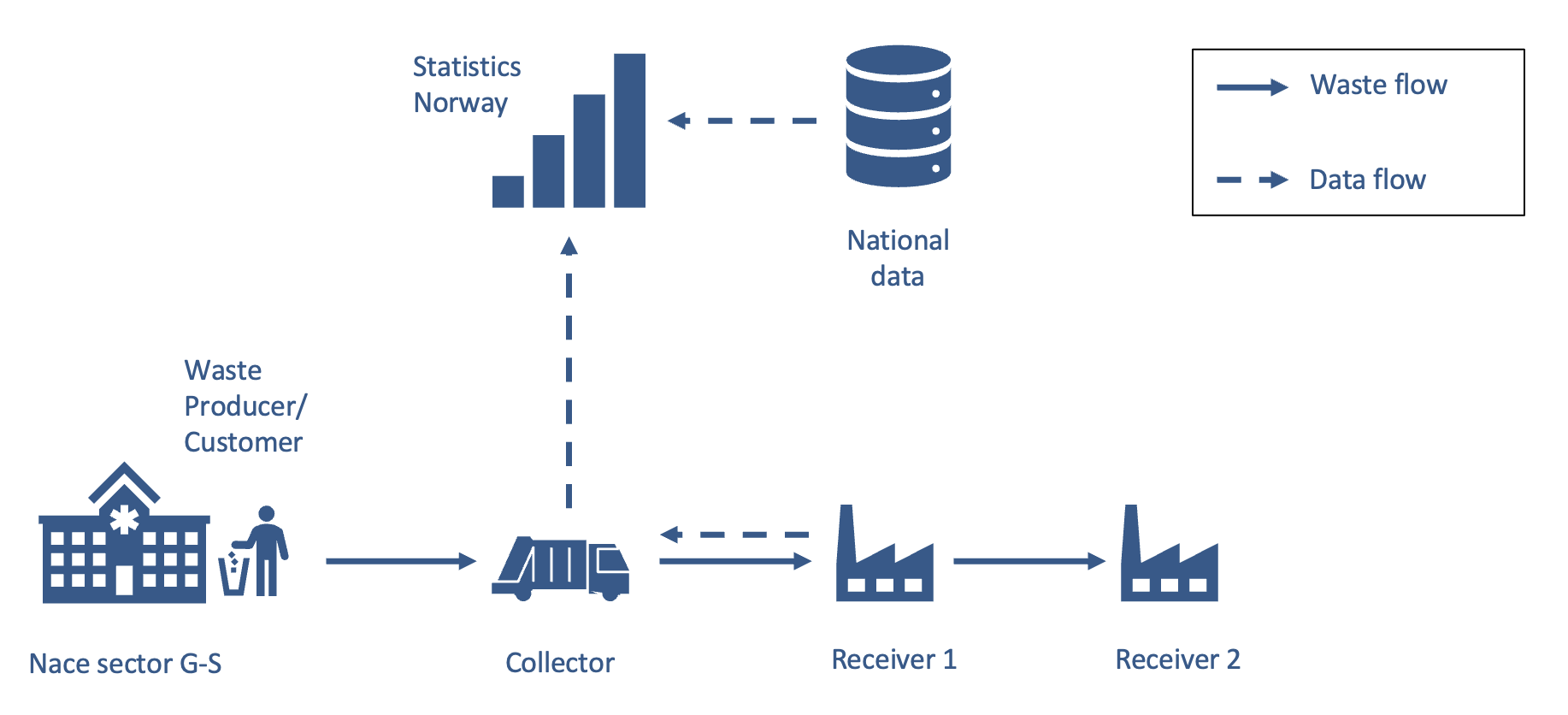
The amounts of municipal waste from other sources (services, industry and businesses) are based on data reported by the waste collectors on their customers from the NACE-sectors (G (46 and 47), and H–S). The data consists of collected waste amounts per customer and their customer lists containing data on the number of employees. The reporting is a yearly survey among a selection of the customers. Statistics Norway performs a representative selection of services and businesses for which the waste collectors report the waste. The resulting data set is not a full count, but it is statistically representative. To calculate the national amounts, the waste per employee is calculated, and the generated amounts are scaled up by the number of employees within each NACE-sector on a national level, see Figure C2.
The data from the NACE-sectors G–S is also used for reference to calculate the share MW from the NACE-sectors B–F, which is included in the MW from other sources. This calculation is also done by scaling up the waste per employee by the total number of employees in the respective sector. Only non-production waste is included in these MW calculations.
Figure C2: Illustration of the waste flow from services and businesses (other sources) and the data flow regarding the waste collected. Note: The data is collected by the Statistics Norway through surveys based on a representative selection of services and businesses within the NACE-sectors G–S.
The delimitation of MW from the total amounts of waste from other sources is done by Statistics Norway in multiple steps. Initially the relevant materials and waste categories are selected based on the waste collectors reporting. Statistics Norway uses the same procedures as the municipalities regarding translation from national waste codes to MW both concerning waste types and treatment options. Then, as for the household waste, the building and construction waste and the transportation packaging are calculated and subtracted.
Since Norway includes waste similar to household waste from the NACE-sectors B–S, this would include waste from some large commerce. Even though there is no clear definition of what large commerce is, some of the enterprises from the B and C sectors would probably sort under this category. As described in Chapter 1 of the report the share of MW from other sources is high in the reported waste. The selection of which NACE codes to include in the scaling of the number may be one explanation for this, given the assumption that the amount of MW from other sources is over estimated.
C.6 The Norwegian Approach to the EU Methodology on Recycling
Collected waste is reported according to the type of material and designated treatment process. The recycled quantities are derived from the reported amounts of waste collected for recycling, composting, or digestion. To be able to report the recycled amounts, both shares of non-MW as C&D waste and transport packaging and process losses need to be removed. This is done by two correction factors (k_{CD} and ALR ) established for the different materials individually according to the following equation:
The non-household waste is subtracted and kept out of the reporting and the losses are redistributed between incineration and landfill, depending on the loss content and treatment process for it.
This calculation is performed separately for household waste and MW from other sources separately.
The average loss rates have been developed, based on information from the treatment facilities regarding amounts, waste quality, treatment processes and results. The resulting loss rates are the weighted average based on the total amounts treated at the respective facilities. The correction factor regarding C&D-waste and transport packaging are as mentioned earlier based on waste composition analyses.
- The Statistics Norway collects raw data on household waste and other sources, which include the type of materials and intended treatment methods
- The data is adjusted to correctly identify MW. Non-MW, losses from treatment procedures, and non-target material are calculated and subtracted using waste composition analyses and average loss rates
- The data undergoes the following correction steps before it is ready for Eurostat reporting:
- Non-MW is removed based on waste analysis
- Average loss rates are used to calculate the amounts undergoing recycling, composting, and digestion, which are based on treatment facility information
- Packaging treatment results reported by PROs are used to calculate packaging waste losses.
- Bottles collected through the pledge bottle-scheme are added to the other waste before reporting, as it is not included in the reporting from the waste collectors
- NGOs collect textile treatment data, which replaces the data originating from municipalities and other sources and reported to Statistics Norway
- The same average loss rates are applied to exported waste as for the waste treated in Norway.
- Average loss rates do not apply to mixed waste and other waste. The share of the mixed waste, ending up in the bottom ash (except for the metals sorted out), is subtracted from the incinerated and added to the landfilled for reporting
- The category “Other treatment” differs from the “Other recovery” category in the Joint Questionnaire. Assessments are made when preparing the data for Eurostat reporting to correctly categorize relevant treatments respective to the materials.