8. Challenges and Risks
This section outlines the challenges and risks associated with the report's recommendations, focusing on critical areas for further investigation and mitigation. While this report does not detail national differences, it highlights apparent gaps and provides a foundation for further analysis.
In the end of this section, a “Risk Matrix” is presented to help manage, evaluate and prioritize the risks identified, based on their probability (the likelihood that the risk will occur) and the estimated impact (the expected magnitude of the consequence if the risk occurs). The matrix serves as a guide to prioritize and address critical risks affecting the implementation of the recommendations, regarding efficient exchange of climate data for businesses to calculate their climate footprint (cf. the objective of the project).
8.1 The respective challenges and risks:
This section will examine the potential difficulties, risks, and obstacles that may arise in implementing the recommendations. Each sub-section addresses a recommendation, alongside associated challenges and risks. These recommendations are based on the project teams’ discussions and should be considered an initial reflection that can serve as the foundation for further specific and detailed analysis or mitigation planning.
8.1.1 Lack of resources to deliver on required information:
Description of recommendation: The report recommends that all businesses, regardless of size, should be able to utilize eDocuments and the current digital setup.
Challenge: Suppliers, especially small organizations, might lack the necessary skills, tools, and knowledge to obtain the requested information, particularly with the new datapoints recommended for implementation in the eDocuments, to support CSRD reporting needs.
Risk 1: Organizations unable to obtain and deliver on the requested data may result in the following consequences:
- Lose competitive ground – market share decline.
- Increased market prices, as there can be fewer suppliers to select from, who is able to deliver “favorable” products with the data needed to compliment the eDocuments. Hence, supply of “favorable” products in the market can decline and if demand remains the same it can create bottlenecks in the supply chain for the “favorable” suppliers.
8.1.2 Limited adoption of eCatalogue
Description of recommendation: The report recommends making use of the eDocuments and the current digital setups, to facilitate the exchange of product and climate data between companies (cf. the TO-BE and integration section).
Challenges: Currently, eDocuments are used differently across countries. For example, Norway uses eCatalogues to a greater extent than Denmark, Sweden, Finland, and Iceland. Consequently, countries not utilizing eCatalogues may not experience the same benefits as Norwegian businesses or have access to the same amount of data, as eCatalogues often provide a better foundation for more detailed information on products.
Risk 2: Limited adoption of eCatalogues could lead to disparities in the level of information available for businesses, such as product information needed for climate and CSRD reporting.
8.1.3 Adoption of Peppol and interoperability with non-Peppol systems.
Description of recommendation: The report recommends utilizing the Peppol Network/Framework to facilitate the secure and standardized electronic exchange of product and ESG information, through relevant eDocuments.
Challenges: Some actors and key stakeholders are unfamiliar with the Peppol Framework hence, not all companies may be ready to adopt the Peppol Network, as they e.g. are using other similar, but different frameworks. Some of the frameworks in place, used to facilitate the electronic exchange in the different countries, are not directly compatible or not comparable with the Peppol Network/Framework.
Risk 3: The challenges above can lead to a slow adoption by some actors, as some stakeholders may resist the change, resulting in delays (lack of buy-in among stakeholder), errors and inconsistencies in data formats.
8.1.4 Cost barriers
Description of recommendation: The recommended datapoints in this report are developed and recommended to be implemented in the current digital setup, to support the reporting needs of companies. However, the recommendation of these datapoints relies on Peppol and CEF eDelivery, being used to facilitate the electronic exchange of these datapoints.
Challenges: Stakeholders’ current digital setups not relying on the Peppol Framework, can be met by barriers, such as cost-barriers. For example, the need to use third-party service providers to do the necessary implementation, adjustments or integrations to current setups, can be expensive.
Risk 4: Cost barriers may discourage SMEs from adopting Peppol, exacerbating market inequalities and therefore increase the risks in 8.1.1.
8.1.5 Non-standardized approaches to calculating emission factors.
Description of recommendation: The “The Green Datapoints” section, recommends implementing 3 datapoints, under the datapoint-group “Emission Factors”, which intends to support the companies in exchanging emissions factors and relevant information related to them.
Challenges: While multiple methods like GHG Protocol standards exist, no common standard for calculating emission factors has been established.
Risk 5: As there are no common approach to calculate emission factors, a risk can occur, in terms of unreliable or incomparable data, due to the use of different methodologies. It may therefore be difficult to compare emissions internally and across businesses and industries, with high accuracy.
8.1.6 Futureproofing and scalability
Description of recommendation: Through the report, it has been recommended to use the current digital setup, CEF eDelivery infrastructure, together with Peppol, as they are designed to be scalable.
Challenges: Frequent updates to Peppol are essential to accommodate the rapid evolving ESG reporting requirements. However, implementing new datapoints in the Peppol Network is a time-consuming process, that often takes at least a year.
Risk 6: Assuming that Peppol does not evolve fast enough to meet the requirements from regulations and companies, the use of the Peppol framework becomes redundant, as it would create gaps in the reporting needs, making the exchange of product and climate data less efficient.
8.1.7 Change management with regards to adopt new datapoints:
Description of recommendation: The report introduces and recommends 5 additional, new datapoints, which are not directly included in the Peppol framework or eDocuments, to be implemented in the respective eDocuments, to support the reporting needs of scope 3, category 1.
Challenges: Introducing new datapoints in eDocuments may face stakeholder resistance, as the suppliers might not be in possession of the relevant data or find it time-consuming to fill in the data in e.g. the eCatalogue. Especially for companies with limited resources, such as SME’s. Furthermore, many stakeholders have limited experience with this type of data, making them unsure whether the datapoints are accurate, precise and filled in correctly. This challenge is supported by investigations and reports that the participating agencies have created with specialists and advisors.
Risk 7: Resistance from stakeholders in adopting and reporting on the new datapoints could result in non-compliance for reporting companies, as they would be unable to include the relevant emission data from these stakeholders.
8.2 Other initiatives and reflections
This section considers other initiatives, which can affect the ability to succeed with the recommendations put forth in this project.
8.2.1 Digital Product Passport
Description of recommendation: The European Union has started to implement a new regulation requiring nearly all products sold in the EU to feature a Digital Product Passport (DPP) (European Union, 2024). The DPP is designed to close the gap between consumer demands for transparency and the current lack of reliable product data (European data , 2024).
Challenges: DPP shall provide comprehensive information about each product’s origin, materials, climate impact, and disposal recommendations which would replace the need for the recommendations made in this project. However, the widespread implementation of the DPP is faced with the same (as well as other) challenges outlined in this project. For this reason, it is sensible to consider the coupling between these initiatives.
Risk 8: Adopting the recommendations outlined in this report and adding changes to e.g. existing infrastructure and digital setups can become obsolete, due to the requirements of DPP.
Reflections: DPP will be rolled out in phases where the first product (batteries) is expected to be ready in 2027 (implementation time is not included) and additional industries and products are then to follow (Faraca, et al., 2024). Other categories will be implemented in 2030’s. Thus, making the DPP a non-viable solution in the foreseeable future. Sustainability reporting regulations will be effective before DPP and not all products or companies will be affected. Nonetheless, companies will have the need to find the necessary data to input into their DPP. In relation to this, the solutions (recommendations) described in this report, will prepare companies for both finding and handling the necessary data to include in the DPP. Companies who adapt and adopt these solutions suggested in the report will therefore be better equipped to meet the requirements of DPP.
8.3 Risk Matrix – Evaluation of Risks to Recommendations
This section evaluates risks related to the proposed recommendations. Each risk was scored from 1 to 5 based on its likelihood and anticipated impact on the project’s success and future work. All risks are referred to as “Risk #” and referred to as “R#” in figure 12. Furthermore, as illustrated in figure 12, the risk assessment scores, for all countries included in this project, are represented as: NO/IC = Norway and Iceland, DK = Denmark, FIN = Finland, and SE = Sweden.
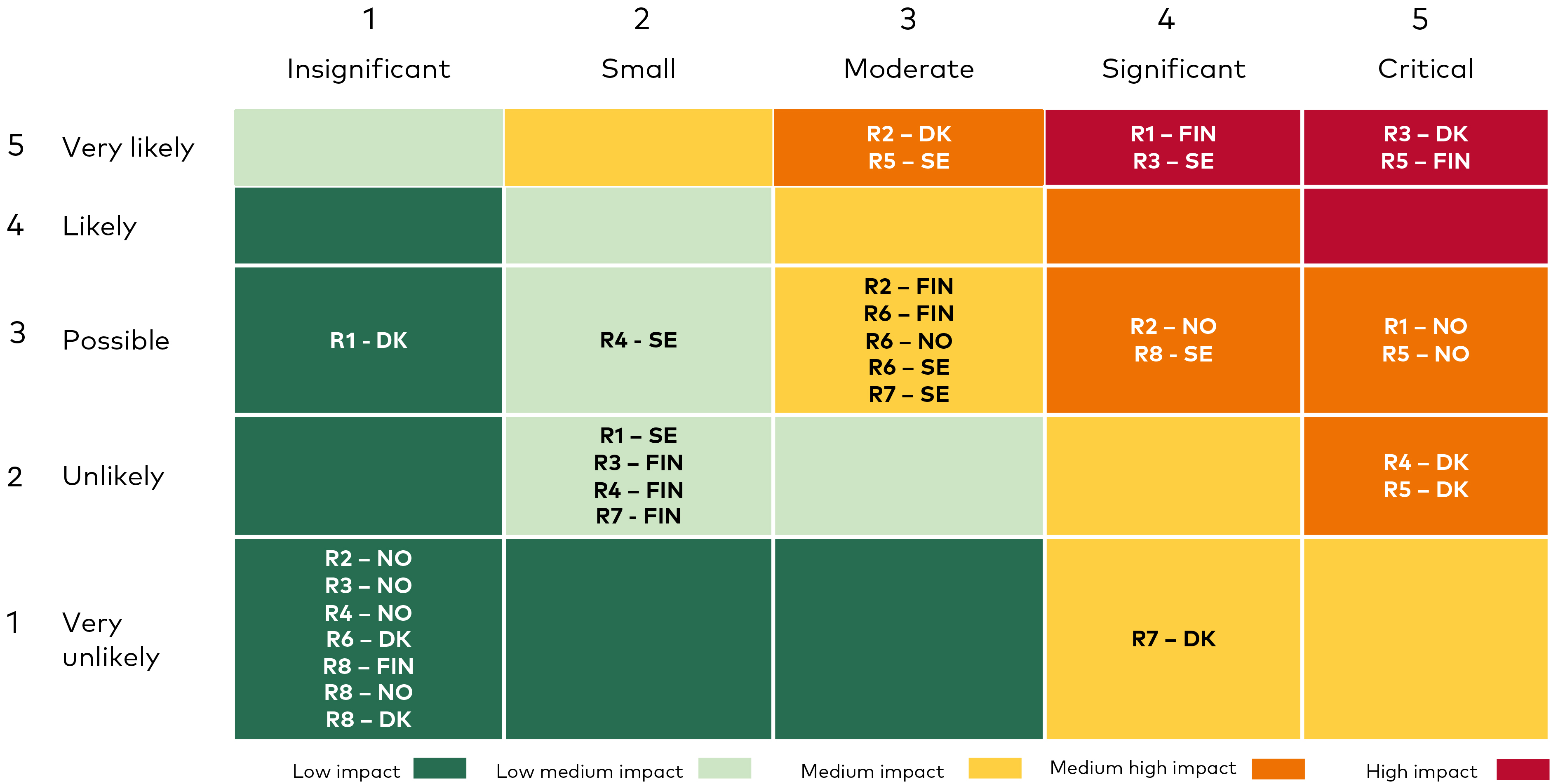
Risks rated with low to low-medium impact should be monitored, but require no immediate action. Risks rated as medium to medium-high impact should be monitored and addressed if necessary. High-impact risks, which could significantly affect the outcomes of this project and objectives, must be considered as important risks to be mitigated. Therefore, the following sub-sections focus exclusively on high-impact risks for each country and general mitigation considerations. The mitigation considerations stem from joint exercises and discussions with all eDocument experts during Workshop 3. Sub-section 8.3.1 adressess risks at a country-specific level due to significant variations in the assessments across countries.
8.3.1 Country specific scoring – top 3 and bottom 3:
The following sections 8.3.1. will outline the scorings considered as the 3 most critical risks assessed by the eDocument experts, on a country-specific level. Detailed country risk assessments are available in appendix 5.
Risk | Finland | Risk | Norway & Iceland | Risks | Sweden | Risks | Denmark |
Risk 5 | 25 | Risk 5 | 15 | Risk 3 | 20 | Risk 3 | 25 |
Risk 1 | 20 | Risk 1 | 15 | Risk 5 | 15 | Risk 2 | 15 |
Risk 6 | 9 | Risk 9 | 9 | Risk 2 | 12 | Risk 5 | 10 |
Top 3 Critical Risks | |||||||
8.3.1.1 Top 3 “Critical Risks” Identified per Country:
Finland:
In a Finnish context, Risk 5 “Non-standardized approaches to calculating emission factors” and Risk 1 “Lack of resources to deliver on required information” were considered high-impact risks, with scores of 25 and 20, respectively. The scoring of Risk 5 suggests that Finland views the non-common or non-standardized approach to calculating emission factors as potentially having critical consequences for climate data reporting. This could lead to difficulties and inaccuracies when comparing emissions internally, across businesses and industries. Regarding Risk 1, Finland believes that making the datapoints mandatory within the eDocuments could disrupt the market, particularly by creating unequal opportunities for companies with limited resources, such as SMEs. General considerations for mitigation strategies of how to address and mitigate these risks can be found in section 8.3.2. Risk 2 “Limited adoption of eCatalogue” was considered as a medium-impact risk. This suggests that Finland sees the limited adoption of eCatalogues as a concern but not as an immediate priority. Therefore, this risk should be monitored on a regular basis but only addressed if found necessary.
In a Finnish context, Risk 5 “Non-standardized approaches to calculating emission factors” and Risk 1 “Lack of resources to deliver on required information” were considered high-impact risks, with scores of 25 and 20, respectively. The scoring of Risk 5 suggests that Finland views the non-common or non-standardized approach to calculating emission factors as potentially having critical consequences for climate data reporting. This could lead to difficulties and inaccuracies when comparing emissions internally, across businesses and industries. Regarding Risk 1, Finland believes that making the datapoints mandatory within the eDocuments could disrupt the market, particularly by creating unequal opportunities for companies with limited resources, such as SMEs. General considerations for mitigation strategies of how to address and mitigate these risks can be found in section 8.3.2. Risk 2 “Limited adoption of eCatalogue” was considered as a medium-impact risk. This suggests that Finland sees the limited adoption of eCatalogues as a concern but not as an immediate priority. Therefore, this risk should be monitored on a regular basis but only addressed if found necessary.
Sweden:
In a Swedish context, Risk 3 “Adoption of Peppol and interoperability with non-Peppol systems” was considered a high-impact risk, with a scoring of 20. This suggest that Sweden considers the utilization and implementation of the Peppol framework across businesses to be a significant risk, as there must likely will be resistance in adopting the Peppol framework from various countries and stakeholders. However, Risk 5 “Non-standardized approaches to calculating emission factors” and Risk 2 “Limited adoption of eCatalogue” were considered as medium-high-impacts risks, with scores of 15 and 12, respectively. For Risk 5, this indicates that Sweden considers the risk of a non-common or non-standardized approach to calculating emission factors to be less significant and less prioritized compared to Finland’s assessment of this specific risk. Indicating that this risk shouldn’t be the priority for mitigation in Sweden, but rather monitored closely. Regarding Risk 2, Sweden considers the limited adoption of eCatalogues across countries a potential risk, though not significant enough to warrant immediate action to ensure the widespread adoption of this eDocument. This assessment aligns closely with Finland's evaluation of Risk 2.
In a Swedish context, Risk 3 “Adoption of Peppol and interoperability with non-Peppol systems” was considered a high-impact risk, with a scoring of 20. This suggest that Sweden considers the utilization and implementation of the Peppol framework across businesses to be a significant risk, as there must likely will be resistance in adopting the Peppol framework from various countries and stakeholders. However, Risk 5 “Non-standardized approaches to calculating emission factors” and Risk 2 “Limited adoption of eCatalogue” were considered as medium-high-impacts risks, with scores of 15 and 12, respectively. For Risk 5, this indicates that Sweden considers the risk of a non-common or non-standardized approach to calculating emission factors to be less significant and less prioritized compared to Finland’s assessment of this specific risk. Indicating that this risk shouldn’t be the priority for mitigation in Sweden, but rather monitored closely. Regarding Risk 2, Sweden considers the limited adoption of eCatalogues across countries a potential risk, though not significant enough to warrant immediate action to ensure the widespread adoption of this eDocument. This assessment aligns closely with Finland's evaluation of Risk 2.
Norway & Iceland:
In the Norwegian and Icelandic contexts, no risks were identified as high-impact risks. However, Risk 5 “Non-standardized approaches to calculating emission factors” and Risk 1 “Lack of resources to deliver on required information” were both considered to have a medium high impact, each with a score of 15. This suggests that both Norway and Iceland perceive some potential risks regarding a non-standardized approach to calculating emission factors and the adoption of the recommended datapoints in eDocuments, particularly if those datapoints were to become mandatory. As a result, they do not view these risks as requiring immediate mitigation but rather as issues to be monitored and addressed if necessary. Risk 6 “Futureproofing and scalability” with a score of 9, indicates that Norway and Iceland view it as a moderate concern regarding Peppol’s ability to support ESG reporting needs.
In the Norwegian and Icelandic contexts, no risks were identified as high-impact risks. However, Risk 5 “Non-standardized approaches to calculating emission factors” and Risk 1 “Lack of resources to deliver on required information” were both considered to have a medium high impact, each with a score of 15. This suggests that both Norway and Iceland perceive some potential risks regarding a non-standardized approach to calculating emission factors and the adoption of the recommended datapoints in eDocuments, particularly if those datapoints were to become mandatory. As a result, they do not view these risks as requiring immediate mitigation but rather as issues to be monitored and addressed if necessary. Risk 6 “Futureproofing and scalability” with a score of 9, indicates that Norway and Iceland view it as a moderate concern regarding Peppol’s ability to support ESG reporting needs.
Denmark:
In the Danish context, Risk 3 “Adoption of Peppol and interoperability with non-Peppol systems” was considered a high-impact risk, with a score of 25. This scoring suggests that Denmark, similar to Sweden, views the integration with and implementation of the Peppol framework across businesses as critical. It indicates a high likelihood of businesses not adopting the recommended framework in a cross-country context, having severe consequences for data exchange across borders. This may result in inconsistent data formats and impose additional manual work for businesses using different framework and standards. Risk 2 “Limited adoption of eCatalogue” and Risk 5 “Non-standardized approaches to calculating emission factors” are considered a medium-high-impact risk, with scores of 15 and 10, respectively. For Risk 2, Denmark, like Sweden, sees the adoption of the eCatalogue as a likely but moderately impactful risk for market inequality. Additionally, for Risk 5, Denmark considers the risk of a non-standardized approach to calculating emission factors to be unlikely to occur. However, if it does occur, it will have critical consequences for businesses' climate reporting, particularly in terms of losing credibility in the reported CO2e figures. Nonetheless, Risk 2 and Risk 5 should be monitored closely and addressed if necessary.
In the Danish context, Risk 3 “Adoption of Peppol and interoperability with non-Peppol systems” was considered a high-impact risk, with a score of 25. This scoring suggests that Denmark, similar to Sweden, views the integration with and implementation of the Peppol framework across businesses as critical. It indicates a high likelihood of businesses not adopting the recommended framework in a cross-country context, having severe consequences for data exchange across borders. This may result in inconsistent data formats and impose additional manual work for businesses using different framework and standards. Risk 2 “Limited adoption of eCatalogue” and Risk 5 “Non-standardized approaches to calculating emission factors” are considered a medium-high-impact risk, with scores of 15 and 10, respectively. For Risk 2, Denmark, like Sweden, sees the adoption of the eCatalogue as a likely but moderately impactful risk for market inequality. Additionally, for Risk 5, Denmark considers the risk of a non-standardized approach to calculating emission factors to be unlikely to occur. However, if it does occur, it will have critical consequences for businesses' climate reporting, particularly in terms of losing credibility in the reported CO2e figures. Nonetheless, Risk 2 and Risk 5 should be monitored closely and addressed if necessary.
8.3.1.2 General mitigation considerations
Considering the top three high-impact risks, only three stand out: Risk 1, scored 20 by Finland, Risk 3, scored 20 by Sweden and 25 by Denmark and Risk 5, scored 25 by Finland. These are the risks that require most significant mitigation to succeed with the implementation of the recommendations. Norway and Iceland have not considered any of the identified risks as having a high impact, which indicates a high level of confidence in successfully implementing the recommendations. The differences in the perceived levels of impact can be attributed to varying levels of maturity in digitization, adoption of eDocuments, local regulations and other operational conditions across the Nordic countries. Considering the objective of this report - to reduce administrative burdens related to exchanging and reporting climate data - the high-impact risks should be mitigated to reduce the burdens for SMEs. This should be done not only to ensure the recommendations are implemented effectively but also to avoid placing additional burdens on companies during the implementation process.
General mitigation considerations:
As part of the workshops, the representatives were tasked with discussing various approaches and considerations to mitigate the identified risks. The input collected can provide general insights and serve as input for detailed mitigation strategies and plans for both national and Nordic levels. In the below, the countries’ reflections are summarized.
General mitigation considerations:
As part of the workshops, the representatives were tasked with discussing various approaches and considerations to mitigate the identified risks. The input collected can provide general insights and serve as input for detailed mitigation strategies and plans for both national and Nordic levels. In the below, the countries’ reflections are summarized.
In general, representatives from the countries should consider continuing the initiated work and elaborate further on the reflections and leverage these to develop mitigation strategies that address risks on a cross-border level. Joint mitigation strategies will enhance the implementation, streamline processes, reduce complexity, and lower costs of the recommendations. The varying risk scores indicate a need for a harmonized Nordic risk assessment framework. A shared Nordic framework would enhance consistency and alignment across the countries. In relation to the high impact risks addressed in this section, the general considerations and high-level suggestions from the groups are:
- To make the adoption of the new datapoints (identified in this initiative) voluntary.
- To take other, open and free standards, into consideration apart from the Peppol Framework.
- To develop a Nordic standard or agree at a Nordic level on which standard/methodology should be utilized to establish a standardized approach for calculating Life Cycle Assessments and Emission Factors.