Chapter 4. The impacts of offshore wind farms on ecosystems
Summary
The push for diverse energy sources is expanding offshore wind farms, impacting marine ecosystems. Understanding these impacts is key to balancing wind energy benefits with biodiversity risks. This study reviews 129 publications on offshore wind farm ecological impacts, mainly in the northeast Atlantic. The most reported pressure was the introduction of new underwater habitats, but the effects reported were diverse and evenly distributed between negative and positive impacts. Consistent negative impacts were however reported for seabirds and cetaceans during both operational and installation phases. Only a third of potential ecosystem interactions were studied. Least studied were impacts from cable installation, maintenance, and decommissioning. To complement our review of offshore wind farms' environmental impacts, we conducted a parallel systematic review on their socio-economic impacts on Scandinavian coastal communities. While some evidence exists from other regions, focusing mainly on business development and national industrial policy, empirical research in this area is lagging, hindering evidence-based decision-making for planners, managers, and policymakers.
Background: the status of offshore wind farms
Wind energy growth has been rapid, both in terms of technology and real-world generation and capacity, with the EU generating ~272 GW of energy from wind in 2023 (WindEurope, 2024). While this growth has been predominantly brought about by land-based installations, off-shore wind has started to play a role and is expected to contribute to half of new installations by 2030 (GWEC, 2024).
While moving large wind energy installations offshore can reduce their impact on local communities (Ladenburg and Dubgaard, 2009; Staupe-Delgado and Coombes, 2020), their interactions with the environment remain. Such interactions have been studied, case-by-case in various contexts and with specific focus on individual parts of the marine ecosystem, or on certain activities associated with the installation or operation of offshore wind infrastructure. For example, marine mammals displaced by noise (Madsen et al., 2006), changes in fish behaviour in response to foundations (Wahlberg and Westerberg, 2005) and potential collision risks for seabirds (Lieske et al., 2019). However, the ad-hoc nature of the empirical investigations, and how sporadically they are cited, does not provide a clear overview of the various interactions that offshore wind farms have with the marine environment, writ large.
Having a clear understanding of the interactions of offshore wind energy infrastructure with the environment, is critical for planners, consenting managers and policymakers, so that negative impacts can be minimised, while maximising the contributions of offshore wind energy to achieving climate goals.
The aim, therefore, of this chapter is to systematically review and synthesise evidence from primary literature on the various interactions between human activities associated with offshore wind energy production and components of the ecosystem.
Methods
The systematic review was conducted according to the PRISMA approach for Ecology and Evolution (O-Dea et al., 2021). In this framework, biases and subjectivity are minimised by defining research questions, search scope, exclusion parameters, data to be extracted, and analytical methods prior to beginning the work. The review built upon an earlier review by Galparsoro et al. (2022), by utilising the same search terms, but by extending the time series of the data to include the most recent evidence. Furthermore, this review retained only articles that included novel empirical data (excluding theoretical models, mechanistic models and reviews), so that the meta-analyses are undertaken only on observed phenomena, without double counting of observations.
Data extraction included bibliographic information, context specific information about the wind farm, activity information about the operations exerting pressures, taxonomic information about the impacted species, and information about the activity-pressure-ecosystem component-response chain of relationships.
The meta-analyses, considered the quality of the evidence, the direction of interaction (positive, negative, or ambiguous relationships), and the amount of evidence (where individual articles could contribute more than one case), while also measuring the level of agreement/disagreement, in the literature. These different aspects of the evidence were combined to produce an “impact matrix”, whereby categories of human activities associated with wind farm operation are matched with the various ecosystem component categories. For each combination of activity/pressure and ecosystem component where evidence is found, an “impact score” is derived which reflects the direction of the impact and the certainty of these interactions, from the literature.
Key Findings
Literature review
We rejected 43% of records that were included in the previous review by Galparsoro et al. (2022), resulting in 91 articles being retained for the current review. From our update search, we identified 1458 records from multiple databases for the period from the fourth quarter of 2020 (end of previous review) to the first quarter of 2024. Deduplicating records resulted in 1032 unique articles, of which we excluded 947 based on titles and abstracts matching one or more of our pre-determined exclusion criteria. A further 47 articles were excluded after considering the full-texts, which resulted in a combined number of 129 articles being retained for data extraction from the previous review and the update search.
Overview of the evidence
Three quarters of the literature retained came from the North-East Atlantic. The vast majority of the remaining literature was based on experiments, and not of real installations (18% of total), while relatively few articles focussed on offshore wind installations from the Northwest Pacific and Northwest Atlantic (6% and 2%, respectively). Studies from the North-East Atlantic were distributed across the United Kingdom, Germany, Belgium, Denmark, and the Netherlands (Figure 1). There were a significant number of articles investigating cross-border impacts in the North and Baltic Seas, with only one article from each of Ireland and Sweden.
Within these articles, we identified 194 unique cases of relationships between human activities, pressures, and ecosystem components (Figure 4.2). The majority of activities associated with offshore wind farms were documented to create multiple pressures. The presence of foundations had the most diverse set of pressures, including the introduction of novel habitat, which was the most prevalent pressure studied and was most often investigated in relation to impacts on fish and benthos. The pressure of displacement was linked to the broadest set of activities, but the majority of studies considered this in the context of seabirds interacting with above water components. The pressure of Noise was studied in relation to a broad set of ecosystem components, however, nearly half of all investigations into noise were focused on Cetaceans.
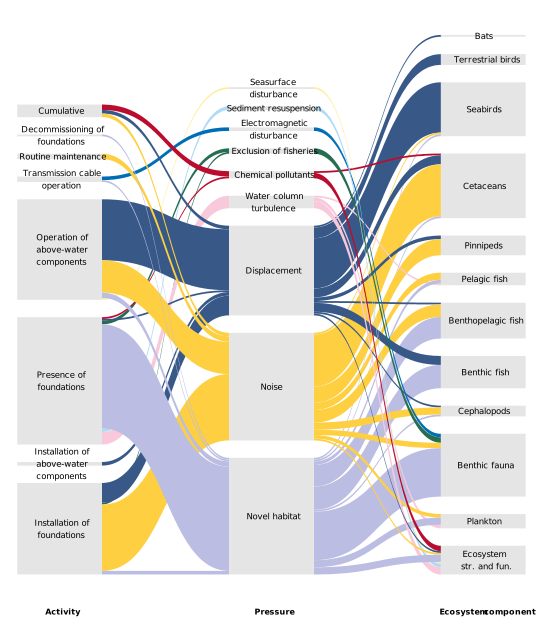
Impacts from the installation of transmission cables, or from decommissioning of above water components were not documented in the literature, indicating potential knowledge gaps.
Twelve different ecosystem components were identified from the literature (Figure 4.3). It is notable that the impact on reptiles as a group was not studied at all, probably due to the geographic bias of both installations and the studies of their impacts to higher latitudes.
Meta analyses
Our meta-analyses provide an overview of scientific consensus based only on empirical evidence. Interactions with large (including largely negative) impact scores highlight strong, generalisable relationships, that can be assumed to hold across different contexts. For example, the activity of installing foundations was consistently found to negatively impact cetaceans (Figure 4.4), while the pressure of displacement negatively impacting seabirds was also reported consistently in the literature (Figure 4.5).
Where these impact scores reduce, or become closer to zero, they indicate that the relationship they represent is context dependent. This may be because the score is based on only a few cases of evidence, and thus impacts may vary if studied under different contexts, or because the larger number of cases have a large diversity of outcomes. For example, the pressure of sea-surface disturbance impacting on ecosystem structure and functioning (only an individual case) (Figure 4.5), or the presence of foundations having an ambiguous impact on benthic fish, despite a relatively large number of cases (Figure 4.4).
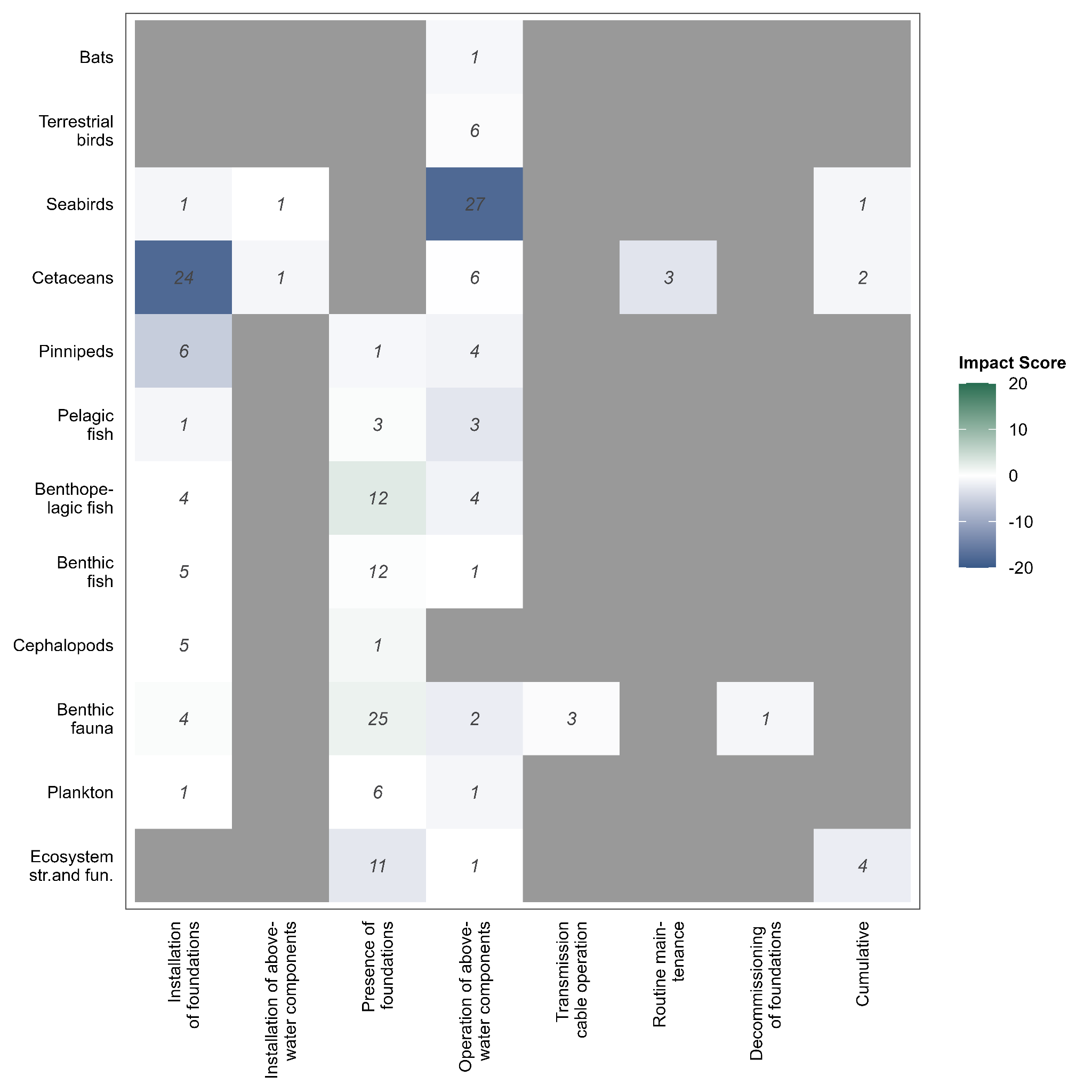
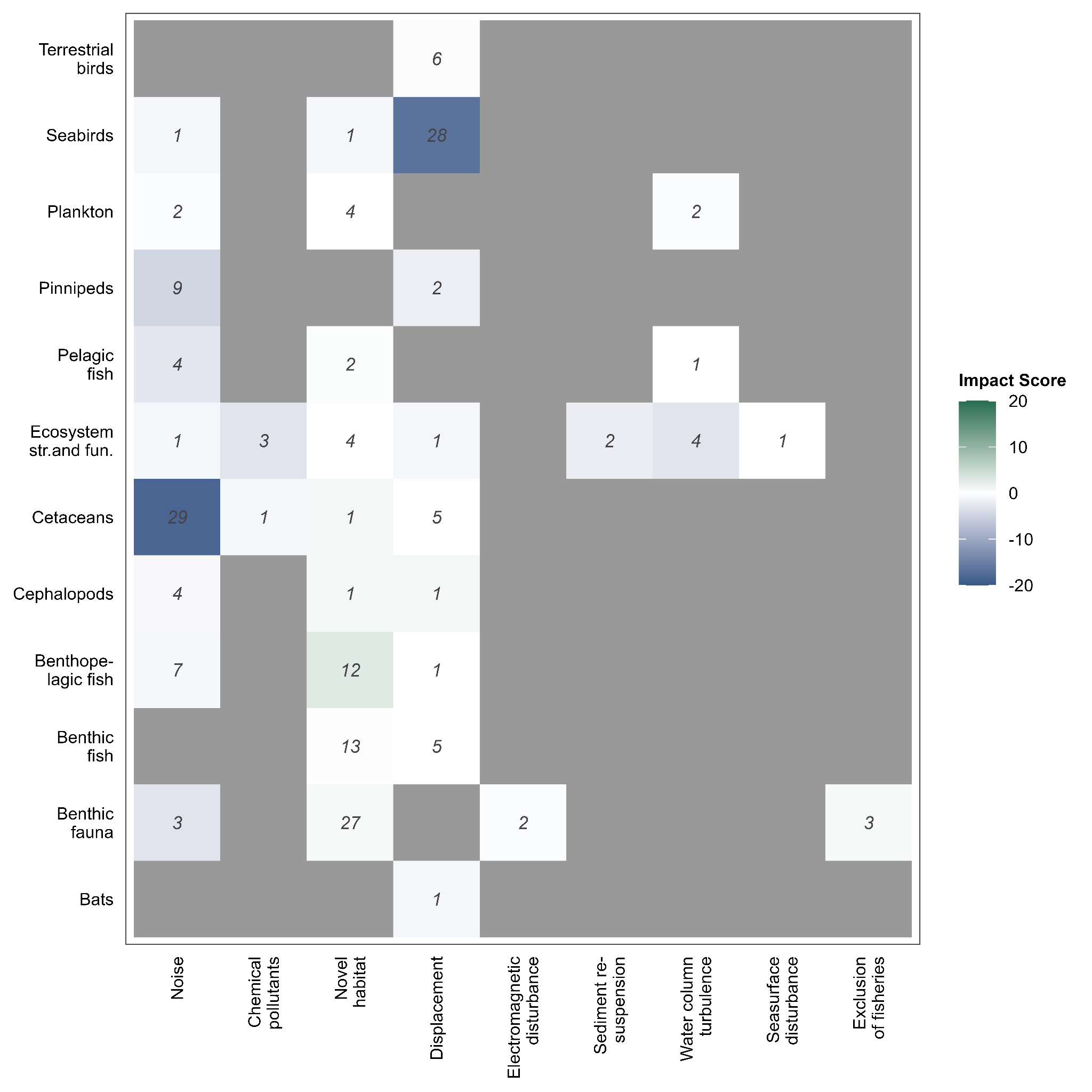
These matrices, therefore, are an up-to-date decision supporting tool for planners, managers and policy makers, where strong impact scores indicate generalised interactions that can be expected across various contexts, where low scores indicate weak evidence that is likely to be context dependent and require project specific consideration, and empty scores that indicate that novel research must be undertaken.
Complimentary review of impacts on coastal communities
To supplement the review of offshore wind farms’ impacts on the environment, we undertook a parallel systematic review. Following the same methodology as described above, but with a focus on the question of what socio-economic impacts offshore wind farms have on coastal communities in Scandinavian contexts.
Our literature review covered all published primary literature up to the end of November 2024, catalogued in SCOPUS. Our search returned 107 records. Screening of titles and abstracts excluded 92 records, retaining only 15 for full-text investigation. At the full-text screening stage, a further 14 articles were excluded and only one article was retained. The majority of articles were rejected because they were not attempting to document socio-economic impacts on coastal communities (66) or they were not investigating the impacts from the offshore wind industry (13). Where some articles described good metrics of socio-economic impacts from offshore wind industries, they were primarily focussed on prospective projects or theoretical impacts (8); for example, peoples’ willingness to pay to have a theoretical near-shore wind farm installed further offshore. We excluded seven articles as review articles, not contributing novel empirical data, most of which were opinion or perspectives papers.
The retained article (Ladenburg & Dubgaard, 2009), was itself a marginal case for retention, as their empirical evidence was based on a survey of the general populace about the placement of a theoretical wind farm. However, this was retained as the survey took account of respondent’s previous exposure to real-world installations, and undertook analyses to investigate how these experiences shaped their perspectives on the presence of offshore wind farms. As only one article was retained, we direct you to read this paper specifically for more information on citizen’s willingness to pay for distributing wind farms further offshore, with lower visual impact.
This absence of published empirical research on the impacts of the offshore wind industry on coastal communities, in Scandinavian contexts, is a gap in knowledge that hinders planners’, managers’, and policy makers’ abilities to make evidence-based decisions. While evidence exists from other geographic and cultural contexts (see Serpa et al., 2025), most socio-economic studies remain focussed on business development and national level industrial policy.
Recommendations
Our matrices of impact scores provide a synthesis of empirically based knowledge that can be used to inform decision making in the permitting, planning, and monitoring of offshore wind projects. Decision makers can couple these activity/pressure impacts with local environmental objectives, while considering the trade-offs that offshore wind development can bring to decarbonisation of energy production.
Where our matrices indicate low scores, decision makers can make use of our published database to compare their specific case to the contexts in which impacts have been investigated. In these circumstances, the incongruity in the literature may be overcome by excluding empirical evidence that is clearly derived from different contexts. For example, wind farms installed on offshore sand banks, vs near shore rocky archipelagos.
As offshore wind infrastructure becomes more rapidly deployed, there exists more and novel opportunities to undertake more research and monitoring projects to fill in the large gaps in our knowledge. Offshore wind permitting authorities should engage with research funding bodies (public and private), to couple research and monitoring requirements to appropriate research funding to facilitate this work. Establishing such projects must be done years in advance of project commencement, to ensure that appropriate experimental designs can be implemented (Before-After-Control-Impact, BACI).
Common practice in offshore wind infrastructure deployments include Environmental Impact Assessments. These assessments include pre-surveys, and subsequent follow-up surveys. Access to the findings of such EIA’s would greatly improve the knowledge available to meta-analyses, such as those we have undertaken here. Access to the actual survey and monitoring data would enable even richer forms of meta-analyses, opening up much more definite conclusions about magnitudes of impact that are not currently possible. Permitting and monitoring authorities should endeavour to make existing and future EIA reports and data available to relevant research projects to gain insights from these potentially rich sources of knowledge.
Finally, empirical studies of socio-economic impacts on coastal communities need to be undertaken in various Scandinavian contexts, to investigate the costs and benefits, and mechanisms to overcome or maximise them for regional development. Scandinavia provides diverse examples of industry transition (e.g. oil & gas, fisheries, or shipbuilding) towards offshore wind industry.
References
Galparsoro, I., Menchaca, I., Garmendia, J.M. et al. (2022). Reviewing the ecological impacts of offshore wind farms. npj Ocean Sustain, vol. 1, issue 1, https://doi.org/10.1038/s44183-022-00003-5
GWEC (2024). Global offshore wind report 2024, Brussels: Global Wind Energy Council. GOWR-2024_digital_final_v2.pdf (gwec.net) [26-09-24]
Ladenburg, J., & Dubgaard, A. (2009). Preferences of coastal zone user groups regarding the siting of offshore wind farms. Ocean & Coastal Management, 52(5), 233-242. https://doi.org/10.1016/j.ocecoaman.2009.02.002
Lieske, D. J., McFarlane Tranquilla, L., Ronconi, R., Abbot, S. (2019). Synthesizing expert opinion to assess the at-sea risks to seabirds in western North Atlantic. Biological Conservation, vol. 233, pp. 41-50, DOI link: https://doi.org/10.1016/j.biocon.2019.02.026
Madsen, P. T., Wahlberg, M., Tougaard, J., Lucke, K., Tyack, P. (2006). Wind turbine underwater noise and marine mammals: implications of current knowledge and data needs. Marine Ecology Progress Series, vol. 309, pp. 279-295, DOI: 10.3354/meps309279
O'Dea RE, Lagisz M, Jennions MD, Koricheva J, Noble DW, Parker TH, Gurevitch J, Page MJ, Stewart G, Moher D, Nakagawa S. Preferred reporting items for systematic reviews and meta-analyses in ecology and evolutionary biology: a PRISMA extension. Biol Rev 2021;96(5):1695-1722. doi: 10.1111/brv.12721
Serpa, S., Costa, J. G., Simão, J., Xu, H. T., & Soares, C. G. (2024). Review on the social and economic impacts of the offshore wind farms. In Innovations in Renewable Energies Offshore (pp. 721-730). CRC Press.
Staupe-Delgado, R., & Coombes, P. R. (2020). Life in anticipation of wind power development: Three cases from coastal Norway. Sustainability, 12(24), 10666. https://doi.org/10.3390/su122410666
Wahlberg, M. and Westerberg, H. (2005). Hearing in fish and their reactions to sounds from offshore wind farms, vol. 288, pp. 295-309, DOI: 10.3354/meps288295
WindEurope (2024). Wind energy in Europe – 2023 Statistics and the outlook for 2024-2030, Brussel: WindEurope. WindEurope - Wind energy in Europe - 2023.pdf [26-09-2024]