Chapter 1. Population structure and connectivity among marine populations in the Skagerrak
Summary
Most species in the Skagerrak have populations that are genetically distinct from populations in the surrounding North Sea, Kattegat, and Baltic Sea. A considerable number of these species also have multiple distinct populations within the Skagerrak, particularly along the coast and inside fjords. Highly mobile fish species, such as cod, herring and bluefin tuna, have multiple distinct populations that temporarily coexist in the Skagerrak during specific parts of the year, or during certain parts of their life cycle. Overall, the Skagerrak is well connected with adjacent seas through passive dispersal of eggs and larvae and active migration of adults. The persistence of distinct local populations despite the large potential for connectivity calls for population-specific conservation and management of marine biodiversity in the Skagerrak. Management, while maintaining an overall ecosystem approach, needs to be species- and population-specific to avoid neglecting or overexploiting vulnerable local populations.
Background
Biodiversity loss is an ongoing crisis that negatively impacts both global and local ecosystems (Cardinale et al., 2012). The currently elevated extinction rate for wild species is often referred to as “the sixth mass extinction” (Cowie et al., 2022) and is caused by various anthropogenic pressures, such as climate change, habitat fragmentation, and overexploitation of wild populations (Pievani 2014). The loss of species is likely preceded by losses of intraspecific diversity (Ceballos et al., 2017), and it has consequently been argued that the population, rather than the species, is the relevant unit for conservation (Allendorf et al., 2022). The UN CBD Kunming Montreal Biodiversity Framework specifically states maintenance of genetic biodiversity as equally important to species and ecosystem diversity. Failure to correctly identify genetic population structure and connectivity in the marine environment can result in the isolation and disappearance of vulnerable and threatened local populations, as well as the overharvesting of depleted fish stocks (Bekkevold et al., 2023). We here summarise biological knowledge on connectivity and population structure in marine species in the Skagerrak – a marginal sea in the northeast Atlantic. The results are of fundamental relevance for both local and regional management, especially in assigning management units, and designing MPA networks. Due to the extensive research performed in this area, we also discuss how conclusions from the Skagerrak may be transferable to other geographic areas.
Definitions
Population structure is the tendency of species to separate into more or less distinct spawning groups or populations. Such populations will independently evolve and maintain genetic differences and adaptations, unless there is genetic connectivity between them.
Connectivity is the passive or active dispersal of individuals – eggs, larvae, spores, seeds, swimming adults, etc. – from one location or population to another. If some individuals reproduce in the new location, this leads to genetic connectivity (gene flow), important for evolution and local adaptation. If the dispersal affects numbers and biomass in the receiving population there is demographic connectivity, important for ecological interactions and fisheries management.
Methods
We performed a systematic literature search for studies on connectivity and population structure in the Skagerrak on the Web of Science database on the 3rd of May 2023. The full list of publications was screened according to a set of five exclusion criteria. Publications were excluded if they A) had a non-marine context; B) were not in the Skagerrak; C) did not investigate connectivity of any marine species; D) were a review, meta-analysis, short-format, or non-peer-reviewed article; or E) were inaccessible.
The systematic literature search yielded a list of 413 unique scientific publications. Out of these, 113 (27 %) were eligible for review. Most excluded publications were so based on thematic irrelevance, i.e., not explicitly assessing connectivity in marine species (exclusion criterion C; 58 %). We supplemented the list of 113 publications by manually adding 59 relevant publications that the authors were aware of, or that were cited in reviewed publications. Thus, after screening, a total of 172 scientific publications, assessing population structure and connectivity in 48 marine species, both within the Skagerrak and in relation to the adjacent North Sea, Kattegat and Baltic Sea and published between 1990 and 2023 were included in the review. Publications were divided amongst the authors, who extracted information on the study design and methodology, and summarised the relevant results. Population structure was assessed primarily using molecular genetic tools, but also with morphometry and chemical isotope analyses. Connectivity was assessed either by studies of tagged individuals or by oceanographic modelling of propagule dispersal. The scientific literature was strongly dominated by fish species, particularly cod and herring.
Key findings
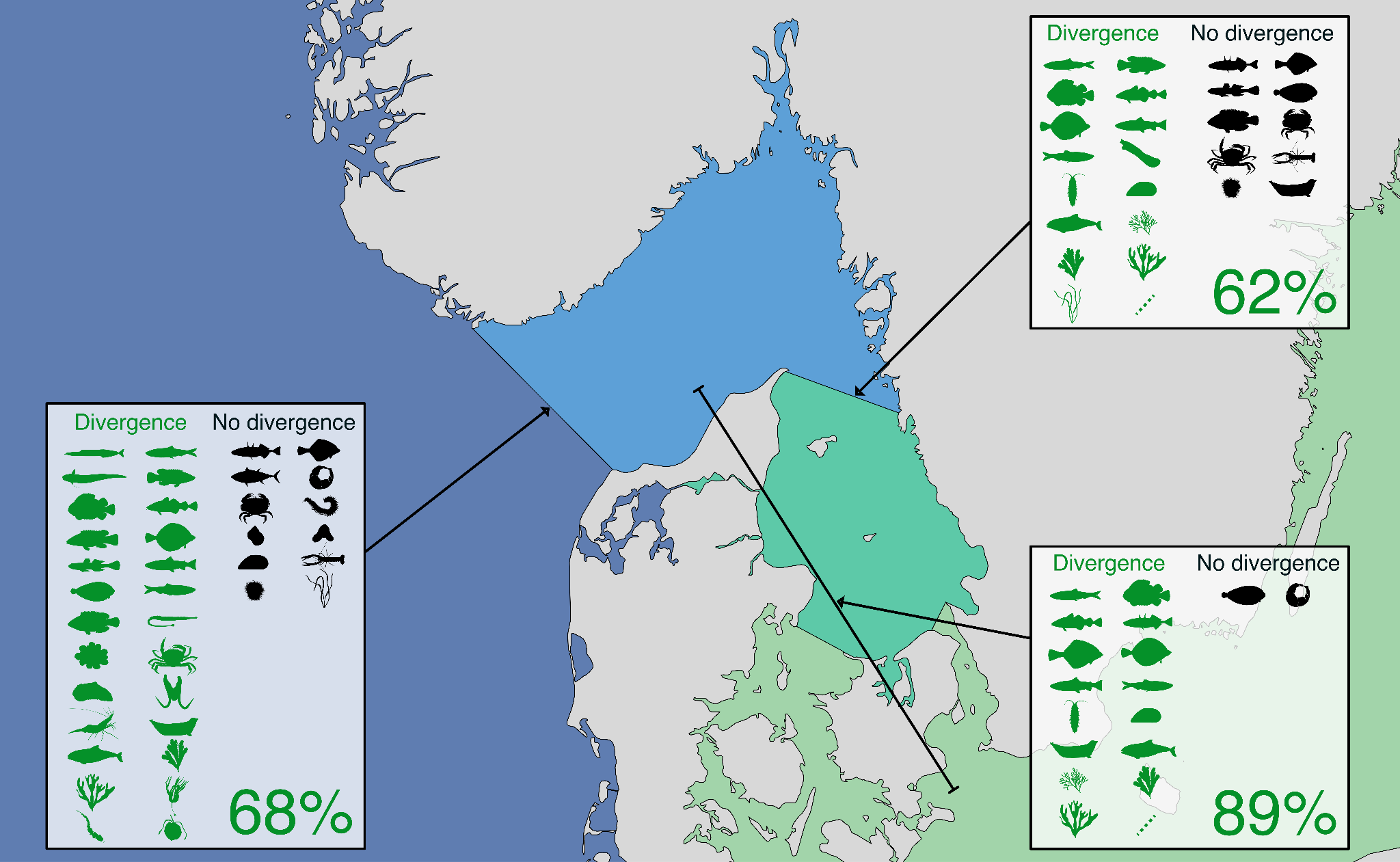
The Skagerrak harbours distinct populations for the majority of species. For these species, there are clear genetic and/or morphological differences between Skagerrak populations and populations in at least one of the adjacent seas (Figure 1.1). In some of those species, including herring, lumpfish, cod, plaice, sea trout, harbour porpoise, bladderwrack and toothed wrack, the Skagerrak populations are divergent from populations in both the North Sea and the Kattegat. Several species share a genetic barrier on the south-western tip of Norway, between the Skagerrak and the North Sea, and also in the south, between the Skagerrak and Kattegat. For a few species no population structure was detected in the North Sea-Skagerrak-Kattegat area: three-spined stickleback, European flounder, brown crab, Norway lobster, and green sea urchin.
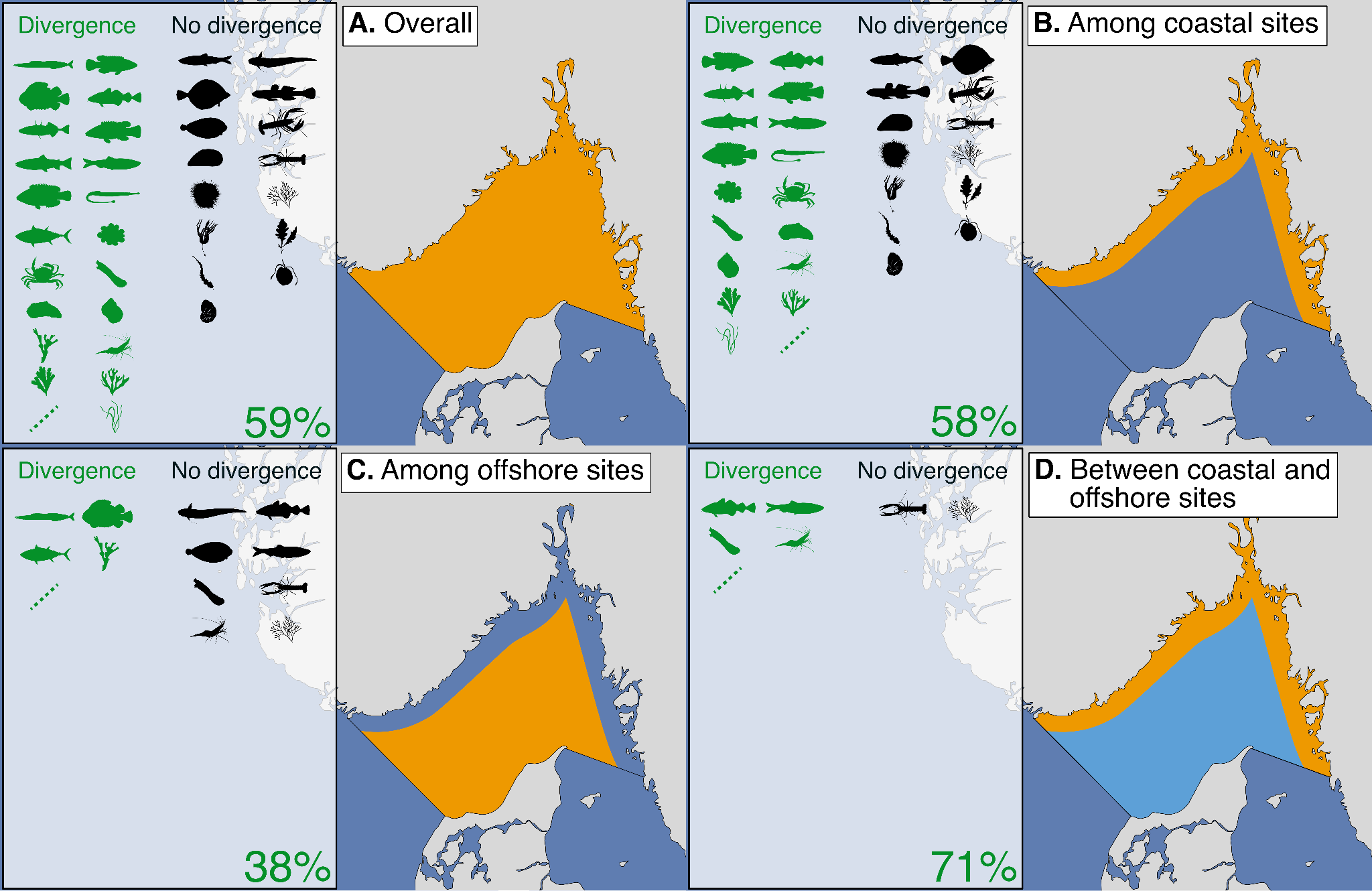
More than half of the assessed species also have multiple distinct populations within the Skagerrak (Figure 1.2A). Population structure is most common among coastal sites (Figure 1.2B), and between coastal and offshore populations (Figure 1.2C). Population structure is rare in offshore areas, and has only been described for lumpfish, Atlantic bluefin tuna, the cold-water coral Lophelia pertusa and the phytoplankton Skeletonema marinoi (Figure 1.2D).
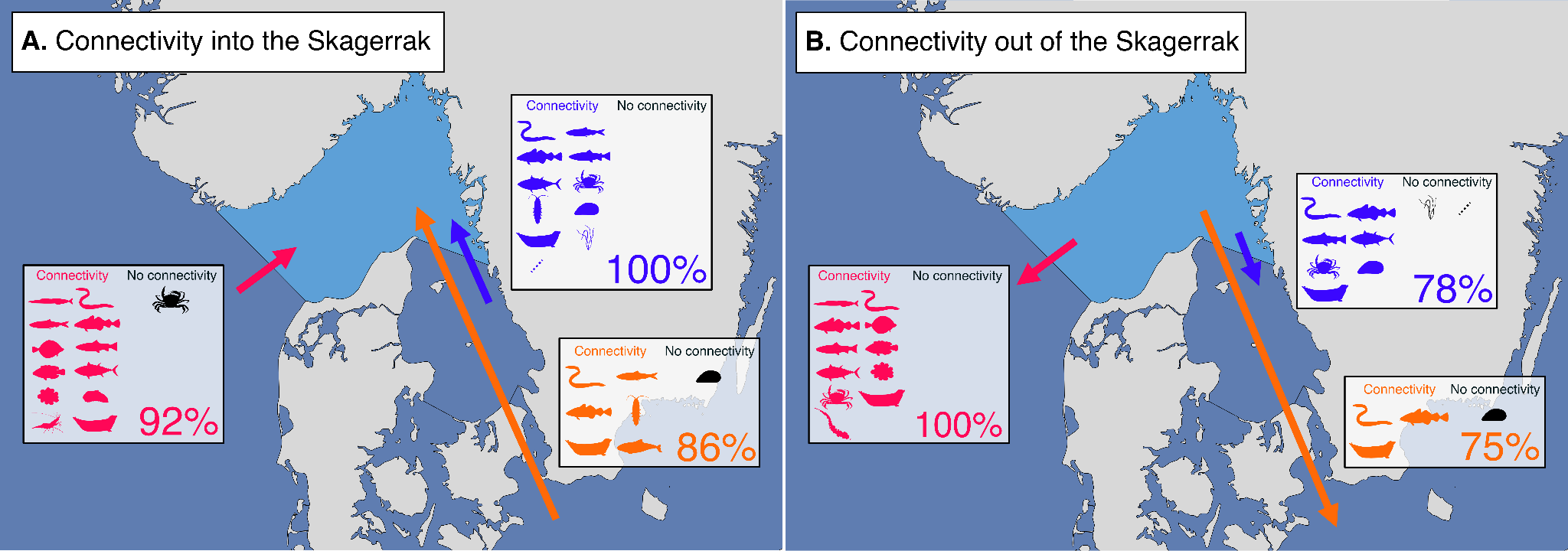
Skagerrak populations generally have the potential to disperse to the adjacent North Sea, Kattegat, and Baltic Sea. Dispersal of organisms, i.e. connectivity, into the Skagerrak from adjacent seas is high in most assessed species (Figure 1.3A), whereas connectivity out of the Skagerrak is high to the North Sea for all assessed species, but slightly lower southward into the Kattegat and the Baltic Sea (Figure 1.3B). Dispersal distances within the Skagerrak are highly species-specific and may range from a few to hundreds of kilometres, meaning that management needs to be species-specific.
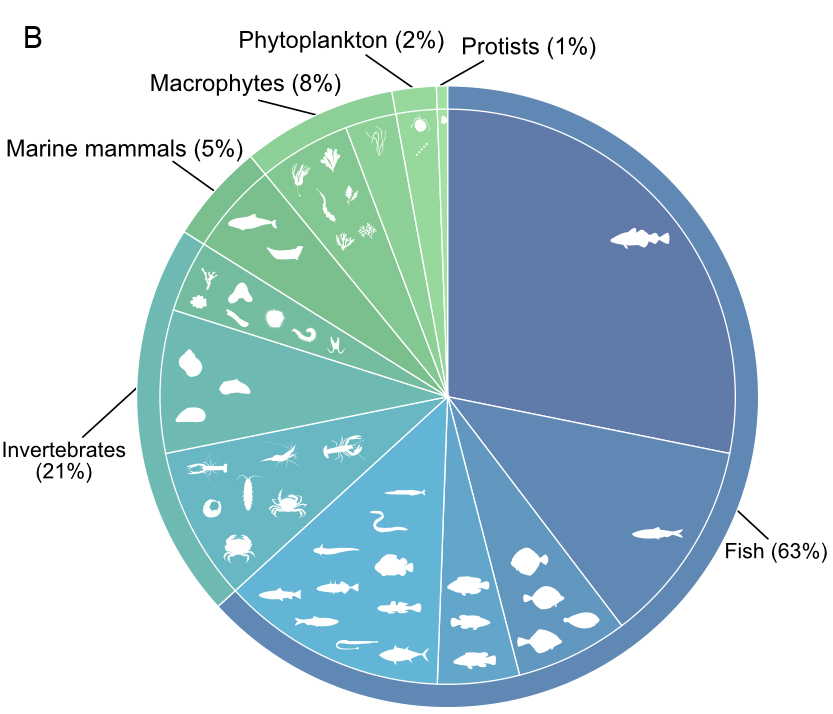
Population structure and connectivity are receiving increasingly more attention within both research and management. Currently, approximately ten scientific publications covering the Skagerak are published every year on these topics (Figure 1.4A). The reviewed scientific literature covers 48 Skagerrak species. However, the literature is dominated by studies on fish species (63% of studies), especially cod and herring (Figure 1.4B).
Perspectives and conclusion
By reviewing the available scientific literature, we show that a majority of species have populations inhabiting the Skagerrak that are genetically and/or morphologically distinct from surrounding populations in the North Sea, Kattegat, and Baltic Sea. Additionally, many species also have several distinct populations within the Skagerrak. Despite this, functional connectivity on the large scale is high in most species, meaning individuals from several populations may coexist in certain areas during parts of the year, especially in highly mobile taxa such as the more mobile fish species. Working according to this connectivity “rule book” is likely essential to achieving sustainable management of intraspecific biodiversity in the Skagerrak. However, with these findings come considerable challenges. The high contemporary connectivity with adjacent seas on the large scale supports the notion of the Skagerrak as a transition zone between the North Sea and the Baltic Sea. Multiple species have populations dispersing in and out of the Skagerrak at different times. Management of marine populations in the area, thus, cannot view the Skagerrak as an entirely isolated system, but needs to take large-scale connectivity into consideration. As shown herein, however, the Skagerrak itself is not homogeneous. Most species have multiple differentiated populations, particularly along the coast, which are unique to the Skagerrak. Management of such species should be on a much finer geographic scale than the entire Skagerrak to preserve unique populations – often on the scale of 10s of kilometres, or of individual fjords. The Skagerrak is, thus, more than just a transition zone – it is also a unique marginal sea requiring special attention from management, to preserve both coastal and offshore populations.
For many of the fish species, particularly those displaying larger movement, there is also temporal variability in population assemblages. The sympatry of multiple populations within a species in a given area poses a significant challenge for spatial methods used to delineate management units. Management of these species should establish practices suitable for mixed-stock management. For instance, in mixed-stock fisheries, the relative proportions in catches over time should be monitored, for instance using population genetic tools, with management decisions taken expediently according to the relative population sizes. Management, thus, needs to be both temporal and spatial. Adding to this point, the fields of connectivity and population structure are growing, gaining more research attention and more utility in legislation. With this development, we are gaining increasingly detailed knowledge, as well as improved taxonomic and geographic representation at both large and small scales. Consequently, management strategies need to be both spatiotemporally sensitive, and flexible enough to adapt to new scientific findings. For instance, management programs for monitoring genetic diversity (e.g., Mastretta-Yanes et al., 2024), and real-time genetic monitoring of fisheries catches (e.g., Dahle et al., 2018) have been suggested to improve management practices, by enabling agile management in response to updated information on intraspecific diversity and connectivity. Incorporating these monitoring tools in management would also aid in the estimation of population sizes, fundamental to analyses of demographic connectivity, which are lacking in this region.
Conservation management efforts have the highest probability of success when they are supported by scientific information on e.g. vulnerability, diversity, location, and connectivity of ecotypes, populations and species (van Oppen & Coleman, 2022). The finding of differentiated populations despite high functional connectivity, although counterintuitive, is not specific to the Skagerrak. Differentiated but sympatric populations are found in marine species in many other regions around the world, running the same risks of mismanagement unless accounted for (e.g., Le Moan et al., 2016; Moore et al., 2021; Diaz-Arce et al., 2024). Therefore, we believe that the patterns inferred here, as well as our recommendations for management, are likely to be more broadly applicable also to other marine systems. In this review, we have described overarching patterns of connectivity and population structure in a marginal sea, enabling marine wildlife management to better account for, conserve, and restore biodiversity – on all levels.
Policy brief on spatial population structure and connectivity among marine populations in the Skagerrak
As part of the SAMSKAG project a policy brief was produced in which the concept of population connectivity was explained and the main findings also presented herein were summarised (André et al., 2024). The following recommendations for management were listed:
- Management of marine biodiversity in the Skagerrak needs to be based on knowledge about species population structure and connectivity.
- Management should be fine-scaled enough to capture population structure within the Skagerrak, often on the scale of 10s of km, especially along the coast and within fjords.
- Fisheries management, MPA design and marine spatial planning need to consider both coastal and offshore marine areas.
- Management needs to consider that different populations may coexist at certain times in a given area. This is especially relevant in fisheries management, when different stocks coexist, and where genetic mixed-stock analysis should be implemented to disentangle and estimate the proportions of the different stocks.
- More information on population structure and connectivity is needed, both for sessile and mobile species.
- Adaptive strategies that incorporate both spatial and temporal management are more likely to succeed in creating a robust and future-proof biodiversity management in the Skagerrak.
References
André, C., Henriksson, S., Jahnke, M., De Wit, P., Knutsen, H., Jorde, P.E., Søvik, G., Moland, E., Berkström, C. and van Deurs, M., 2024. Spatial population structure and connectivity among marine populations in the Skagerrak: implications for marine biodiversity conservation. Nordic Council of Ministers. Nord 2024:033. https://doi.org/10.6027/nord2024-033
Allendorf, F. W., Funk, W. C., Aitken, S. N., Byrne, M., Luikart, G. 2022. Conservation and the Genomics of Populations, 3rd edition. Oxford University Press, Oxford. 784pp.
Bekkevold, D., Berg, F., Polte, P., Bartolino, V., Ojaveer, H., Mosegaard, H., .. & Andersson, L. 2023. Mixed-stock analysis of Atlantic herring (Clupea harengus): a tool for identifying management units and complex migration dynamics. ICES Journal of Marine Science 80: 173-184. https://doi.org/10.1093/icesjms/fsac223
Cardinale, B., Duffy, J., Gonzalez, A. et al. 2012. Biodiversity loss and its impact on humanity. Nature 486:59–67. https://doi.org/10.1038/nature11148
Ceballos, G., Ehrlich, P.R., Dirzo, R. 2017. Biological annihilation via the ongoing sixth mass extinction signaled by vertebrate population losses and declines. Proceedings of the National Academy of Sciences U.S.A. 114: E6089-E6096, https://doi.org/10.1073/pnas.1704949114
Cowie, R.H., Bouchet, P. and Fontaine, B. 2022. The Sixth Mass Extinction: fact, fiction or speculation? Biological Reviews 97:640-663. https://doi.org/10.1111/brv.12816
Dahle, G., Johansen, T., Westgaard, J-I., Aglen, A., Glover, K.A. 2018. Genetic management of mixed-stock fisheries “real-time”: The case of the largest remaining cod fishery operating in the Atlantic in 2007–2017. Fisheries Research, 205: 77-85. https://doi.org/10.1016/j.fishres.2018.04.006
Díaz‐Arce, N., Gagnaire, P. A., Richardson, D. E., Walter III, J. F., Arnaud‐Haond, S., Fromentin, J. M., ... & Rodríguez‐Ezpeleta, N. 2024. Unidirectional trans‐Atlantic gene flow and a mixed spawning area shape the genetic connectivity of Atlantic bluefin tuna. Molecular Ecology 33:e17188. https://doi.org/10.1111/mec.17188
Le Moan, A., Gagnaire, P. A., & Bonhomme, F. 2016. Parallel genetic divergence among coastal–marine ecotype pairs of European anchovy explained by differential introgression after secondary contact. Molecular ecology 25: 3187-3202. https://doi.org/10.1111/mec.13627
Mastretta‐Yanes, A., da Silva, J. M., Grueber, C. E., Castillo‐Reina, L., Köppä, V., Forester, B. R., ... & Hoban, S. 2024. Multinational evaluation of genetic diversity indicators for the Kunming-Montreal Global Biodiversity Framework. Ecology Letters 27: e14461. https://doi.org/10.1111/ele.14461
Moore, J. W., Connors, B. M., & Hodgson, E. E. 2021. Conservation risks and portfolio effects in mixed‐stock fisheries. Fish and Fisheries 22:1024-1040. https://doi.org/10.1111/faf.12567
Pievani, T. 2014. The sixth mass extinction: Anthropocene and the human impact on biodiversity. Rendiconti Lincei 25:85–93. https://doi.org/10.1007/s12210-013-0258-9
van Oppen, M.J.H., Coleman, M.A. 2022. Advancing the protection of marine life through genomics. PLoS Biology 20:e3001801. https://doi.org/10.1371/journal.pbio.3001801