Why should businesses share data across the value chain?

Traditional business models in transition - there will not be sufficient material supply to meet demand in a cost effective and sustainable way
Humanity is consuming 60% more resources than Earth can sustainAccenture Research . This is bad behavior, but it is also bad business.
Accenture Research
Human consumption is growing at almost unprecedented rates, and we now consume twice as much as we did during the ‘Great Acceleration’ after World War II
Accenture Research
Accenture Research
We are facing high price volatility in raw materials, supply chain disruptions, and unmet market demand. Additionally, there is increased geographical instability, affecting our supply chains
WEF (2025), Global Risks Report 2025
Brookings (2022), A data-sharing approach for greater supply chain visibility
 | International Energy Agency (2022), Global EV Outlook 2022 | ||
 | WEF (2019), Many coffee species are threatened with extinction | ||
 | Accenture Research |
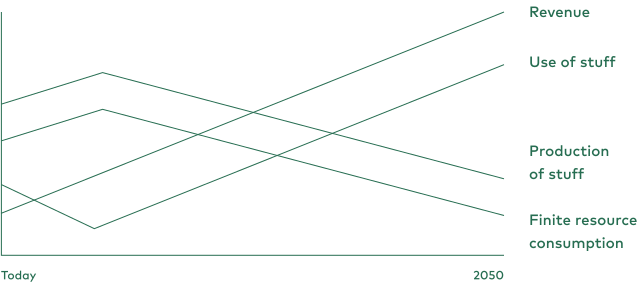
We need to redefine value creation, disconnecting it from consumption
To future-proof businesses, it is necessary to redefine value creation and disconnect it from consumption. This involves reconsidering traditional value chains and the methods used to deliver products and services. It involves adopting circular thinking.
In a circular economy, the money flows without the production of net-new products (and the baggage that comes with it). This approach allows us to meet people's needs using only 70% of the materials we currently useThis will not only drive sustainability impact but create business value.
Accenture Research
Value migration
e.g., $400B value migration driven by growth in alternative products and secondary markets
e.g., $400B value migration driven by growth in alternative products and secondary markets
Accenture (2020), The Circular Economy Handbook: Realising the Circular Advantage; Nordic Innovation & Accenture (2021), Nordic Circular Economy Playbook – Circular business models for the manufacturing industry
Alternative products (e.g. EVs in automotive) Alternative services (e.g., as-a-service offerings) Platforms (e.g., second-hand markets)

Accenture Research

Value addition
e.g., $500B value addition through lean design, sourcing circular materials, improved forecasting, and efficient production
e.g., $500B value addition through lean design, sourcing circular materials, improved forecasting, and efficient production
Accenture (2020), The Circular Economy Handbook: Realising the Circular Advantage; Nordic Innovation & Accenture (2021), Nordic Circular Economy Playbook – Circular business models for the manufacturing industry

Brand differentiation and market share Premium pricing in some industries Monetization of waste and by-products

Designing leaner products Sourcing non-virgin materials Improving forecasting to reduce unsold products Producing more efficiently
End-to-end visibility of value chains powered by collaboration on data is essential to drive systemic change and transformation
This new business reality requires end-to-end value chain visibility.
To enable a circular economy, we must first understand our value chains—and that requires collaboration on data. No company has full visibility across the lifecycle of materials, products, and impacts. By sharing data on material flows, product performance, and emissions, value chain partners can drive systemic progress together.
Regulators try to incentivize value chain collaboration, but proactive business engagement is needed to move the needle
European regulators are pushing for end-to-end visibility and data sharing. But it is not enough.
Sustainability cannot be achieved in silos, and European regulators are enforcing laws to ensure cross value chain cooperation and data sharing. These mandate companies to report ESG data, product lifecycle information, and traceability details based on supply chain data. As an example, ESPR's Digital Product Passport (DPP) is a digital identity card for products, tracking information from materials used to repairability at the end of use.
Achieving these disclosures is difficult – and impossible without value chain collaboration and data sharing. Yet collaboration is often hindered by competition, lack of standardized systems, and limited resources, making companies hesitant to share data. Companies must be proactive and facilitate the end-to-end transformation of the value chain—ensuring consistent implementation across the industry in the face of ever-evolving regulations.
European Commission | ||
The winners in this new reality are boundary-less enterprises, that collaborate across the value chain to optimize and grow their business
The value realization cannot be achieved by individual companies alone – a complete value chain reinvention and cross-company data sharing will be required.
Companies must move away from the "four walls mentality" that hinders both internal and external data collaboration, or they will fall behind those who embrace agility and ecosystem approaches
Accenture Research
Delivering on this potential requires a fundamental shift in mindset—moving from maximizing short-term profits to enhancing long-term value; and from relying solely on internal R&D to embracing open innovation and data sharing.
Ultimately, the boundaryless enterprise will outperform the rest—everyone has a piece of the puzzle, and progress depends on collaborating on data across the value chain.
“Circularity calls for a transformation that requires us to stop solving issues as isolated islands but partner up and embrace the challenges together.”
– Grundfos, Nordic Circular Accelerator participant
“Circularity calls for a transformation that requires us to stop solving issues as isolated islands but partner up and embrace the challenges together.”
– Grundfos, Nordic Circular Accelerator participant
Aspirational Case in Point
Kalundborg Symbiosis
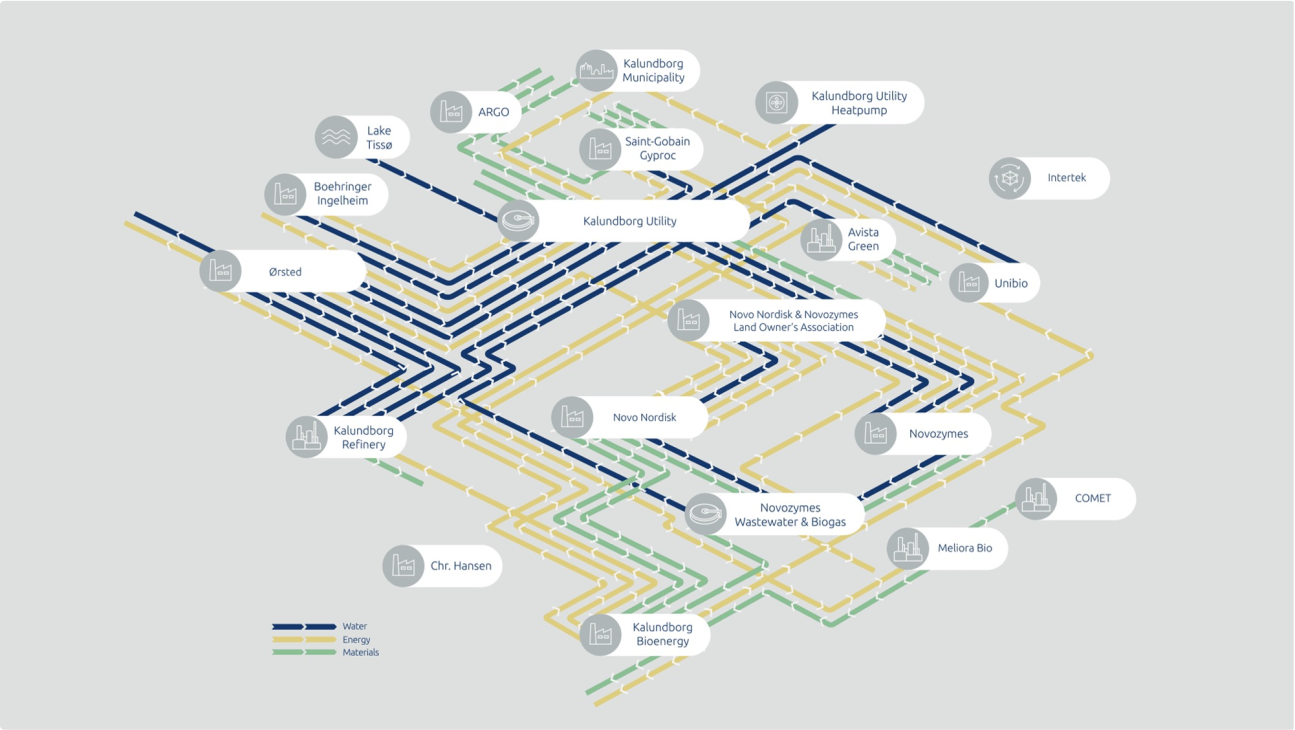

Kalundborg Symbiosis is an industrial symbiosis project located in Kalundborg, Denmark, and is the first industrial symbiosis in the world with a circular approach to production.
In a network of 17 companies, the residual flow in one company becomes a resource in another – benefiting both the environment and business financials.
The project aims to create a circular economy by leveraging data sharing to optimize resource utilization, reduce waste, and promote collaborative practices among participating industries.
Every year the symbiosis saves 4 million m³ ground water, 586.000 tons CO₂ and 62.000 tons of residual materials are recycled.
Kalundborg Symbiosis is an industrial symbiosis project located in Kalundborg, Denmark, and is the first industrial symbiosis in the world with a circular approach to production.
In a network of 17 companies, the residual flow in one company becomes a resource in another – benefiting both the environment and business financials.
The project aims to create a circular economy by leveraging data sharing to optimize resource utilization, reduce waste, and promote collaborative practices among participating industries.
Every year the symbiosis saves 4 million m³ ground water, 586.000 tons CO₂ and 62.000 tons of residual materials are recycled.

Successful corporations will not only comply with regulation, but unlock benefits from optimized operations and drive new growth
Organizations that embrace value chain data sharing unlock a spectrum of benefits depending on their ambition level and appetite for change.
By leveraging shared circularity data, businesses enhance transparency, optimize resource use, and build resilience in a rapidly evolving market.
At the foundational level, the key value driver is regulatory compliance. Aligning with global and local regulations through accurate data sharing helps mitigate risks, avoid fines, and build stakeholder trust.
As companies mature their circular data-sharing capabilities, operational efficiency becomes central. Access to real-time supply chain data enables waste reduction, better resource utilization, and agile decision-making.
At the highest ambition level, business growth is unlocked by using end-to-end data visibility to drive innovation, develop smarter and more sustainable products, and uncover new revenue opportunities.
 | ||||||||||
 Operational efficiency Optimize operations: Reduce waste and enhance efficiency Efficiency is the key to long-term profitability. By sharing and analyzing supply chain data, businesses can eliminate waste, optimize resource use, and enhance operational performance. Leveraging real-time data improves decision-making, drives agility, and strengthens resilience in a rapidly changing landscape. | ||||||||||
 Regulatory compliance Comply with regulations: Build license-to-operate Accurate data sharing ensures compliance, minimizes risk, and builds trust with regulators and stakeholders. By maintaining transparency and aligning with global and local regulations, businesses can reduce legal exposure, prevent disruptions, and establish a solid foundation for sustainable operations. | ||||||||||