What use cases for data sharing and what type of data to share?

Data sharing ecosystems should be created around use cases that drive impact across the value chain
A well-defined use case allows the data sharing ecosystem to work in a purposeful and focused manner, efficiently driving real impact and value.
Companies must identify value-driven use cases to guide them on who to include in the ecosystem, what data to share, and how to collaborate.
A use case is a systematic description of a situation in which a product or service is tested in practice and can help to understand the functional requirements
Sitra (2024), Data-driven competitiveness
A clear use case sets objectives, engages stakeholders by showing value, and ensures relevant data is shared.
This Playbook focuses on three circularity use cases:
The use cases were selected based on their widespread adoption in the Nordic region
Accenture Research

Digital Product Passports |  | |
 | ||
 | ||
 | ||
Resource Efficiency & Recovery |  | |
 | ||
 | ||
 | ||

Product Use Extension & As-a-Service Business Models |  | |
 | ||
 | ||
Each use case is enabled by cross-value chain data sharing and offers strong potential, while requiring collaboration to address key challenges
Each use case is enabled by cross-value chain data sharing and offers strong potential, while requiring collaboration to address key challenges
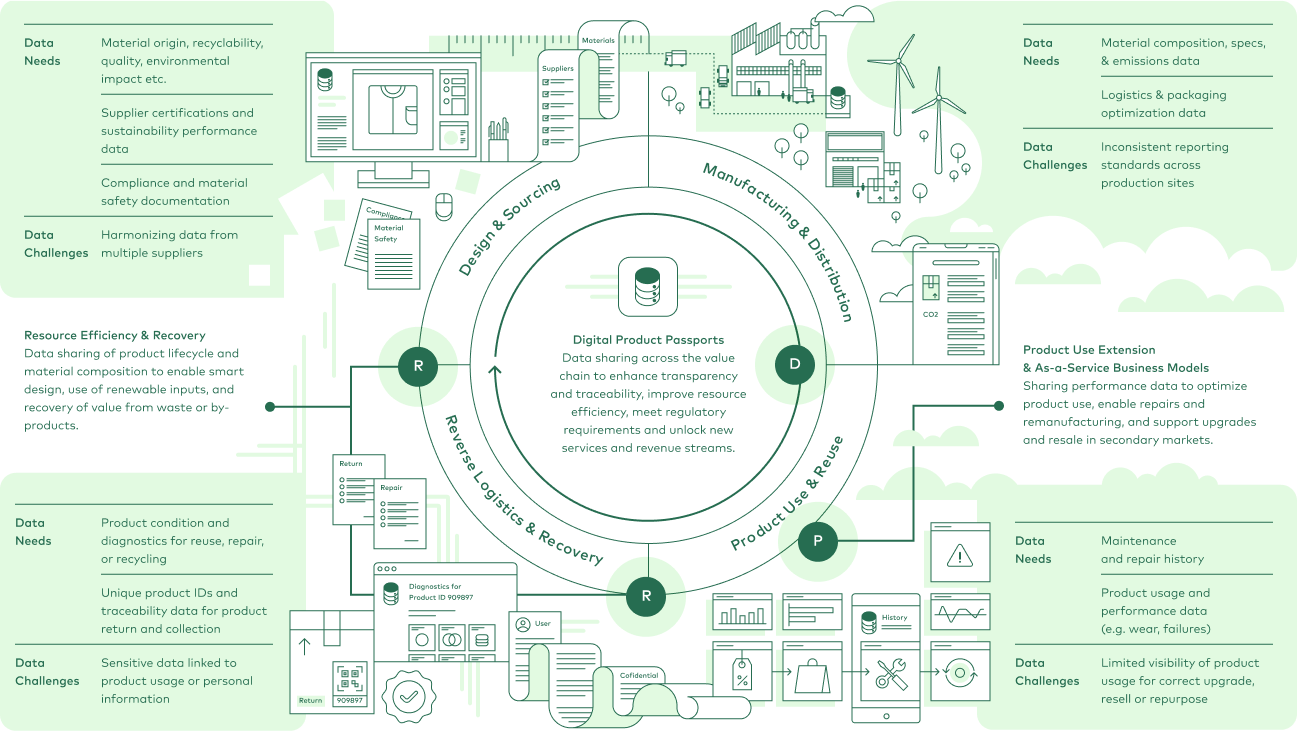
Digital Product Passports explained
Mandated by the EU Eco-design for Sustainable Products Regulation (ESPR), the Digital Product Passport (DPP) aims at providing a complete view of the product to ensure that:
Actors along the value chain can easily access product information relevant to them | |||
Facilitate the verification of product compliance by national authorities | |||
Improve the traceability of products along the value chain and facilitate resource efficiency | |||
DPPs can be introduced as 'Digital Product Labels’ – a consumer-facing version that highlights key sustainability information, helping guide purchasing decisions through greater transparency.
Typical ecosystem stakeholders
 | Supplier |  | Tech Provider |
 | Manufacturer |  | Reseller |
 | Designer |
Mandated by the EU Eco-design for Sustainable Products Regulation (ESPR), the Digital Product Passport (DPP) aims at providing a complete view of the product to ensure that:
Actors along the value chain can easily access product information relevant to them | |||
Facilitate the verification of product compliance by national authorities | |||
Improve the traceability of products along the value chain and facilitate resource efficiency | |||
DPPs can be introduced as 'Digital Product Labels’ – a consumer-facing version that highlights key sustainability information, helping guide purchasing decisions through greater transparency.
Typical ecosystem stakeholders
 | Supplier |  | Tech Provider |
 | Manufacturer |  | Reseller |
 | Designer |
Value Drivers
Regulatory compliance: ESPR mandates that nearly all physical products sold in the EU, excluding food, animal feed, and medical products, possess a DPP by 2030 | |||
Enhanced supply chain transparency: DPPs enable companies to monitor products throughout their lifecycle, leading to improved traceability and operational efficiency | |||
Meeting consumer demand for transparency: DPPs provide detailed product information, enabling consumers to make informed choices, thereby enhancing brand trust and potentially increasing sales | |||
Development of new services and revenue streams: Access to comprehensive product data through DPPs paves the way for innovative business models, such as repair services and recycling or resell programs, offering additional revenue streams | |||
Typical data points
 | UNIQUE PRODUCT IDENTIFIER |  | INSTRUCTIONS FOR USE, REPAIR, AND end-of-life |
 | MATERIAL COMPOSITION DATA (e.g., recycled content) |  | ENVIRONMENTAL IMPACT AND CARBON FOOTPRINT DATA |
 | SECONDARY DEMAND DATA (e.g., pricing for refurbished products) |  | COMMERCIAL / SALES DATA (e.g., price) |
Value Drivers
Enhanced supply chain transparency: DPPs enable companies to monitor products throughout their lifecycle, leading to improved traceability and operational efficiency | |||
Meeting consumer demand for transparency: DPPs provide detailed product information, enabling consumers to make informed choices, thereby enhancing brand trust and potentially increasing sales | |||
Development of new services and revenue streams: Access to comprehensive product data through DPPs paves the way for innovative business models, such as repair services and recycling or resell programs, offering additional revenue streams | |||
Typical data points
 | UNIQUE PRODUCT IDENTIFIER |  | INSTRUCTIONS FOR USE, REPAIR, AND end-of-life |
 | MATERIAL COMPOSITION DATA (e.g., recycled content) |  | ENVIRONMENTAL IMPACT AND CARBON FOOTPRINT DATA |
 | SECONDARY DEMAND DATA (e.g., pricing for refurbished products) |  | COMMERCIAL / SALES DATA (e.g., price) |
Case in point
Fiber traceability initiative
Case in point
Fiber traceability initiative

” This project serves as a springboard for brands that are preparing for the upcoming legislation. Traceability and transparency also provide business advantages and contribute to sustainable market structures.”
– Stina Behrens, Project Manager Future Materials, Axfoundation
The issue
The fashion industry produces 100 billion garments annually, with half discarded within 12 months, contributing to massive waste. Traceability remains a major challenge, with wool tracking often limited to the country of origin and no certification for sustainability or animal welfare. Most garments rely on virgin, fossil-based synthetic fibers, worsening environmental impact. While new EU regulations promote responsible production, companies struggle with practical implementation and data-sharing across the value chain.
The solution
Axfoundation, Filippa K, GS1 Sweden and VirtualRoutez established The Fiber Traceability Initiative (FTI) to investigate how Digital Product Passports (DPPs) may drive positive change in the fashion industry. The project has implemented digital data collection and sharing based on GS1 data standards throughout the entire production chain – from sheep farms in South Africa to scouring plants and knitting factories in Europe. The solution is a beta version of a digital product passport, preparing all actors for upcoming EU legislation regarding digital product passports.
Through a new project called ‘ReValue - Clothing Resale through Digital Product Passports’ the organizations explore how increased transparency via DPPs enables new business models, specifically the fashion resale model.The project aims to pilot a minimum viable product technical implementation of a Resale DPP with a selection of ecosystem partners.
Results
Achieved full traceability and transparency throughout the wool value chain for selected Filippa K products | |||
Implemented a standardized, digital business language through GS1 standards throughout the value chain | |||
Paved the way for companies to implement DPPs in alignment with upcoming EU legislation | |||
Confirmed a clear profitability case for both marketplaces and brands, as well as environmental benefits of integrating DPPs into resale ecosystems to drive value from resell business models | |||
Resource Efficiency & Recovery explained
Resource efficiency & recovery aims to optimize the use and flow of resources across the value chain and strengthen overall supply chain resiliency , and includes examples like:
Optimizing product design to reduce material needs | |||
Using bio-based or renewable material inputs to reduce resource consumption | |||
Recovering value in waste or by-products from own or other’s operations | |||
Typical ecosystem stakeholders
 | Supplier |  | Supply chain partner |
 | Utility Company |  | Recycler |
 | Manufacturer |
Value Drivers
Reduced material and waste costs: Recycling materials and using bio-based materials will drive down costs on raw materials and waste management | |||
Streamlined and resilient supply chains: By driving efficiency across the supply chain, companies will build resilience in a time of high global uncertainty | |||
Recover value from waste streams: Companies can generate revenue by selling recycled materials or residual waste as input for other value chain actors | |||
Typical data points
 | MATERIAL COMPOSITION DATA (e.g., recycled content) |  | WASTE & RESIDUAL MATERIAL DATA (e.g., waste classification) |
 | PRODUCT & LIFECYCLE DATA (e.g., product lifespan) |  | SECONDARY MATERIAL DEMAND (e.g., pricing for recycled materials) |
 | WASTE APPLICATION DATA (e.g., info on potential usage) |
Resource efficiency & recovery aims to optimize the use and flow of resources across the value chain and strengthen overall supply chain resiliency , and includes examples like:
Optimizing product design to reduce material needs | |||
Using bio-based or renewable material inputs to reduce resource consumption | |||
Recovering value in waste or by-products from own or other’s operations | |||
Typical ecosystem stakeholders
 | Supplier |  | Supply chain partner |
 | Utility Company |  | Recycler |
 | Manufacturer |
Value Drivers
Reduced material and waste costs: Recycling materials and using bio-based materials will drive down costs on raw materials and waste management | |||
Streamlined and resilient supply chains: By driving efficiency across the supply chain, companies will build resilience in a time of high global uncertainty | |||
Recover value from waste streams: Companies can generate revenue by selling recycled materials or residual waste as input for other value chain actors | |||
Typical data points
 | MATERIAL COMPOSITION DATA (e.g., recycled content) |  | WASTE & RESIDUAL MATERIAL DATA (e.g., waste classification) |
 | PRODUCT & LIFECYCLE DATA (e.g., product lifespan) |  | SECONDARY MATERIAL DEMAND (e.g., pricing for recycled materials) |
 | WASTE APPLICATION DATA (e.g., info on potential usage) |
Case in point
Ericsson Connected Recycling
Case in point
Ericsson connected recycling

Click here to watch a movie about the Ericsson Connected Recycling
“The world is surprisingly focused on emissions only – but the environment is so much more. Water, biodiversity, scarcity of raw materials. With this platform we plan to enable fact-based decision making considering both environmental and business impact.”
– Sophia Fahlen, Ericsson
The issue
The telecom industry faces numerous sustainability challenges, yet progress in addressing these issues has been slow
BCG (2024), Why the Telecom Industry’s Slow Progress on Sustainability Is Risky Business
The solution
Boliden, Ericsson, Telia, Transtema & Eltel collaborated to introduce digital platforms that improve material traceability, encourage reuse and recycling, and facilitate data-driven decision-making in the telecom industry. This initiative aims to enhance circularity, minimize environmental impact, optimize resource utilization, and promote sustainability.
The solution leverages Ericsson Connected Recycling, an end-to-end digital platform that enhances data sharing and traceability of end-of-life materials across global value chains. The SaaS solution combines IoT, a mobile app, an analytics platform, and marketplaces to ensure traceability and monetize waste materials efficiently.
Results
Designed circularity-driven digital platform to enable data sharing and value chain traceability | |||
Defined standardization structures (e.g., material traceability framework) and best practices (e.g., circular economy guidelines for suppliers) | |||
Piloted a model to validate data sharing processes, identify gaps, and measure financial and business impact | |||
Established cross-industry collaboration model between telecom provider, manufacturer & recyclers | |||
Product Use Extension & As-a-Service Business Models explained
Product use extension and as-a-service business models aims to extend product lifetime and optimize capacity use with optimized products and new service models, including examples like:
Leveraging product usage data to optimize product design and materials | |||
Offering product repairs and component reconditioning to extend product lifecycle | |||
Creating innovative business services and models such as secondary resale or sharing services | |||
Typical ecosystem stakeholders
 | Supplier |  | Service Provider |
 | Designer |  | Recycler |
 | Manufacturer |
Product use extension and as-a-service business models aims to extend product lifetime and optimize capacity use with optimized products and new service models, including examples like:
Leveraging product usage data to optimize product design and materials | |||
Offering product repairs and component reconditioning to extend product lifecycle | |||
Creating innovative business services and models such as secondary resale or sharing services | |||
Typical ecosystem stakeholders
 | Supplier |  | Service Provider |
 | Designer |  | Recycler |
 | Manufacturer |
Value Drivers
Reduced resource consumption and costs: By maximizing the product lifespan, companies will see a reduction in manufacturing and raw material costs | |||
New revenue streams through verticalization: To extend the use of products, companies can offer repair services and secondhand sales and thereby capture more of their existing value chain | |||
Revenue decoupled from consumption: Introducing as-a-service business models will drive revenue uplift, and decouple business growth from resource consumption | |||
Enhance business reputation: Building durable products and offering new customer services such as repair-services will enhance the brand value and increase customer loyalty and retention | |||
Typical data points
 | PRODUCT & MATERIAL DATA (e.g., material composition) |  | WARRANTY AND SERVICE DATA (e.g., product ownership) |
 | PERFORMANCE DATA (e.g., usage & product condition data) |  | MAINTENANCE & REPAIR DATA (e.g., repair history) |
 | SECONDARY DEMAND DATA (e.g., pricing for refurbished products) | RECOVERY DATA (e.g., end-of-life return options) |
Value Drivers
Reduced resource consumption and costs: By maximizing the product lifespan, companies will see a reduction in manufacturing and raw material costs | |||
New revenue streams through verticalization: To extend the use of products, companies can offer repair services and secondhand sales and thereby capture more of their existing value chain | |||
Revenue decoupled from consumption: Introducing as-a-service business models will drive revenue uplift, and decouple business growth from resource consumption | |||
Enhance business reputation: Building durable products and offering new customer services such as repair-services will enhance the brand value and increase customer loyalty and retention | |||
Typical data points
 | PRODUCT & MATERIAL DATA (e.g., material composition) |  | WARRANTY AND SERVICE DATA (e.g., product ownership) |
 | PERFORMANCE DATA (e.g., usage & product condition data) |  | MAINTENANCE & REPAIR DATA (e.g., repair history) |
 | SECONDARY DEMAND DATA (e.g., pricing for refurbished products) |  | RECOVERY DATA (e.g., end-of-life return options) |
Case in point
IOXIO & DAPONET | IOXIO & BESPORT

Click here to learn more about the data sharing ecosystems
“The BESPORT collaboration has helped us to make data sharing easy for all stakeholders in logistics chains and how we and our customers can get value from the data shared. The project has also helped to open up new circular business models."
– Pekka Yli-Paunu, Research Director, Kalmar Finland Oy
The issue
The logistics and manufacturing sectors face mounting pressure to decarbonize operations, comply with ESG regulations, and meet green transition objectives. While sustainability reporting and traceability are vital, companies also need new models for creating value – ones that support greener production and better customer outcomes. At the same time, siloed data and incompatible systems across logistics and manufacturing supply chains prevent the kind of visibility and optimization needed to address these challenges.
The solution
Two cross-industry clusters DAPONET (mining & manufacturing) and BESPORT (port & logistics) are pioneering data sharing ecosystems to enable extended product use, predictive maintenance, and digital services
BESPORT is focusing on real-time data sharing across cargo corridors to improve operational efficiency and enable service innovation for port users and operators.
DAPONET is concentrating on a product lifecycle data sharing across mining equipment suppliers to support product-as-a-service models, maintenance planning, and material circularity.
Results
DAPONET (mining & manufacturing) | |||
Developing a scalable product lifecycle data model to extend equipment use, and improve ESG reporting and product quality | |||
Enabling new “as-a-service” business models by leveraging shared equipment and component data for predictive operations | |||
BESPORT cluster (port & logistics): | |||
Enabling real-time data sharing to build digital corridors for seamless and sustainable logistics , service performance, and predictive operations | |||
Advancing port decarbonization and electrification through data-driven, performance-based logistics services | |||