Setup & Manage
This chapter includes the following capabilities:
Setup & manage

Data standardization & requirements
“Data collection should always answer the 'so what' question, providing actionable insights rather than unnecessary complexity."
– Roundtable participant in the Nordic Circular Accelerator
Data standardization & requirements
“Data collection should always answer the 'so what' question, providing actionable insights rather than unnecessary complexity."
– Roundtable participant in the Nordic Circular Accelerator

Introduction
Why standardize data?
Before defining your data requirements, it is essential to establish a common terminology and methodology. Standardizing your data sharing practices will ensure consistency and comparability, enhance trust by improving data quality and accuracy, and drive scalability.
Data standardization
Data standardization involves establishing a common language that facilitates cross-organizational data sharing and interoperability. This can include shared data terminologies (e.g., consistent terms for describing data), data formats (e.g., uniform units or structures), and data methodologies (e.g., consistency in calculation logic and assumptions). It is important to strike a balance – standardization should not be too superficial, as this would impede comparability, nor excessively detailed, as overly stringent standardization could lead to generic analysis and results.
Using recognized data standards like ISO, GS1, or UN/CEFACT can simplify and speed up your data standardization.
Data requirements
Data requirements are the specific data that must be shared to achieve success with your use case and fulfill your value case. Here it is key to differentiate between "nice-to-have" data and "need-to-have" data. Prioritize the collection of essential, measurable data points that facilitate decision-making and deliver impact throughout the value chain. Data sharing is a journey, and to get started you need to understand your basic data needs. Maturity can be developed over time.
Introduction
Why standardize data?
Before defining your data requirements, it is essential to establish a common terminology and methodology. Standardizing your data sharing practices will ensure consistency and comparability, enhance trust by improving data quality and accuracy, and drive scalability.
Data standardization
Data standardization involves establishing a common language that facilitates cross-organizational data sharing and interoperability. This can include shared data terminologies (e.g., consistent terms for describing data), data formats (e.g., uniform units or structures), and data methodologies (e.g., consistency in calculation logic and assumptions). It is important to strike a balance – standardization should not be too superficial, as this would impede comparability, nor excessively detailed, as overly stringent standardization could lead to generic analysis and results.
Using recognized data standards like ISO, GS1, or UN/CEFACT can simplify and speed up your data standardization.
Data requirements
Data requirements are the specific data that must be shared to achieve success with your use case and fulfill your value case. Here it is key to differentiate between "nice-to-have" data and "need-to-have" data. Prioritize the collection of essential, measurable data points that facilitate decision-making and deliver impact throughout the value chain. Data sharing is a journey, and to get started you need to understand your basic data needs. Maturity can be developed over time.
Key learnings
- Establish common data formats and standards before outlining the data needs – this simplifies partner integration, enhances real-time collaboration and creates system interoperability
- Start small and expand your data needs over time – the need for more data is a never-ending excuse for not getting started'
- Consider your level of ambition and use case when defining your data requirements – what are you solving for and what data do you as a minimum need to get there?
- Make sure there is a clear linkage between the value drivers of your collaboration and your data requirements – how will the data give you the insights needed to drive business value?
- Identify and prioritize high-impact data points, such as waste volumes, energy output and carbon reduction to maximize the value of data sharing
- Consider using common data standards (e.g., ISO, GS1, UN/CEFACT) created by recognized organizations and governing bodies to comply with relevant regulations
Key learnings
- Establish common data formats and standards before outlining the data needs – this simplifies partner integration, enhances real-time collaboration and creates system interoperability
- Start small and expand your data needs over time – the need for more data is a never-ending excuse for not getting started'
- Consider your level of ambition and use case when defining your data requirements – what are you solving for and what data do you as a minimum need to get there?
- Make sure there is a clear linkage between the value drivers of your collaboration and your data requirements – how will the data give you the insights needed to drive business value?
- Identify and prioritize high-impact data points, such as waste volumes, energy output and carbon reduction to maximize the value of data sharing
- Consider using common data standards (e.g., ISO, GS1, UN/CEFACT) created by recognized organizations and governing bodies to comply with relevant regulations

Get started with your data standardization & requirements
Get started with your data standardization & requirements
Key questions to ask your collaboration in this step: | ||||||
1 | Establish common data definitions and frameworks Build a common language for data sharing by defining shared data terminologies, data formats, and data methodologies for your collaboration. Make sure to document your harmonization practices. |
| ||||
2 | Explore existing data standards Map out the existing landscape of circularity data standard (e.g., ISO, GS1, UN/CEFACT) and regulatory standards (e.g., ERSR) and consider if your collaboration can use these to standardize your circularity data and data sharing activities. Make sure to use standards that are relevant to your industry. |
| ||||
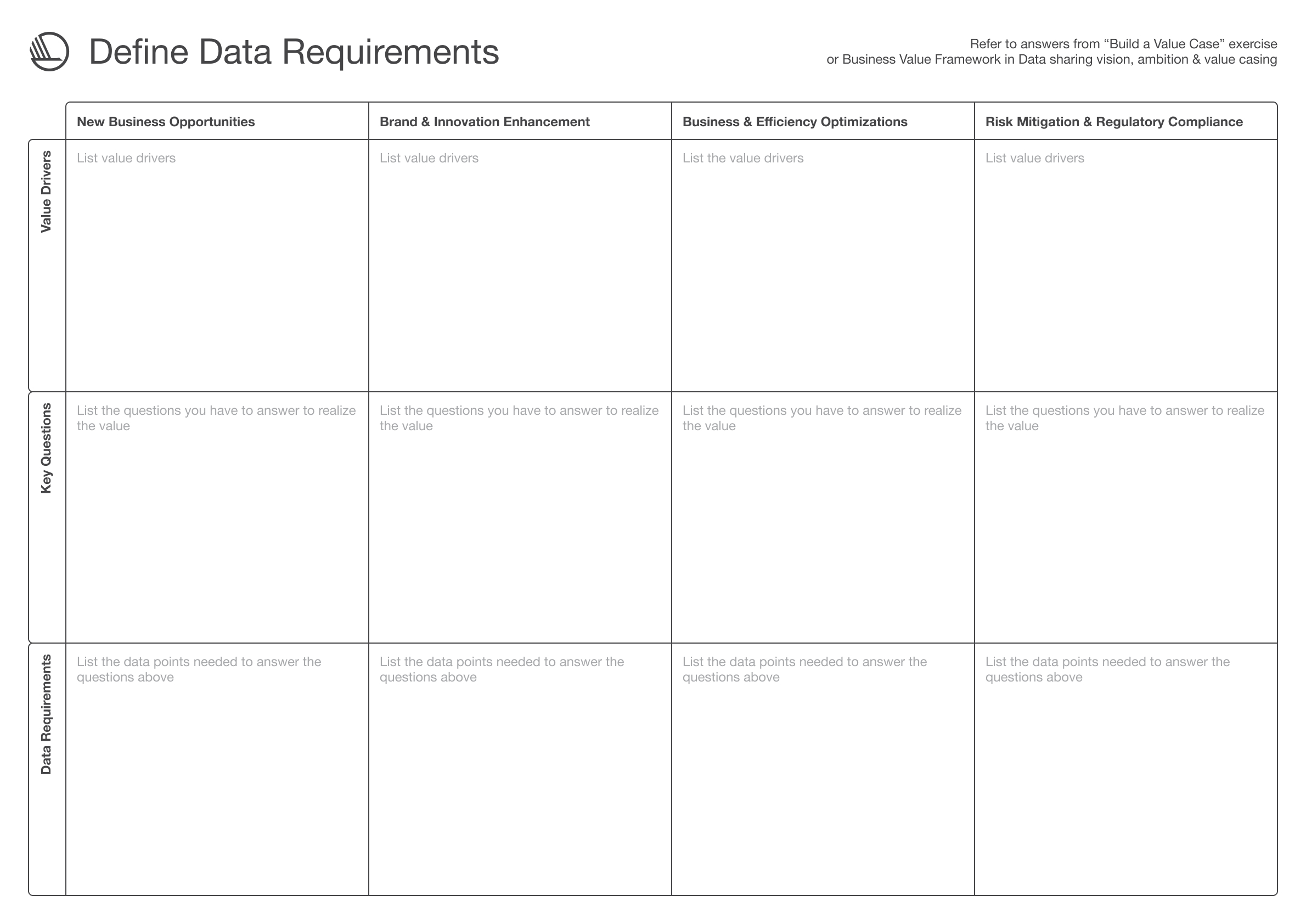
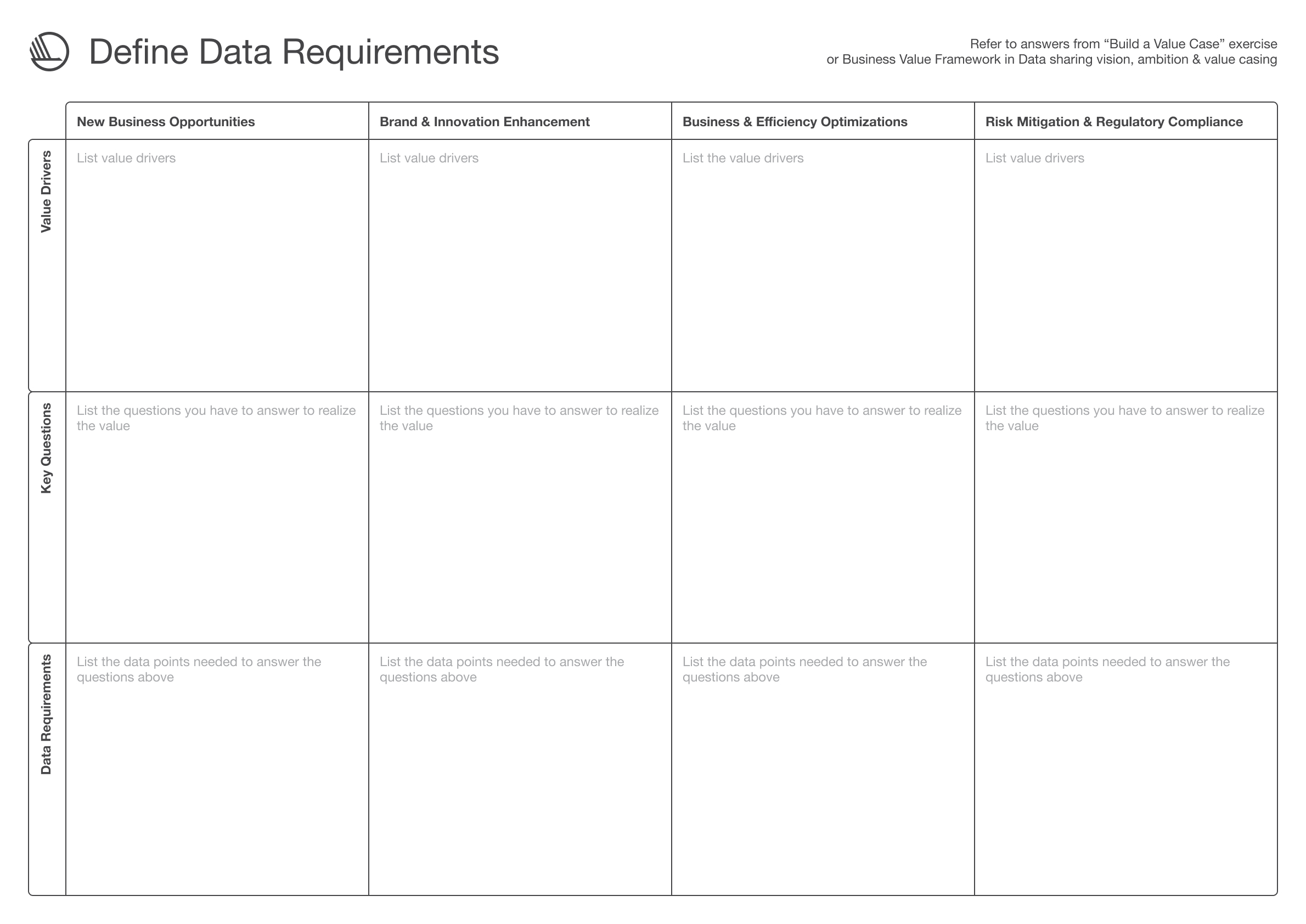
3 | Define data and insight requirements Revisit the vision, use case, and value drivers of your collaboration to outline key questions needed to answer to fulfill your goals. Outline the data needed to answer your questions and summarize your data requirements, using the worksheet on. |
| ||||
4 | Identify data sources Consider the data requirements and map them to the different actors of the value chain to understand the sources of your data. Discuss who will be responsible for quality assuring and sharing the data. |
| ||||
Adopting universal data standards such as ISO can facilitate the harmonization of data sharing and alignment with regulations
Various standards from industry bodies and standardization organizations can help streamline your data sharing for circularity. Choosing the right standard will depend on your industries’ standardization body.
Adopting universal data standards such as ISO can facilitate the harmonization of data sharing and alignment with regulations
Various standards from industry bodies and standardization organizations can help streamline your data sharing for circularity. Choosing the right standard will depend on your industries’ standardization body.
- ISO
Global standardization organization offering more that 25,000 different business standards - GS1
Global standardization organization in supply chain and product traceability, esp. in Retail - GRI
Global standardization organization with a focus on sustainability and impact - ESRS
European Sustainability Reporting Standards introduces with the Corporate Sustainability Reporting Directive (CSRD) - UN/CEFACT
Intergovernmental body of the United Nations that develops electronic business standards
- ISO
Global standardization organization offering more that 25,000 different business standards
- GS1
Global standardization organization in supply chain and product traceability, esp. in Retail - GRI
Global standardization organization with a focus on sustainability and impact - ESRS
European Sustainability Reporting Standards introduces with the Corporate Sustainability Reporting Directive (CSRD) - UN/CEFACT
Intergovernmental body of the United Nations that develops electronic business standards
ISO (2024), Circular economy — Vocabulary, principles and guidance for implementation | |||||
The ISO 59000 family of standards offers a global consensus on circular economy definition and principles. These standards provide a comprehensive toolkit for implementation, covering vocabulary, strategies, business models, value networks, measurement, and evaluation. | |||||
ISO 59004 Vocabulary, principles, and guidance for implementation | |||||
ISO 59010 Guidance on transition of business models and value networks | ISO 59020 Measuring and assessing circularity performance | ISO 59040 Product circularity datasheet | ISO 59014 Sustainability & traceability of secondary material recovery | ||

Case in point
Grundfos & Danfoss
Case in point
Grundfos & Danfoss

“This collaboration was all about sharing information and insights to be able to establish and industry definition of circular products.”
– Grundfos, Nordic Circular Accelerator participant
“This collaboration was all about sharing information and insights to be able to establish and industry definition of circular products.”
– Grundfos, Nordic Circular Accelerator participant
With bold circularity ambitions of both Grundfos and Danfoss, the parties set out to define an industry standard for circular products – determining when a product is “circular enough” to claim that it is circular.
In the process of standardizing their definition of ‘circularity’, Grundfos & Danfoss made several learnings.
One reflection was to include multiple metrics when determining the “circularity degree” of a product to allow for coverage of various product types. One key measurement is weight when it comes to resource minimization, but combined with e.g., costs or carbon emissions the circularity scoring of components changes completely.
The collaboration is now iterating and exploring the metrics, before moving towards a shared taxonomy and metrics definition for product circularity in the pump industry.
With bold circularity ambitions of both Grundfos and Danfoss, the parties set out to define an industry standard for circular products – determining when a product is “circular enough” to claim that it is circular.
In the process of standardizing their definition of ‘circularity’, Grundfos & Danfoss made several learnings.
One reflection was to include multiple metrics when determining the “circularity degree” of a product to allow for coverage of various product types. One key measurement is weight when it comes to resource minimization, but combined with e.g., costs or carbon emissions the circularity scoring of components changes completely.
The collaboration is now iterating and exploring the metrics, before moving towards a shared taxonomy and metrics definition for product circularity in the pump industry.
Jointly exploring the definition of a circular product
The collaboration discussed the impact of using weight, cost and/or CO2 as metrics to define the circularity of a product.
Jointly exploring the definition of a circular product
The collaboration discussed the impact of using weight, cost and/or CO2 as metrics to define the circularity of a product.
“A pump can reach 50% circularity by weight more easily than an electronic product, where more components must be recirculated to meet the same threshold — and where CO₂ emissions are often higher.”
– Grundfos, Nordic Circular Accelerator participant
“A pump can reach 50% circularity by weight more easily than an electronic product, where more components must be recirculated to meet the same threshold — and where CO₂ emissions are often higher.”
– Grundfos, Nordic Circular Accelerator participant
Insights from the collaboration:
- Weight is a useful starting point, but often insufficient on its own
- Combining weight with cost or CO₂ helps reflect real circularity performance
- Different product types require different approaches – one metric may not fit all
- More concrete guidelines are needed from standards bodies on circular metrics
- Terms like remanufactured, refurbished, and reused should be defined with clear thresholds or ranges
Insights from the collaboration:
- Weight is a useful starting point, but often insufficient on its own
- Combining weight with cost or CO₂ helps reflect real circularity performance
- Different product types require different approaches – one metric may not fit all
- More concrete guidelines are needed from standards bodies on circular metrics
- Terms like remanufactured, refurbished, and reused should be defined with clear thresholds or ranges
Case in point
IOXIO & DAPONET
Case in point
IOXIO & DAPONET
“Not all data brings value – at least not from day 1. Focus on the most important data rather than sharing data for the sake of it.”
– IOXIO, Nordic Circular Accelerator participant
“Not all data brings value – at least not from day 1. Focus on the most important data rather than sharing data for the sake of it.”
– IOXIO, Nordic Circular Accelerator participant
In collaboration with IOXIO, the DAPONET cluster is working together on circular product data sharing.
- Map out the value chain for the selected business case
- Outline key information flows in the selected value chain based on the defined use case
- Discover relevant regulations and industry standards
- Define the data needed to share across multiple parties according to regulatory requirements and industry standards
- Identify the key data sources and users to define how data will be shared in practice outlining the responsibilities and workflows needed to deliver new value in collaboration
In collaboration with IOXIO, the DAPONET cluster is working together on circular product data sharing.
- Map out the value chain for the selected business case
- Outline key information flows in the selected value chain based on the defined use case
- Discover relevant regulations and industry standards
- Define the data needed to share across multiple parties according to regulatory requirements and industry standards
- Identify the key data sources and users to define how data will be shared in practice outlining the responsibilities and workflows needed to deliver new value in collaboration
Data sharing vision, ambition & value case | ||||||||||||
Data sharing use case | ||||||||||||
Value Chain | Design | Sourcing | Manufacturing | Logistics | Use & Resource Recovery | |||||||
Design | Tier N | Tier 2 | Tier 1 | Manufacturer / producer | Trade | Distribution | Use / Reuse | End-of-Life | ||||
Data Mapping | Materials, legal entities, locations & transactions | ERP | Services, legal entities, locations & transactions | |||||||||
Certification schemes & other data sources | ESG Data Sources | After sales Data | Reuse, Recycle, Discard | |||||||||

Exercise
Exercise
Participants 5 - 10 | Duration 1.0 hrs |
Participants
5 - 10
5 - 10
Duration
1.0 hrs
1.0 hrs
Instructions
Divide participants into three groups and assign each one a value category (e.g., new business opportunities).Start by copying the relevant value drivers from your value case onto post-its.
Then, capture the key questions you need to answer to unlock that value—and the specific data points that need to be shared to answer those questions.
Wrap up by sharing your group’s input with the full team to co-create a shared view of the data sharing requirements across the collaboration.
Next steps
Review data requirements and define data sources, availability and quality.
Instructions
Divide participants into three groups and assign each one a value category (e.g., new business opportunities).Start by copying the relevant value drivers from your value case onto post-its.
Then, capture the key questions you need to answer to unlock that value—and the specific data points that need to be shared to answer those questions.
Wrap up by sharing your group’s input with the full team to co-create a shared view of the data sharing requirements across the collaboration.
Next steps
Review data requirements and define data sources, availability and quality.
Data management, governance & security
“Data governance is almost as important as the problem you are solving – if you can’t trust the data, you can never trust the solution that is built on top.”
– Cognite, Nordic Circular Accelerator participant
Data management, governance & security
“Data governance is almost as important as the problem you are solving – if you can’t trust the data, you can never trust the solution that is built on top.”
– Cognite, Nordic Circular Accelerator participant

Introduction
Why establish shared and secure data management practices?
Effective data management ensures the foundational capabilities necessary to govern, organize, secure, and utilize data efficiently, setting the foundation to enable efficient data sharing with third parties in a circular economy. In this way, successful data management is a critical precondition for generating value from your circular data sharing.
Data management
Data management refers to the process of collecting, storing, organizing, maintaining, and using circularity data in a way that optimizes its value and minimizes risks. It is your day-to-day operations to successfully manage and share data in your collaboration. It includes principles such as data governance, meta data management, and data security.
Data governance
Data governance is about how you govern and manage all data in your collaboration. Compared to data management, it focuses on the overarching structures, underlying principles, and contractual elements needed to be in place for successfully sharing circularity data.
Data security
Data security involves using policies, procedures, and technologies like access controls and encryption to prevent unauthorized access, use, or disclosure of data. It is crucial in cross-organizational collaboration, as lack of trust is a major barrier. Further, it is essential for regulatory compliance. Key frameworks include the EU Data Governance Act and the EU Data Act, which clarify how businesses can unleash the opportunities of shared data, while ensuring fair access and data protection.
Introduction
Why establish shared and secure data management practices?
Effective data management ensures the foundational capabilities necessary to govern, organize, secure, and utilize data efficiently, setting the foundation to enable efficient data sharing with third parties in a circular economy. In this way, successful data management is a critical precondition for generating value from your circular data sharing.
Data management
Data management refers to the process of collecting, storing, organizing, maintaining, and using circularity data in a way that optimizes its value and minimizes risks. It is your day-to-day operations to successfully manage and share data in your collaboration. It includes principles such as data governance, meta data management, and data security.
Data governance
Data governance is about how you govern and manage all data in your collaboration. Compared to data management, it focuses on the overarching structures, underlying principles, and contractual elements needed to be in place for successfully sharing circularity data.
Data security
Data security involves using policies, procedures, and technologies like access controls and encryption to prevent unauthorized access, use, or disclosure of data. It is crucial in cross-organizational collaboration, as lack of trust is a major barrier. Further, it is essential for regulatory compliance. Key frameworks include the EU Data Governance Act and the EU Data Act, which clarify how businesses can unleash the opportunities of shared data, while ensuring fair access and data protection.
Key learnings
- Build your data management and governance on established regulatory frameworks (e.g., EU Data Act) to create a strong and secure foundation for your collaboration
- Ensure data management practices are aligned with existing business practices of the participating actors to avoid data sharing activities to run in parallel
- Spend time setting up the right governance model – without proper data governance you risk non-reliable data, especially within sustainability
- Write down your data-sharing principles as a foundational contractual element in the early days of your collaboration to foster trust and transparency
- Seek to decentralize and distribute data-sharing responsibility in the ecosystem to ensure actors can manage and control their own data while still allowing for efficient data sharing
- Consider culture, change management, and upskilling as part of your data governance – data sharing with third parties is unnatural to most people

Get started with your data management, governance & security
Get started with your data management, governance & security
Key questions to ask your collaboration in this step: | ||||||
1 | Define roles and responsibilities Design the collaboration structure of your ecosystem by establishing clear roles and responsibilities. Consider how you will split the ownership and accountability of various data within the collaboration. |
| ||||
2 | Draft data sharing policies and principles Create rulebooks1 aligned with European data sharing policies (e.g., EU’s Data Governance Act and Data Act) on how you will use, store, retain, and protect data. |
| ||||
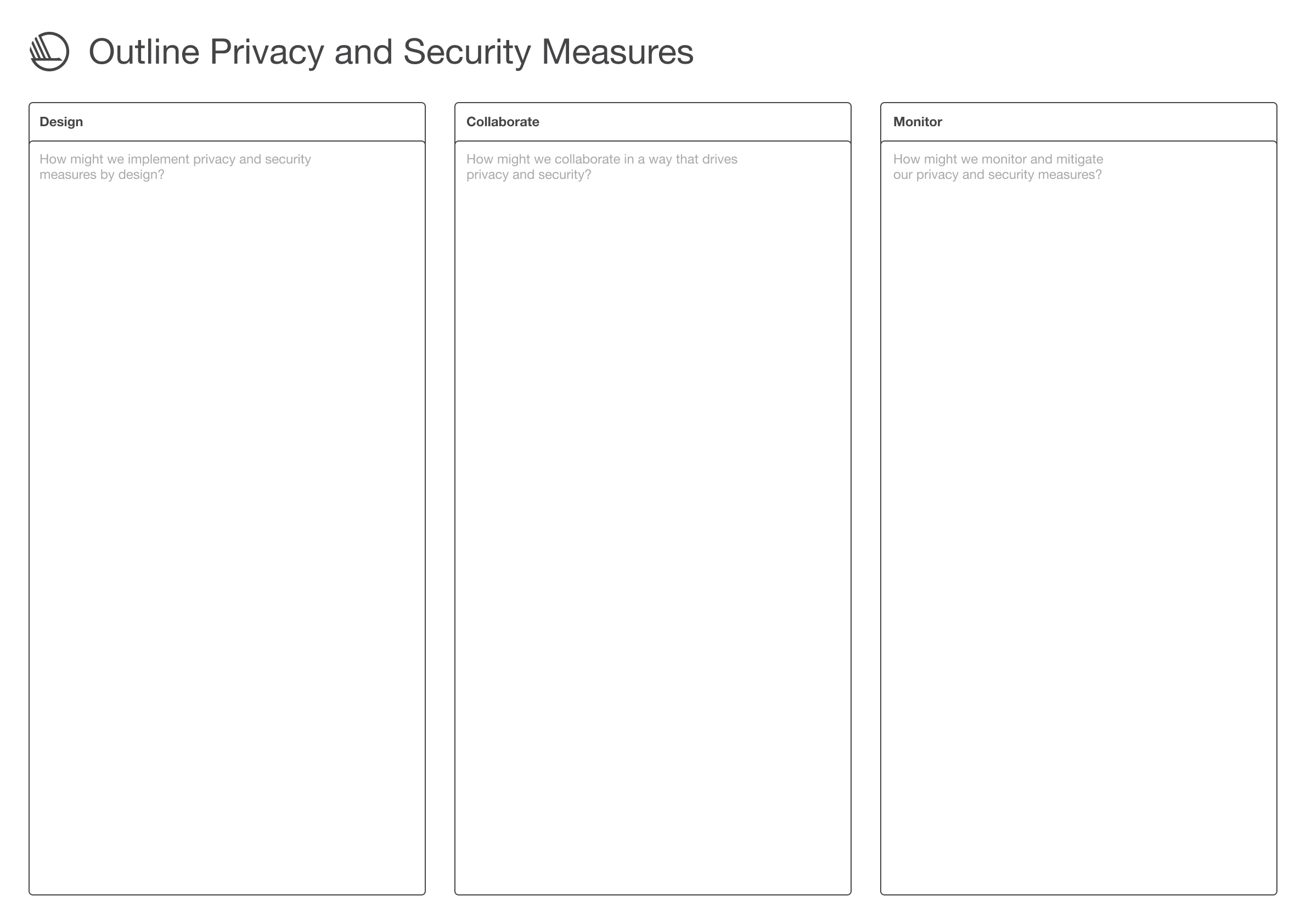
3 | Outline privacy and security measures Consider what privacy and security mechanisms you will integrate in your collaboration and way of working with data to drive safety. Outline the measures you will take before and during your collaboration, leveraging the Data Privacy and Security Framework. |
| ||||
4 | Build and enforce a data sharing culture Discuss how you will communicate and socialize in the ecosystem to ensure continuous engagement in the collaboration, increase share of learnings and best practices, and encourage a culture of ownership and progress. |
| ||||
Master, reference & metadata management, data quality management, data architecture, data modeling, data security
A strong data governance framework establishes a common ground of shared practices for data sharing.
A data governance framework is a set of rules, practices, and processes that defines how to share data in the ecosystem. By creating a data governance framework in your collaboration, you establish a common ground for the data sharing to ensure data will be shared in a streamlined, efficient, and secure manner.
The framework should be informed by the vision and objectives of your data sharing ecosystem and will inform how data is managed in the collaboration.
Tip! Revisit your data sharing vision, ambition, and value case when designing your data governance to ensure alignment.
Master, reference & metadata management, data quality management, data architecture, data modeling, data security
A strong data governance framework establishes a common ground of shared practices for data sharing.
A data governance framework is a set of rules, practices, and processes that defines how to share data in the ecosystem. By creating a data governance framework in your collaboration, you establish a common ground for the data sharing to ensure data will be shared in a streamlined, efficient, and secure manner.
The framework should be informed by the vision and objectives of your data sharing ecosystem and will inform how data is managed in the collaboration.
Tip! Revisit your data sharing vision, ambition, and value case when designing your data governance to ensure alignment.
PROCESSES Steps to govern and manage data throughout its lifecycle, used to standardize, increase efficiency in the data-sharing ecosystem | ||
POLICIES AND PRINCIPLES Rules that guide usage, storage, retention, and protection of data e.g., the EU’s Data Governance Act and Data Act and established principles in the collaboration | 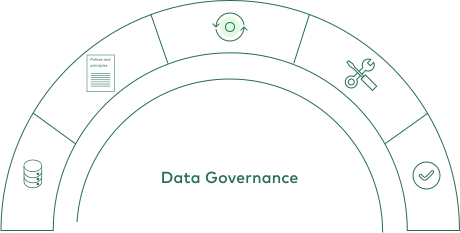 | TECHNOLOGY ENABLEMENT Technology foundation that enables the execution of data governance activities with simplified tasks and automated processes |
COLLABORATION STRUCTURE, ROLES & RESPONSIBILITIES Structure defining collaborative relationships and accountability to drive the data governance | CULTURE AND CHANGE MANAGEMENT Communication and socialization in the ecosystem to ensure consistent onboarding, share of best practices, and increase of adoption | |

Case in point
IOXIO & BESPORT
Case in point
IOXIO & BESPORT
”For data sharing to become a success, the legal and contractual premises must be in place and applied on a practical level.”
– IOXIO, Nordic Circular Accelerator participant
”For data sharing to become a success, the legal and contractual premises must be in place and applied on a practical level.”
– IOXIO, Nordic Circular Accelerator participant
In collaboration with IOXIO, the BESPORT cluster is developing digital corridors for cargo to enable sustainable and profitable logistics chain.
The BESPORT cluster is creating new value by sharing operational, terminal and logistics data across stakeholder in the port. Data remains in its original systems, with full control retained by the data holders.
Through trusted data-sharing service, standardized formats enable seamless exchange between cargo handling machines and systems, supporting use cases like cargo turnaround optimization and electrification planning.
Data sharing is governed by clear and fair rules, ensuring responsible, legally compliant data use that strengthens the entire ecosystem.
In collaboration with IOXIO, the BESPORT cluster is developing digital corridors for cargo to enable sustainable and profitable logistics chain.
The BESPORT cluster is creating new value by sharing operational, terminal and logistics data across stakeholder in the port. Data remains in its original systems, with full control retained by the data holders.
Through trusted data-sharing service, standardized formats enable seamless exchange between cargo handling machines and systems, supporting use cases like cargo turnaround optimization and electrification planning.
Data sharing is governed by clear and fair rules, ensuring responsible, legally compliant data use that strengthens the entire ecosystem.
Ensuring data interoperability and trust trough data sharing principles
Controlled
Data stays within the original systems and the holders retain control over how their data is shared
Data stays within the original systems and the holders retain control over how their data is shared
Standardized
Data is in common formats and standards to ensure seamless exchange between systems
Data is in common formats and standards to ensure seamless exchange between systems
Trusted
Clear rules on data access, usage, and governance are established to build trust
Clear rules on data access, usage, and governance are established to build trust
Fair
Data sharing is based on voluntary agreements and fair conditions
Data sharing is based on voluntary agreements and fair conditions
Responsible
Participants must act responsibly and adhere to contractual and legal obligations
Participants must act responsibly and adhere to contractual and legal obligations
Ensuring data interoperability and trust trough data sharing principles
Controlled
Data stays within the original systems and the holders retain control over how their data is shared
Data stays within the original systems and the holders retain control over how their data is shared
Standardized
Data is in common formats and standards to ensure seamless exchange between systems
Data is in common formats and standards to ensure seamless exchange between systems
Trusted
Clear rules on data access, usage, and governance are established to build trust
Clear rules on data access, usage, and governance are established to build trust
Fair
Data sharing is based on voluntary agreements and fair conditions
Data sharing is based on voluntary agreements and fair conditions
Responsible
Participants must act responsibly and adhere to contractual and legal obligations
Participants must act responsibly and adhere to contractual and legal obligations

Addressing privacy and security early in the collaboration will help overcome data sharing barriers
By establishing comprehensive privacy and security mechanisms you can derisk data sharing and foster trust in your collaboration.
Privacy and security concerns are significant barriers for companies to engage in data sharing and should be addressed throughout any data sharing collaboration.
Integrate privacy and security mechanisms by design (e.g., clear data policies aligned with current regulations and minimal data collection) to build a secure foundation.
Foster trust throughout your collaboration by enforcing secure ways of working (e.g., anonymized or levelized data, secure data sharing platforms).
Continue to monitor and mitigate potential threats (e.g., with periodic risk assessments and risk response plans).
Tip! Seek to simplify the data requirements – you may not need to share as much as you think.
Addressing privacy and security early in the collaboration will help overcome data sharing barriers
By establishing comprehensive privacy and security mechanisms you can derisk data sharing and foster trust in your collaboration.
Privacy and security concerns are significant barriers for companies to engage in data sharing and should be addressed throughout any data sharing collaboration.
Integrate privacy and security mechanisms by design (e.g., clear data policies aligned with current regulations and minimal data collection) to build a secure foundation.
Foster trust throughout your collaboration by enforcing secure ways of working (e.g., anonymized or levelized data, secure data sharing platforms).
Continue to monitor and mitigate potential threats (e.g., with periodic risk assessments and risk response plans).
Tip! Seek to simplify the data requirements – you may not need to share as much as you think.
Design | Collaborate | Monitor |
Establish clear policies Define shared rules on how data is collected, stored, processed, and shared, aligned with existing regulations | Use a secure data platform Ensure all data shared between external stakeholders is shared in a safe manner (e.g., data space) | Conduct regular audits Regularly monitor systems and conduct security audits to identify and address security threats |
Integrate privacy early Incorporate privacy considerations into the design of the data sharing ecosystem | Control access Implement role-based access controls to limit data access to authorized people only | Assess risks Conduct periodic risk assessments to identify and mitigate potential risks |
Minimize data collection Design for minimal collection of data to only collect data necessary for the collaboration | Anonymize data Use techniques to anonymize data wherever possible to protect sensitive business information | Prepare response plan Develop and maintain an incident response plan to address data breaches promptly |

Case in point
Catena-X
One way to practically implement data governance is through European ‘data spaces’ – and Catena X is a prime example.
A Data Space is a framework that supports data sharing within a data ecosystem by providing a clear structure for participants to share, trade, and collaborate on data assets. The EU commission strongly recommends the use of data spaces and is helping with initial funding for sector specific Common European Data Spaces to make more data available for access and reuse.
Catena-X is an advanced data space within the automative industry. Here it was found that a data space was a mean to share primary data securely and self-sovereignly along the value chain. The self sovereign identity mechanism enables trusted partner identification, and the access & usage policies define who is allowed to see which part of your data.
Commercial data space in the automotive industry
Global Chemicals Producer | Global Automotive Manufacturer | Automotive Recycler | ||||||||
Catena-X is a fundamental element for our recycling business. We benefit from much better access to secondary materials and a reliable source of qualitative primary data on the materials we purchase. | Catena-X is essential for sovereign data exchange in the automotive industry. Without this platform and network, sustainability simply isn’t possible—we can’t do it alone. | The secondary marketplace and product pass greatly simplify purchasing, giving us upfront material value and a leaner end-of-life process through better information. | ||||||||
Tier-n | Tier-2 | Tier-1 | OEM | Usage | Dismantle | Recycler | ||||
Products | Marketplace for Secondary Materials | Digital Product Passports | R-Strategy Assistant | Excerpt | ||||||
The ‘one up, one down’ principle ensures data privacy and security | ||||||||||
Value Chain Actor 1 | ↔︎ | Value Chain Actor 2 | ↔︎ | Value Chain Actor 3 | ||||||
Self-sovereign identity lets value chain actors store circularity data locally and share it securely, one step at a time, with direct value chain partners—reducing the risk of unauthorized access and ensuring better control over sensitive information. Note: This principle can also be applied to other data sharing models, e.g., a decentralized network model. | ||||||||||

Exercise
Exercise
Participants 5 - 10 | Duration 45 min |
Participants
5 - 10
5 - 10
Duration
45 min
45 min
Instructions
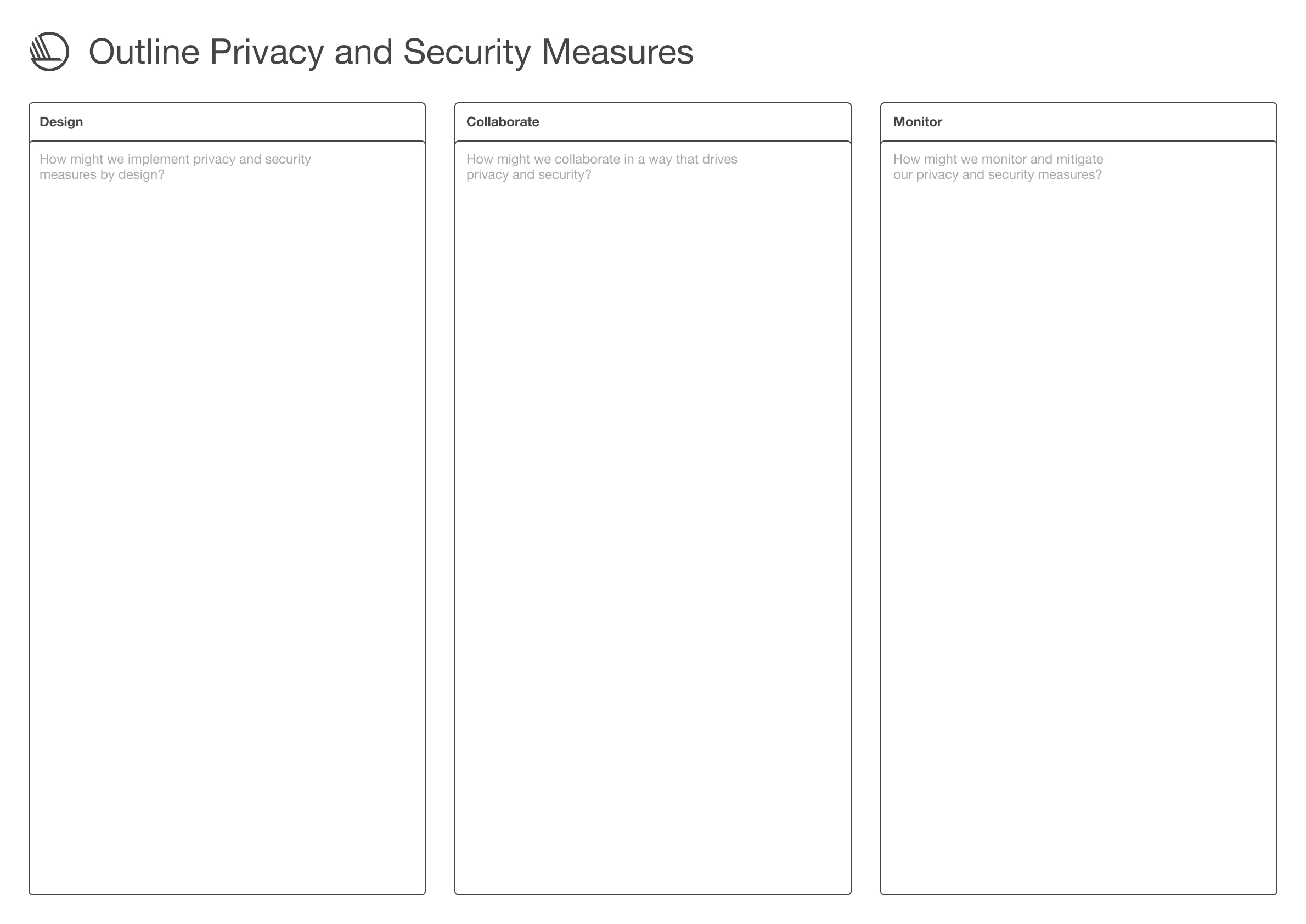
Divide the group into two teams to brainstorm privacy and security initiatives for each category listed on the worksheet. Write your thoughts on post-it notes and place them on the worksheet.
Then, reconvene as a larger group to share your insights and engage in a discussion.
Cluster the post-it notes to identify 3-5 key initiatives for each category.
Next Steps
Make sure that the privacy and security initiatives are integrated into the collaboration (e.g., draft a rule book) and remember to review the list regularly during the collaboration.
Instructions
Divide the group into two teams to brainstorm privacy and security initiatives for each category listed on the worksheet. Write your thoughts on post-it notes and place them on the worksheet.
Then, reconvene as a larger group to share your insights and engage in a discussion.
Cluster the post-it notes to identify 3-5 key initiatives for each category.
Next Steps
Make sure that the privacy and security initiatives are integrated into the collaboration (e.g., draft a rule book) and remember to review the list regularly during the collaboration.