4. Examples of promising practices and solutions
Open preschool as an arena for integration for children and mothers
Hanna Sällemark, The Swedish Association of Local Authorities and Regions
Jenny Rivas and Maria-Pia Colton, Nacka municipality, Sweden
Open preschools are available in 220 of Sweden’s 290 municipalities. Participation is voluntary – you may attend as often as you like – and they are free of charge. There is no formal enrolment for children; parents decide when and how often their children participate.
In 16 municipalities across Sweden, open preschools are participating in a project coordinated by the Swedish Association of Local Authorities and Regions. The project focuses on helping foreign-born women enter the labour market, leveraging open preschools as an effective platform to reach and support them.
– Open preschools already exist. They are open meeting spaces with responsive participants accustomed to working according to individual needs. They are a gathering place for all new parents, not just foreign-born ones, which also helps promote integration. Because of their voluntary nature, open preschools are safe spaces; you can come only if you want and whenever you choose.
Hanna Sällemark at the Swedish Association of Local Authorities and Regions says open preschool is also a good opportunity to introduce regular preschool, which is important for the children’s continued development and language skills.
It is also important to enable parents to move forward on their path toward self-sufficiency after parental leave. Foreign-born women are significantly less employed in the labour market than other groups.
– We have a very important labour reserve here; we need every person who can work in this country, Hanna Sällemark says.
The open preschool in Fisksätra, in the municipality of Nacka, is participating in this project. Fisksätra is an area of Nacka with a higher proportion of foreign-born residents, a lower employment rate, and fewer preschoolers.
In 16 municipalities across Sweden, open preschools are participating in a project coordinated by the Swedish Association of Local Authorities and Regions. The project focuses on helping foreign-born women enter the labour market, leveraging open preschools as an effective platform to reach and support them.
– Open preschools already exist. They are open meeting spaces with responsive participants accustomed to working according to individual needs. They are a gathering place for all new parents, not just foreign-born ones, which also helps promote integration. Because of their voluntary nature, open preschools are safe spaces; you can come only if you want and whenever you choose.
Hanna Sällemark at the Swedish Association of Local Authorities and Regions says open preschool is also a good opportunity to introduce regular preschool, which is important for the children’s continued development and language skills.
It is also important to enable parents to move forward on their path toward self-sufficiency after parental leave. Foreign-born women are significantly less employed in the labour market than other groups.
– We have a very important labour reserve here; we need every person who can work in this country, Hanna Sällemark says.
The open preschool in Fisksätra, in the municipality of Nacka, is participating in this project. Fisksätra is an area of Nacka with a higher proportion of foreign-born residents, a lower employment rate, and fewer preschoolers.
– We offer Swedish classes for foreign-born mothers. These classes are designed for both mothers who studied Swedish before their parental leave and those who have never studied the language. Participants include newly arrived mothers as well as those who have lived in Sweden for a longer period, Jenny Rivas explains.
The education is adapted to the participants’' needs. Mothers can sit on the floor with their children and take breaks as needed. The group is highly diverse. Some mothers have clear goals for their future studies or careers, while others are still exploring their aspirations.
– In addition to supporting these mothers in pursuing jobs or education, another important goal is to encourage them to consider Swedish regular preschool as a good option for their children, Jenny Rivas says.
– In addition to supporting these mothers in pursuing jobs or education, another important goal is to encourage them to consider Swedish regular preschool as a good option for their children, Jenny Rivas says.
Maria-Pia Colton adds that it is sometimes necessary to dispel misconceptions, such as the belief that learning Swedish will impede children’s development in their native language. She stresses the importance of children having adequate knowledge of Swedish by the time they begin compulsory primary school.
– Building trust is crucial. Mothers need to trust the system to feel comfortable leaving their children at preschool while they pursue work or education. Preschool is closely connected to mothers’ ability to access education or employment opportunities.
New Nordic research: Digital inclusion of immigrant women in the Nordic countries and the role of NGOs
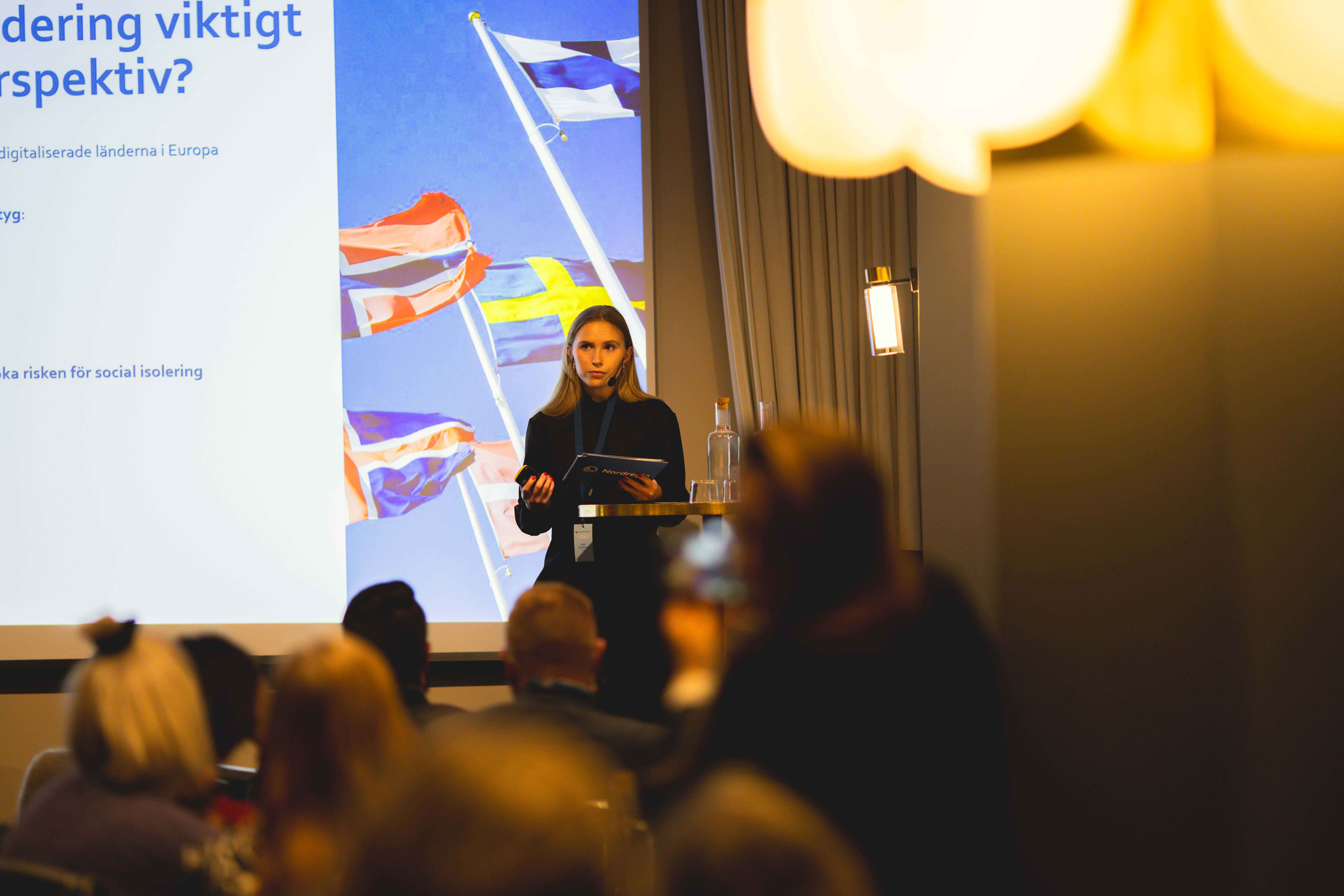
Maja Bryntesson, Research Fellow, Nordregio
Digital inclusion is crucial in the Nordic countries, which are among the most digitalised nations in Europe. Many aspects of life require digital skills, ranging from job and educational opportunities to accessing healthcare and communicating with authorities, banks, and schools. Maja Bryntesson from the research centre Nordregio presented the initial results of a new research project on the digital inclusion of migrant women.
– Foreign-born women, particularly those who are newly arrived and have refugee backgrounds, limited proficiency in the national language, and lower socio-economic or educational backgrounds, have been identified as one of the groups facing challenges and at risk of digital exclusion in the Nordics.
– Foreign-born women, particularly those who are newly arrived and have refugee backgrounds, limited proficiency in the national language, and lower socio-economic or educational backgrounds, have been identified as one of the groups facing challenges and at risk of digital exclusion in the Nordics.
The research project aims to understand the barriers preventing full digital inclusion and identify practices that enable access and engagement in digital society.
– NGOs play a crucial role in digital inclusion due to their direct contact with target groups, their function as a bridge between these groups and the public sector, and their knowledge and access to the communities they serve.
Maja Bryntesson also notes that NGOs face several challenges, including irregular funding, social stigma, a lack of volunteers, insufficient strategic focus, and inadequate financial support from policymakers.
The results of the research project also highlight the main barriers to digital inclusion. Language is one such barrier, particularly regarding understanding the national technical and bureaucratic terminology.
– There are also challenges related to skills and knowledge. The group we are focusing on is complex, and their levels of knowledge vary. Some are complete beginners and need help using a computer or e-mail, while others possess basic knowledge and want to develop further. This knowledge also includes understanding society and being able to navigate websites and digital public services.
To strengthen digital literacy, NGOs offer various types of support, such as courses and programmes, IT cafés, meeting places, mentorship, individual sessions, and digital ambassadors.
Another barrier is trust. People need to trust the technology and the system, as well as themselves. Designing the support initiatives with the participants and tailoring the materials to the group are seen as effective approaches by the NGOs. It is also important to identify the conditions that enable the group to participate, such as offering childcare and creating safe spaces for participation, for example, by organising groups with women from similar backgrounds.
– Crucial to the process is that participants develop confidence in themselves and their ability to succeed. This is a form of digital empowerment, Maja Bryntesson concludes.
– Crucial to the process is that participants develop confidence in themselves and their ability to succeed. This is a form of digital empowerment, Maja Bryntesson concludes.
Read more:
Maja Bryntesson, Research Fellow, Nordregio
Järvaveckan – a platform for open dialogue and community building
Ahmed Abdirahman, CEO & Founder, Järvaveckan Foundation
Since its launch in 2016, Järvaveckan has grown into one of Sweden’s most significant events for socially engaged businesses, organisations, authorities, politicians, and citizens. It serves as a forum for open dialogue, providing opportunities for people to connect outside their usual circles and learn from each other.
– We work towards a society where every individual has the opportunity to influence their own future on equal terms, regardless of where they come from, CEO Ahmed Abdirahman says.
Järvaveckan is organised by the Järvaveckan Foundation, a non-partisan, non-religious, non-profit organisation. Each summer, between 50,000 and 70,000 people gather for the four-day Järvaveckan event. Ahmed Abdirahman says that Järvaveckan offers something unique: a meeting place that bridges different social groups, enabling dialogue that is often limited in today’s society.
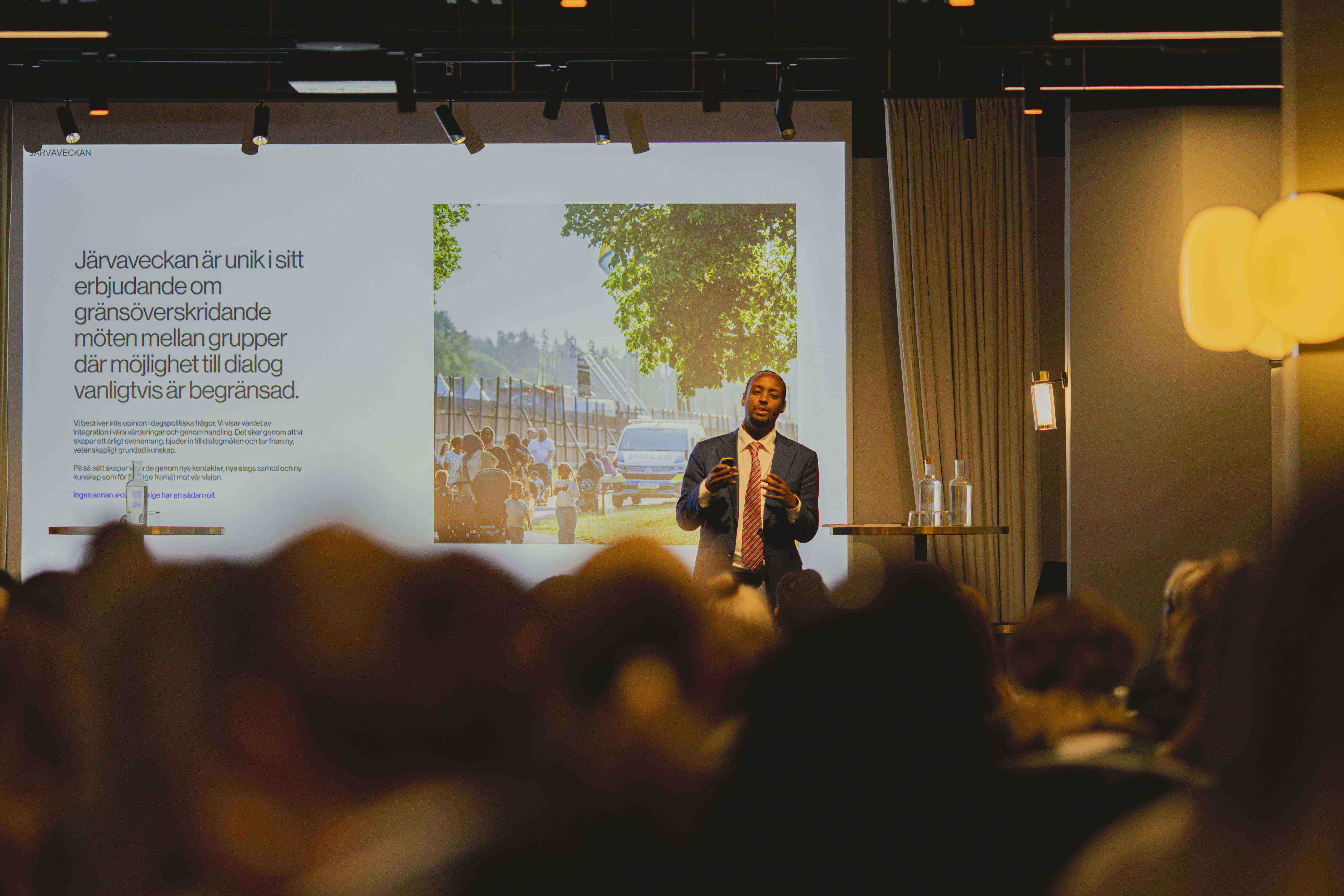
There are groups and individuals in our society who try to convince us that those of us who come from different countries and backgrounds are so different that we cannot collaborate or engage in dialogue. While they are a minority, it is incredibly dangerous if these groups gain ground.
This is why, says Ahmed Abdirahman, it is crucial for the majority to demonstrate that dialogue and coexistence, which Järvaveckan strives to achieve, are possible.
Sweden has changed markedly over the past 20 years, with nearly two million people moving to the country, including 1.2 million born outside Europe. Many of them are young, which, according to Ahmed Abdirahman, represents significant potential, provided that immigration is managed effectively.
– When we communicate with one another, we realise that we have more in common, even if we differ in certain areas. It is also important to recognise that cultural integration evolves over time, with individuals from diverse backgrounds often aligning more closely with Swedish societal norms, such as gender equality.
When the Järvaveckan Foundation asked people with foreign backgrounds if they had experienced discrimination in the Swedish job market, 50 per cent said yes. Many attributed this to their ethnicity or background.
Sweden has changed markedly over the past 20 years, with nearly two million people moving to the country, including 1.2 million born outside Europe. Many of them are young, which, according to Ahmed Abdirahman, represents significant potential, provided that immigration is managed effectively.
– When we communicate with one another, we realise that we have more in common, even if we differ in certain areas. It is also important to recognise that cultural integration evolves over time, with individuals from diverse backgrounds often aligning more closely with Swedish societal norms, such as gender equality.
When the Järvaveckan Foundation asked people with foreign backgrounds if they had experienced discrimination in the Swedish job market, 50 per cent said yes. Many attributed this to their ethnicity or background.
We were surprised. This is heartbreaking. Many people feel a knot in their stomachs every time they apply for a job, fearing they might be discriminated against, even when all they want is to do the right thing and work for the country they have moved to. We must address this.