Refining PSS Strategies

After establishing your PSS business solution and gaining a solid understanding of PSS principles, the next step is to optimise your solution. This can involve leveraging your organisation’s data or mapping ecosystems in greater detail. In this final chapter, you will find digital calculation tools, workbooks, and checklists that support data-driven decision-making. For organisations in the process of tracking climate impact and financial performance, these resources help identify the necessary data, such as climate accounts, and clarify how to use it effectively for further optimisation.
PROTEUS PSS Tool Book
The PROTEUS project was a 3.5-year Innovation Consortium funded by the Danish Agency for Science, Technology, and Innovation (DASTI), and the tool book is designed to assist companies in creating user-centric PSS solutions.
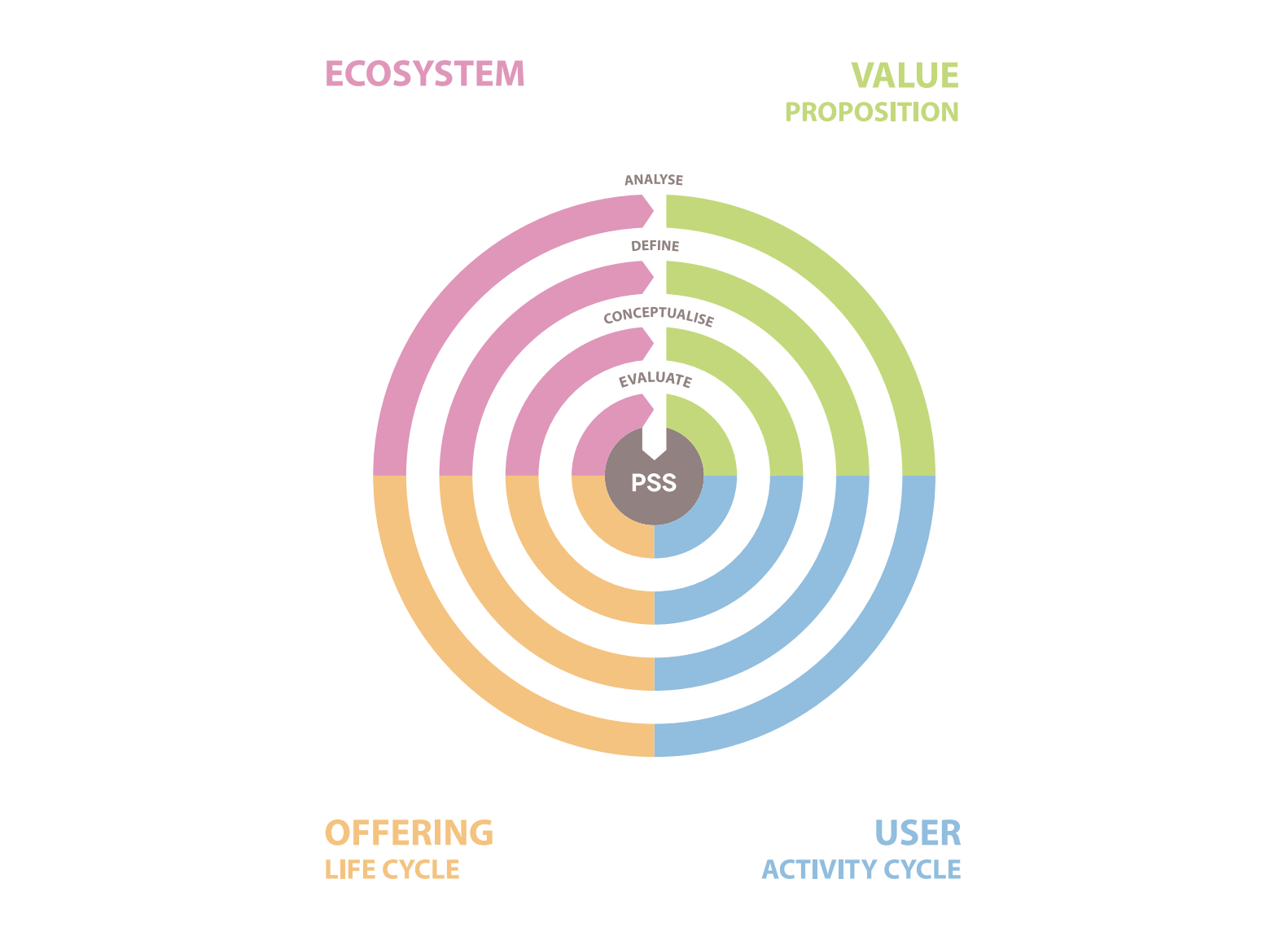
The toolbook is built around four fundamental dimensions of PSS, identified through observations of industrial PSS practices. A successful PSS concept must address the value proposition that considers and serves key stakeholders. This includes extensive consideration of the target users’ activities, an in-depth understanding of the entire life cycle of the offerings, and careful consideration and integration of various stakeholders in the business ecosystem.
The PROTEUS PSS Tool Book provides 11 practical tools, each aligned with one of the four key dimensions of PSS:
PSS Audit Matrix: Ecosystem Map: User Activity Cycle: A template that helps identify user activities and the associated needs in the context of a PSS solution.Product Life Gallery: A template for tracking the life cycle of physical products within the PSS.
In addition to these, the tool book offers other valuable templates and tools, including:
- Service Blueprint template
- TCO Chart tool
- Value Strategy Canvas
- PSS Configurator tool
- PSS Morphology template
- PSS Concept Evaluator tool
- Design for PSS template
The tool book provides comprehensive resources for PSS product development, pricing, and strategy formulation, helping organisations refine and optimise their PSS models.
CE valuator
The CEvaluator is a systematic checklist designed for the financial sector, created to objectively assess the circularity performance of investments. Developed by Flanders Circular, a partnership of authorities, companies, and research organisations, the tool is aimed at facilitating actionable steps towards circularity in financial decision-making.
The CEvaluator considers product and material flow and broader aspects of ecological sustainability without relying on percentages or scores. Instead, it provides a nuanced overview of the opportunities and risks associated with circular economy investments.
It is particularly valuable for professionals in the financial sector but can be used by anyone interested in assessing circularity from a financial perspective. The tool also allows users to compare data files, offering insights into how well the input aligns with circularity dimensions.
Aligned with broader European frameworks, including the EU Commission’s Expert Group on Circular Economy Financing, the CEvaluator ensures that the outputs are objective and relevant across Europe. The CEvaluator takes users through six key steps:
- Transition to a circular economy
- Environmental sustainability
- Opportunities
- Risks
- Your details
- Your results
Steps 1–4 are structured like a survey, prompting users to reflect on whether the essential circular parameters have been addressed in the business’s investment application. Step 5 gathers basic business information, and Step 6 delivers the results, offering a clear evaluation of circularity from both opportunity and risk perspectives.
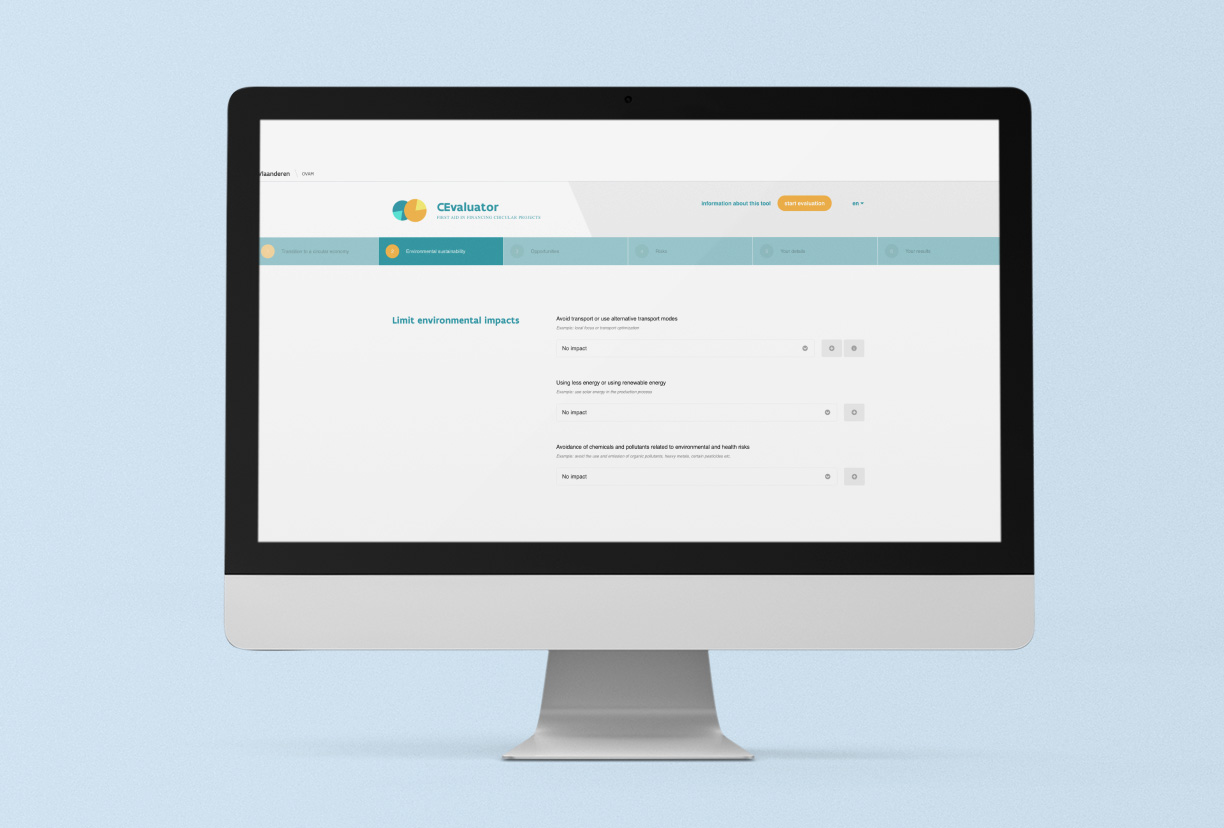
The online assessment tool, CEvaluator, contains questions within 4 main categories: Transition to a circular economy, Environmental sustainability, Opportunities and Risks.
Klimakompasset
Klimakompasset (The Climate Compass) was developed by the Danish Business Agency to help businesses calculate greenhouse gas (GHG) emissions resulting from their activities. The tool provides flexibility, allowing businesses to use it partially or fully, depending on available data and specific needs. All data and results are based on the Greenhouse Gas Protocol, which sets the standard for calculating CO₂ emissions, covering six types of greenhouse gases. The results are reported in tonnes of CO₂-equivalent (CO₂e) emissions, divided into three scopes:
Scope 1: Scope 2: Indirect emissions from energy and heat consumption.Scope 3: Indirect emissions from the value chain.
Klimakompasset provides a total CO₂e emissions report, using annually updated emission factors based on factors such as the implementation of renewable energy sources in Denmark.
While the tool cannot be used directly for certification or green marketing, it has several relevant functions for PSS providers. For example, it allows businesses to assess emissions from five key categories: energy and process consumption, primary and secondary procurement, transportation, waste and recycling, and products sold. The “products sold” category is particularly useful for PSS providers as it includes the emissions from the use phase of products that are sold or rented out. The tool offers a clear overview of which categories businesses should focus on for emission reduction and calculates CO₂e emissions per employee, per million DKK turnover, and per square meter.
PSS providers can leverage the tool’s results for annual climate reporting, which many Danish businesses are required to prepare in anticipation of future climate regulations.
Most importantly, Klimakompasset evaluates the impact of different emission reduction measures across scopes 1, 2, and 3. This feature makes it a valuable decision-making tool, allowing businesses to compare multiple scenarios and strategically select the most effective reduction measures. The Danish Business Agency also provides a detailed, step-by-step guide to help businesses make the best use of Klimakompasset.
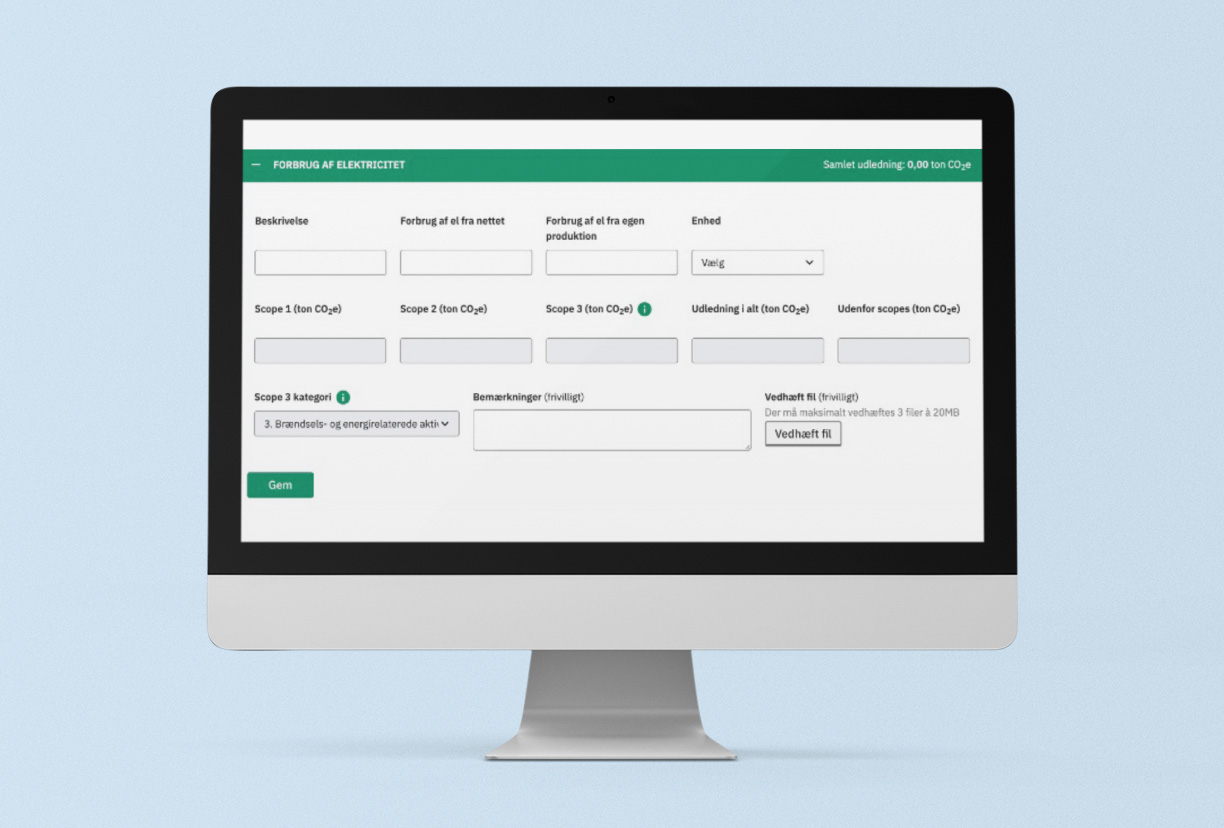
An example of the fields the user plots data available (Klimakompasset).
CIRCit Norden
CIRCit Norden was a research project that ran from 2017 to 2021, focused on developing, testing, and implementing science-based tools for the circular economy in the Nordic region. The project resulted in 32 tools and templates, which are organised into six workbooks:
- Circular Economy Sustainability Screening
- Circular Economy Business Modelling
- Circular Product Design and Development
- Smart Circular Economy
- Closing the Loop for a Circular Economy
- Collaborating and Networking for a Circular Economy
Each tool on the CIRCit Norden platform includes step-by-step guides, with an overview of when the tool should be applied during the development process. Depending on the product-service development stage, all workbooks offer valuable insights for designing and refining PSS business models. Some of the key tools relevant for PSS providers include:
Guidance for Navigating Trade-offs to Support Sustainability-related Decision-making: This tool supports decision-makers in the early stages of developing sustainability-related initiatives at the tactical and operational levels. It helps build strong arguments and justifications for decisions, avoiding arbitrary choices. The guidance is particularly useful for multidisciplinary teams, business developers, product designers, and service managers. This tool is part of the Circular Economy Sustainability Screening workbook.Circular Economy Customer and End-user Journey Map: This template assists in defining the appropriate value and experience for customers and end-users by evaluating their benefits and pain points. It encourages the refinement of business models and promotes resource decoupling practices, helping PSS providers address challenges. This tool is found in the Circular Economy Business Modelling workbook.Market and Product Decision Tree:
Total Cost of Ownership tool
The Total Cost of Ownership (TCO) Tool is a calculation platform designed to assess the total costs of a product, including its purchase price and lifetime operating costs. It is presented in a simple, Excel-based format with detailed guidance.
While the TCO tool does not cover all product types, it is relevant for evaluating a variety of product groups, including computers, displays, multifunctional devices, projectors, servers, storage, large network equipment, small network equipment, lighting, refrigerators and freezers, self-service machines, add-on bidets, motorised vehicles, air coolers, condenser units, dishwashers, ovens, and washing machines.
The tool is designed primarily for providers and procurers in the B2G market, but it can also be useful for PSS providers in the B2B and B2C sectors. The TCO tool is most effective in scenarios where:
- Operating costs constitute a significant portion of the total product cost.
- There are notable differences in annual operating costs between products.
- There are significant differences in product lifespan.
- A standard for measuring product lifespan is available.
The TCO tool factors in data related to ownership expenses, such as power consumption, water use, material resources, installation, services, and labour. While it focuses on economic costs, it does not directly account for environmental impacts. However, PSS providers can use the tool to estimate a product’s climate footprint by referencing CO₂ emissions and kWh standards.
Developed as part of the Danish Strategy for Intelligent Public Procurement, the tool is frequently used during tender processes by public agencies and organisations, as well as product providers.
For PSS providers, the tool offers valuable insights into the total costs and potential climate footprints of products, serving as a guide for pricing strategies and improving service offerings. These insights are particularly relevant for addressing the challenges that many Nordic PSS providers face when developing sustainable business models.
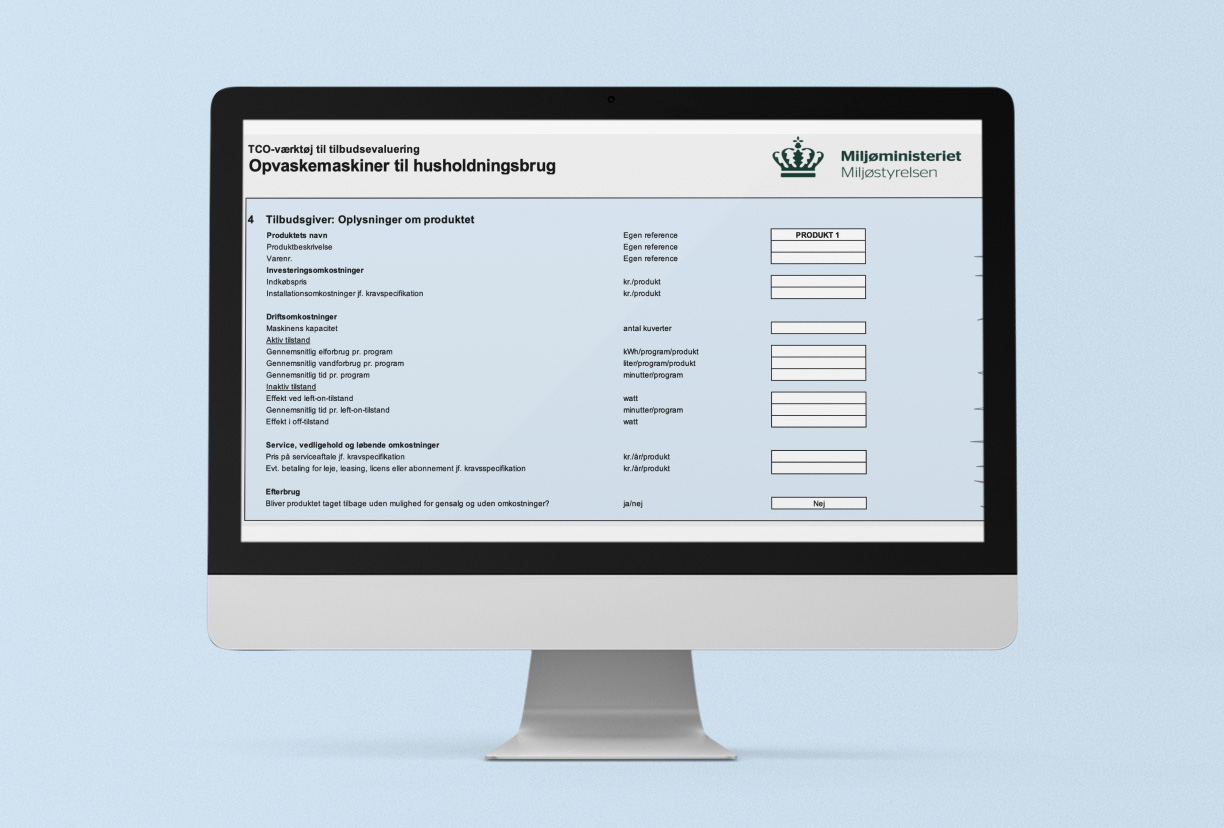
An example of the Excel tool specifically for dishwashers for household use.