Developing PSS strategies

Once you have a foundational understanding of PSS and circularity, the next step is to experiment and further develop your PSS concepts. This section provides tools, platforms, and handbooks designed to help you build a robust PSS strategy. Key areas include evaluating risks, comparing solutions, and initiating pilot projects to test your ideas in practice. Like the tools in the previous chapter, many of these resources also offer additional insights to deepen your understanding of PSS concepts.
ResCoM – Resource Conservative Manufacturing
The ResCoM platform integrates 11 software applications, descriptive tools, and methods that guide decision-making in closed-loop manufacturing. One key feature is the Circular Pathfinder, designed to help users identify the most relevant ResCoM tools for their specific product pathways. While the platform is primarily focused on manufacturers, many of the tools are also highly beneficial for PSS providers involved in distribution, retail, or reselling products.
Key tools on the ResCoM platform include:
Multiple Lifecycle Product Design Tool: Circular Calculator: Economic and Environmental Performance Tools: Tools such as the multi-method simulation tool, multiple product lifecycle management tool, and the MI: BoM Analyzer (Eco Audit Reports) provide detailed overviews of the business model’s economic and environmental performance. The MI: BoM Analyzer also assesses regulatory and supply chain risks associated with circular scenarios.
For Nordic PSS providers, regulatory and financial risks can pose significant challenges, particularly in developing new products and services. ResCoM helps mitigate these risks through early assessments, including evaluating regulatory uncertainty.
Additionally, ResCoM features an interactive game, ‘Lease or Buy’, which helps users explore different business models, revenue streams, and risks associated with ownership. This game particularly benefits new PSS providers, offering insights into the uncertainties in designing a successful business model.
The platform also includes relevant publications and case studies that provide additional insights into PSS models, making ResCoM a comprehensive resource for any business looking to adopt or refine closed-loop manufacturing and circular economy practices.
ready 2LOOP
Ready2LOOP is an online platform developed to help manufacturing companies and their value chains transition to a circular economy (CE). While originally developed for manufacturers, the platform is versatile and can be used by any business. Its goal is to enhance industry competitiveness by supporting the transition to CE across the entire value chain.
The platform resulted from a three-year project in which the ready2LOOP consortium collaborated with multiple companies to define, develop, and implement initiatives that improved their transition to CE. Insights from these collaborations were used to create the Transition Paths tools available on the platform.
Ready2LOOP offers three main tools for businesses looking to develop or enhance their PSS strategies:
MECO Analysis Tool: Readiness Workshop Toolkit: Circular Strategy Scanner: Provides an overview of circular economy strategies to inform decision-making.
In addition to these free tools, the platform offers 21 exclusive tools for registered members, such as the Circular Economy Sustainability Screening Tool, the Recirculation Strategy Decision Tree, and the Business Eco-system Mapping Tool. These tools are particularly useful for PSS providers seeking to collaborate with new partners or enhance existing partnerships.
Ready2LOOP also features five tool databases that provide an extensive overview of relevant resources for PSS providers and other businesses offering circular products or services. Accessing these additional tools requires creating a profile on the website.
Assessing a company’s readiness for transitioning to a circular economy, identifying strategic opportunities, prioritising key areas of focus, and planning the implementation of circular actions.
Support manufacturing companies and their value chains to make the transition to CE.
The Technical University of Denmark in consortium with other Nordic partners.
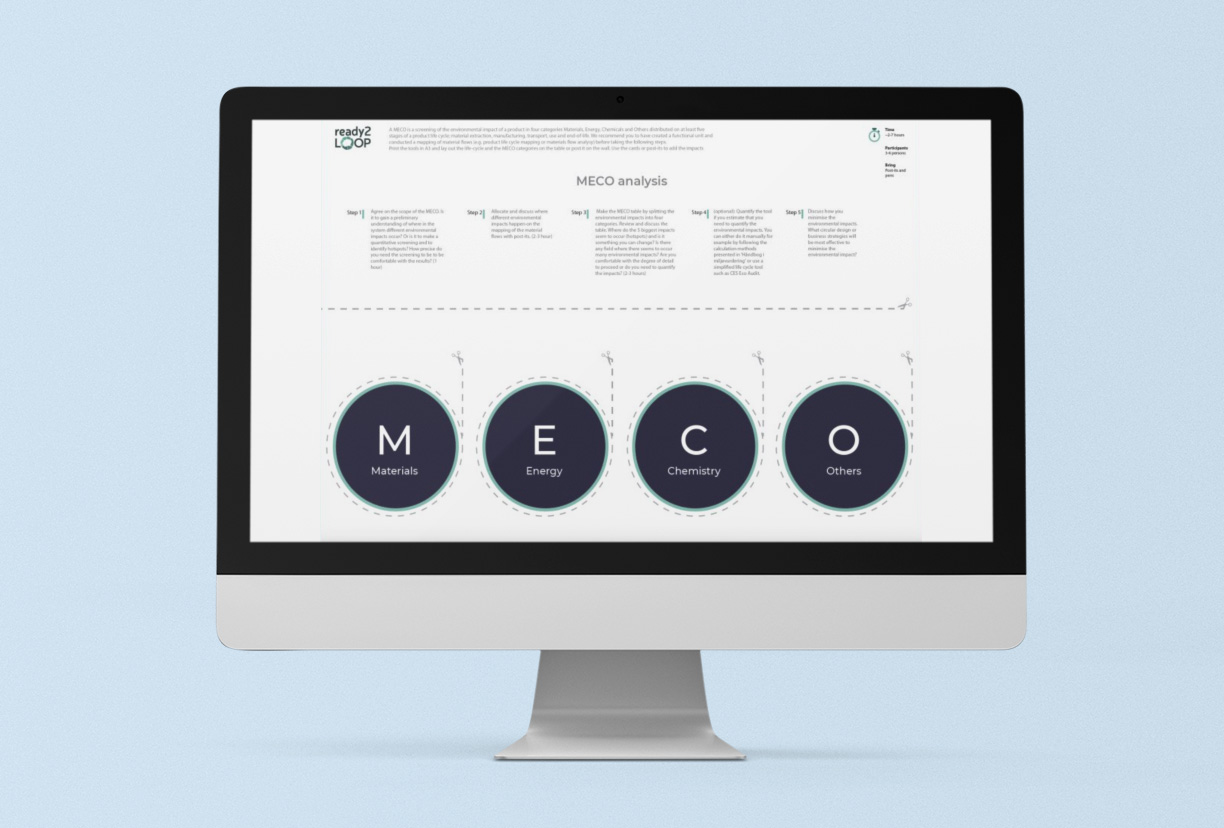
A snapshot of the MECO tool template from the ready2LOOP platform.
The Circular Toolbox
The Circular Toolbox is a comprehensive and educational, step-by-step guide designed primarily for apparel brands to plan and execute a rental pilot in 10 months. It is a versatile resource which offers a range of valuable resources, such as podcasts, workshop sheets, interview guides, educational slides, and templates. Although tailored for the apparel sector, the resources in the toolbox can easily be adapted to pilot projects in other industries. The Circular Toolbox was developed as part of the Circle Textiles Programme, the first sector programme by Circle Economy, launched in 2014. The guide is organised into five modules, each focusing on critical aspects of piloting a rental business model:
Getting started: Understanding the customer and the market:
Facilitating the introduction of rental schemes into new or existing business practices and preparing and launching pilot programmes.
Apparel branches, wanting to implement PSS solutions; gaining knowledge on implementation of pilot.
Prototyping your concept: Fine-tuning your business model: After this module, you’ll have a clear blueprint of your resale or rental model, helping you identify the partnerships, decisions, and steps needed for a successful pilot launch. It will also help you assess if your model is financially viable, customer-friendly, and positively impacts people and the planet. Importantly, for PSS solutions, tools focused on challenges and opportunities when creating meaningful partnerships can be found in this module.Piloting your business model:
Each step includes time estimates and clear guidance on whether exercises are meant for the core or extended team, making integrating these activities into everyday workflows easier. Some modules also include recommended reading to better understand the core principles and concepts used.
The toolbox is designed for brands, consultants, professors, and students. To access the resources, users must create an account on the platform to access the tools.
ATTC 2 toolbox
The ATTC 2 Managerial Toolbox provides a broad range of methods designed to diagnose and facilitate organisational change and business model innovation toward circularity within organisations and business ecosystems. The toolbox combines theoretical research and practical managerial insights to offer theoretically robust and easy-to-use tools, making them ideal for driving organisational transformation toward more sustainable practices.
The toolbox’s primary aim is to help organisations break free from the “management of unsustainability” lock-in and transition towards more sustainable configurations. It shifts the focus from merely “doing things better” to fundamentally “doing better things.”
The toolbox includes:
- 15 diagnostic methods to assess readiness for change and identify areas that need improvement.
- 9 methods for facilitating organisational change, which can be applied by organisations themselves or external facilitators.
- 9 methods for creating and developing business ecosystems, intended for ecosystem leaders.
The selection and application of tools should be carefully planned and adapted to the organisation’s specific needs. Ideally, this process is supported by change management experts who can help identify the root causes of unsustainable practices and recommend a tailored combination of methods to address these issues effectively.
Assessing readiness for organisational change, identifying necessary changes, and facilitating business model innovation toward circularity.
Organisations/management profesionals moving towards circular business models.
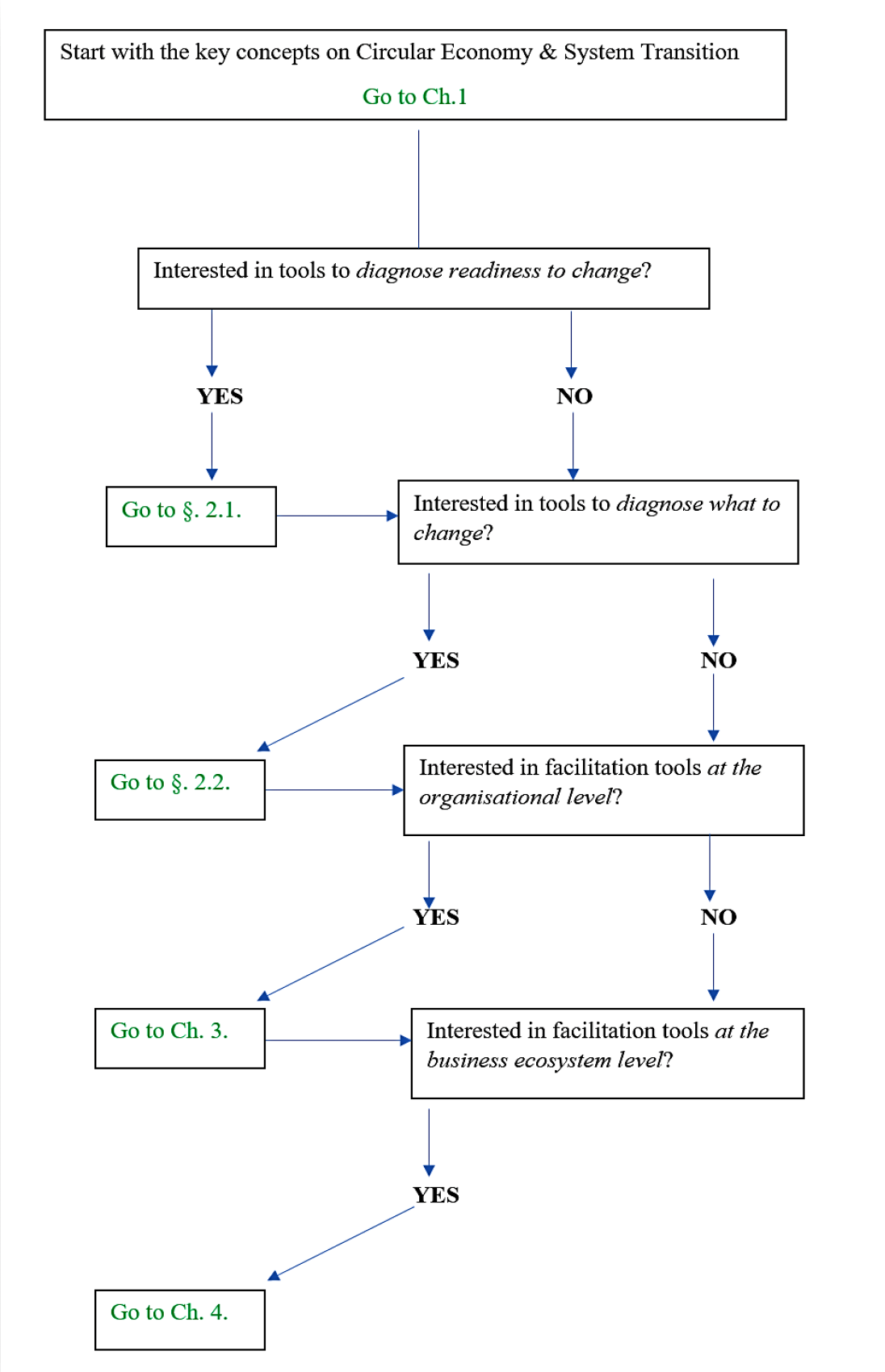
A navigation chart (from ATTC 2, p. 12) guiding the reader to the relevant chapter.
Circular X tools
The Circular X tools, developed as part of an ambitious 6.5-year research project focused on experimenting with circular service business models, are funded by the European Research Council (ERC), which supports top researchers globally. The platform provides a range of resources to help businesses adopt circular strategies. Among the ten tools currently available, five are especially relevant for PSS providers or businesses exploring PSS opportunities:
Business for sufficiency database: Boundary tool: Circular rebound tool: The Circular Experimentation Workbench: Circular Business Model Pilot Plan:
These tools and others developed as part of the Circular X project provide valuable resources for organisations aiming to transition towards more sustainable and circular business models.