overview of resources

This section provides a visual overview of the 15 Nordic and European tools identified. The tools, templates, and guides are categorised by their level of PSS integration and grouped according to key business needs. The overview is designed to help you quickly find the most relevant resources, whether you are a start-up seeking guidance on developing a PSS model or an established company looking to enhance and optimise your current operations.
Tools and guides
The following is a curated list of the resources featured in this report. While not an exhaustive list, it includes tools that are specifically designed to support circular business models, such as PSS. The tools highlighted were identified between 2022 and 2023 as part of the broader “PSS in the Nordics” project, primarily focusing on Nordic and European sources.
Each resource has been chosen for its relevance and practicality in supporting companies on their PSS journey, whether they are at the early stages of exploration or looking to optimise existing systems. All tools and guides are freely available, accessible online, and can be downloaded without restrictions. Most are in English, with two resources offered in Danish, specifically for organisations operating in Denmark.
- Accelerating System Transitioning Towards
- CEvaluator
- CIRCit Norden
- Circularity – ATTC 2 toolbox
- Circular X tools
- Guide for developing product as a service business
- Klimakompasset (the climate compass)
- Lean Service Creation (LSC) Handbook
- PROTEUS PSS Tool Book
- ready2LOOP
- ResCoM
- The Circular Design Guide
- The Circular Toolbox
- The Circulator
- Total Cost of Ownership tool
Visual overview
The following figures visually map out the tools, categorising them by their level of PSS integration and the specific business needs they address.
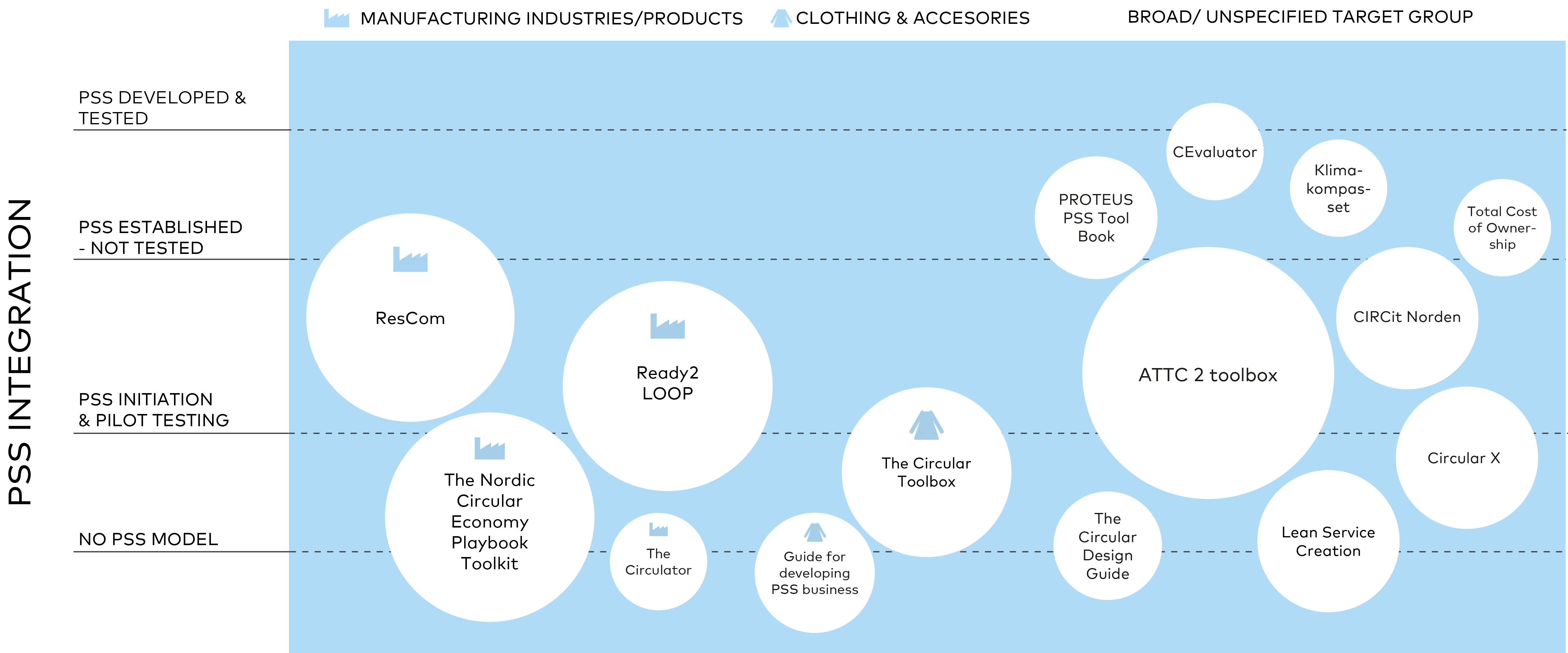
In these visualisations, PSS integration is shown on a spectrum from “No PSS model” to “PSS developed & tested,” representing the extent to which an organisation has integrated PSS into its business model and offerings.
It is important to highlight that these visualisations and categorisations are intended as a guide. While tools are categorised based on their relevance to specific integration levels, many can be applied flexibly across different stages of PSS development.
Where are you?
The figure below provides an overview of the PSS tools, categorised by their intended target group and the level of PSS integration within a business. At the bottom of the spectrum, you’ll find tools designed for companies with no existing PSS model, offering support from the ground up. As you move upward, the tools become more specialised, helping businesses refine and advance their PSS solutions as they mature. The size of the circles indicates the versatility of each tool: larger circles represent broader tools that can support businesses across multiple stages of PSS development.
What is needed?
This overview organises the tools based on the specific needs businesses may have when developing or enhancing their PSS solutions. The PSS integration levels are simplified into “No PSS” for businesses that have yet to integrate PSS into their operations and “PSS developed” for those with established PSS models. Tools marked as “Unspecified PSS integration” are flexible and applicable across different stages of PSS development, making them relevant for businesses regardless of their current level of integration.

Categories of needs
To help you easily identify the purpose of each tool, they are organised into seven categories that reflect the specific challenges businesses encounter when developing or refining their PSS solutions. Some tools appear in multiple categories, as they address a wide range of business needs.
Get inspired through cases
If you’re looking for real-world examples of organisations implementing circular solutions relevant to PSS, start with the case catalogues in this category. These resources feature examples from various sectors, showcasing organisations at different stages of PSS integration.
Compare solutions
These tools are best suited for businesses with existing PSS models or products that need to be evaluated for their environmental or economic performance. Tools like ResCom allow you to compare PSS models with traditional linear models, while tools such as Klimakompasset help track climate impact over time. Accurate data is essential for conducting meaningful assessments.
Calculate/quantify impact
For businesses looking to measure the environmental or economic impact of their products or operations, the tools in this category offer guidance on collecting and utilising relevant data. If you don’t yet have the necessary data, these tools can help identify what information should be gathered. Please note that some tools are tailored specifically for Danish organisations and require MitID access.
Create or refine a business model
This category offers tools to help you develop or refine your business model toward a PSS or circular approach. The resources here introduce different types of circular business models and offer broad perspectives on stakeholders, value chains, products, and end-users, enabling you to identify new opportunities.
Evaluate solutions/improve existing services
These tools are designed for businesses familiar with PSS and looking to evaluate or optimise their existing solutions. Some tools may require specific data for a thorough evaluation. If you’re ready to critically review and enhance your PSS business, this category will support your efforts.
evaluate readiness to transition
Before jumping into changes, it is essential to assess your organisation’s starting point and readiness for the shift to circular and PSS models. The tools in this category help you evaluate and diagnose your current state, providing insights into how prepared your business is for the transition.
Evaluate risks
This category includes tools designed to help businesses assess the risks associated with transitioning to and implementing PSS solutions. Key resources include SWOT analysis tools (CIRCit), financial evaluation questionnaires (CEvaluator), and MI:BoM Analyzer (ResCom) for material impact evaluations.
Guide structure
The guide is organised into three chapters, simplifying the PSS integration levels into three distinct stages.
Chapter 1: Getting Started with PSS focuses on tools and guides suited for businesses in the early stages of PSS integration. At this level, the PSS solution has not yet been defined, and a foundational understanding of PSS models is required. Many of the tools in this chapter provide introductory content on Circular Economy and PSS concepts.
Chapter 2: Developing PSS Strategies offers tools to help businesses advance their PSS solutions, providing a pathway towards deeper integration. These resources assist in moving from basic PSS models to more structured and strategic approaches.
Chapter 3: Refining PPS Strategies is designed for businesses with established PSS models. It includes tools, templates, and guides that enable providers to reassess and optimise their PSS solutions for continued improvement and efficiency.
The chapter overview indicates which tools are explained in each section of the report, aligning with the progression of PSS integration levels.