3. Sustainable Development as an Educational Aim
The target groups of this publication are governmental educational officers, educational trade union officers, educational researchers, and educational practitioners (teachers, school leaders, etc.). Sustainable Development (SD) as an educational aim appears rather differently for these distinct groups. While the administrators may approach it from the view of policy, administration and resources, the practitioners are often more concerned with their day-to-day working with students where the practicalities of school life may both pose challenges as well as open possibilities. The researchers are sometimes situated in-between the two groups, focusing on both policy and the work in schools and other educational settings. Addressing education for sustainable development (ESD) or sustainability education (SE) with these three groups in mind is, thus, a complex task. To focus the work and bring into sync these three different perspectives, we begin by discussing some organising concepts.
Similar to the report Mapping Education for Sustainability in the Nordic Countries, the concepts of Bildung and Stephen Sterling’s sustainable education are here used as organising concepts (Sterling, 2001). Since one of the target groups is practitioners, this report also uses a more concrete or practice-oriented model called PACK, devised by Ólafur Páll Jónsson and Allyson Macdonald. The PACK model is framed around four questions addressing pedagogy (P), assessment (A), curriculum (C), and knowledge (K) (see Table 2):
Table 2: Four types of questions about educational reform
P Pedagogy | A Assessment | C Curriculum | K Knowledge | |
Guiding questions | How to teach students? | How to evaluate learning? | What is to be taught? | What knowledge is needed? |
Jónsson and Macdonald distinguish two ways of answering these four questions. The first is a conventional way, which corresponds to what Sterling has called “the conventional educational paradigm” (2021). According to this way of answering the four questions, one moves from right to left, beginning by identifying the relevant or necessary knowledge (K) and ending by devising methods that deliver the goods in an “appropriate” manner (P). According to the conventional educational paradigm, educational design would proceed in the following way:
(K) Gather experts to identify relevant knowledge and skills;
(C) Organise these as objectives of formal education;
(A) Devise a way of assessing the extent to which these objectives are met; and
(P) Develop appropriate practices for the work of students that connect the knowledge (K), the curricular objectives (C), and the assessment (A).
(C) Organise these as objectives of formal education;
(A) Devise a way of assessing the extent to which these objectives are met; and
(P) Develop appropriate practices for the work of students that connect the knowledge (K), the curricular objectives (C), and the assessment (A).
The second way to answer the questions about educational reform (see Table 2) relies on an alternative understanding of educational design that aims at change at a deeper level, second or third, and focuses on students’ competencies, their own knowledge, values, ideas and participation in the learning process. This way moves in the opposite direction (from P to K) and also interprets the key concepts differently:
(P) Develop a pedagogy where teachers and students meet in a collaborative setting to learn from each other, and
(A) jointly assess the quality and the outcome of the educational activity according to measures that are developed as part of the educational activity,
(C) while working towards objectives that are at least partly defined through a collaborative learning process, which
(K) aims to make the learners question their conceptions of themselves and the world.
(A) jointly assess the quality and the outcome of the educational activity according to measures that are developed as part of the educational activity,
(C) while working towards objectives that are at least partly defined through a collaborative learning process, which
(K) aims to make the learners question their conceptions of themselves and the world.
The four questions and the two ways of answering them are summed up in the following table (Table 3).
Table 3: Sustainable education framing of PACK-ing for educational design
P Pedagogy | A Assessment | C Curriculum | K Knowledge | |
Guiding questions | How to teach students? | How to evaluate learning? | What is to be taught? | What knowledge is needed? |
Conventional understanding | Present established knowledge and training for skills. | Assessed students, either formatively or summatively. | Curricula defines objectives and content of education. | Knowledge building is an accumulation of established knowledge and skills. |
Transformative understanding | Engage with students in a collaborative setting. | Students and teachers together assess the process of learning. | Objectives of education are identified through collaborative learning. | Knowledge building is more about enabling conceptual change and transformation. |
According to the transformative understanding of the PACK model, educational change for sustainability supports teachers and other practitioners in reflecting on how they think of education and shape the way they teach. This, in turn, calls for support for people at various administrative levels to work with teachers and students in developing their work. In this scenario, the role of academics and researchers is not to produce external expert knowledge but to support both practitioners and people at various administrative levels in their work.
When considering the Nordic countries’ Overshoot Days (see Figure 2) we see that the change needed is not a matter of mere amendments or reform but a thorough transformation of how people live in the Nordic region, and in other parts of the affluent north. When looking at the countries with the earliest Overshoot Days, i.e. the countries with the most ecologically demanding economies, we see countries which boast of good educational systems. Among the top scorers on PISA for many years, Finland has an overshoot day at the end of March. The other Nordic countries are not far off with none getting past the first four months of the year.
If education is supposed to be a driver for change, then we need something drastically different from what we have seen so far. In Sustainable Education: Revisioning Learning and Change Sterling describes what he calls the ‘conventional educational paradigm’:
Although over twenty years old, these words are not outdated. Other scholars have written in a similar vein. As early as 1992 Bob Jickling wrote a provocative paper titled “Why I don’t want my children to be educated for sustainable development” where he argued that such education would be too instrumental at the expense of meaningful education (what we might refer to as Bildung in the Nordic context). He also said that the concept of sustainable development was too contestable to be useful to define aims in education, and that the prescription of particular outcomes conflicted with the development of autonomous thinking as an educational aim. The PACK model mentioned above is, in part, an attempt to respond to such worries. This model leaves the door open to a future that can be visioned and planned by the students, and even encourages them to question the entire SD idea and to suggest alternatives (see also Wolff, 2011; Wolff et al., 2024).
3.1 Main Trends in Sustainability Education
Within the field of SE or ESD, diverse conceptions of education related to sustainability have emerged. We will describe a few such approaches, beginning with various conceptual frameworks and then give examples of educational programs which explicitly aim at sustainability. In a paper titled “Learning for Change: Exploring the Relationship Between Education and Sustainable Development” Paul Vare and William Scott make a distinction between ESD1 and ESD2, which many later scholars and practitioners have found useful. They describe ESD1 as expert-knowledge driven:
What Vare and Scott refer to as ESD2, on the other hand, is not about reaching certain predefined goals but locating SD within the learning process itself:
Vare and Scott then elaborate on the learning process which exemplifies ESD2 saying:
Arjen Wals makes a similar distinction between instrumental and emancipatory environmental education. He describes the former in the following way:
This kind of education falls neatly within the conventional paradigm that Sterling criticised for sustaining unsustainability. Wals then questions the instrumental approach on grounds similar to those that had scared Jickling away from ESD some twenty years earlier:
In summing up the difference between an instrumental approach and an emancipatory approach, which he favours, Wals writes:
The differences between ESD1 and ESD2, as well as the differences between instrumental and emancipatory education, fit well with the difference between conventional and transformative education highlighted by the PACK model. The conventional reading corresponds to ESD1 and instrumental education while the transformative reading corresponds to ESD2 and emancipatory education. What all authors agree on is the importance of internalising the principles of SE through personal and collaborative incentives that encompass a transformative mindset. Some scholars and practitioners have related this to the head-heart-hand approach to SE mentioned above (Jordan, 2022; Singleton, 2015).
3.2 Transformation, Competencies, and Bildung
As already mentioned, the policy documents used to implement sustainability in education are not undisputable. They have often been developed by a large number of people from various countries, with many kinds of experiences and from various disciplines. Therefore, the result is not always in line with pedagogic principles or educational research findings. Consequently, ideas and concepts may be used superficially or with an intention to make the measurement of learning results easy. In the following, we will present a few educational views that relate to SE.
3.2.1 Transformation
An often-mentioned approach related to sustainability is transformation. The UN policy report Transforming Our World: The 2030 Agenda for Sustainable Development (UN, 2015) includes the word ‘transformation’ already in its title. When discussing SE, transformation is increasingly suggested as the remedy. Obviously, all educational levels must support a profound worldview change, a transformation (Balsiger et al., 2017). Yet, such a transformation may include changes at many levels: personal, cultural, organisational, institutional, and so on. Yet, transformation processes are all but simple — they are extremely complicated. In policy discourses, it may be unclear why, how, what or who to transform. It is most obvious that the state of the world is all but good. However, there is still no consensus on how to change the world to make it a better place to live. It is also worthwhile considering in whose interest any change would be, and what its consequences are (O’Brien & Sygna, 2013; Zilliacus & Wolff, 2021). Many voices argue that the Agenda 2030 and its SDGs are not radical enough (Briant Carant, 2017; Scott, 2015; Swain, 2018). They see the agenda as a tool to continue an unjust economic development. In contrast, they call for a global redistribution of resources.
Even if Agenda 2030 and similar policy agreements are not convincing enough, they point out that the course of the world needs to be altered. The urgent situation depends on human willingness and capability to change the development in a more sustainable direction. Obviously, the planet needs more than technical innovation and economic growth. It needs humans, who can solve the tremendous planetary problems while handling uncertainty and unpredictability. This, in turn, depends on profound knowledge about the planet and its limits, but also knowledge about society and everyone’s knowledge about oneself (Wolff, 2011). In addition, the world needs a population with a willingness to learn from history, to live a conscious life in the present, and to build the future responsibly and jointly. For education to become part of the solution to current challenges, to be truly sustainable, it must be transformed. It is widely accepted that such transformation can take different forms. The phrases ‘transformative education’ and ‘transformative learning’ are used in many contexts, but often without much theoretical base (Rodríguez Aboytes et al., 2020) — sometimes so that they are little more than empty words.
For many decades, the theory of transformative learning has been used in adult learning contexts and lately also in SE contexts. In the 1970s, Jack Mezirow started the development of the “transformative learning theory”. In adult education, Mezirow (2009) saw learning as a process in which the learners transform problematic frames of reference on specific topics (e.g., democracy) to make them open for change. According to the transformative learning theory, the learner is an active participant in discourses (Mezirow, 1991). The transformative learning theory is strongly based on earlier basic theories, and with help of many other scholars, Mezirow continued to develop the transformative learning theory for many decades (Wolff, 2022). This makes the theory complicated and a fast implementation of it all but easy. The transformative learning theory requires testing and developed to become a useful theory for SE.
3.2.2 Competence and competency
Another concept that relates to SE, and often is mentioned in connection to transformation is competencies (alternated with the word ‘competence’, which is not a synonym; competence is a state, i.e. the successful achievement of one or more competencies). In the wake of the 21st century skills and other contemporary educational concepts, and policy approaches, competence and competency (plural form ‘competencies’) have become increasingly attractive. This is also the case when discussing SE. In the 1990s, the OECD began to use competency as a development aim in educational contexts (OECD, 2014). In 2024, numerous SE programs strive towards developing the students’ competence or competencies. Thus, numerous sustainability competency lists are presented in various educational contexts, especially policies, though the lists seldom explain what theories they are built on (Brundiers, et al., 2021). The competency approach is mostly instrumentally focused on changing people, and it is, therefore, worth considering if competency approaches are appropriate if the aim is to educate students to become independent and critical thinkers in a complex unsustainable world situation.
3.2.3 Bildung
A third concept increasingly common in SE is Bildung. It relates strongly to transformative learning, and partly shares the same theoretical roots. Both Mezirow’s transformative learning theory and Bildung are built on thoughts of philosophers like Rousseau, Kant, Schleiermacher, Hegel, Herbart, and Habermas (Wolff et al., 2024). According to the idea of Bildung, humans can learn to exceed the present. Metaphorically this exceeding is like a creative dialogue in which a novice learns through a discussion with the surrounding world. Nevertheless, in the Bildung process the outcome is left open. Therefore, a Bildung process does not promote any specific way of thinking or living but is “a guiding concept that reflexively ties together a diversity of life experiences and lifestyles” (Riese & Hilt, 2021, p. 99). In both transformative learning and Bildung, critical reflection is a crucial element. By critically reflecting on the past, the student becomes able to transform the present towards something they consider better. Thus, Bildung helps the students to realise the shortcomings of their former knowledge, and envision the future (Uljens, 2020). Similarly, Wolfgang Klafki (1997, 1998) asserts that teachers do not know what knowledge students might need in the future. Therefore, Klafki includes ‘epochal key problems’ into the Bildung concept to address global crises related to both nature and society. According to Klafki (1998), Bildung includes promotion of a students’ ability to critique, argue, and show empathy. The Bildung concept has also been criticized for being overly human-centred and recent work has both questioned and explored the possibilities of a post-human concept of Bildung (Taylor, 2017).
3.3 Approaches to Sustainability Education
Many agencies, such as international and interstate organisations have created programs and strategies on how to promote sustainability and sustainability education. Their reasons are, though, different. Some of them have a humanist aim, others a political goal, and still others may have an economic interest driving their task. These agencies also have various views of the role of education, and sometimes they are strongly instrumental, such as creating employment or aiming at economic success. Therefore, these documents may not present a unified view of sustainability education and are open for negotiations. A few of them are presented below. The first is the most cited, and it is a major document for people working with the implementation of sustainability all over the world.
3.3.1 United Nations and UNESCO: Sustainable Development Goals (UN SDGs) and Key Competences
In autumn 2015, the UN General Assembly adopted the 2030 Agenda for Sustainable Development creating a framework to redirect humanity onto a path for sustainable living. The agenda consists of seventeen goals (see Figure 4) which are meant to secure a sustainable, peaceful, prosperous, and equitable life on earth for everyone now and in the future. These goals are well known; they are featured on posters in many schools and a lot of learning material has been produced which is framed in terms of these seventeen goals.
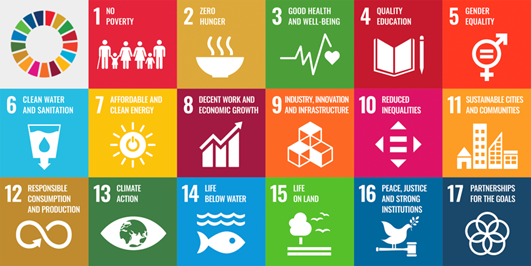
Figure 4: The seventeen UN SDGs adopted by the UN General Assembly on September 25th, 2015.
Stockholm Resilience Centre has reorganised these goals into the so-called “wedding cake” model (see Figure 5). In this model the three circles correspond to the three pillars — environment, society and economy — in terms of which SD was defined in the report Our Common Future from 1987. From a pedagogical point of view, the “wedding cake” model relates the seventeen UN SDGs to the three pillars of sustainability. The wedding cake model can thus help teachers to have a better overview of the SDGs while simultaneously seeing the interrelationship between them.
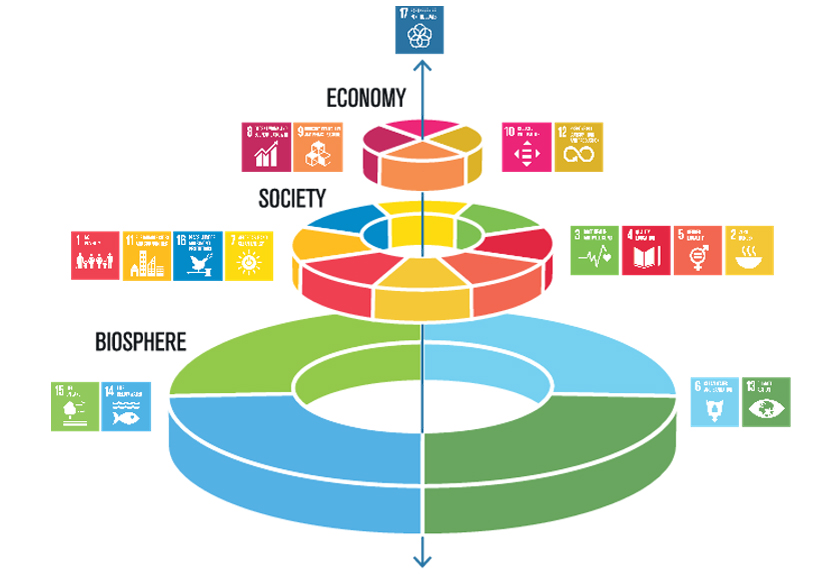
Figure 5: The “wedding cake” model of the seventeen UN SDGs developed by Stockholm Resilience Centre. (Azote for Stockholm Resilience Centre, Stockholm University CC BY-ND 3.0.)
In addition to the UN SDGs, the UN also defined broad key competences which were described in the following way:
These UNESCO key competencies are:
- Systems thinking competency: the abilities to recognize and understand relationships; to analyse complex systems; to think of how systems are embedded within different domains and different scales; and to deal with uncertainty.
- Anticipatory competency: the abilities to understand and evaluate multiple futures — possible, probable and desirable; to create one’s own visions for the future; to apply the precautionary principle; to assess the consequences of actions; and to deal with risks and changes.
- Normative competency: the abilities to understand and reflect on the norms and values that underlie one’s actions; and to negotiate sustainability values, principles, goals, and targets, in a context of conflicts of interests and trade-offs, uncertain knowledge and contradictions.
- Strategic competency: the abilities to collectively develop and implement innovative actions that further sustainability at the local level and further afield.
- Collaboration competency: the abilities to learn from others; to understand and respect the needs, perspectives and actions of others (empathy); to understand, relate to and be sensitive to others (empathic leadership); to deal with conflicts in a group; and to facilitate collaborative and participatory problem solving.
- Critical thinking competency: the ability to question norms, practices and opinions; to reflect on one’s own values, perceptions and actions; and to take a position in the sustainability discourse.
- Self-awareness competency: the ability to reflect on one’s own role in the local community and (global) society; to continually evaluate and further motivate one’s actions; and to deal with one’s feelings and desires.
- Integrated problem-solving competency: the overarching ability to apply different problem-solving frameworks to complex sustainability problems and develop viable, inclusive and equitable solution options that promote sustainable development, integrating the abovementioned competences.
Various programmes and initiatives have taken up the SDGs and other material developed by the UN and developed diverse educational resources, methods and various supporting material. One such programme is The World’s Largest Lesson (https://worldslargestlesson.globalgoals.org/). The web page offers the possibility to search resources by theme, SDG, resource type, age group, duration and language, with Danish, Norwegian and Swedish among the language choices in addition to English. A problem with the SDGs has sometimes been that people in various contexts, also in education, have chosen to split the goals and focus on only a few of them. To see them as a complexity that is intertwined has not always been easy.
3.3.2 European Commission: GreenComp
The EU Commission adopted a Council Recommendation on learning for environmental sustainability in January 2022. It provides recommendations, research evidence and good practice from across Europe and can serve as a guide for policy makers, educators, individuals and organisations working on the issue of sustainability in the education and training sector. Key EU policies point to the role of education and training in empowering and engaging people for environmental sustainability and boosting the skills and competencies needed for a green transition. The EU Commission’s proposal recognises different movements and strands that work for SE. All these movements and concepts share a vision of education and learning which is transformative, embraces change and promotes sustainability.
To prepare the proposal, the EU Commission consulted widely on the current state of learning for environmental sustainability to collect good practice and to identify difficulties and barriers. Workshops were arranged with policymakers and stakeholders from the field of education and training, the research arena and the youth sector. In addition, a series of online meetings were held with teachers who were active on sustainability and environmental issues in their schools. This process led to a clear understanding that support was needed that could facilitate third level changes both on individual and societal levels. To this end the GreenComp approach was developed:
GreenComp consists of twelve competencies organised into four areas: (1) embodying sustainability values, (2) embracing complexity in sustainability, (3) envisioning sustainable futures, and (4) acting for sustainability (see Figure 6). As a reference tool, GreenComp can serve a wide range of purposes, including education reforms described earlier in relation to the PACK model. GreenComp can also support education and training systems in cultivating critical thinkers who care about the planet, as it presently is and as it can be imagined as flourishing in the future.
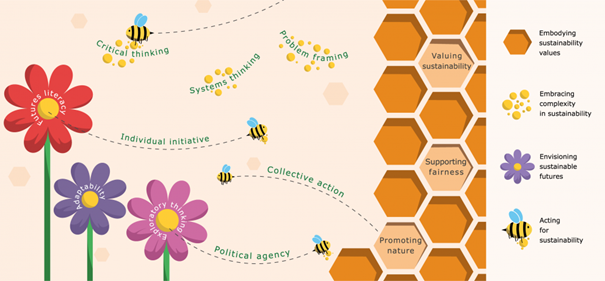
Figure 6: A pictorial representation of the GreenComp framework. The four competence areas are on the right with the 12 competences represented by the flowers, bees, honey and honeycomb.
3.3.3 OECD: Future of Education and Skills 2030
In 2019 the Organization for Economic Cooperation and Development (OECD) published a series of concept notes under the heading OECD Future of Education and Skills 2030. The document begins by raising the following questions:
The first concept is what OECD refers to as the ‘Learning Compass 2030’ (see Figure 7), which outlines the knowledge, skills, attitudes, and values students need to constructively face their realities and shape their futures. OECD refers to the Learning Compass as a “learning framework” — not as an “assessment framework” or a “curriculum framework”. According to OECD, the Compass offers a broad vision of the types of competencies students need to thrive in 2030, as opposed to what kind of competencies should be measured or can be measured. Moreover, the Learning Compass is not confined to formal education, which is guided by explicit curricula and instructional strategies, but applies to informal and non-formal education as well. The Learning Compass 2030 is composed of seven elements:
- Core foundations. The OECD Learning Compass 2030 defines core foundations as the fundamental conditions and core skills, knowledge, and attitudes and values that are prerequisites for further learning across the entire curriculum. The core foundations provide a basis for developing student agency and transformative competencies. All students need this solid grounding in order to fulfil their potential to become responsible contributors to and healthy members of society.
- Transformative competencies. To meet the challenges of the 21st century, students need to be empowered and feel that they can help shape a world where well-being and sustainability — for themselves, for others and for the planet — are achievable. The OECD Learning Compass 2030 identifies three “transformative competencies” that students need to contribute to and thrive in our world, and shape a better future: creating new value, reconciling tensions and dilemmas, and taking responsibility.
- Student agency/co-agency. Student agency is defined as the belief that students have the will and the ability to positively influence their own lives and the world around them as well as the capacity to set a goal, reflect and act responsibly to effect change. Student agency relates to the development of an identity and a sense of belonging. When students develop agency, they rely on motivation, hope, self-efficacy and a growth mindset (the understanding that abilities and intelligence can be developed) to navigate towards well-being. This enables them to act with a sense of purpose, which guides them to flourish and thrive in society. Students learn, grow and exercise their agency in social contexts, and this is why co-agency is also crucial. Students develop co-agency in an interactive, mutually supportive and enriching relationship with their peers, teachers, parents and communities in an organic way in a larger learning ecosystem.
- Knowledge. As part of the OECD Learning Compass 2030, knowledge includes theoretical concepts and ideas in addition to practical understanding based on the experience of having performed certain tasks. The Education and Skills 2030 project recognises four different types of knowledge: disciplinary, interdisciplinary, epistemic and procedural.
- Skills. Skills are the ability and capacity to carry out processes and be able to use one’s knowledge in a responsible way to achieve a goal. The OECD Learning Compass 2030 distinguishes three different types of skills: cognitive and metacognitive; social and emotional; and practical and physical.
- Attitudes and values. Attitudes and values refer to the principles and beliefs that influence one’s choices, judgements, behaviours and actions on the path towards individual, societal and environmental well-being. Strengthening and renewing trust in institutions and among communities require greater efforts to develop core shared values of citizenship in order to build more inclusive, fair, and sustainable economies and societies.
- Anticipation-Action-Reflection cycle. The Anticipation-Action-Reflection (AAR) cycle is an iterative learning process whereby learners continuously improve their thinking and act intentionally and responsibly. In the anticipation phase, learners become informed by considering how actions taken today might have consequences for the future. In the action phase, learners have the will and capacity to take action towards well-being. In the reflection phase, learners improve their thinking, which leads to better actions towards individual, societal and environmental well-being (pp. 15–17).
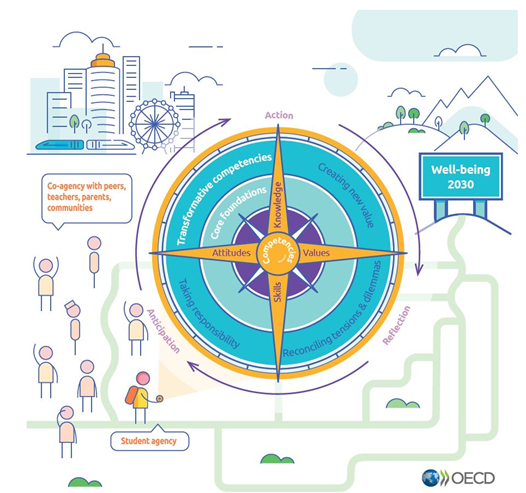
Figure 7: OECD Learning Compass 2030 (OECD, 2019).
3.3.4 Council of Europe: Reference Framework on Competences for Democratic Culture
The Council of Europe (CoE) has developed various educational frameworks, activities, tools and resources and most of them — if not all — are relevant for the implementation of Agenda 2030. The organisation has, therefore, not set up new objectives, instruments or activities in relation to the UN SDGs, but has aligned the existing ones with relevant UN SDGs (see https://www.coe.int/en/web/un-agenda-2030/home).
The organisation is not directly responsible for implementing Agenda 2030; that responsibility lies with each state, but the instruments developed by CoE can, however, contribute to national implementation and reporting by member states. Since 2013, the CoE has been developing the Reference Framework for Competences for Democratic Culture (RFCDC). The RFCDC can be used by education systems to “equip young people with competences that are needed to take action to defend and promote human rights, democracy and the rule of law, to act as active citizens, to participate effectively in a culture of democracy, and to live peacefully together with others in culturally diverse societies”. The RFCDC defines twenty key competences that are organised into four categories: (1) values, (2) attitudes, (3) skills, and (4) knowledge and understanding. These twenty competences are often represented as “the butterfly” (see Figure 8). Although “sustainability” does not appear as one of the competences within the RFCDC framework, it aligns well with both the UNESCO key-competences and the GreenComp developed by the European Commission.
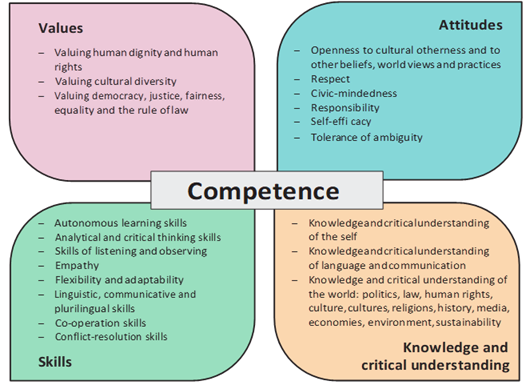
Figure 8: “The butterfly” of competences for democratic culture developed by the Council of Europe (https://www.coe.int/en/web/reference-framework-of-competences-for-democratic-culture).