1. Introduction
The Nordic countries aim to rank among the most sustainable countries in the world, according to various vision statements and policy documents, many of which highlight the importance of education for reaching this goal (Nordic Council of Ministers, 2019; 2022). However, the Nordic countries approach sustainability differently, and educators understand the concepts of sustainability and sustainable education in diverse ways. Within the Nordic region aspects related to policy and teacher education have already been documented (Jónsson et al., 2021), and various local studies on sustainability education have been conducted. However, there is still limited knowledge about the bigger picture of actual practices within schools and other educational settings, as well as at various administrative levels.
In the introduction to the document Education for Sustainable Development Goals: Learning Objectives published by the UN in 2017 the authors write:
Yet, despite extensive work, both locally within individual countries and globally, the climate continues to deteriorate, democracy and human rights are threatened, inequalities continue to increase, and the number of refugees worldwide is on the rise and those most vulnerable are often met by punitive systems rather than humanitarian empathy. The challenge for those working in the educational sector is to make change towards sustainability possible. The challenge is not to merely improve the current educational paradigm but to thoroughly change it with the aim of changing society. Therefore, the change we are talking about is more than a change of teaching methods or the introduction of a new subject. While ‘whole school approach’ sounds right in this context, since the change must be holistic and not just a limited aspect of the school, nothing short of ‘whole society approach’ is needed.
Education has always been the backbone of society; it is interwoven into the culture and shapes the way individuals and nations think, feel and act. Through the ages, education has answered the demands of the present to draw on experience for past challenges and problems, making headway toward future solutions. At present, however, past experiences may not be sufficient to pave the way. Past solutions – along with current cultural values – have resulted in the detrimental situation in which humanity finds itself right now. What is needed is a new vision, new imagination, perhaps new hope. Nobody has ever experienced what a sustainable society at the beginning of the 21st century might look like (Iyengar & Kwauk, 2021).
To encompass sustainability, it will not suffice to tell educators, students, and academia what to do. Education must be embodied with the understanding of sustainability through the head, heart, and hand ideology (Olsen et al., 2024) so that people may become true sustainability citizens. In addition, now living individuals cannot alone be blamed for the unsustainability situation. Nobody can fix this without joint efforts. The crises the world faces today is a result of human practice for centuries and depend on deeply rooted norms and mistreatment of human beings and other forms of nature for a long time.
1.1 A Paradoxical Situation
Within the Nordic countries, the situation concerning sustainability is somewhat paradoxical. According to various scales, the Nordic countries are leading the way, and the politicians are proud to present the Nordic region as performing well. In this spirit is the vision for 2030 presented by the Nordic prime ministers and the Ministers for Nordic Co-operation in autumn 2019:
The tone here is proud and optimistic, there is a conviction that the Nordic countries can send the rest of the world a positive message that sustainability is an achievable goal. The tone is similar in another publication from 2019, A Good Life in A Sustainable Nordic Region: Nordic Strategy for Sustainable Development 2013-2025. The following quote from the introductory chapter shows this:
Our report does not question that many positive things are carried out in the Nordic countries – it is a good place to live, and the region is progressive in many ways. However, the quality of life in the Nordic Countries is excessively carbon and resource intensive and far from being sustainable.
Various measures calculated both globally and for individual countries make this evident, such as the Environmental Footprint or the Earth Overshoot Day. The global measure is defined in the following way:
This is not a precise measure but can illustrate that real change is urgently needed. In 2024 Earth Overshoot Day fell on August 1st and has, with minor exceptions, been moving backward since 1970 as shown in Figure 1. The figure illustrates the global situation, or rather the accumulated situation where the impact of people from across the globe is combined.
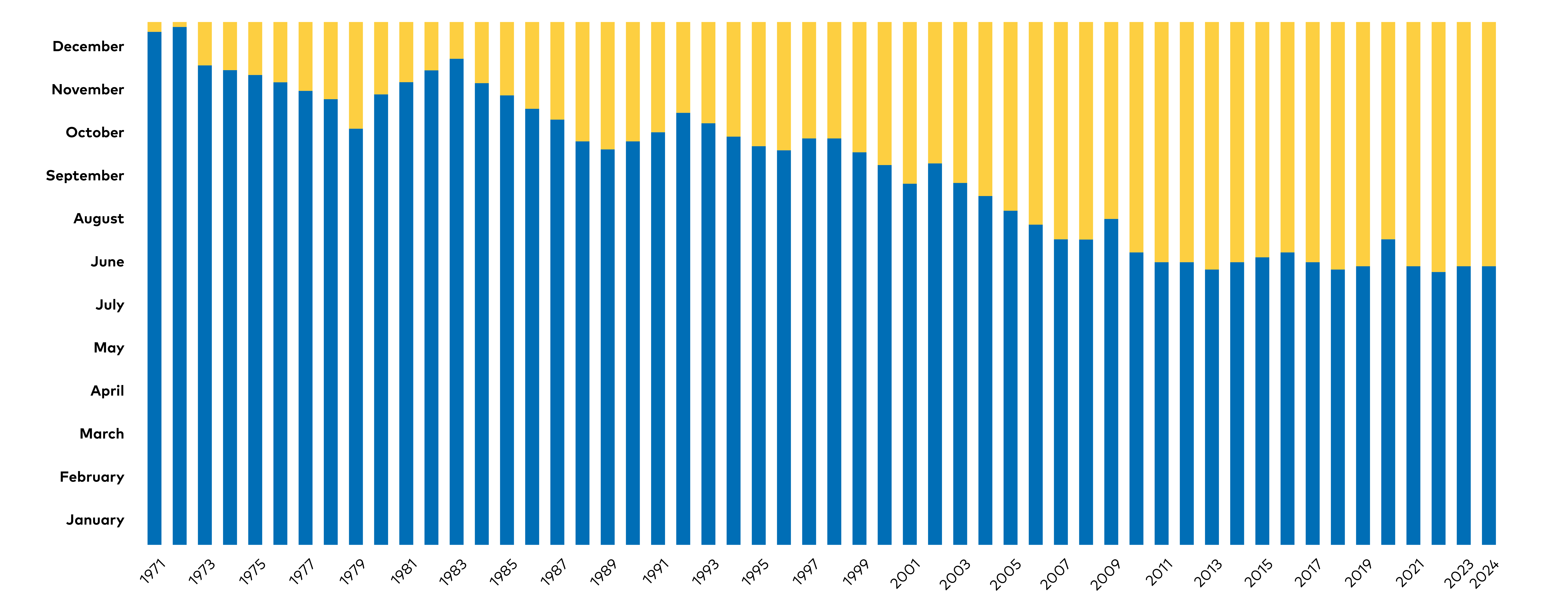
Figure 1: Earth Overshoot day from 1971 to 2024.
Earth Overshoot Day has also been calculated for each country with Country Overshoot Day defined in the following way:
Considering how the Nordic countries are doing according to this measure, provides a picture that is far from the proud – even if a little concerned – message from the Nordic Ministers and the Nordic Council’s sustainability policy documents, as evident in Table 1.
Table 1: Country overshoot days for the Nordic countries from 2018 to 2024. (Earth Overshoot Day, n.d.1)
2018 | 2019 | 2020 | 2021 | 2022 | 2023 | 2024 | |
Denmark | Mar 28 | Mar 28 | Mar 28 | Mar 26 | Mar 28 | Mar 28 | Mar 16 |
Finland | Apr 8 | Apr 8 | Apr 5 | Apr 10 | Mar 31 | Mar 31 | Apr 12 |
Iceland* | Feb 28 | Feb 28 | Feb 28 | Feb 28 | Feb 28 | Feb 28 | Feb 28 |
Norway | Apr 18 | Apr 18 | Apr 12 | Apr 12 | Apr 12 | Apr 12 | |
Sweden | Apr 4 | Apr 4 | Apr 2 | Apr 6 | Apr 3 | Apr 6 | Apr 21 |
* The Global Footprint Network does not publish comparable data for Iceland. Estimates for Iceland vary greatly, but most calculations locate the Overshoot Day for Iceland no later than the end of February (Jóhannesson et al., 2018). | |||||||
The Nordic countries’ Earth Overshoot Days for the last six years are compared with the Global Earth Overshoot Days in Figure 2. What might be called the sustainability line, December 31, which is the time when the overshoot day must be if people want to live sustainably. Figure 2 indicates that the Nordic countries are among the least sustainable in the world, with only a handful of countries performing worse. From a European perspective, the Nordic countries radically fail, with only Luxembourg, Belgium, the Netherlands, and Austria performing worse in 2024.
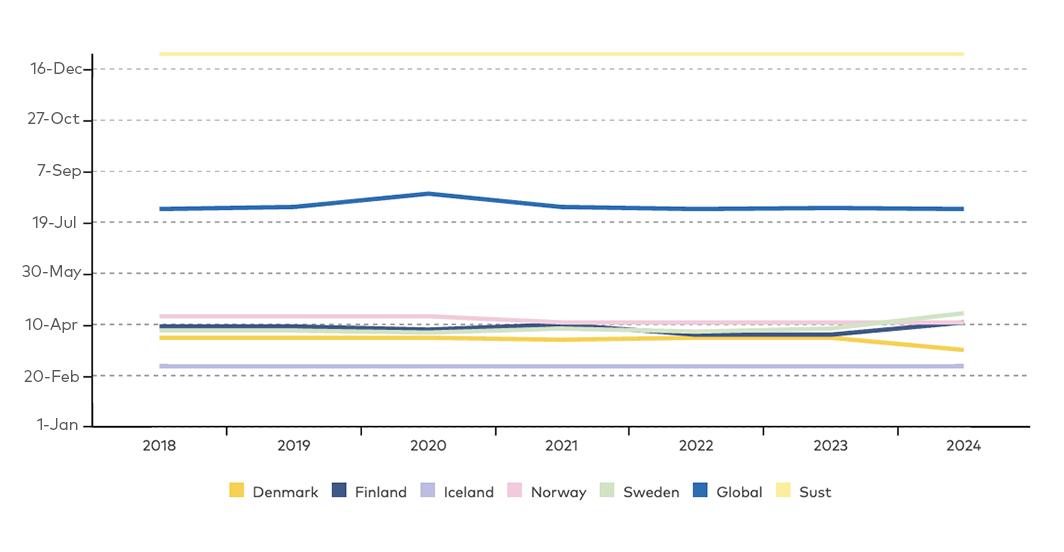
Figure 2: Earth overshoot days for the Nordic Countries compared to the global earth overshoot day (beginning of August) and the sustainability line (December 31).
The Nordic countries have also failed when it comes to biodiversity protection. In December 2022, the Global Biodiversity Framework (GBF) was adopted during the 15th COP meeting in Montreal (Convention on Biological Diversity, 2024, Feb 14). The members adopting the framework were “alarmed by the continued loss of biodiversity and the threat that this poses to nature and human well-being” and suggested urgent action to preserve and restore biodiversity. Although the Nordic Countries have a long tradition of environmental politics and environmental education, some having entrenched policies on public access to nature and outdoor life or “friluftsliv” (Gelter, 2000), they have also failed in this respect as Ulla Agerskov observes in her blog “Biodiversity Crisis in the Nordics”:
These Earth Overshoot Day measurements show the Nordic paradox of sustainability. While the Nordic countries have, in many ways, taken a leading role in sustainability and sustainability education, they remain among the most unsustainable countries in the world.
1.2 Young People’s Worries about the Future
Environmental issues, not least the unfolding climate changes, are challenges that young people in the Nordics and other countries constantly encounter. Through the media horrible consequences for people’s ways of life are daily on display. Such reports might be about drought in southern Europe, forest fires in California, massive floods in Pakistan, or rising sea levels in the Maldives. But young people around the globe respond differently to such reports.
Hickman et al. (2021) conducted a large-scale survey concerning climate anxiety among 10.000 young people, age 16–25, from ten countries, with Finland as the only Nordic country represented. Figure 3 below shows that young people from affluent countries such as Finland, the USA and the UK are not as worried about climate changes compared to young people from other less affluent countries such as Brazil, India, and the Philippines.
Figure 3: Worries about climate change and impact on functioning. Data are shown for the whole sample (n = 10.000 age 16-25, n pr. country = 1.000) (Hickman et al., 2021, p. e866).
As previously indicated in Table 1, the Nordic countries reached their overshoot day already around the beginning of April 2024. The people of the Nordic countries are, thus, among those with the highest impact on the environment while, at the same time, the young people from Finland — and supposedly also the other Nordic countries — are less worried about climate changes than many others. This is a concern for education. If education is supposed to be the means to meet challenges to sustainability and lead the way out of current climate crisis, one would expect young and “well educated” people to be worried about the situation with their feelings having a significant impact on their functioning. Given the presence of challenges to sustainability in curricula and media Heinrich Pestalozzi’s head-heart-hand metaphor may prove useful to unpacking this disconnect. Although young people have some knowledge about the climate crisis and other sustainability challenges (head, cognitive aspect), the numbers indicate that the knowledge has not reached the heart (emotions), or the hand (action) (Jordan, 2022; Singleton, 2015).
Young people have been bombarded with information on climate change through mainstream media, social media, and the school system their whole lives. For some, this flow of information has resulted in climate anxiety, as well as feelings of anger, guilt and helplessness (Hickman et al., 2021, p. e867). In the paper “Climate Change and Culture: Apocalypse and Catharsis”, Carien Smith argues that catastrophes have become a consumer product through the media leading to responses where people often release anxiety — and experience catharsis — through superficial responses without engaging significantly with the issues. Smith puts forward an empirical case that supports the argument:
Educators around the globe, not least in countries such as those in the Nordic region, need to find a balance between raising awareness of challenging issues such as climate change, communicate the urgency to students, and giving them a chance to respond without such responses being a mere catharsis in the sense of Smith. A comparison between fifth-grade students in Tanzania and Finland on the topic of climate change is indicative of this challenge (Sjöblom et al., 2022). Among the Tanzanian students their own roles as change makers were more obvious, since they had already experienced climate-change challenges like soil erosion, widespread disease, and problems with food availability. The Finnish students, who had not experienced similar challenges, felt less urgency to lead any change.
Another concern in the Nordic countries could be rooted in misconceptions that climate change is not real due to fake news and misguiding online influencers. Climate change denial is related to populist politics (Huber, 2020) and is popular among right wing males in Norway (Krange et al., 2019). Therefore, the teachers as well as teacher trainers need to both present knowledge about climate change, and thoroughly discuss the issue with the students from various perspectives, not least political and economic.
1.3 The Need for Sustainability Education
To sum up what is said in the Introduction. Undoubtedly, the world situation is critical, and all but sustainable. Therefore, sustainability is an aim that is most urgent, including the implementation of sustainability through education. Human actions and activities need to change, and real change goes deeper than words. Even if there are numerous strategies and fine arguments, they are not enough. The statistics show another side of the coin, also in the Nordic countries, which perhaps have more to learn from other countries than they can teach.
In The Climate Book, created by Greta Thunberg and authored by over 100 people, Thunberg opens the last section “What we just do now” with a short essay titled “The most effective way to get out of this mess is to educate ourselves”. Having discussed a few Swedish words which have made it to an international vocabulary, such as ‘flygskam’ she writes:
The point Thunberg is making here concerns not the content of education but the means and impact of it. Education that deserves the label ‘sustainability education’ must be folkbildning in the sense of initiating the kind of change that makes not only individuals but whole societies capable of changing through learning.
It is urgent to send “a clear signal to the rest of the world that real and positive development is possible”, as the Prime ministers want to do, but it is worth considering what that message could be. Perhaps it is wiser to focus on listening and collaborating than speaking and preaching. In education, both students and teachers need to relearn and unlearn to see clearly what has brought humanity to this situation, where humans stand now and what the entire planet needs most now and in the future. In this document. we want to present a few challenges of sustainability education in the Nordic countries today, but also to show possibilities and create hope for the future. We also hope to trigger thoughts and creativity.