25 Kristian August gate 13
25 Kristian August gate 13, Norway
Building use | Office | Stories above ground | 8 |
Location | Kristian August gate 13, Oslo | Basement area | 372 m2 |
Client | Entra | Structural system | Steel columns (existing) |
LCA consultant | Asplan Viak | Façade type | Concrete plates and brick |
Year of completion | 2021 | Roof type | Flat roof – adding sedum |
Reference area | 4,050 m2 (Gross floor area) | Heat demand /source | District heating |
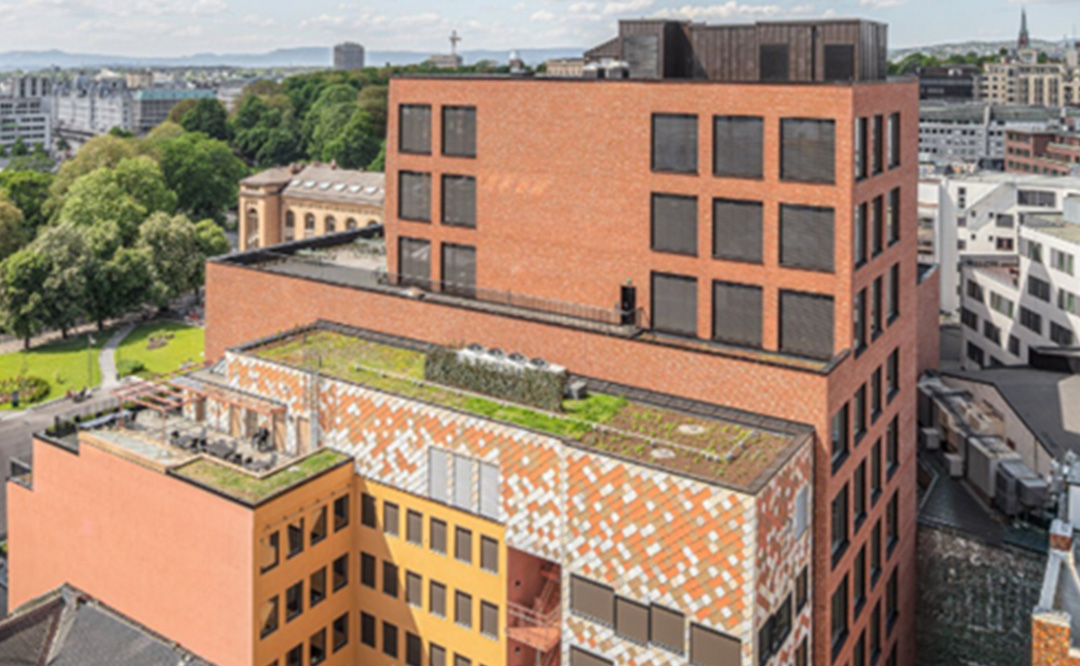
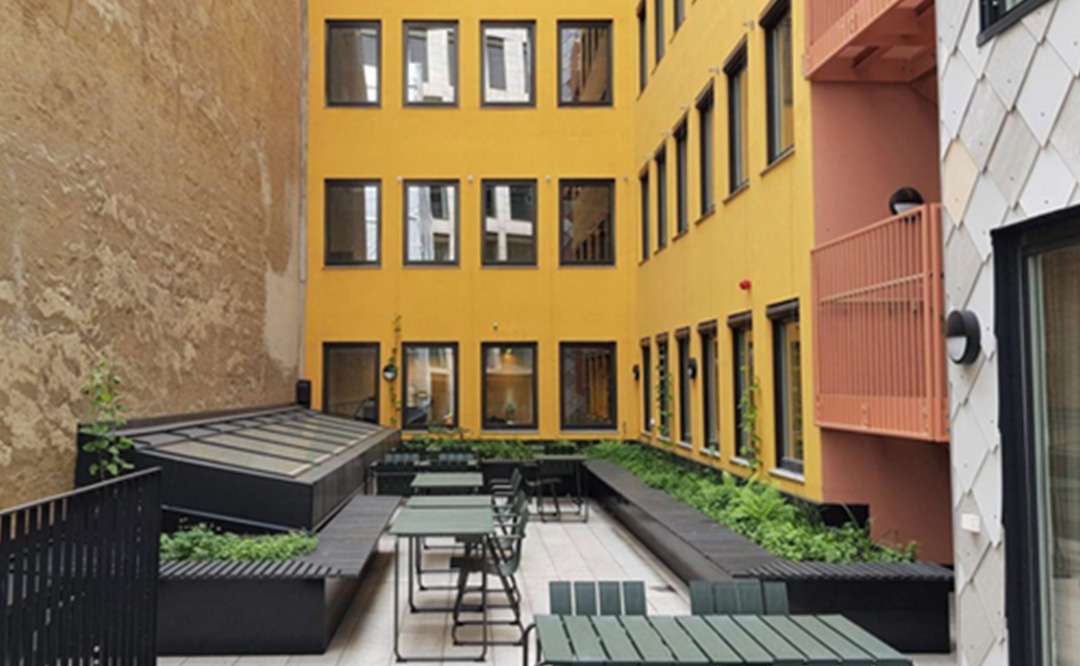
The project is Norway’s first building to utilise large-scale reuse of materials and circular solutions, achieving up to 80% material reuse. Key aspects of the project included repurposing components from the existing structure, such as support systems and interior surfaces, alongside materials sourced from various “donor buildings”. The existing support system and outer walls have been retained, with the exception of necessary holes and reinforcements. In the extension, hollow-core slabs from the government quarter (R4) have been used on three floors. Approximately 75% of the steel is reused. There is also a lot of reuse in other parts of the project, such as façade cladding and interior equipment such as radiators, sanitary equipment, ducts and pipes, office fronts and doors. Workshops facilitated knowledge sharing within the industry, focusing on regulations regarding documentation for reused building products. Entra, the project’s developer, engaged legal experts and government officials to navigate these regulations, addressing the limited availability of established players and materials in the reuse market. Collaborative efforts from contractors, particularly those involved in demolition, significantly contributed to identifying reusable building components. With a design rooted in the 1950s, the existing structure showcases original features like mosaic tiles and terrazzo stairs. The project includes an extension of approximately 60 m² across eight floors, adhering to current building regulations. The design emphasises openness and accessibility, with a glass façade and a large roof terrace promoting green spaces and urban integration.
Assessment method
LCA scheme compliance | FutureBuilt |
LCA tool version | ByggLCA v.1.1 |
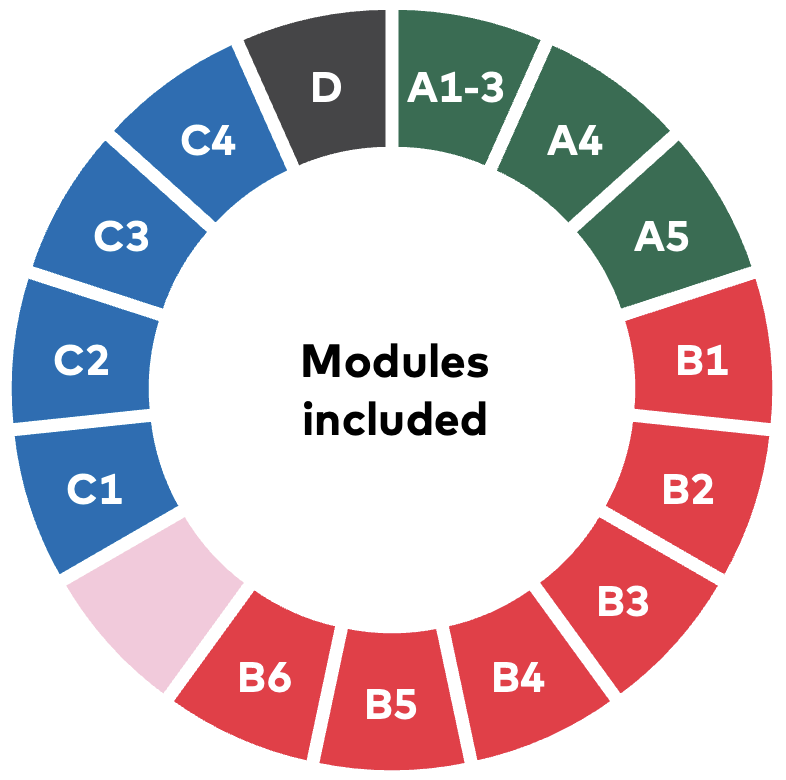
Life cycle stages included | A1-3, A4-A5, B1-B5, B6, C1-C4 |
Material emission data | Generic Norwegian database, EPDs |
Material decarbonisation scenario | — |
Energy calculation method | Emission factor for scenario 1 in NS 3720 |
Energy, dynamic scanario | Norway Mix |
LCA results: Life cycle modules
[kgCO2e/m2 reference area * year]
%
[kgCO2e/m2 reference area * year]
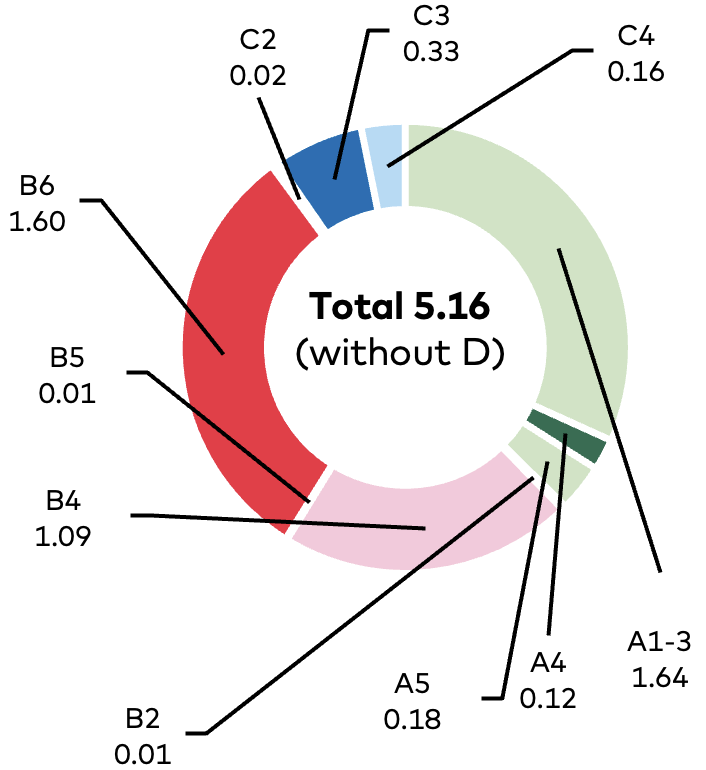
The system boundary includes all modules except B7. The impact for B6 is estimated with the Norwegian electricity mix, if instead the Norwegian+ EU28 electricity mix had been used the impact of B6 would have been 9,4 kgCO2e/m2 reference area / year. The reason behind the relative high emissions related to the B-modules is that the upfront emissions are greatly reduced by various reuse measures.
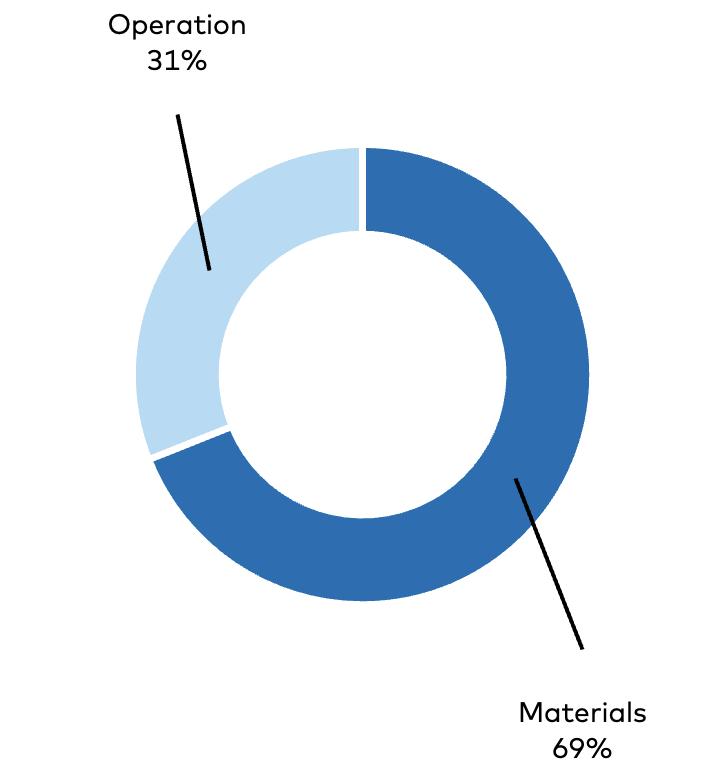
In the second figure, Operation includes B6, while materials include A1-A5, B1-B5, C1-C4.
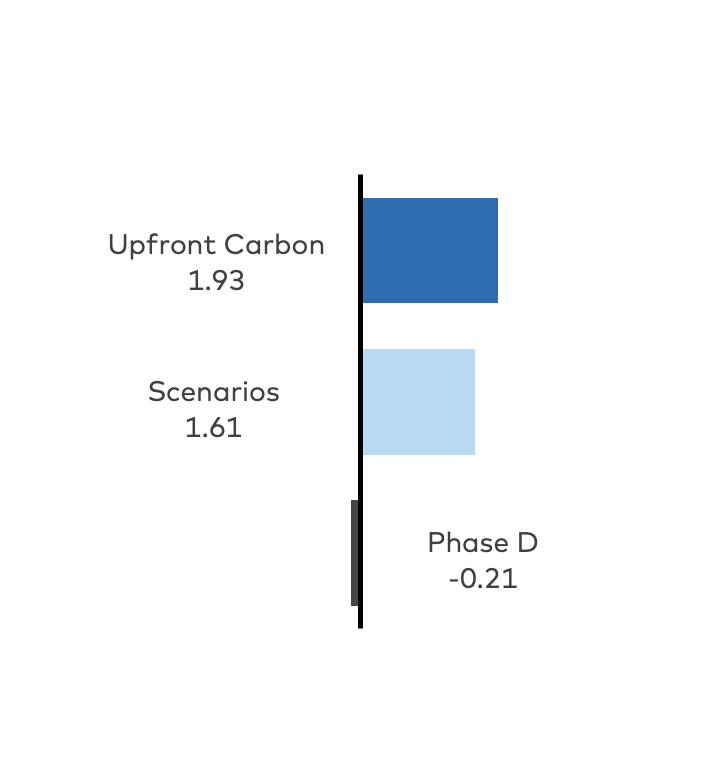
In the third figure, Upfront includes A1-A5, scenarios include B1-B5, C1-C4, and D is shown separately.
In the second figure, Operation includes B6, while materials include A1-A5, B1-B5, C1-C4.
In the third figure, Upfront includes A1-A5, scenarios include B1-B5, C1-C4, and D is shown separately.
LCA results: Building elements
GWP / reference area [kgCO2e/m2 reference area]
Material inventory: All materials
Life cycle modules: A1-A5, B1-B5, C1-C4
Foundations include piling, interior walls include finishes and coverings, floor slabs include flooring and ceilings, exterior walls include façade cladding, roof structure includes exterior cladding.
Building element quantity / reference area [kg building element / m2 reference area]
GWP of building element / building element quantity [kgCO2e / kg building element]
Material inventory: All materials
Life cycle modules: A1-A5, B1-B5, C1-C4
Life cycle modules: A1-A5, B1-B5, C1-C4
Building element quantity per building reference area is a measure for the material intensity, while element impacts per element quantity is a measure for the elements’ carbon intensity relative to their weight.
LCA results: Products
Product quantity / reference area [kg product / m2 reference area]
GWP of product / reference area [kgCO2e/m2 reference area]
Material inventory: Top 10 products with the highest impacts
Life cycle modules: A1-A4, B4
Life cycle modules: A1-A4, B4
Construction product quantity per building reference area is a measure for the material intensity, while product impacts per building reference area is a measure for carbon intensity.