24 Rusløkka skole
24 Rusløkka skole, Norway
Building use | School | Stories above ground | 6 |
Location | Løkkevejen 15, Oslo | Basement area | 2496 m2 |
Client | Oslobygg KF | Structural system | Steel columns and hollow core concrete slabs. |
LCA consultant | Asplan Viak | Façade type | Bricks and façade solar cells |
Year of completion | 2021 | Roof type | Hollow core concrete slab with green roof cover + terrace |
Reference area | 10,300 m2 (gross floor area) | Heat demand /source | District heating |
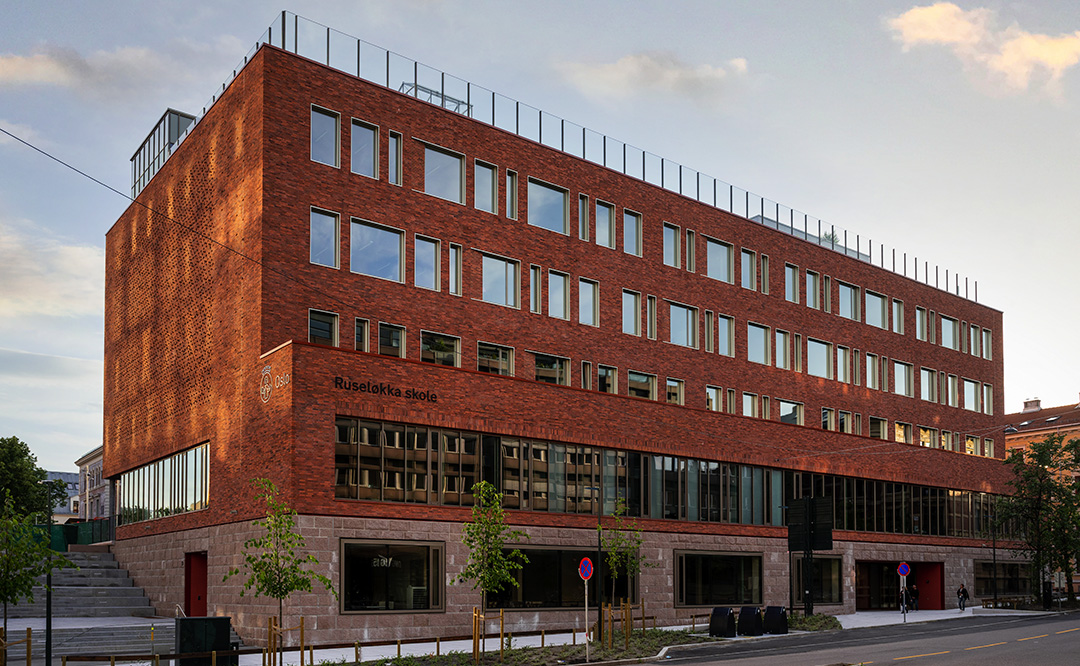
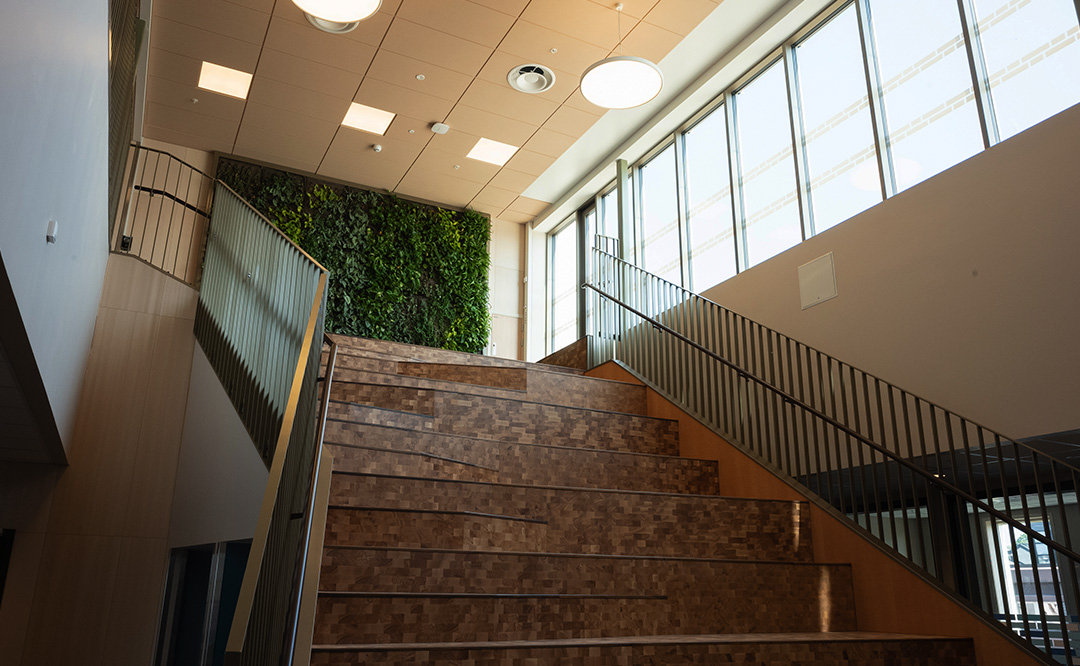
Ruseløkka School is a primary and secondary school for 690 pupils in Vika in Oslo. The project has been carried out as a turnkey contract with Veidekke, and there has been user participation throughout all phases of the project. The architect from GASA has been continued from the preliminary project to detailed design and implementation. The environmental goals have been anchored in FutureBuilt's quality program and followed up during the project. The school building meets the energy requirements of a near-zero-energy building (nZEB). In practice, this means a building body that meets the requirements for passive houses, in addition to building-integrated solar cells in the façade (320 m2) and solar cells on roofs (370 m2) that supply renewable energy. The solar cells on the roof are combined with a green roof for retention of stormwater. It is estimated that the solar cells on the façade and roof will produce approximately 75,000 kWh/year. District heating with low carbon emissions is used for heating and a small cooling demand is covered by adiabatic cooling, which is a very energy-efficient way of cooling the building using water vapour. At Ruseløkka, we have tested low-carbon concrete extreme (CEM III/B) on all site-built concrete. Approx. 4500 bricks were picked out from the old school building, which were reused as interior walls at the knowledge staircase in the main entrance. Old granite steps have been used as benches outside. Mitigation measures were also implemented at the construction site. District heating was used for building heating and construction, and the project had several electric construction machines such as dump trucks, wheel loaders and lifts under construction.
Assessment method
LCA scheme compliance | FutureBuilt, NS3720 |
LCA tool version | ByggLCAv1.1 |
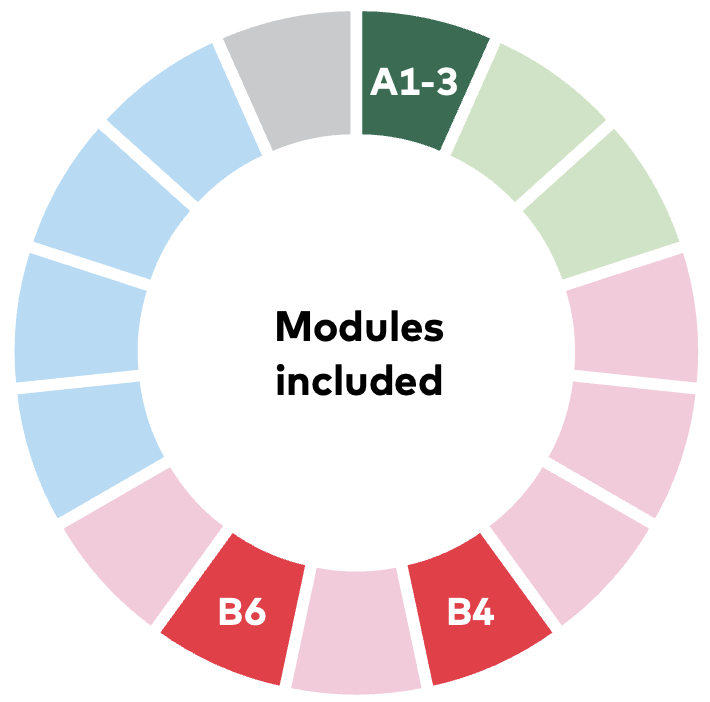
Life cycle stages included | A1-A3, B4, B6 |
Material emission data | - |
Material decarbonization scenario | - |
Energy calculation method | NS3031:2014, NS3701:2012 |
Energy, dynamic scanario | - |
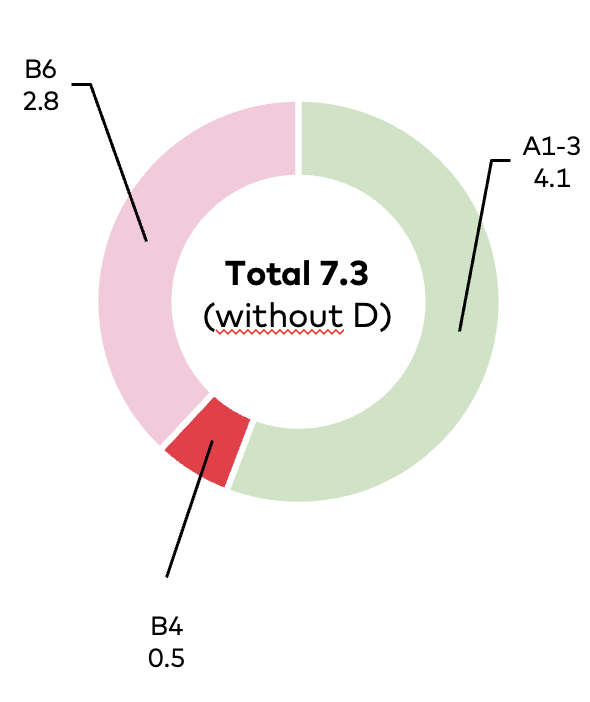
LCA results: Life cycle modues
[kgCO2e/m2 reference area * year]
%
[kgCO2e/m2 reference area * year]

The system boundary includes the product, use and end-of-life stages.
The material inventory includes a detailed account on building services (lifts, electricity system, HVAC system, solar cells). In the estimation for B6, the energy grid EU28+Norway has been used. If an energy grid for only Norway had been used, the impact of B6 would have been 0.62 kgCO2e/m2 reference area/year.
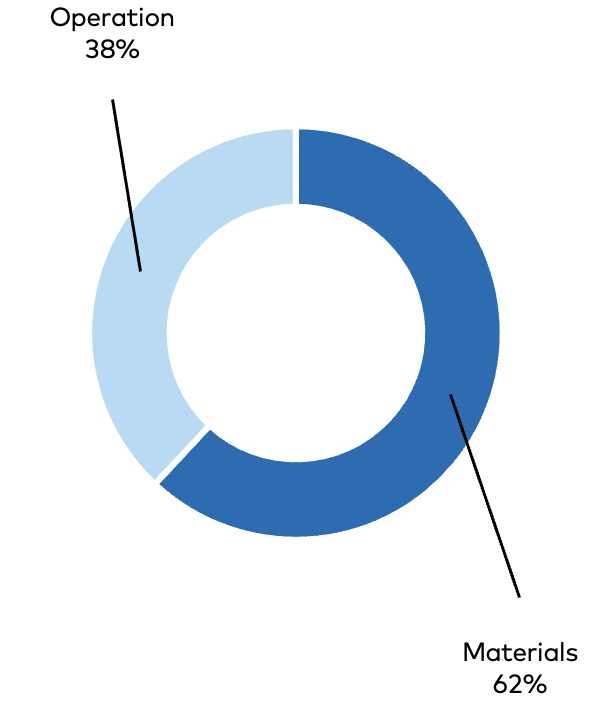
In the second figure, Operation includes B6, while materials include A1-A5, B4, C2-C4.
In the third figure, Upfront includes A1-A5, scenarios include B4, C2-C4, and D is shown separately, had it been included in the assessment.
The material inventory includes a detailed account on building services (lifts, electricity system, HVAC system, solar cells). In the estimation for B6, the energy grid EU28+Norway has been used. If an energy grid for only Norway had been used, the impact of B6 would have been 0.62 kgCO2e/m2 reference area/year.
In the second figure, Operation includes B6, while materials include A1-A5, B4, C2-C4.
In the third figure, Upfront includes A1-A5, scenarios include B4, C2-C4, and D is shown separately, had it been included in the assessment.
LCA results: Building elements
GWP / reference area [kgCO2e/m2 reference area]
Material inventory: All materials
Life cycle modules: A1-A3, B4
Life cycle modules: A1-A3, B4
Interior walls included finishes, Floor slabs include flooring, external walls include façade cladding, and roof includes exterior cladding. The floor slabs and external walls are dominating due to the building layout.
Building element quantity / reference area [kg building element / m2 reference area]
GWP of building element / building element quantity [kgCO2e / kg building element]
Material inventory: All materials
Life cycle modules: A1-A3, B4
Life cycle modules: A1-A3, B4
Building element quantity per building reference area is a measure for the material intensity, while element impacts per element quantity is a measure for carbon intensity of the elements relative to their weight.
LCA results: Products
Product quantity / reference area [kgCO2e/m2 reference area]
GWP of product / reference area [kgCO2e/m2 reference area]
Material inventory: Top 10 products with the highest impacts
Life cycle modules: A1-A5, B4, C2-C4
Life cycle modules: A1-A5, B4, C2-C4
Construction product quantity per building reference area is a measure for the material intensity, while product impacts per building reference area is a measure for carbon intensity.
The graph shows that It is the structural system that has the highest GWP/area where the system is made of mainly steel and concreate. Quantity/area of the two structural elements shows that the steel quantity is much lower than that of concrete – even as main structural material.