
23 Vertikal Nydalen
23 Vertikal Nydalen, Norway
Building use | Apartment building, office and hotel | Stories above ground | 18 |
Location | Gullhaug Torg 2a, Oslo | Basement area | 1 floor |
Client | Avantor | Structural system | Steel frame |
LCA consultant | Skanska | Façade type | Kebony (wood) cladding |
Year of completion | 2023 | Roof type | Flat roof |
Reference area | 11,188 m2 (Gross floor area) | Heat demand /source | Heat pump and district heating |
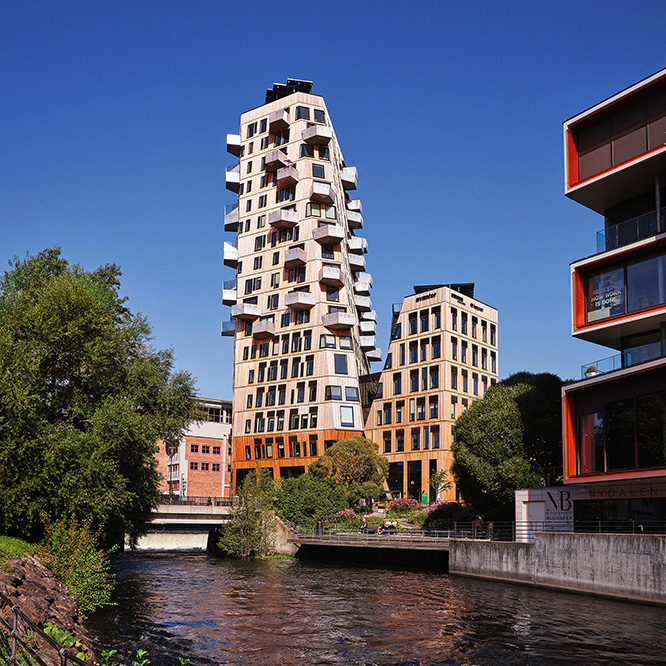
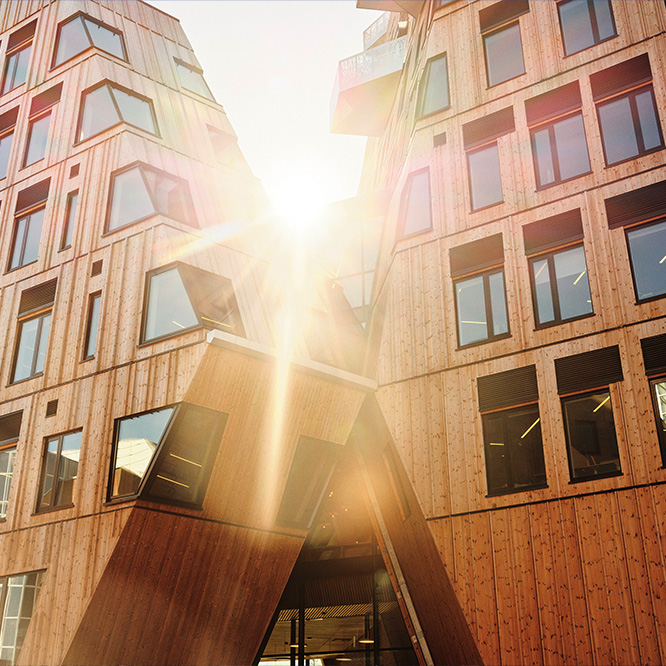
The building includes offices, restaurants and residential units and is Norway’s first combination building with natural air conditioning. Its design prioritises simple operation and maintenance, resulting in a lower environmental impact compared to traditionally mechanically ventilated buildings, while enhancing user experience through better indoor climate control. A critical aspect of the building is its integration into the LowEx and Naturally research projects, both funded by the Research Council of Norway. The building is environmentally certified according to BREEAM NOR. Its architecture promotes natural ventilation, with a unique geometric design that effectively channels air and creates pressure differences throughout the structure. Each apartment features high ceilings, ample natural light and materials that promote a healthy indoor atmosphere. Instead of traditional air conditioning units and ducts, the building utilises strategically placed façade hatches that open and close in response to external temperature and wind conditions. This passive system is complemented by computer simulations allowing for precise placement of air vents to optimise airflow. Further corban mitigation is accomplished by using heavy, low-emitting materials, waterborne underfloor heating, and solar panels. The heat pump system is supported by groundwater drawn from 300-metre-deep wells, significantly reducing energy consumption.
Assessment method
LCA scheme compliance | BREEAM NOR |
LCA tool version | OneClickLCA |
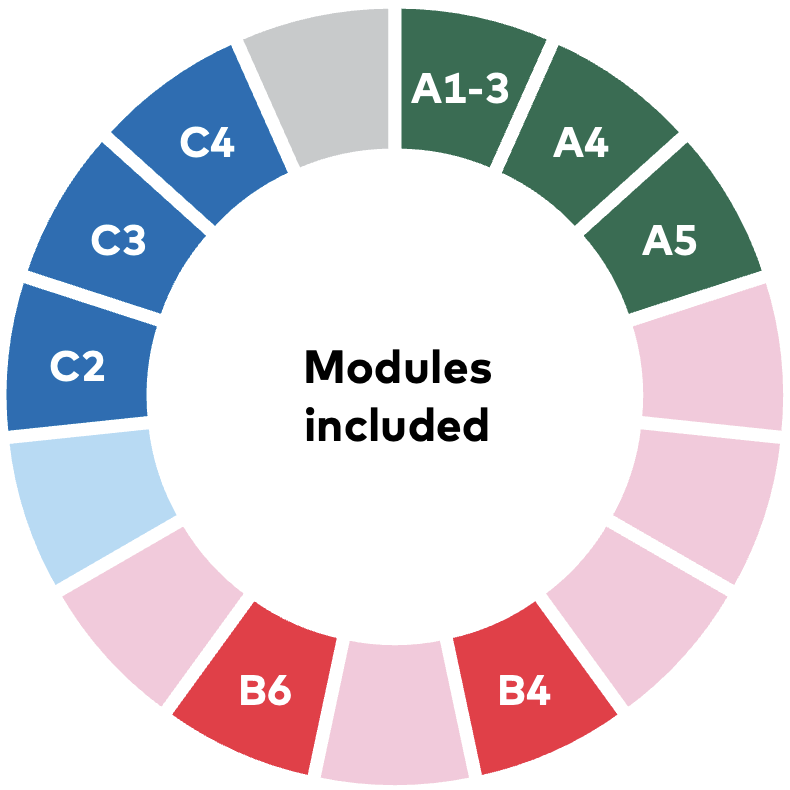
Life cycle stages included | A1-3, A4-A5, B4, B6, C2-C4 |
Material emission data | Generic Norwegian database, EPDs |
Material decarbonisation scenario | — |
Energy calculation method | Emission factor for scenario 2 in NS 3720 |
Energy, dynamic scenario | EU28+Norway mix |
LCA results: Life cycle modules
[kgCO2e/m2 reference area * year]
%
[kgCO2e/m2 reference area * year]
The system boundary includes the product, use and end-of-life stages.
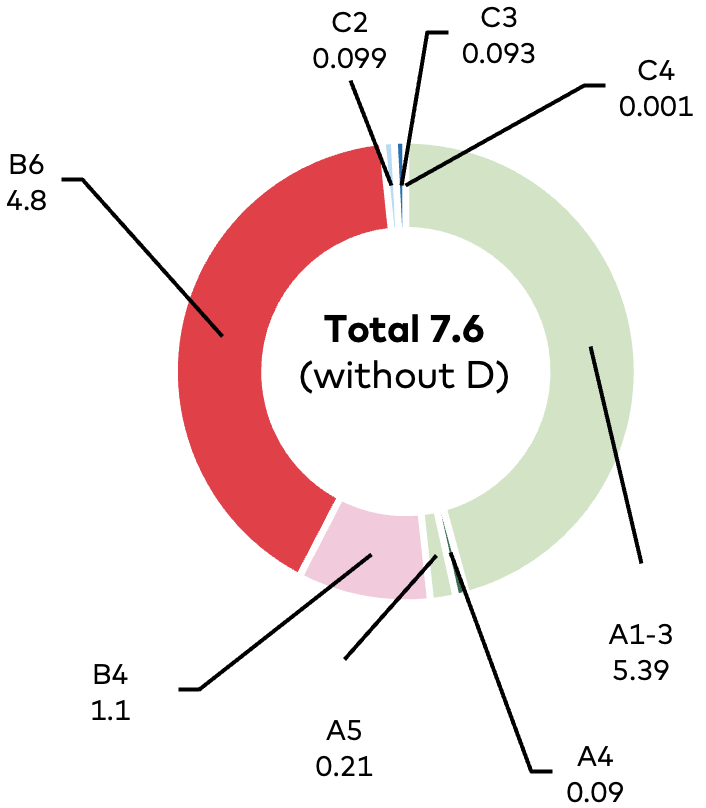
The material inventory includes a detailed account on building services (lifts, electricity system, HVAC system, solar cells). In the estimation for B6, the energy grid EU28+Norway has been used. If an energy grid for only Norway had been used, the impact of B6 would have been 0.62 kgCO2e/m2 reference area/year.
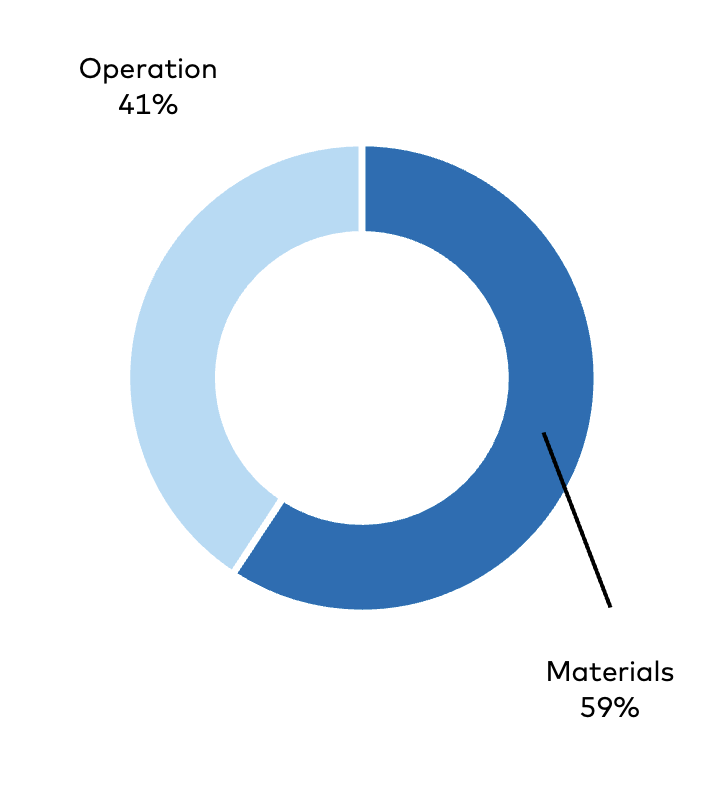
In the second figure, Operation includes B6, while materials include A1-A5, B4, C2-C4.
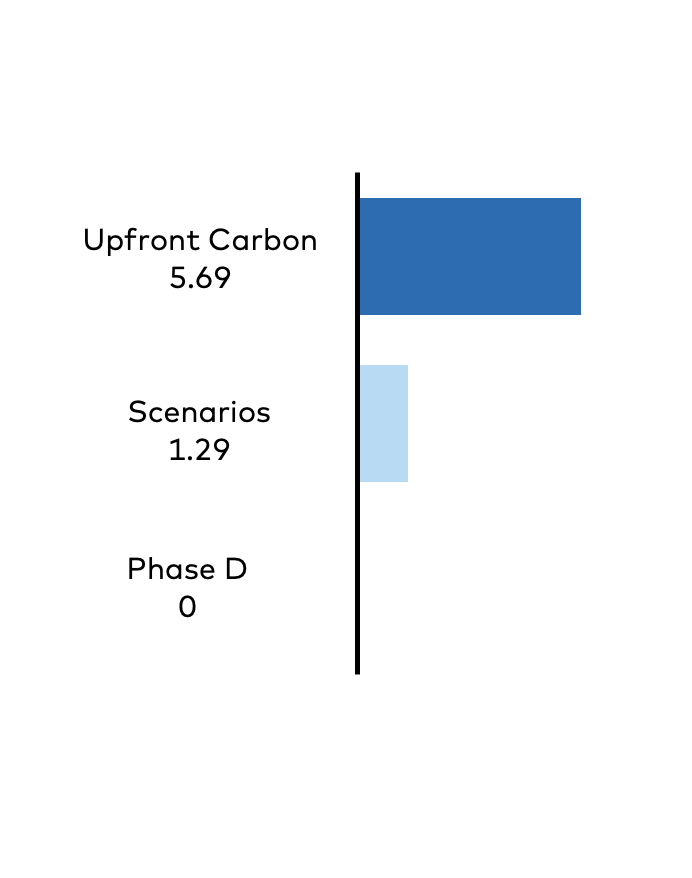
In the third figure, Upfront includes A1-A5, scenarios include B4, C2-C4, and D is shown separately, had it been included in the assessment.
The material inventory includes a detailed account on building services (lifts, electricity system, HVAC system, solar cells). In the estimation for B6, the energy grid EU28+Norway has been used. If an energy grid for only Norway had been used, the impact of B6 would have been 0.62 kgCO2e/m2 reference area/year.
In the second figure, Operation includes B6, while materials include A1-A5, B4, C2-C4.
In the third figure, Upfront includes A1-A5, scenarios include B4, C2-C4, and D is shown separately, had it been included in the assessment.
LCA results: Building elements
GWP / reference area [kgCO2e/m2 reference area]
Material inventory: All materials
Life cycle modules: A1-A5, B4, C2-C4
Life cycle modules: A1-A5, B4, C2-C4
Foundations include piling, interior walls included finishes and coverings, Floor slabs include flooring and ceilings, exterior wall includes façade cladding.
In this project, floor slabs are dominating due to the high-rise layout.
Building Element quantity / reference area [kg building element / m2 reference area]
GWP of building element GWP / building element quantity [kgCO2e / kg building element]
Material inventory: All materials
Life cycle modules: A1-A5, B4, C2-C4
Life cycle modules: A1-A5, B4, C2-C4
Building element quantity per building reference area is a measure for the material intensity, while element impacts per element quantity is a measure for the elements’ carbon intensity relative to their weight.
LCA results: Products
Product quantity / reference area [kg product / m2 reference area]
GWP of product / reference area [kgCO2e/m2 reference area]
Material inventory: Top 10 products with the highest impacts
Life cycle modules: A1-A5, B4, C2-C4
Life cycle modules: A1-A5, B4, C2-C4
Construction product quantity per building reference area is a measure for the material intensity, while product impacts per building reference area is a measure for carbon intensity.
The graph shows that It is the structural system that has the highest GWP/area where the system is made of mainly steel with some concreate columns. Quantity/area of the two structural elements shows that the steel quantity is much lower than that of concrete – even as main structural material.