14 Villazero
14 Villazero, Sweden
Building use | Detached home | Stories above ground | 1 |
Location | Furustigen 6, 78450 Borlänge | Basement area | — |
Client | Fiskarhedenvillan AB, Borlänge Sweden | Structural system | Wooden framework |
LCA consultant | — | Façade type | Pressure treated wood |
Year of completion | 2022 | Roof type | Asymmetrical gable roof |
Reference area | 136 m2 (gross floor area) | Heat demand /source | Heat pump |
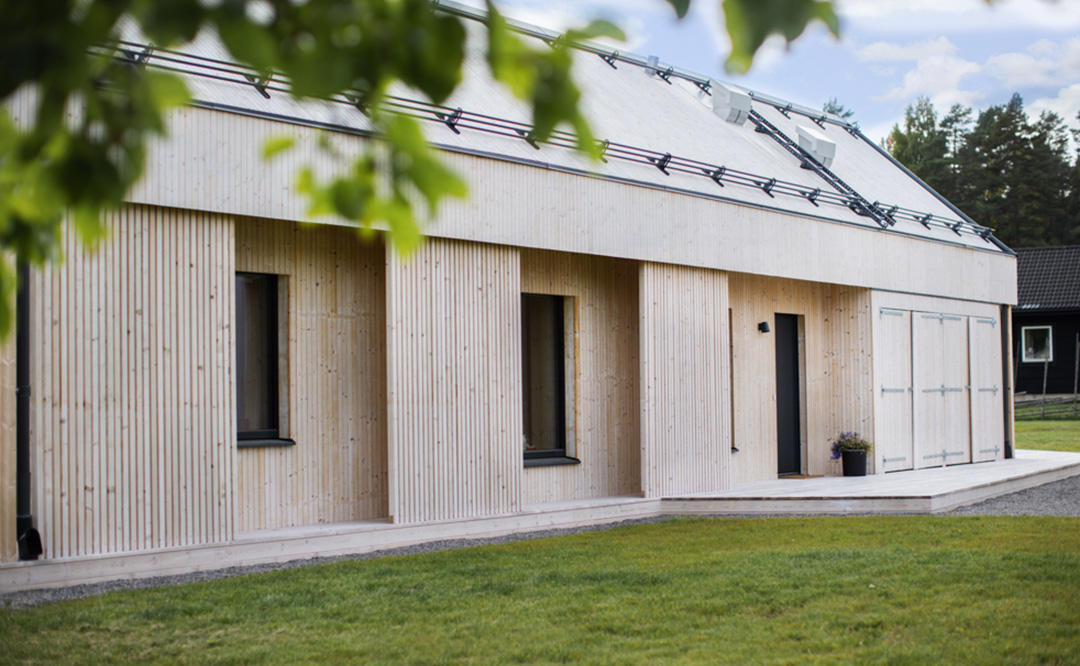
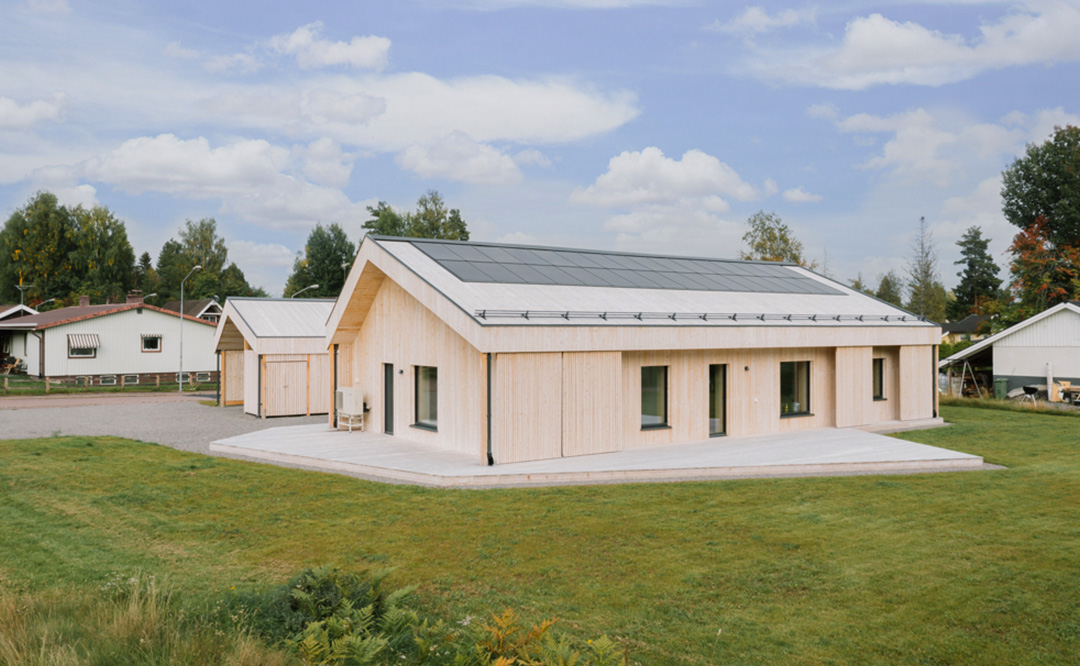
To build and construct a detached single-family home with reduced CO2 emissions while also developing our knowledge about sustainability, the decision to aim for the NollCO2 certification was made early on. Among the first tasks to be completed was the identification of building materials with a high CO2 impact in a standardised detached single-family home, and decide what materials needed to be replaced. One material that stood out as very versatile and in most cases with a low CO2 impact was wood. That insight inspired the project to use wood extensively. The most innovative area of use was probably the replacement of concrete with CLT (cross-laminated timber) in the foundation. Instead of casting a concrete slab on top of EPS and reinforcing bar, six prefabricated CLT elements were mounted on top of 400 mm of EPS. Another area where the project chose wood instead of the conventional solution was the roof covering. Instead of using concrete tiles, a pressure-treated wooden cladding combined with building integrated PV-panels forms the roof of the southern side of the building. To make the house both energy-efficient and reduce CO2 impact, insulation made from wood fibres was chosen for external walls and roof. While innovation is important, it is also crucial to be sensible which is why several sensors have been installed in various parts of the foundation, external walls and roof. The sensors measure dampness, temperature and relative humidity (RH) during their approximate five-year lifespan.
Assessment method
LCA scheme compliance | Noll CO2, Nordic Swan Ecolabel |
LCA tool version | NollCO2 |
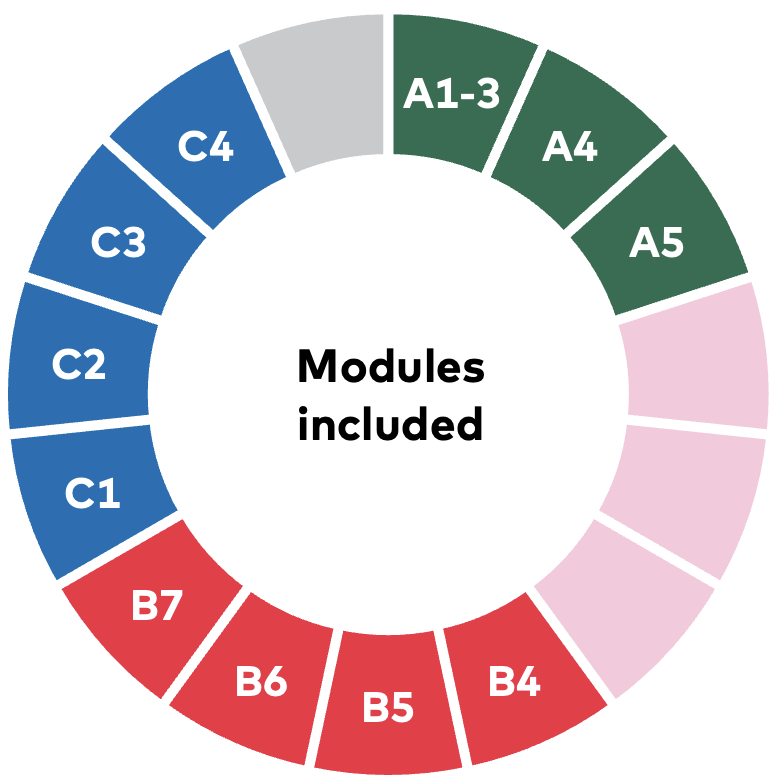
Life cycle stages included | A1-A5, B4-B7, C1-C4 |
Material emission data | Generic Swedish database, EPDs |
Material decarbonisation scenario | — |
Energy calculation method | Energy simulation method for Noll CO2 certification |
Energy, dynamic scenario | Noll CO2 certification |
LCA results: Life cycle modules
[kgCO2e/m2 reference area * year]
%
[kgCO2e/m2 reference area * year]
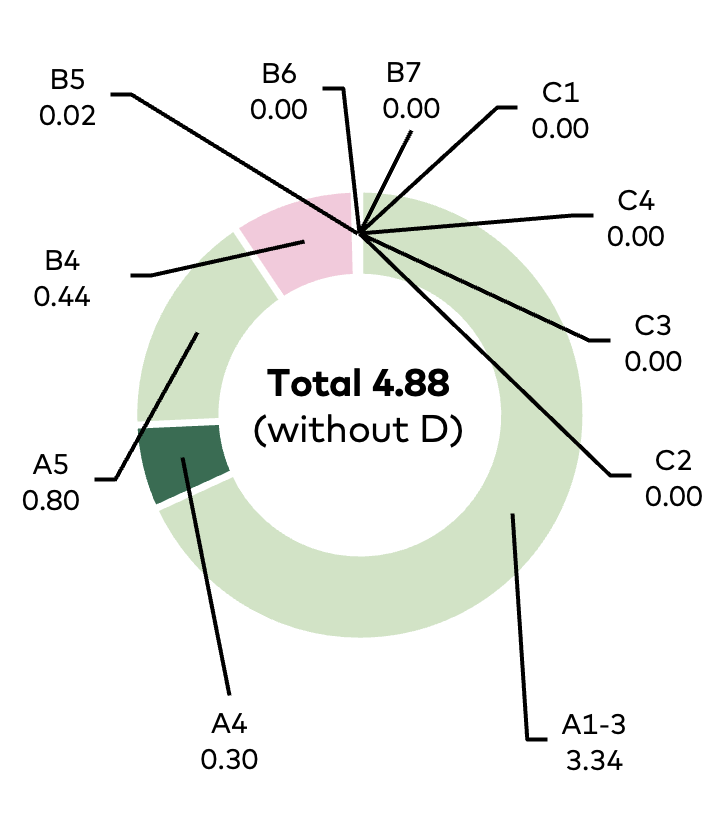
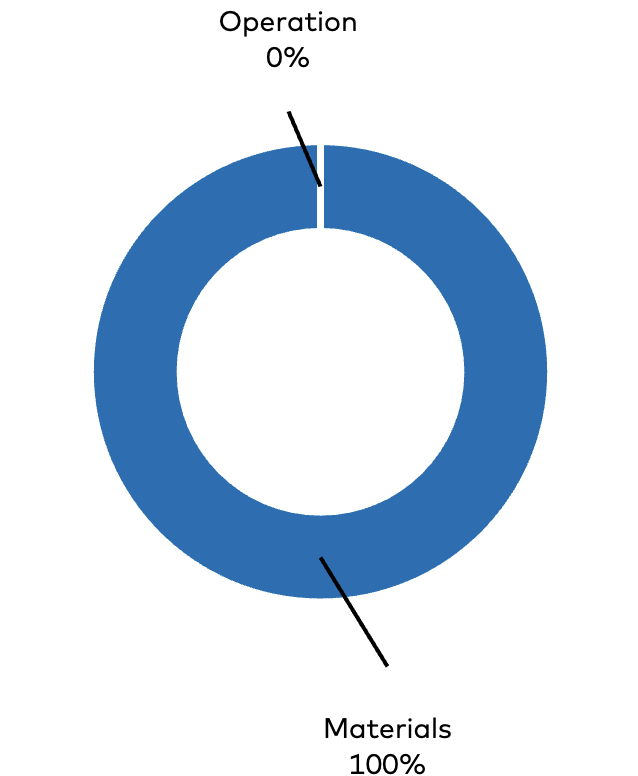
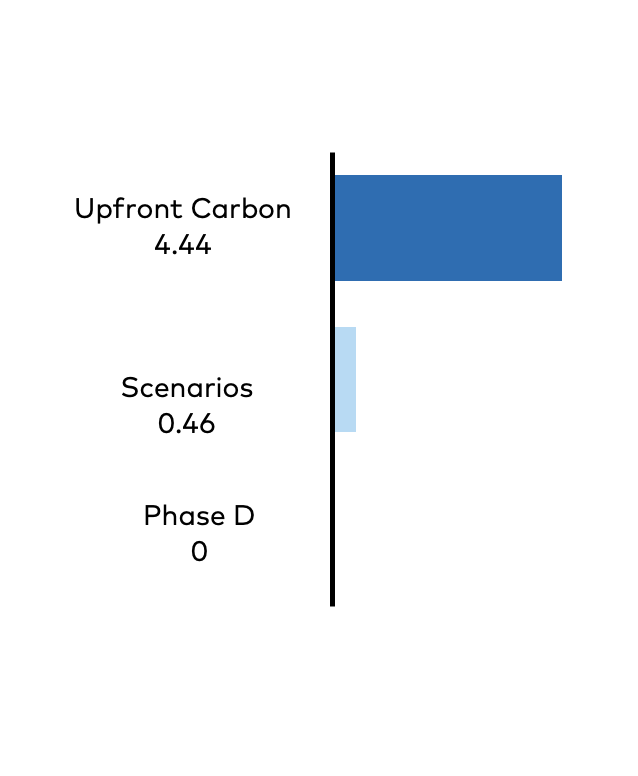
The results shown here are from the NollCO2 certification. The system boundary covers almost all life cycle modules where the product stage is dominating followed by energy consumption. All materials are reported, including building energy systems/installations such as electrical cables, HVAC, water pipes, sewage pipes, heating systems, lifts and solar PV panels. B6 becomes a negative climate value according to the certification, as solar power displaces coal power in the electricity networks covered by Nord Pool. A total of -114.10 tons of CO2-e by 2050 when all electricity produced in the electricity grid is assumed to have no climate impact. The impact is for B6 is shown to be zero in the figures.
In the second figure, Operation includes B6 and B7, while materials include A1-A5, B4-B5, C1-C4.
In the third figure, Upfront includes A1-A5, scenarios include B4-B5, C1-C4, and D is shown separately, had it been included in the assessment.
In the second figure, Operation includes B6 and B7, while materials include A1-A5, B4-B5, C1-C4.
In the third figure, Upfront includes A1-A5, scenarios include B4-B5, C1-C4, and D is shown separately, had it been included in the assessment.
LCA results: Building elements
GWP / reference area [kgCO2e/m2 reference area]
Material inventory: All materials
Life cycle modules: A1-A5, B4, B5
Life cycle modules: A1-A5, B4, B5
Exterior walls and roofing are included exterior cladding. Interior finishes are for walls and ceilings. All the technical components and piping for electricity, water etc. were included in the estimation. Combined, they have an impact of 33 kgCO2e/m2 reference area (not included in the figure).
Building element quantity / reference area [kg building element / m2 reference area]
GWP of building element / building element quantity [kgCO2e / kg building element]
Material inventory: All materials
Life cycle modules: A1-A5, B4, B5
Life cycle modules: A1-A5, B4, B5
Building element quantity per building reference area is a measure for the material intensity, while element impacts per element quantity is a measure for the elements’ carbon intensity relative to their weight.
LCA results: Products
Product quantity / reference area [kg product / m2 reference area]
GWP of product / reference area [kgCO2e/m2 reference area]
Material inventory: Top 10 products with the highest impacts
Life cycle modules: A1-A5, B1-B5, C1-C4
Life cycle modules: A1-A5, B1-B5, C1-C4
Construction product quantity per building reference area is a measure for the material intensity, while product impacts per building reference area is a measure for carbon intensity.