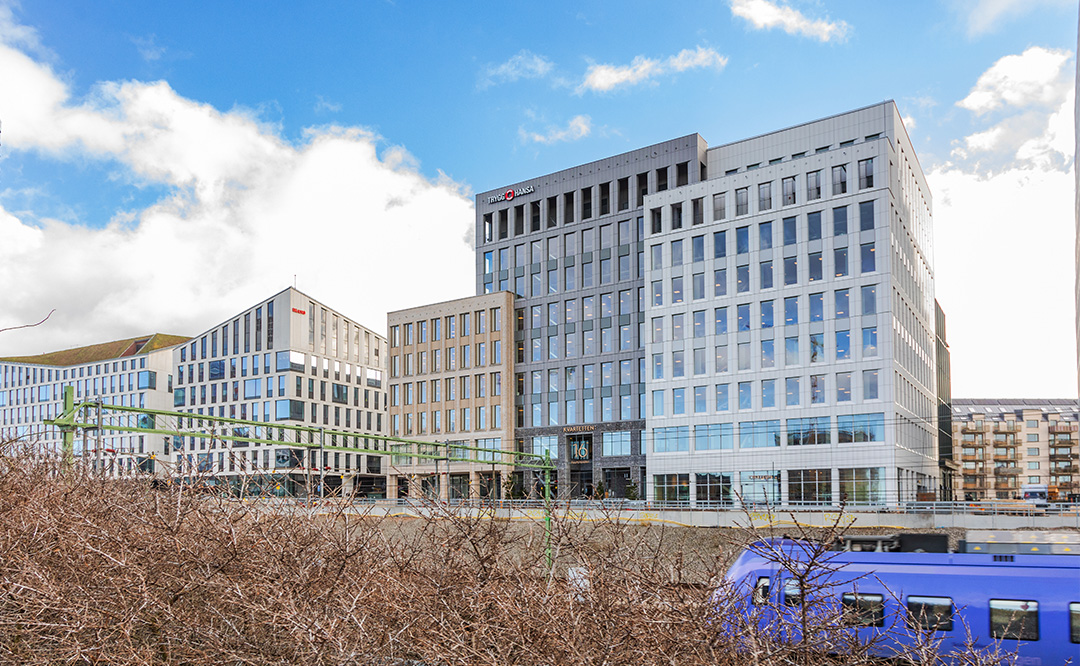
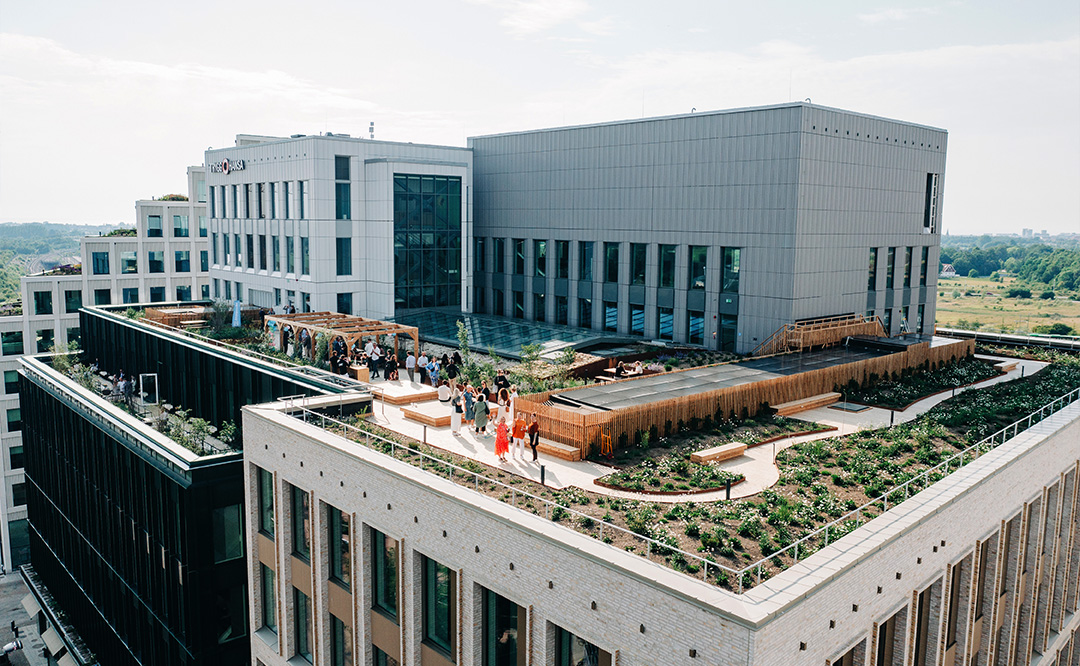
12 Kvartetten
12 Kvartetten, Sweden
Building use | Office | Stories above ground | 9 |
Location | Skrivaregatan 21, Malmö | Basement area | 3,140m2 |
Client | Wihlborgs Fastigheter AB | Structural system | Prefabricated concrete walls/ slabs and steel beams/columns |
LCA consultant | Projekt Engagemang (PE) and PEAB | Façade type | Several; Brick, metal, corrugated sheet, ceramics, flint |
Year of completion | 2023 | Roof type | Flat roof |
Reference area | 23,247 m2 (gross floor area) | Heat demand /source | District heating |
From the outset, the project had high climate targets: in addition to certification according to Miljöbyggnad Gold and WELL Gold, Kvartetten is also part of the LFM30, a local initiative to drive climate-neutral construction. Prior to the detailed design, the decision was made to see if it was possible to certify the project according to the NollCO2 certification scheme, since then the work on this has been a central part of the design and production of all parties involved. Collaboration between all stakeholders and dialogue with suppliers were a standard procedure in the project. The building is very flexible for the office tenants. For example, by utilising modular dimensions that control the layout of installations and having a wall screen above the suspended ceiling, tenants can easily expand or contract their operations or change from an open landscape to cell offices or meeting rooms. To reduce the project’s climate impact, the choice of materials and products has been reviewed, the structure has been slimmed down and recycled materials have been compared. For example, this resulted in the use of concrete with alternative binders to cement, dividing the slap into sections to reduce local thickness, using bricks produced with renewable energy and the drainage board on the exterior basement walls consisting of recycled material. A major change was to raise the atrium roof, which allowed the building to have less external walls and thus significantly reduce its climate impact.
Assessment method
LCA scheme compliance | Miljöbyggnad, WELL, and Noll CO2 certification |
LCA tool version | One Click LCA |
Life cycle stages included | A1-A5, B4-B7 |
Material emission data | EPDs |
Material decarbonisation scenario | — |
Energy calculation method | Energy simulation method for Noll CO2 certification |
Energy, dynamic scenario | Noll CO2 certification |
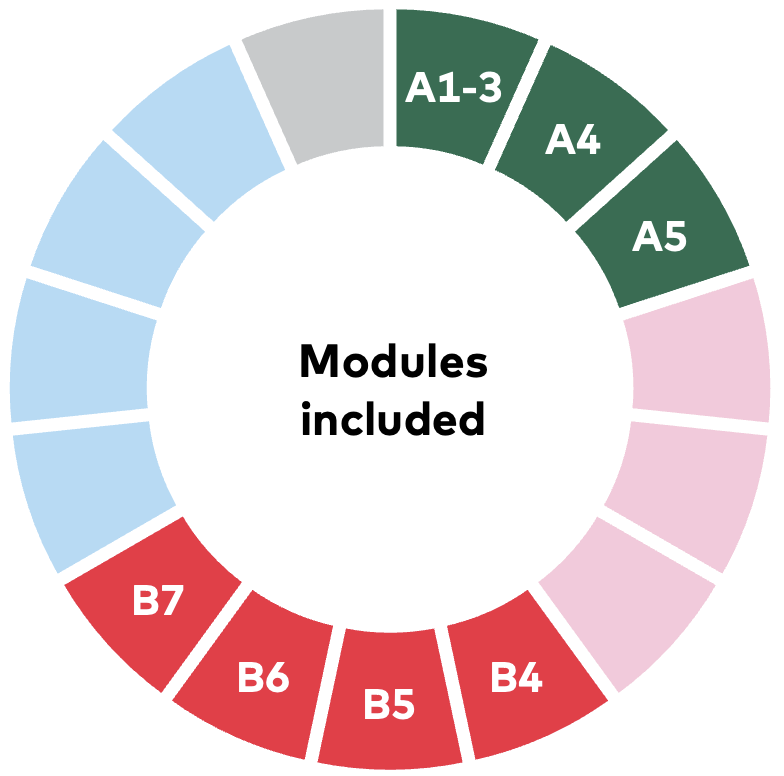
LCA results: Life cycle modules
[kgCO2e/m2 reference area * year]
%
[kgCO2e/m2 reference area * year]
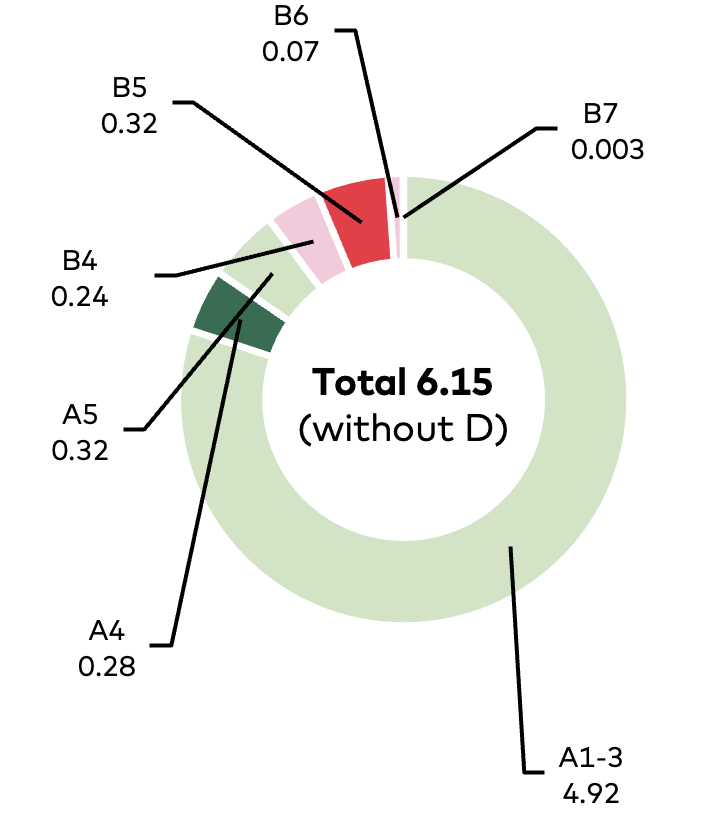
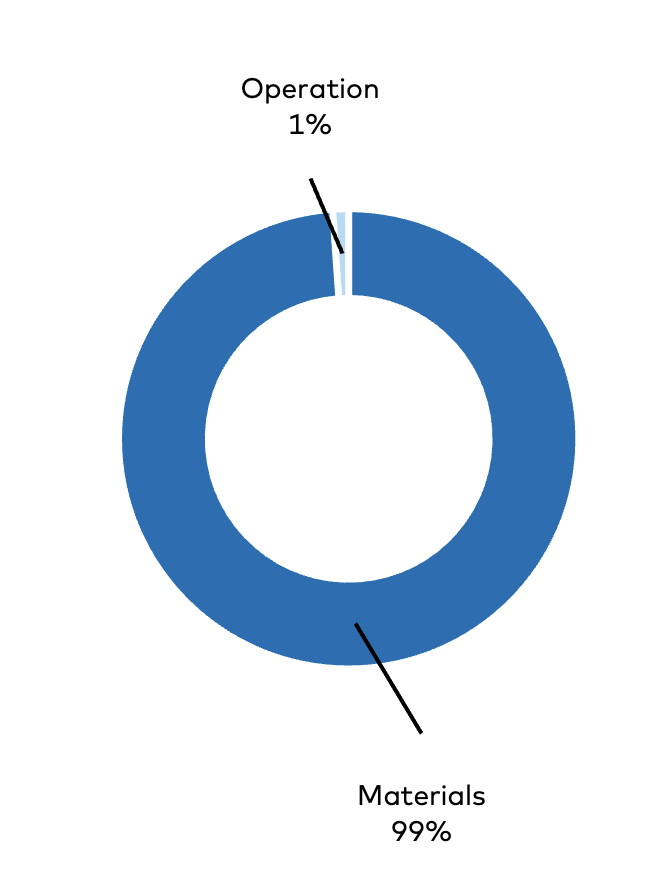
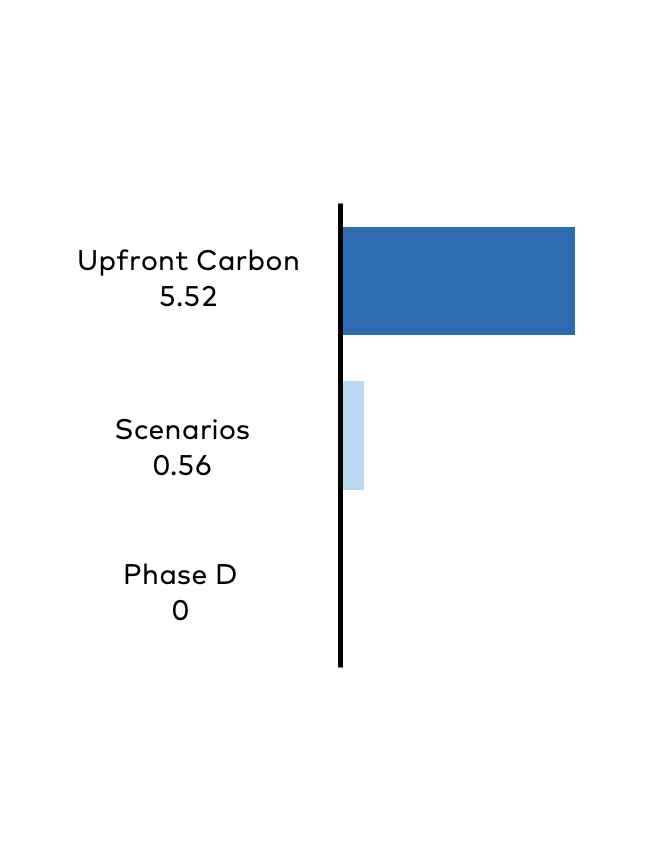
The results shown here are from the NollCO2 certification. The system boundary covers almost all life cycle modules, where the product stage is dominating followed by energy consumption. All materials are reported, including building energy systems/installations such as electrical cables, HVAC, water pipes, sewage pipes, heating systems, lifts and solar PV panels. The NollCO2 report states that end-of-life stages, C1-C4, are included in the assessment. However, the impacts are all set to zero.
In the second figure, Operation includes B6 and B7, while materials include A1-A5, B4-B5.
B6 and B7 have very low impacts, mainly because in the used version of the NollCO2 certification the impact from energy use is reduced annually until assumed zero in 2050.
In the third on the right, Upfront includes A1-A5, scenarios include B4-B5, and D is shown separately, had it been included in the assessment.
In the second figure, Operation includes B6 and B7, while materials include A1-A5, B4-B5.
B6 and B7 have very low impacts, mainly because in the used version of the NollCO2 certification the impact from energy use is reduced annually until assumed zero in 2050.
In the third on the right, Upfront includes A1-A5, scenarios include B4-B5, and D is shown separately, had it been included in the assessment.
LCA results: Building elements
GWP / reference area [kgCO2e/m2 reference area]
The results shown here are based on the Miljöbyggnad certification.
Material inventory: Materials used for the building frame and underground structure (foundation, ground floor down to the drainage layer, and basement walls).
Life cycle modules: A1-A3.
Building element quantity / reference area [kg building element / m2 reference area]
GWP of building element / building element quantity [kgCO2e / kg building element]
The results shown here are based on the Miljöbyggnad certification.
Material inventory: Materials used for the building frame and underground structure (foundation, ground floor down to the drainage layer, and basement walls).
Life cycle modules: A1-A3
Material inventory: Materials used for the building frame and underground structure (foundation, ground floor down to the drainage layer, and basement walls).
Life cycle modules: A1-A3
Building element quantity per building reference area is a measure for the material intensity, while element impacts per element quantity is a measure for the elements’ carbon intensity relative to their weight.
LCA results: Products
Product quantity / reference area [kg product / m2 reference area]
GWP of product / reference area [kgCO2e/m2 reference area]
The results shown here are based on the Miljöbyggnad certification. This means that only materials used for the building frame and underground structure (foundation, ground floor dawn to the drainage layer, and basement walls) are included.
Material inventory: Top 10 products with the highest impacts
Life cycle modules: A1-A3
Life cycle modules: A1-A3
Construction product quantity per building reference area is a measure for the material intensity, while product impacts per building reference area is a measure for carbon intensity.
The listed products for the structural system are dominated by concrete and steel materials, led by the floor slabs.