11 Dalarnas Villa
Sweden
11 Dalarnas Villa, Sweden
Building use | Detached home | Stories above ground | 2 |
Location | Dalarna, Sweden | Basement area | 0 m2 |
Client | Dalarnas Försäkringsbolag | Structural system | Column-beam timber frame |
LCA consultant | Researcher: Bojana Petrovic, PhD project | Façade type | Wood cladding |
Year of completion | 2019 | Roof type | Pitched roof |
Reference area | 180 m2 (Gross floor area) | Heat demand /source | Heat pump |
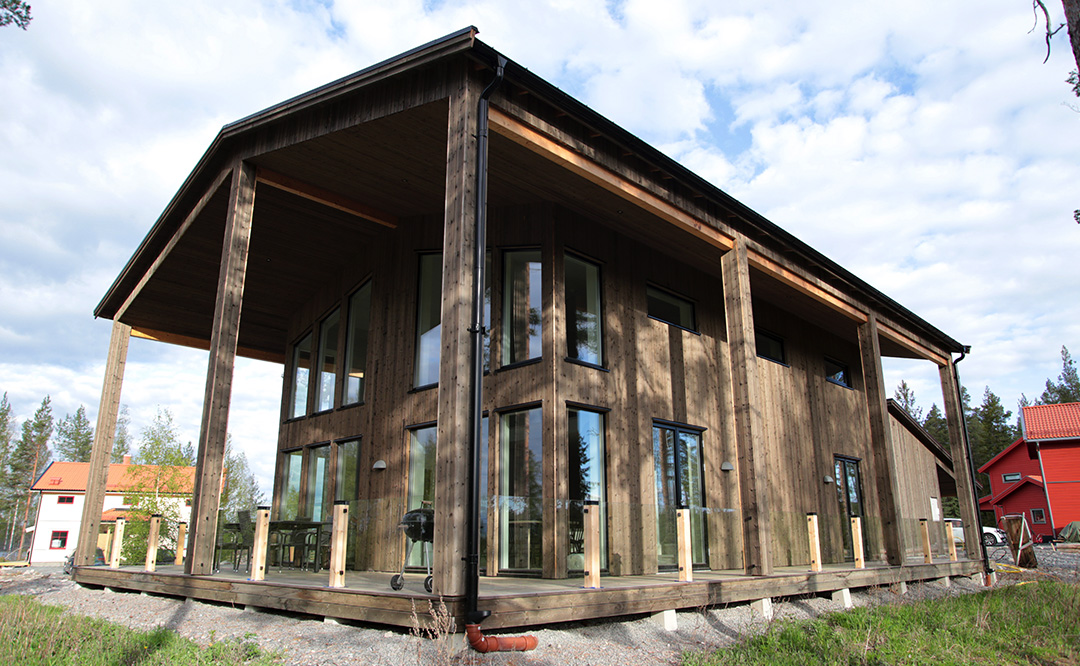
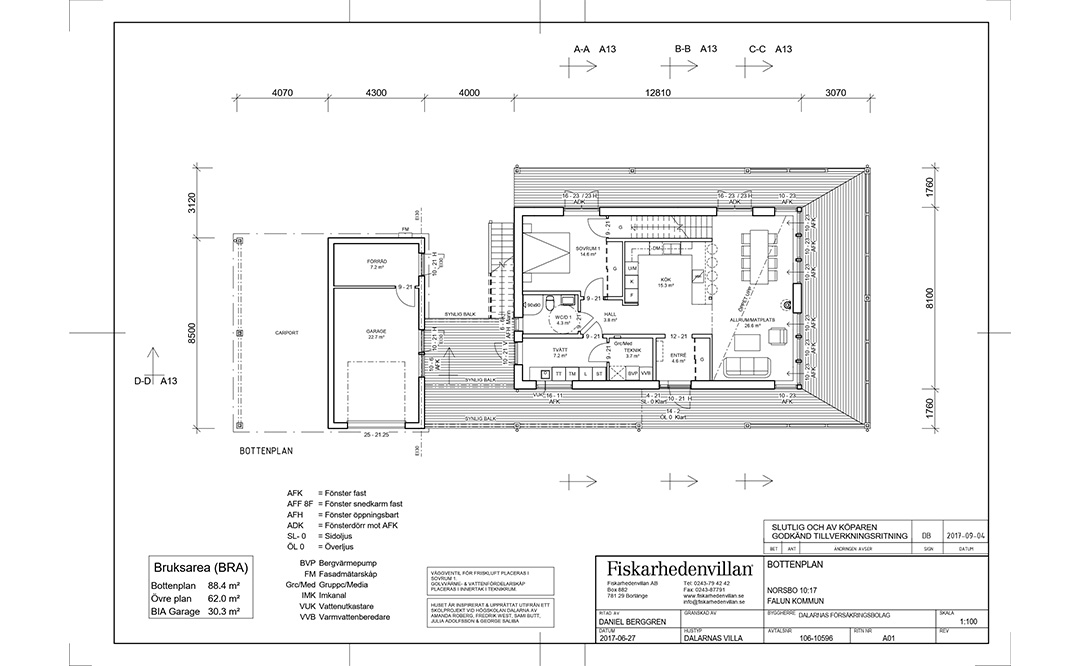
Dalarnas Villa was financed by the insurance company Dalarnas Försäkringsbolag, and was built in collaboration with stakeholders such as Dalarna University, Fiskarhedenvillan AB (house manufacturer and supplier of building materials) as well as other entrepreneurs specialising in building energy systems. This was among the first Swan-labelled single-family homes and many resources were invested into certifying the project. The main purpose of this project was to test, compare and evaluate sustainable solutions dominated by wood-based building materials and energy-efficient systems. The building’s envelope consists of a wooden framework and wood panel façades, while concrete was only used in the foundation. Instead of using conventional insulation materials such as glass and rock wool, the idea was to install cellulose insulation for the external walls and for the ceiling, and wood fibre insulation was used for the internal walls’ insulation. The roof is made of steel, while the doors and windows are a combination of glass and wood. Moreover, a major focus was on replaceable components; if any installation breaks, it should be easy to replace. In accordance with the forthcoming Boverket regulations for single-family residential buildings, entering into force on 1 July 2025, the proposed carbon emissions threshold for building materials (including phases A1-A5) is set at 180 kg CO₂e/m². The Dalarnas Villa home reported emissions of 130 kg CO₂e/m², representing a reduction of nearly 30% below the established reference limit. This outcome underscores the project’s alignment with progressive sustainability targets and demonstrates the potential for carbon reduction in residential construction.
Assessment method
LCA scheme compliance | Svanen |
LCA tool version | One Click LCA |
Life cycle stages included | A1-3, A4-A5, B1-B5, B6, B7, C1-4, D |
Material emission data | Mainly included EPDs with minor data based on Generic Swedish database |
Material decarbonisation scenario | - |
Energy calculation method | TMF energy programme |
Energy, dynamic scanario | Non |

LCA results: Life cycle modules
[kgCO2e/m2 reference area * year]
%
[kgCO2e/m2 reference area * year]


The LCA includes all life cycle stages. The product stage is dominating, followed by the impacts released during the building’s use stage, while the lowest amount of impacts are found during the construction, water use and end-of-life phases. The product stage is modelled with a detailed building model, including all building materials and building energy systems/installations: Electrical cables, HVAC, water pipes, sewage pipes, heating systems (heat pump) as well as solar PV panels. Despite the completeness, a relatively low total climate impact is achieved. Biogenic carbon was assessed separately and is not included in these results. In the second figure, Operation includes B6, B7, while materials include A1-A5, B1-B5, C1-C4. Even though the materials’ share of impacts includes all modules, operations make up 25% of the total GWP, which related to the cold climate in the Dalarna region, located north of Stockholm. In the third figure, Upfront includes A1-A5, scenarios include B1-B5, C1-C4, and D is shown separately. Upfront and future scenarios are relatively balanced due to the complete modelling of the use stage and the considerable energy demand, while D is relatively small.
LCA results: Building elements
GWP / reference area [kgCO2e/m2 reference area]
Material inventory: All materials
Life cycle modules: A1-A5, B1-B5, C1-C4
Life cycle modules: A1-A5, B1-B5, C1-C4
The external openings have the highest impacts followed by the façade cladding. If the external walls were added to the façade cladding, they would dominate the results. All the technical components and piping, for electricity, water etc. were included in the estimation. Combined, they have an impact of 192 kgCO2e/m2 reference area (not included in the figure).
Building element quantity / reference rea [kg building element / m2 reference area]
Building element GWP / building element quantity [kgCO2e / kg building element]
Material inventory: All materials
Life cycle modules: A1-A5, B1-B5, C1-C4
Life cycle modules: A1-A5, B1-B5, C1-C4
Building element quantity per building reference area is a measure for the material intensity, while element impacts per element quantity is a measure for the elements’ carbon intensity relative to their weight.
Even though the roof structure with overhang covers a large area, its lightweight build-up exhibits a low material intensity. Due to this light weight, a high carbon intensity occurs. The opposite is true for flooring and foundations, which include the ground floor deck and strip foundations dominated by reinforced concrete.
Windows and doors also have a significant carbon intensity.
LCA results: Products
Product quantity / reference area [kg product / m2 reference area]
GWP of product / reference area [kgCO2e/m2 reference area]
Material inventory: Top 10 products with the highest impacts
Life cycle modules: A1-A5, B1-B5, C1-C4
Life cycle modules: A1-A5, B1-B5, C1-C4
Construction product quantity per building reference area is a measure for the material intensity, while product impacts per building reference area is a measure for carbon intensity.
Concrete, gypsum boards and drainage pipes are dominating the material weight in the building.
Concrete, gypsum boards and drainage pipes are dominating the material weight in the building.
The carbon impacts are also dominated by concrete, however followed by solar cells and the triple-glazed windows and doors.