10 Wood social housing
10 Wood social housing, Finland
Building use | Apartment building | Stories above ground | 4 |
Location | Vanhankallionkatu 5 | Basement area | 1 floor |
Client | Y-Foundation, M2-Kodit Oy | Structural system | CLT sheets and volumetric elements |
LCA consultant | Vesitaito | Façade type | Cladding |
Year of completion | 2021 | Roof type | Tin roof |
Reference area | 1,490 m2 (heated floor area) | Heat demand /source | Central district heating |
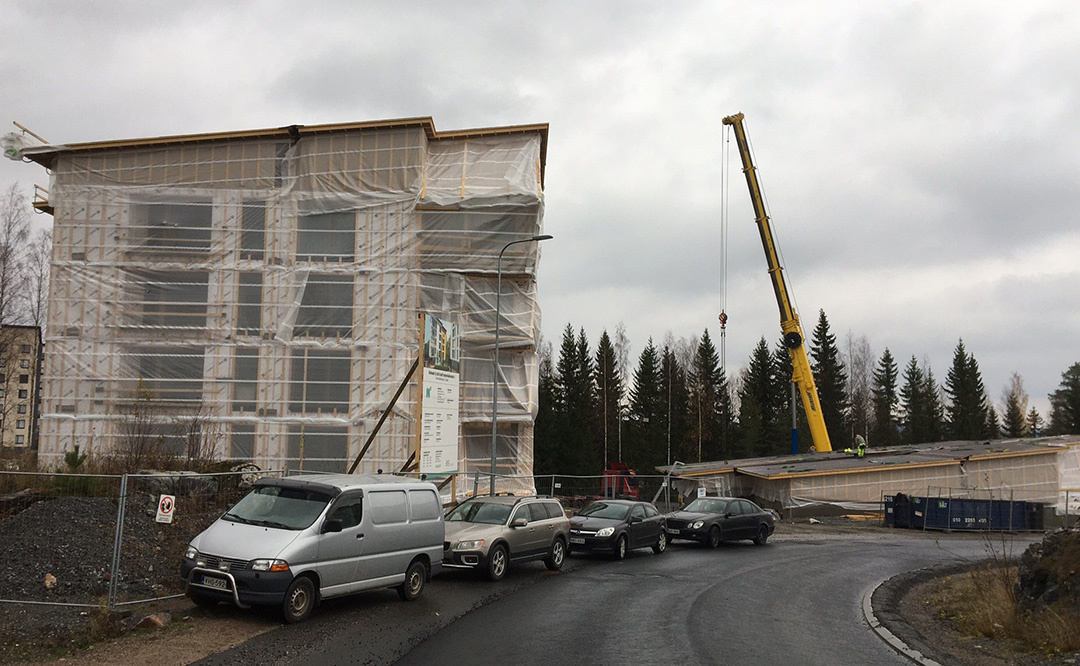
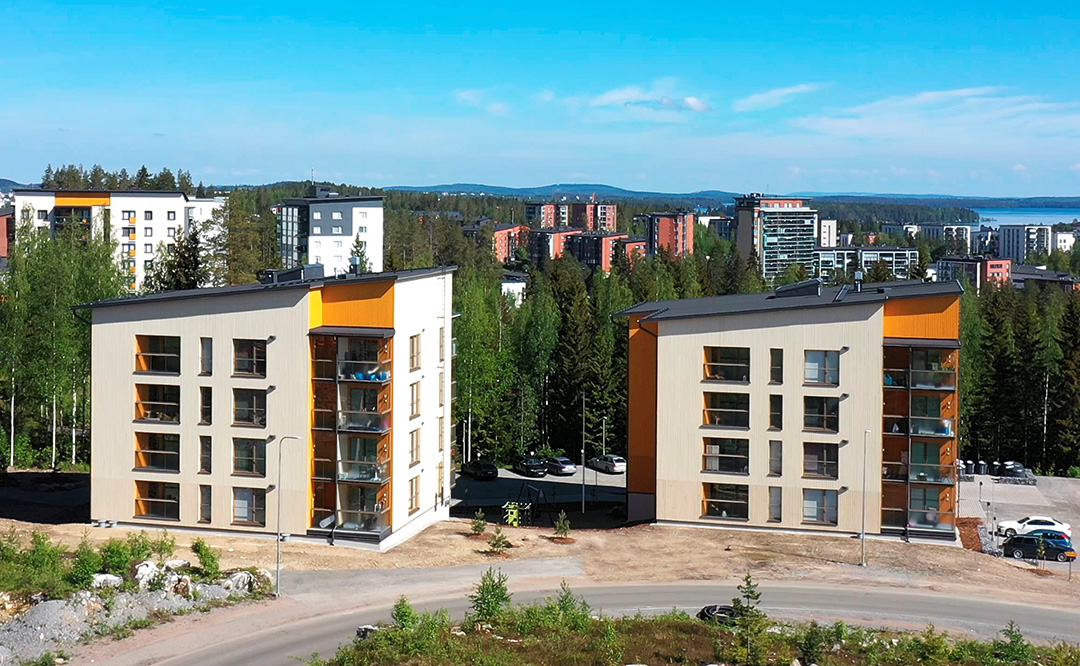
The project consists of two separate buildings and 48 apartments. Other facilities include outdoor equipment storage, space for storing baby carriages and a drying room. Building B also has a laundry room, sauna and a communal club room for use by the residents of both buildings. The load-bearing structure is wood and cross-laminated timber (CLT), resulting in a low carbon footprint. The 31.5 m2 and 36 m2 studios and 48 m2 two room apartments are made with individual volumetric elements and the 64 m2 three room apartments use two volumetric elements. The glazed balconies are also part of the volumetric elements. The elevator shafts and stairs are made of CLT sheets. Together with the façade cladding, they make the use of wood visible. The city plan specifies the roof shape and colour effects allowed in the area, which guided the design. The entire building has sprinklers, and the interior walls are clad with drywall. Rubber insulation between the volumetric elements cuts off the lateral displacement of sound. Work on site progressed as planned. Special effort was paid to the weather protection. The roof sections were assembled on site, leaving only the surface membrane uninstalled, and then put up for weather protection as element installation progressed. In both buildings, it took two months to build the ground floors and other concrete structures. Volumetric elements were prefabricated from CLT in Kuhmo and lifted into place on site under the protection of pre-assembled roof sections. On-site wood element installation took two weeks in both buildings, and the roofs were built on site in three weeks. It can be concluded that prefabrication has shortened the construction process, prevented damage from moisture and improved quality.
Assessment method
LCA scheme compliance | Method for the whole-life carbon assessment of buildings (Finnish Ministry of the Environment) |
LCA tool version | OneClickLCA |
Life cycle stages included | A1-A5, B4-B5, B6, C2-C4, D |
Material emission data | Generic Finnish database, EPDs |
Material decarbonisation scenario | — |
Energy calculation method | Energy Performance Certificate (Finnish) |
Energy, dynamic scenario | Energy decarbonisation scenario according to the Finnish method; (most likely) benefit-sharing method |
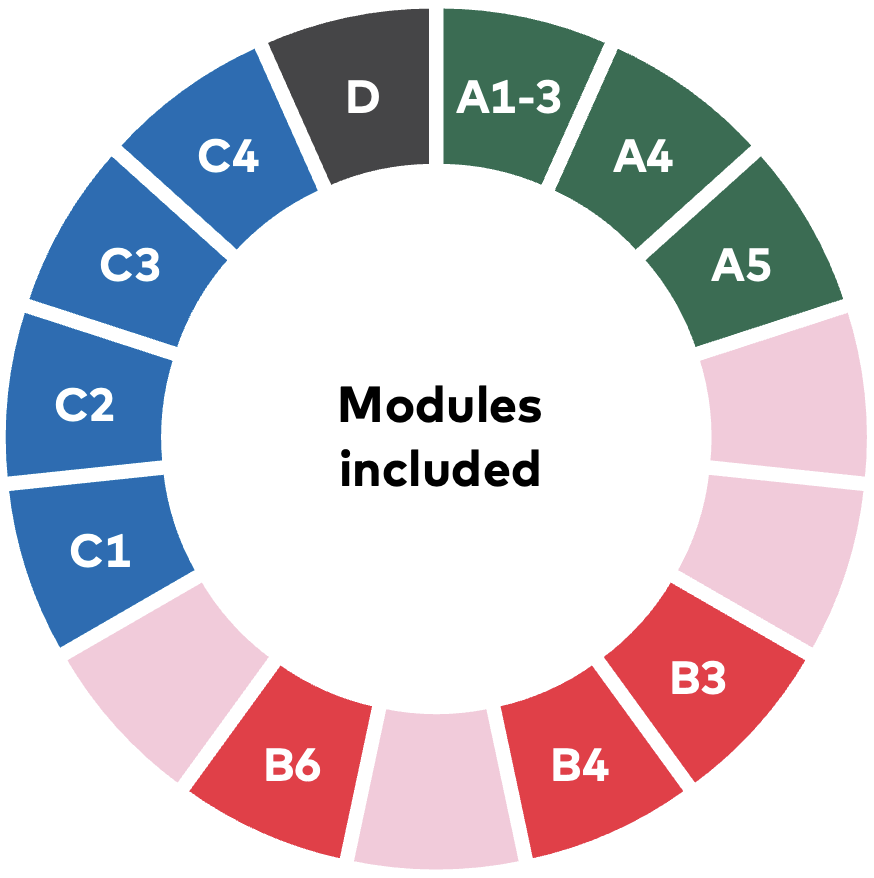
LCA results: Life cycle modules
[kgCO2e/m2 reference area * year]
%
[kgCO2e/m2 reference area * year]
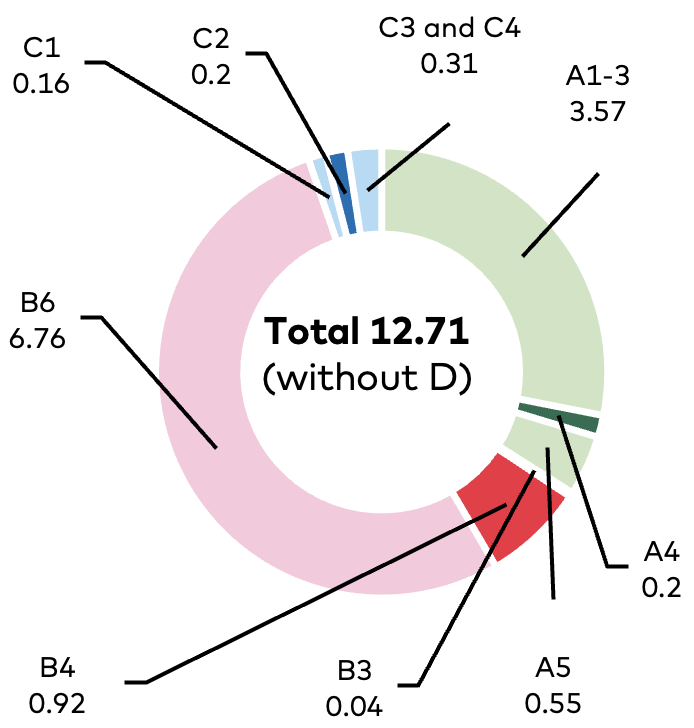
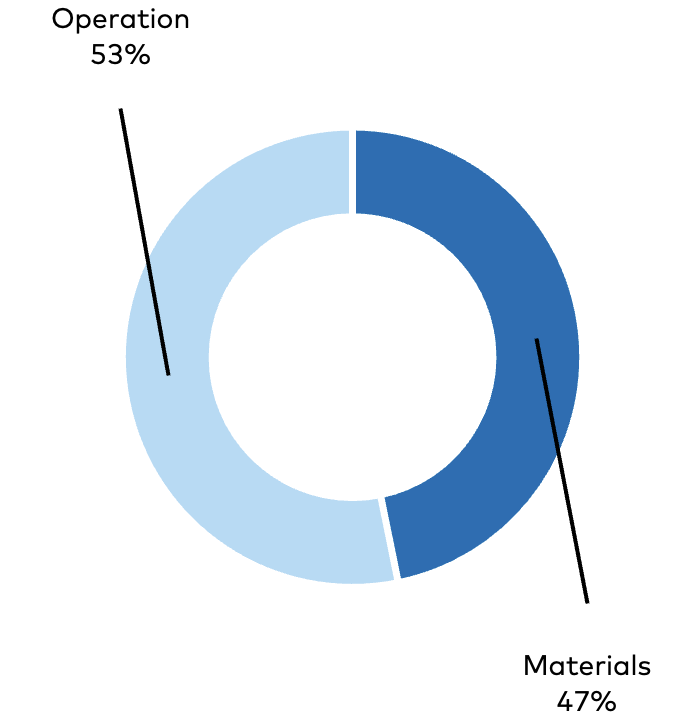
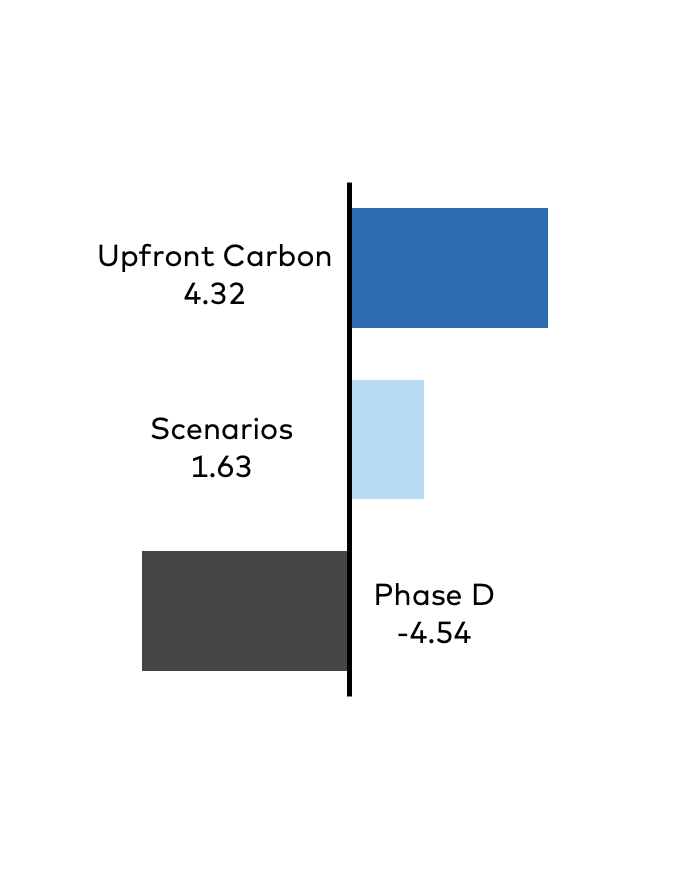
The system boundary covers almost all life cycle modules, where the energy consumption is dominating the overall impacts, followed by the product stage. Building services are modelled in detail (lifts and escalators, electricity system, HVAC system, renewable energy systems, water system, heating system).
In the second figure, Operation includes B6, while materials include A1-A5, B3-B4, C1-C4
In the third figure, Upfront includes A1-A5, scenarios include B3-B4, C1-C4, and D is shown separately.
In the second figure, Operation includes B6, while materials include A1-A5, B3-B4, C1-C4
In the third figure, Upfront includes A1-A5, scenarios include B3-B4, C1-C4, and D is shown separately.
LCA results: Building elements
GWP / reference area [kgCO2e/m2 reference area]
Material inventory: All materials
Life cycle modules: A1-A5, B3-B4, C1-C4
Life cycle modules: A1-A5, B3-B4, C1-C4
The building is made with prefabricated space elements and is thus difficult to separate into individual elements. The roofing is most likely included in floor slabs. Internal walls include surfaces and finishes.
Building element quantity / reference area [kg building element / m2 reference area]
GWP of building element / building element quantity [kgCO2e / kg building element]
Material inventory: All materials
Life cycle modules: A1-A5, B3-B4, C1-C4
Life cycle modules: A1-A5, B3-B4, C1-C4
Building element quantity per building reference area is a measure for the material intensity, while element impacts per element quantity is a measure for the elements’ carbon intensity relative to their weight.
LCA results: Products
Product quantity / reference area [kg product / m2 reference area]
GWP of product / reference area [kgCO2e/m2 reference area]
Material inventory: Top 10 products with the highest impacts
Life cycle modules: A1-A5, B3-B4, C1-C4
Life cycle modules: A1-A5, B3-B4, C1-C4
Construction product quantity per building reference area is a measure for the material intensity, while product impacts per building reference area is a measure for carbon intensity.
In this lightweight prefabricated structure, concrete for the ground floor deck is dominating the individual product impacts, followed by the triple-glazed windows and CLT.