09 Wood city Office II
09 Wood city Office II, Finland
Building use | Office | Stories above ground | 7 |
Location | Jätkäsaarenlaituri 1, 00180 Helsinki | Basement area | 900 m2 |
Client | WithSecure Oyj | Structural system | Steel |
LCA consultant | Sustera, Vantaa, Finland | Façade type | Column-beam system (GLT) - CLT-hybrid slap (CLT + concrete) |
Year of completion | 2024 | Roof type | Bituminous roofing felt on mineral wool insulation |
Reference area | 18,327 m2 (gross floor area) | Heat demand /source | District heating |
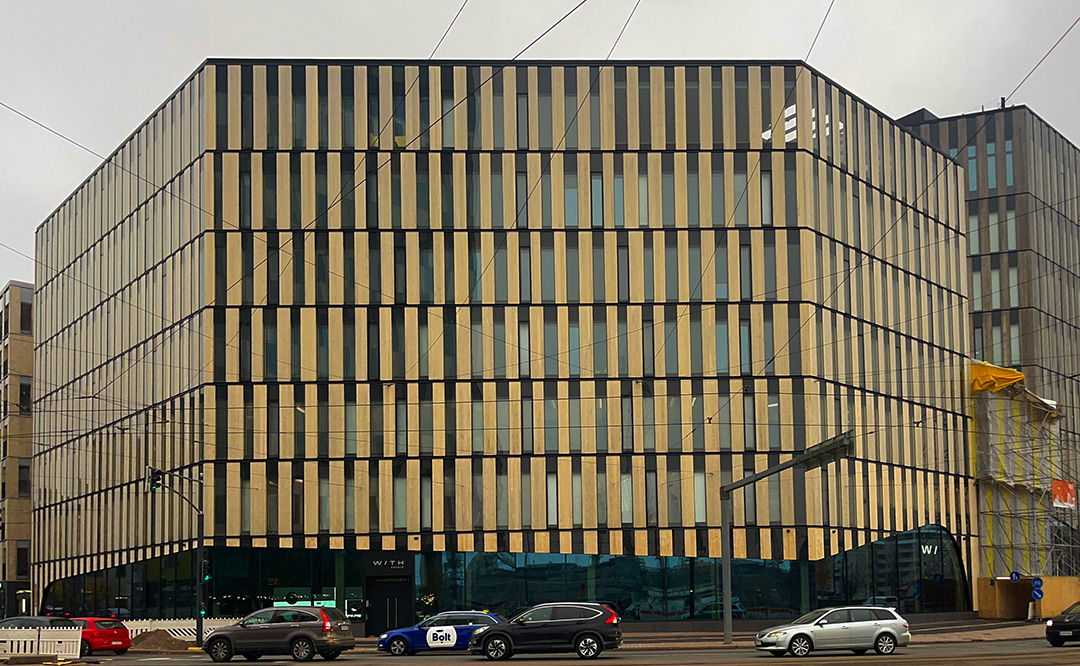
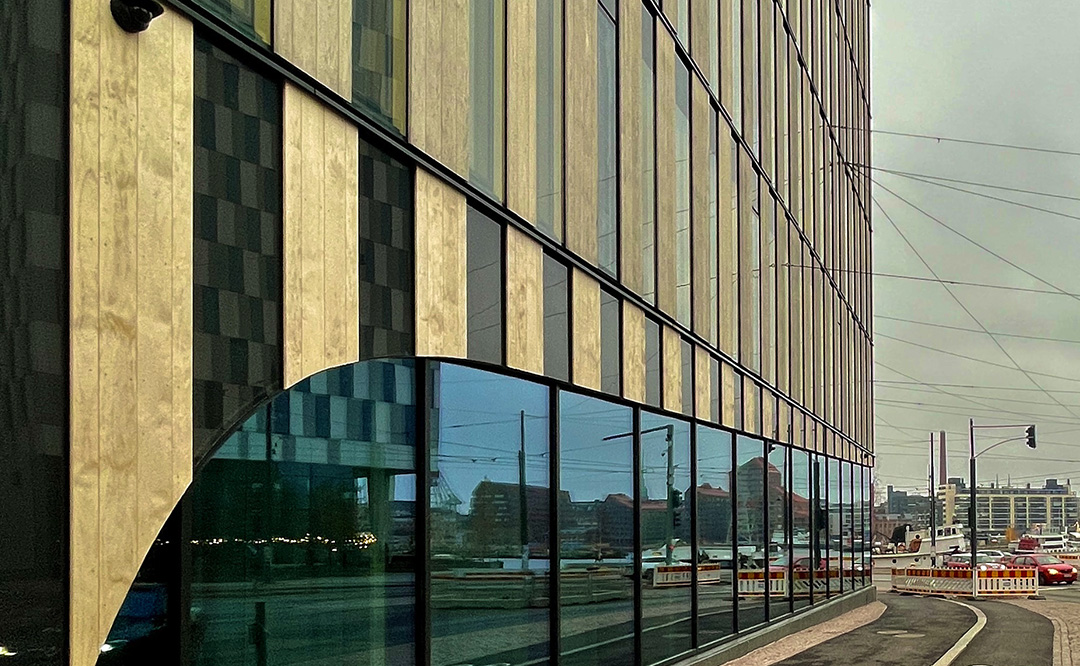
The 8-story wooden office building in Jätkäsaari, Helsinki, completed in 2024, is a low-carbon pioneer in Finnish office construction. It features 1,200 m3 structural timber, including a CLT intermediate floor plan and wooden façades, which are rare for office buildings. Besides the timber solutions, which have been innovated for this project, one of the remaining carbon hot spots are the steel structures with particularly high emissions, for which alternative solutions had to be found. Additional efforts include achieving low energy consumption during operation as well as low-emission product solutions, documented by environmental product declarations. Effective cooperation with the customer has enabled an accurate calculation result. Based on a preliminary calculation, the carbon footprint of the site was presented to the Client during the construction phase during the site visit.
Assessment method
LCA scheme compliance | Method for the whole-life carbon assessment of buildings (Finnish Ministry of the Environment), LEED Platinum |
LCA tool version | One Click LCA |
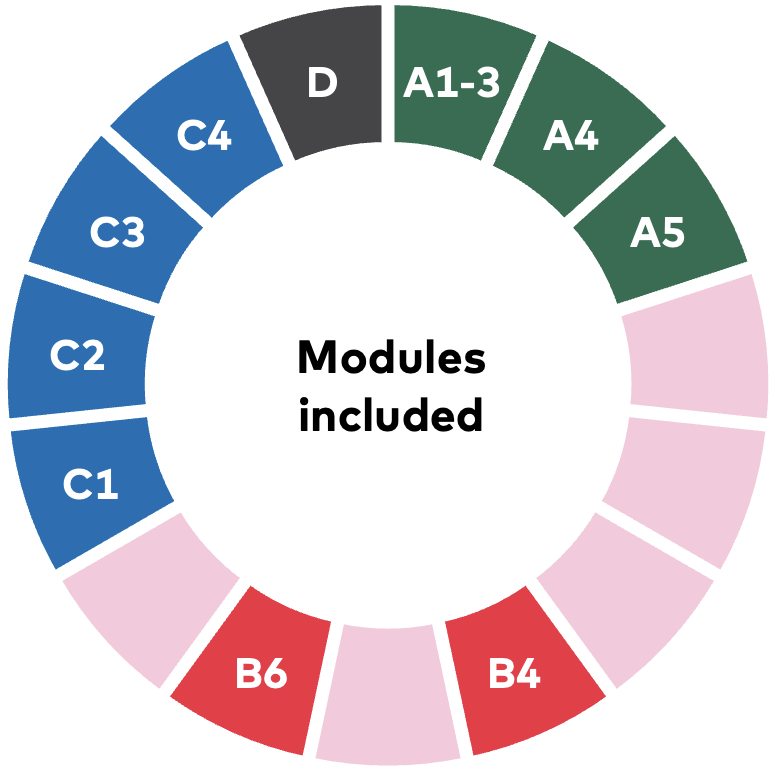
Life cycle stages included | A1-A5, B4, B6, C1-C4, D |
Material emission data | Generic Finnish database, EPDs |
Material decarbonisation scenario | — |
Energy calculation method | Energy Performance Certificate (Finnish) |
Energy, dynamic scenario | Energy decarbonisation scenario according to the Finnish method; (most likely) benefit-sharing method |
LCA results: Life cycle modules
[kgCO2e/m2 reference area * year]
%
[kgCO2e/m2 reference area * year]
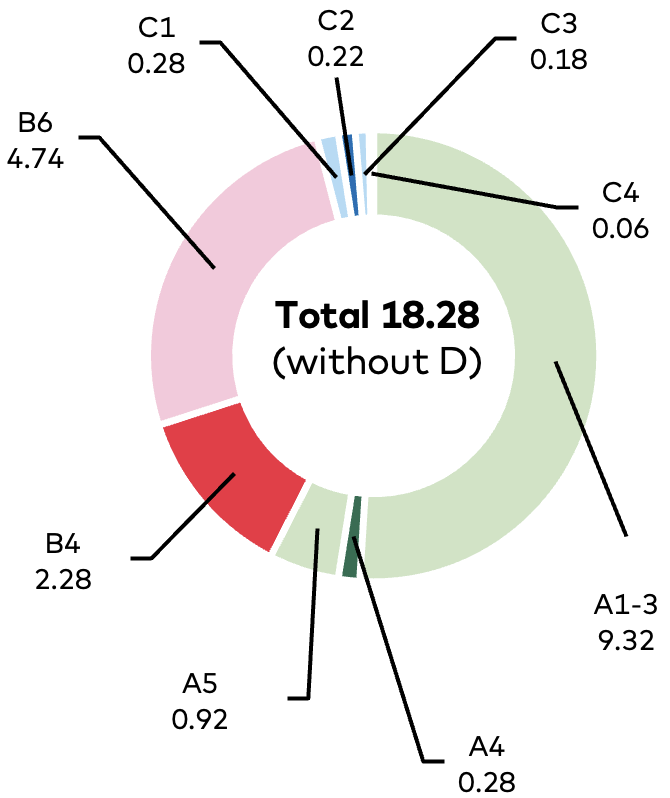
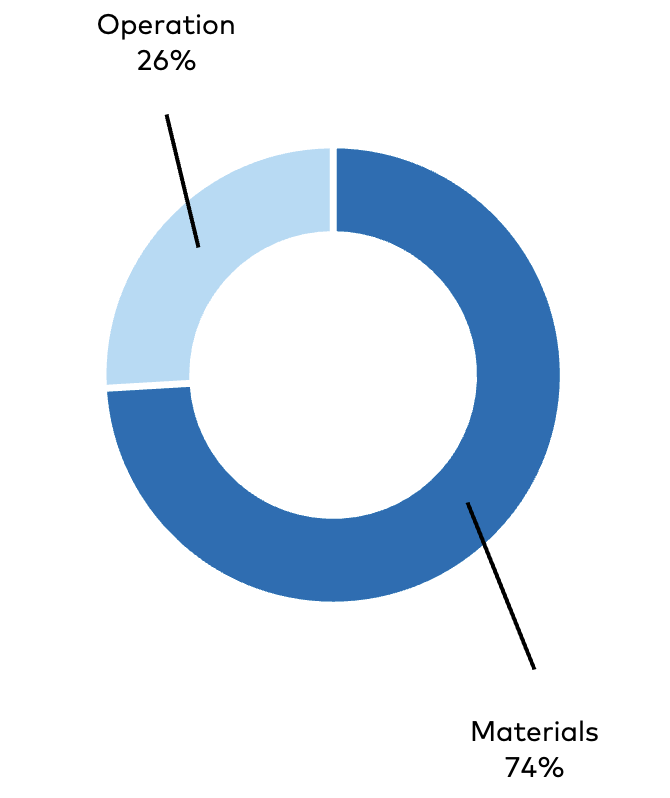

The system boundary covers almost all life cycle modules, where the product stage is dominating the overall impacts, followed by energy use. Building services are modelled in detail (lifts and escalators, electricity system, HVAC system, renewable energy systems, water system).
In the second figure, Operation includes B6, while materials include A1-A5, B4, C1-C4
In the third figure, Upfront includes A1-A5, scenarios include B4, C1-C4, and D is shown separately.
In the second figure, Operation includes B6, while materials include A1-A5, B4, C1-C4
In the third figure, Upfront includes A1-A5, scenarios include B4, C1-C4, and D is shown separately.
LCA results: Building elements
GWP / reference area [kgCO2e/m2 reference area]
Material inventory: All materials
Life cycle modules: A1-A5, B4, C1-C4
Life cycle modules: A1-A5, B4, C1-C4
Basement walls are included in the frame. Floor slaps include flooring and ceiling. Interior walls include finishes and coverings. Both the roof structure and exterior walls include exterior cladding. All the technical components and piping for electricity, water etc. were included in the estimation. Combined, they have an impact of 95 kg CO2e/m2 reference area (not included in the figure).
Building element quantity / reference area [kg building element / m2 reference area]
GWP of building element / building element quantity [kgCO2e / kg building element]
Material inventory: All materials
Life cycle modules: A1-A5, B4, C1-C4
Life cycle modules: A1-A5, B4, C1-C4
Building element quantity per building reference area is a measure for the material intensity, while element impacts per element quantity is a measure for the elements’ carbon intensity relative to their weight.
The curtain wall façade is dominating the product list with the highest impacts, likely due to the large glazing area. Internal doors are likely a large number of glass doors with large dimensions.
LCA results: Products
Product quantity / reference area [kg product / m2 reference area]
GWP of product / reference area [kgCO2e/m2 reference area]
Material inventory: Top 10 products with the highest impacts
Life cycle modules: A1-A5, B1-B5, C1-C4
Life cycle modules: A1-A5, B1-B5, C1-C4
Construction product quantity per building reference area is a measure for the material intensity, while product impacts per building reference area is a measure for carbon intensity.
The highest-ranking product is in-situ concrete, including all subtypes. This is followed by steel beams, HVAC systems and the curtain wall façade, reflecting a classic urban office building.