Photos by Helene Høyer Mikkelsen, Realdania By og Byg
04 MiniCO2 Etagehus TRÆ
Denmark
04 MiniCO2 Etagehus TRÆ, Denmark
Building use | Apartment building | Stories above ground | 5 |
Location | Kongens Stræde 90, 7000 Fredericia, Kanalbyen | Basement area | — |
Client | Realdania By og Byg | Structural system | Column-beam timber frame |
LCA consultant | Artelia A/S | Façade type | Wood |
Year of completion | 2024 | Roof type | Pitched roof |
Reference area | 576.7 m2 (gross floor area) | Heat demand /source | District heating |
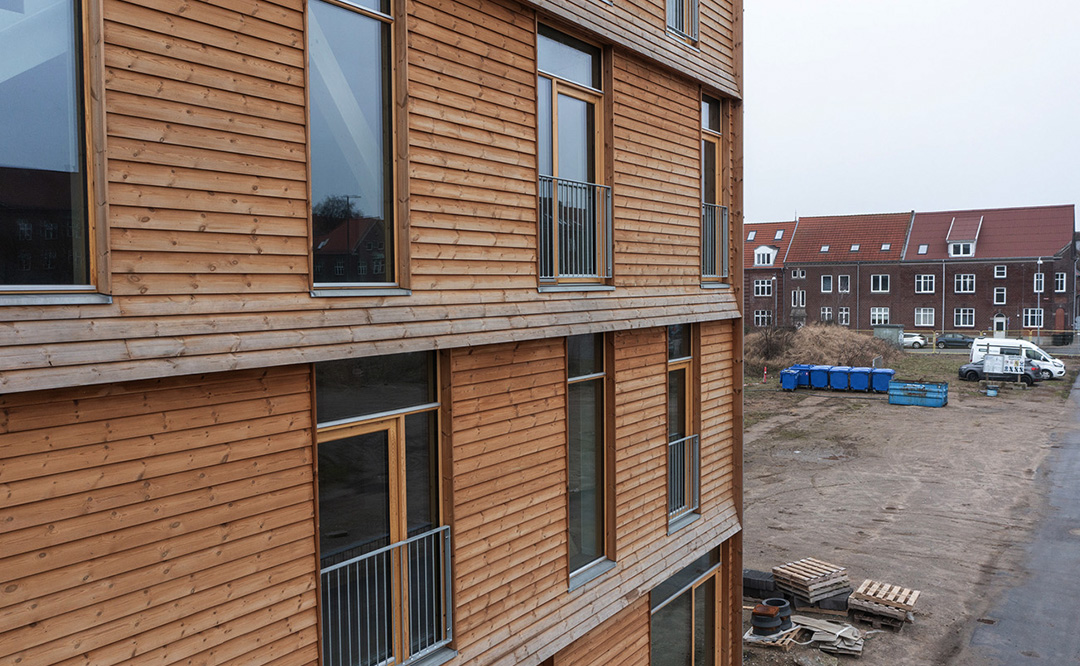
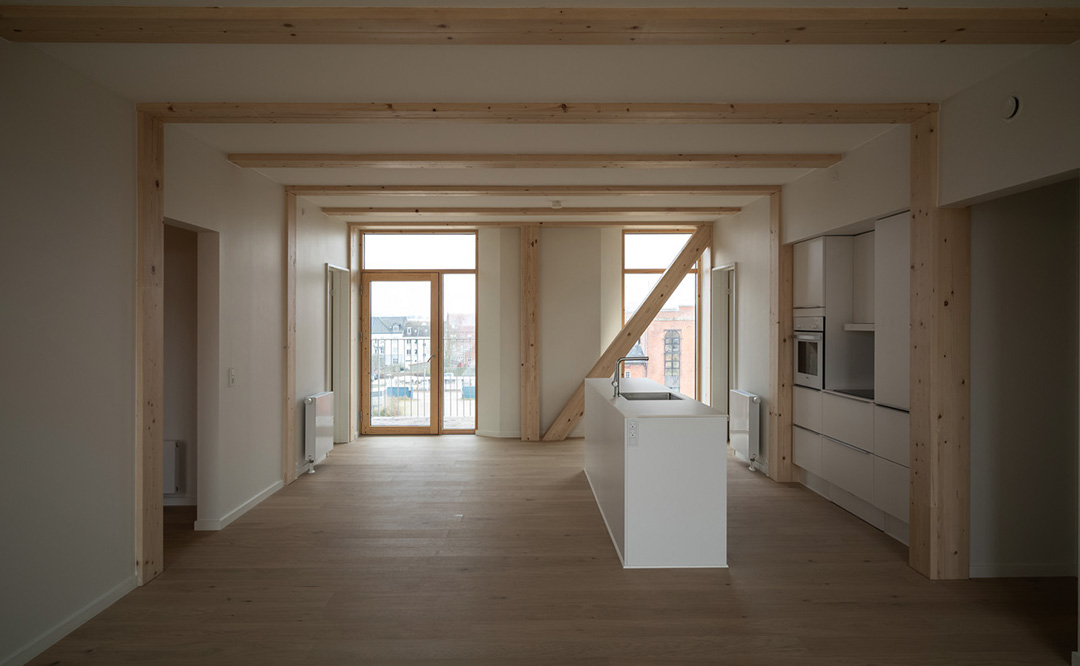
The building is part of an experimental project by Realdania By og Byg that includes several buildings, each in its own primary material. The project included stakeholders and contributors; JAJA Arkitekter, Egil Rasmussen, Blumer-Lehmann and Artelia A/S. The purpose of MiniCO2 has been to construct the buildings primarily in wood and then compare them with similar buildings in other materials such as concrete and brick. The project sets requirements for the experimental buildings that enable them to be compared in terms of carbon footprint and strength. The test building will function as a residential building and is designed with one dwelling per floor. The five-storey building stands on a pile foundation and a reinforced concrete foundation slab. The ground floor is made of concrete, with EPS as insulating material. The building’s load-bearing structures consist of CLT, glulam and steel. The insulating materials are primarily wood fibre and mineral wool in select places. The lightweight exterior walls are built as a timber frame, primarily insulated with wood fibre. The façades are clad with cedar, and the interior surfaces are clad with fibre plaster. The lightweight inner walls are timber frame structures with fibre plaster. The floor decks are constructed as ribbed decks with CLT and glulam and are insulated with paper wool. Special attention has been paid to meeting acoustic requirements between floors, which can be a challenge without the use of concrete. The roof is a timber beam and rafter structure.
Assessment method
LCA scheme compliance | — |
LCA tool version | LCAbyg 5 |
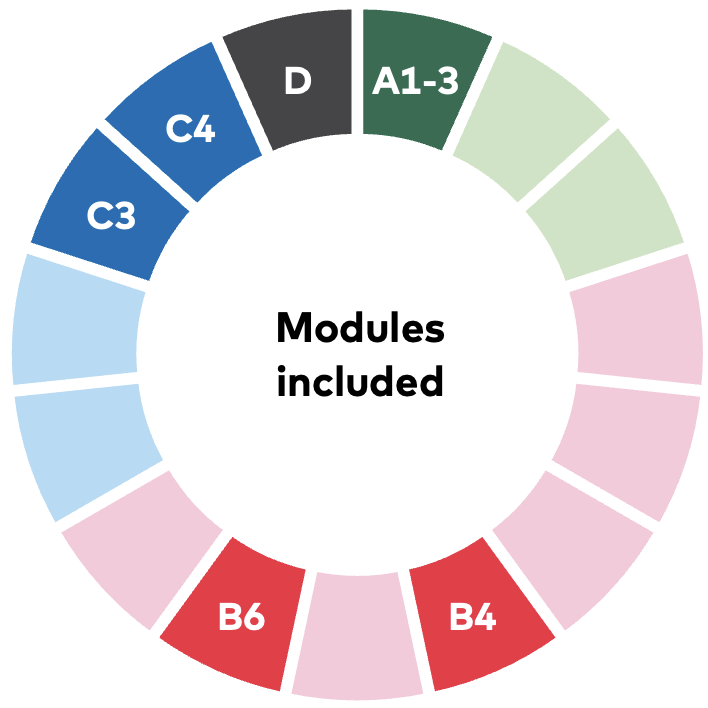
Life cycle stages included | A1-A3, B4, B6, C3, C4, D |
Material emission data | Generic Danish database used in LCAbyg and DGNB and EPD |
Material decarbonisation scenario | — |
Energy calculation method | According to building regulations |
Energy, dynamic scenario | Dynamic development of energy supply according to frozen policy, based on an official national report from 2020 |
LCA results: Life cycle modules
[kgCO2e/m2 reference area * year]
%
[kgCO2e/m2 reference area * year]
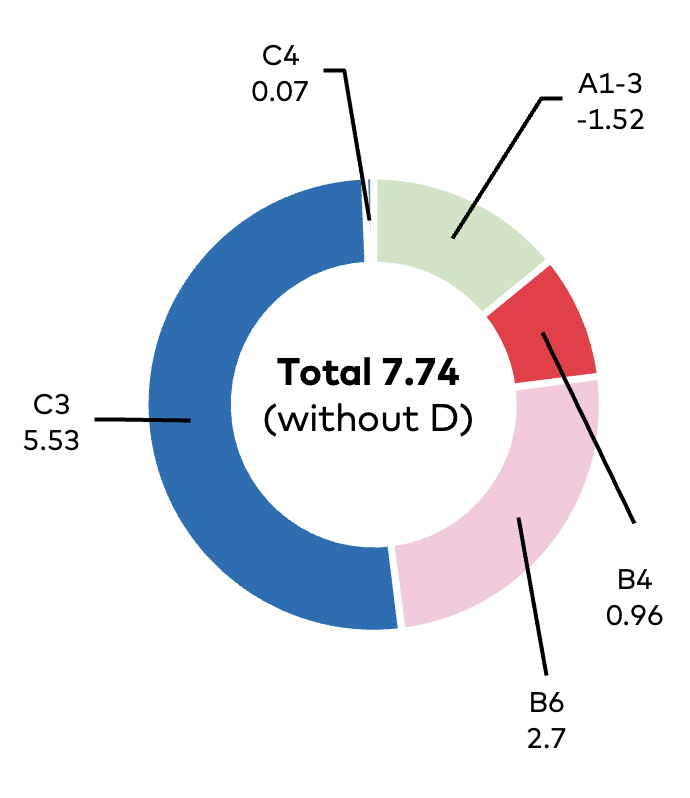
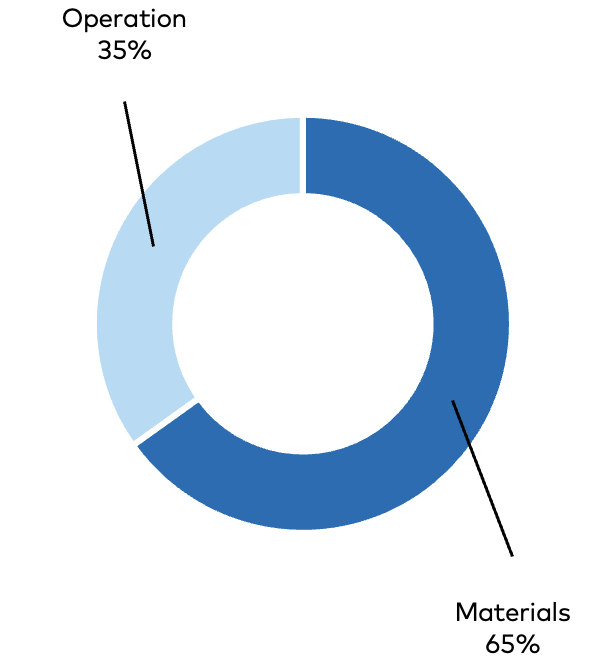
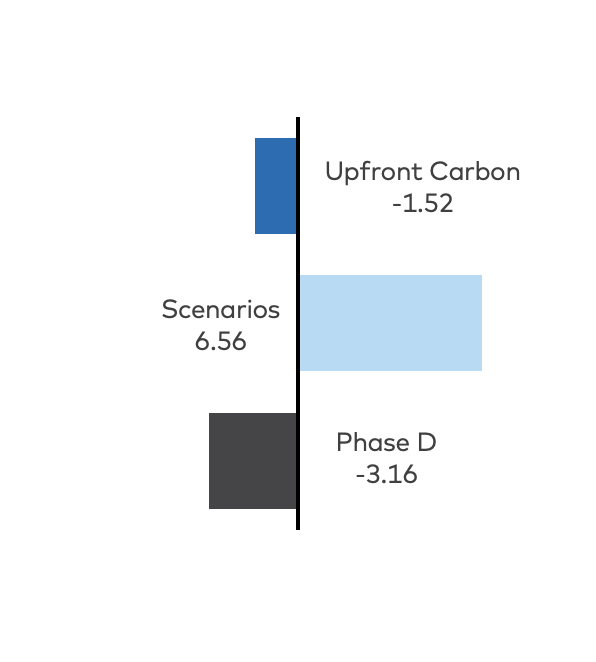
The system boundary reflects the current Danish practice, including a minimum number of modules of all stages. Impacts are below the current limit value of 12.0 and the low-emission level of 8.0 kgCO2e/m2a. In the second figure, Operation includes B6, while materials include A1-A3, B4, C3-C4. In the third figure, Upfront includes A1-A3, scenarios include B4, C3-C4, and D is shown separately. Upfront impacts are negative due to the large share of biogenic materials.
LCA results: Building elements
GWP / reference area [kgCO2e/m2 reference area]
Material inventory: All materials
Life cycle modules: A1-A3, B4, B6, C3-C4
Life cycle modules: A1-A3, B4, B6, C3-C4
Foundations include deep-rammed concrete piles and have the largest relative impacts. In a multi-storey building, floor slabs are relevant too, even though the building has been optimised for balancing both acoustic and fire performance.
Building element quantity / reference area [kg building element / m2 reference area]
GWP of building element / building element quantity [kgCO2e / kg building element]
Material inventory: All materials
Life cycle modules: A1-A3, B4, B6, C3-C4
Life cycle modules: A1-A3, B4, B6, C3-C4
Building element quantity per building reference area is a measure for the material intensity, while element impacts per element quantity is a measure for the elements’ carbon intensity relative to their weight.
LCA results: Products
Product quantity / reference area [kg product / m2 reference area]
GWP of product / reference area [kgCO2e/m2 reference area]
Material inventory: Top 10 products with the highest impacts
Life cycle modules: A1-A3, B4, B6, C3-C4
Life cycle modules: A1-A3, B4, B6, C3-C4
Construction product quantity per building reference area is a measure for the material intensity, while product impacts per building reference area is a measure for carbon intensity.
Based on its coastal location, rammed concrete piles are the single highest impact products, followed by the elevator and concrete for foundations. In non-test conditions, two instead apartments instead of one would share an elevator, halving its relative emissions.