03 Living places Copenhagen
Denmark
03 Living places Copenhagen, Denmark
Building use | Detached home | Stories above ground | 3 |
Location | Otto Busses Vej 29A, 2450 København SV | Basement area | — |
Client | Velux Group | Structural system | Cross-laminated timber |
LCA consultant | Artelia | Façade type | Wood |
Year of completion | 2023 | Roof type | Pitched roof |
Reference area | 147 m2 (gross floor area) | Heat demand /source | Heat pump and solar cells |
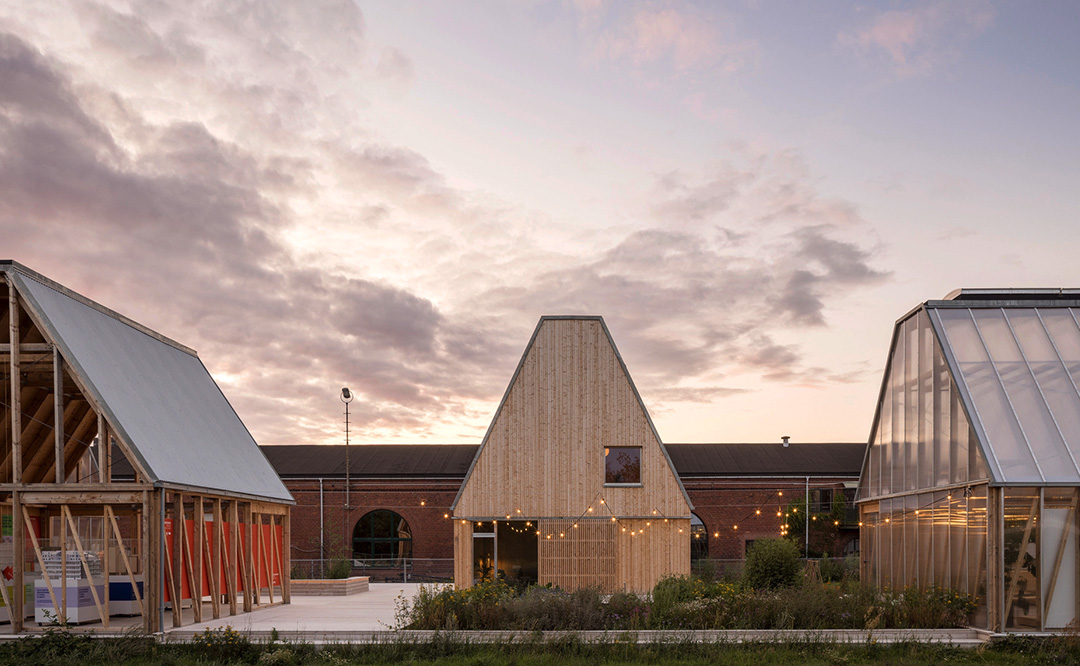
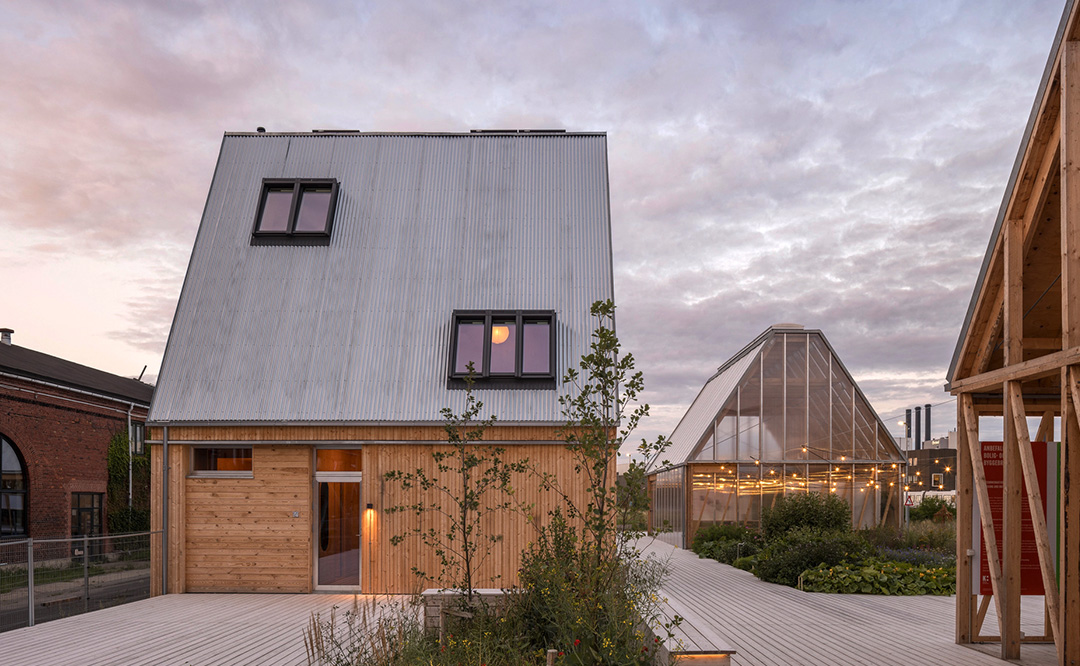
With Living Places, we are exploring how far we can go with existing solutions for housing construction, and the results are promising. Living Places demonstrates scalable solutions that can ensure healthy and good housing for future citizens with radical reduction of emissions and resource consumption in the buildings’ life cycle. The buildings will be a temporary 1:1 exhibition model in the centre of Copenhagen. It will show how to build with a low-carbon footprint and focus on health. The one-family home shown here is one of two completed houses that are part of a larger exhibition showcasing a total of seven new building prototypes to promote healthier and lower-impact homes. The building design and material choices have been optimised for minimal carbon emissions and improved indoor climate. The building has been constructed using cross-laminated timber (CLT), both in the walls and the roof, and with a ground screw foundation to ensure minimal disruption to the building plot. The building has been designed towards utilising natural ventilation as much as possible. This was achieved through placing windows and openings in the interior structure to allow for an undisrupted flow of air and light through the building and by using windows with motors for automatic opening.
Assessment method
LCA scheme compliance | — |
LCA tool version | LCAbyg 5 |
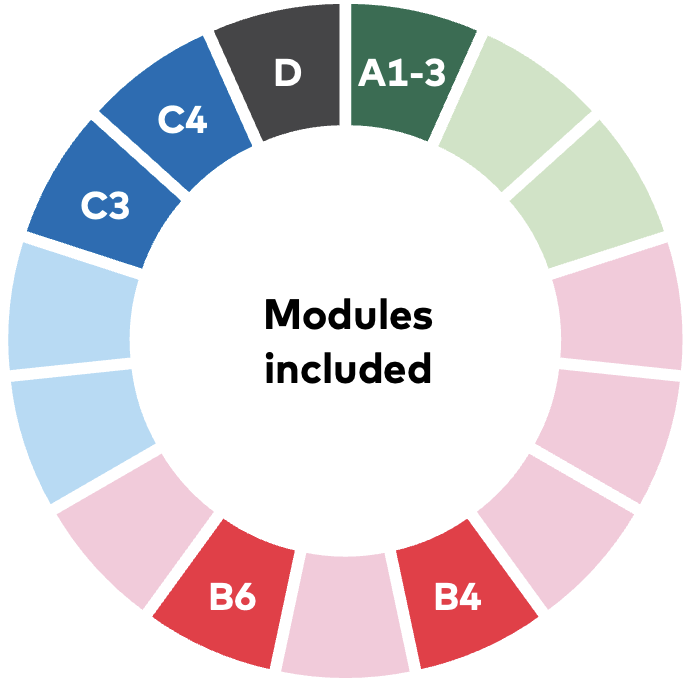
Life cycle stages included | A1-A3, B4, B6, C3, C4, D |
Material emission data | Generic Danish database used in LCAbyg and DGNB and EPD |
Material decarbonisation scenario | — |
Energy calculation method | According to building regulations |
Energy, dynamic scenario | Dynamic development of energy supply according to frozen policy, based on an official national report from 2020 |
LCA results: Life cycle modules
[kgCO2e/m2 reference area * year]
%
[kgCO2e/m2 reference area * year]
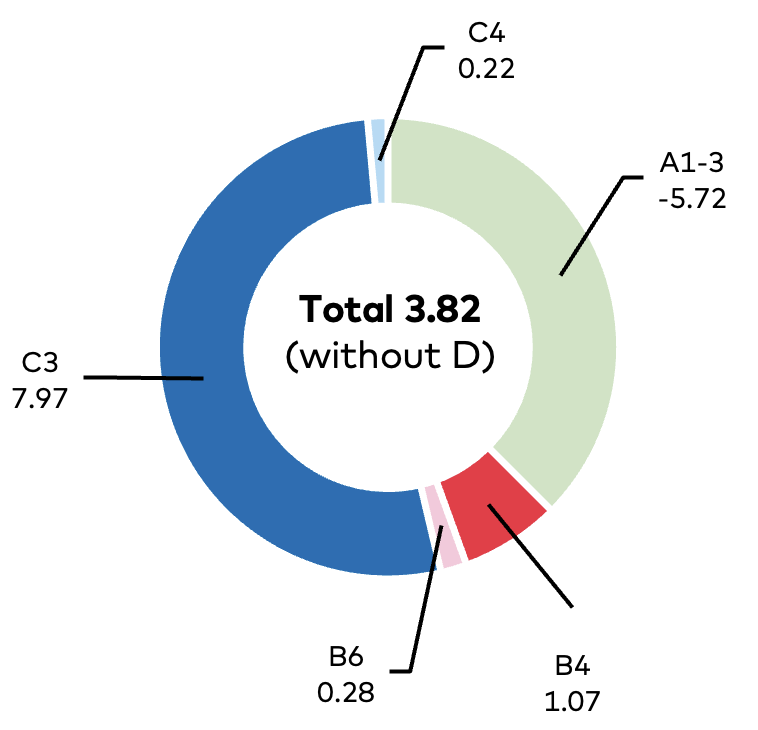
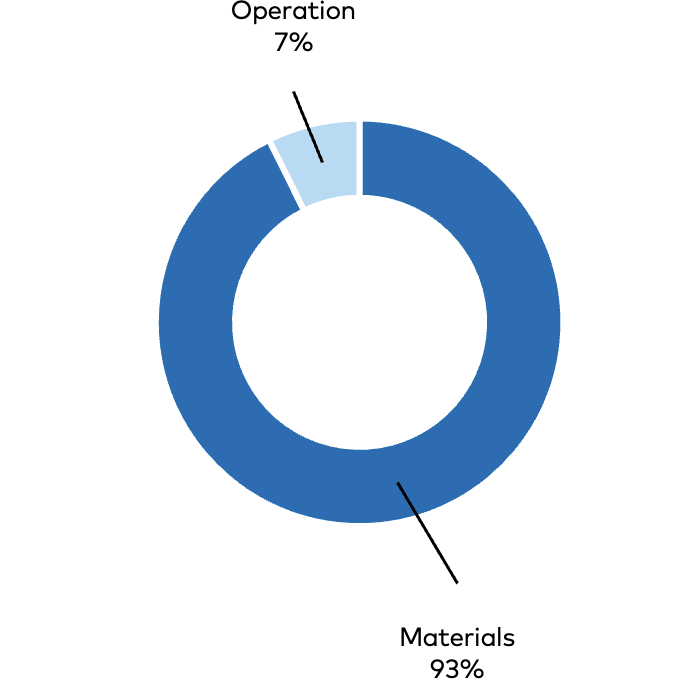
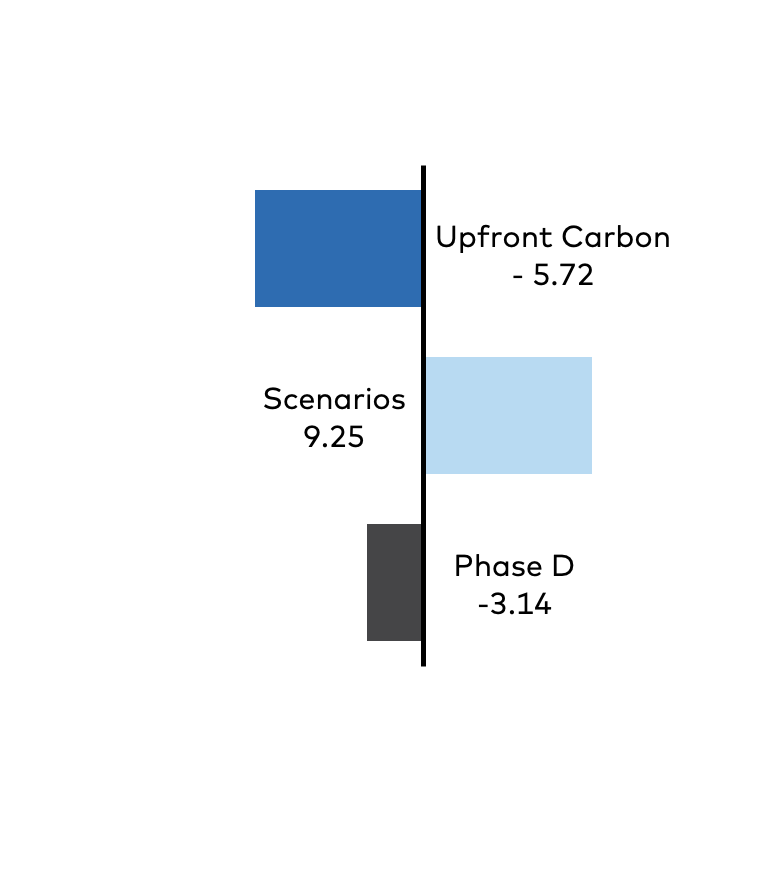
The life-cycle modules follow Danish practice in voluntary schemes and the carbon regulations of that time. Modules A1-3 have negative emissions due to the dominating biogenic materials used, while the effect is reversed in C3. In the second figure, Operation includes B6, while materials include A1-A3, B4, C3-C4. The project is highly energy efficient and uses heat pumps and solar cells, combined with low emissions in the electricity mix. In the third figure, Upfront includes A1-A3, scenarios include B4, C3-C4, and D is shown separately. Upfront impacts are negative due to the biogenic content of the added materials.
LCA results: Building elements
GWP / reference area [kgCO2e/m2 reference area]
Material inventory: All materials
Life cycle modules: A1-A3, B4, C3-C4
Life cycle modules: A1-A3, B4, C3-C4
External doors and windows dominate the element GWP ranking, which in parts is due to the low impacts of the remaining elements. The roof has a relative high impact due to its large dimension relative to the building geometry. Foundations and ground floor deck have a reduced impact due to screw technology.
Building element quantity / reference area [kg building element / m2 reference area]
GWP of building element / building element quantity [kgCO2e / kg building element]
Material inventory: All materials
Life cycle modules: A1-A3, B4, C3-C4
Life cycle modules: A1-A3, B4, C3-C4
Building element quantity per building reference area is a measure for the material intensity, while element impacts per element quantity is a measure for the elements’ carbon intensity relative to their weight.
The steel screw foundations show a low weight, but a relatively high carbon intensity. Due to the lightweight structure, the roof has a rather large carbon intensity per weight.
LCA results: Products
Product quantity / reference area [kg product / m2 reference area]
GWP of product / reference area [kgCO2e/m2 reference area]
Material inventory: Top 10 products with the highest impacts
Life cycle modules: A1-A3, B4, C3-C4
Life cycle modules: A1-A3, B4, C3-C4
Construction product quantity per building reference area is a measure for the material intensity, while product impacts per building reference area is a measure for carbon intensity.
Façade windows dominate the product GWP ranking, especially when also including the skylight windows and panes. Note that windows are modelled with a series of products.
Other high impacts are in the heating system and solar cells.