6. Impact on consumption based emissions
The Nordic countries are often high performers when it comes to mitigation of national (terrestrial) emissions and working towards sustainability, positioning on top rankings on indicators such as The Climate Change Performance Index (CCPI, n.d) and the SDG performance index (Sustainable Development Report, n.d). However, the Nordic countries often face challenges in reducing climate impact when it comes to consumption-based emissions (Nordic Council of Ministers, 2025). Climate policy and goals are often based on terrestrial emissions, leaving out the accountability of emissions for consumption of foreign goods.
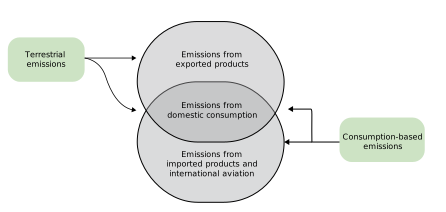
Figure 9. Relationship between terrestrial and consumption-based emissions
Historically, and still in many parts of the world, national territorial GHG emissions have been closely correlated to GDP. Yet, between 2010–2018, the EU saw a decrease in domestic environmental impact, while still experiencing economic growth, indicating a decoupling of environmental impact from economic growth (European Commission, 2022a). However, when emissions related to trade are included, the decoupling proved to be limited. Consumption-based emissions are typically higher than territorial emissions in wealthy countries, posing a responsibility for the Nordic countries to rightfully account for consumption-based emissions while still thriving for continuously increasing wealth (Nordic Council of Ministers, 2024; Our World in Data, 2024). Consumption-based accounting allows for national emissions to include trade-based emissions, reflecting actual emissions related to national consumption. This emphasizes the importance of trade-focused policies, like CBAM, in the aim of mitigating national emissions in the Nordics.
6.1 Current methodologies for calculating consumption-based emissions
This section outlines the main methodological approaches used to calculate consumption-based emissions, and describes how Finland, Sweden and Denmark currently apply these methods in practice. The section focuses on consumption-based accounting (CBA), and the top-down and bottom-up approaches with multi regional Input-output tables (MRIO) and Life Cycle Assessment (LCA). It also highlights the growing relevance of these methodologies in light of CBAM, which may provide new data sources that can strengthen existing models.
6.1.1 Consumption-based accounting
Consumption-based accounting (CBA) is a method to calculate national GHG-emissions caused by the consumption of its residents, regardless of where in the world these emissions occur (see figure x). Contrary to terrestrial/production-based accounting, it captures the emissions in the entire life cycle of satisfying final consumption (Tukker et al., 2020). Consumption-based emissions differ from terrestrial emissions, as it goes beyond geographical borders, and add the dimension of trade. As a substantial part of the consumption in the EU is imported, a large share of the emissions associated with that consumption is generated in third countries. The countries covered within the scope of this study have among the highest consumption-based footprint in the EU, all ranking above EU-27 average. According to a recent report by (Axelsson et al., 2024) , Denmark had the highest per capita consumption based climate footprint in the EU as of 2021, emphasizing the importance of consumption-based emissions.
To ensure accurate consumption-based accounting, it is vital to have sufficient data which requires data collection not only nationally but from supplying third countries. This has resulted in several databases, utilized by countries in national consumption-based accounting. Among these are ICIO (OECD database), EXIOBase, FIGARO (EU), GTAP, WIOD-database and the EORA-database (Nordic Council of Ministers, 2024). These are usually divided into individual country tables, making them accessible for specific country analysis. The databases have different qualities, dependent on the desired calculation approach and choice of modelling in consumption-based accounting (Nordic Council of Ministers, 2024).
6.1.2 Top-down and bottom-up approaches
The bottom-up approach refers to the life cycle assessment (LCA) accounting approach, where the entire GHG inventory of a product, service, process or policy is tracked all through the value chain (Wiebe et al., 2016). The LCA approach has a primary focus on systematic analysis of the product, and is a micro-scale tool, making it useful in providing individual consumption levels. The LCA method is thoroughly standardized, notably in the international standardization, ISO (International Organization for Standardization) 14040 series (ISO, 2006), making it possible to harmonize the application. As the approach is product based, it is not an efficient method in addressing macro-scale consumer impact (Wood et al., 2018). Working with the LCA approach on a governmental scale is difficult, as it heavily relies on the data collection skills of producers, making it a labour-intensive procedure. It is therefore not a commonly used method to calculate consumption-based emissions on a national scale. However, the LCA approach has laid the foundation for governmental scale frameworks, such as the European Union framework on addressing the performance on consumption-based emissions of member states (European Commission, 2022a). Due to the data-intensive dimension of the bottom-up approach, a top-down approach that is based on economic flows between sectors and has readily available data, offers a popular alternative.
Central to the top-down approach is typically an input–output table describing the goods and services bought and sold between different actors in the economy and finally sold to final consumers (Palm et al., 2019). The multi-regional input-output (MRIO) model is the main method in the top-down approach and is a very common tool in consumption-based accounting. For environmental data, the model can be extended with “Environmental Extensions” (EE), describing the resource use or emissions per industry, in which case the model is called an EE MRIO model. This is the most commonly used method to calculate embodied carbon emissions in consumption-based accounting in the Nordic countries (Nordic Council of Ministers, 2024). The EE MRIO model allows for an analysis of regionally embodied carbon emissions in product consumption that includes trade dimensions, and value added along the production chain (Wiebe et al., 2016). EE MRIO is based on (country specific) input-output tables of different sectors and industries as well as several product and service groups, creating supply-use matrices that shows how much input a sector need, to produce an output product (Tukker et al., 2020). The EE can include a variety of environmental stressors including GHG emissions but also e.g. electricity usage, water extraction, and land use (Wood et al., 2018). While EE MRIO models are typically seen as valuable tool for providing overviews of key resource flows and associated environmental impacts limitations like course sector detail, time lags and uncertainty in trade flows and emission factors means that existing models are typically not well adapted for analysis of systems in transition and for fine-grained, short-term policy design.
The literature suggests that consumption-based accounting can provide more accurate calculations of environmental impact with a hybrid model, coupling both top-down and bottom-up approaches with extended data (See: Osei-Owusu et al., 2022; Tukker et al., 2020; Wiebe et al., 2016). A hybrid model can help minimize some of the limitations of both the bottom-up and top-down approaches, potentially minimizing errors of completeness and accuracy (Wiebe et al., 2016). With the EE MRIO method, it might prove difficult to account the new data that CBAM offers, as they are product specific. However, CBAM can provide data to potentially make a hybrid model between the two approaches, offering a supplement to the existing methodology (see Section 4.3). Both Denmark, Sweden and Finland use hybrid models that combines domestic emissions data with emissions data from EXIOBase.
6.1.3 Methodologies in scope countries
Denmark, Finland and Sweden all apply variations of hybrid models to calculate consumption-based emissions, combining domestic emissions data with internationally sourced input–output databases such as EXIOBase. While the underlying methodology is broadly similar across the three countries, the implementation, level of regional detail and policy relevance differ. The following subsections briefly outline the current approaches in each country and highlight emerging challenges and opportunities for further development—particularly in relation to data quality, model comparability and potential links to CBAM.
Denmark
The Danish consumption-based emissions are calculated and published yearly in a report by “Energistyrelsen” (the Danish Energy Agency), that maps out Denmark’s global climate impact. The method of calculation is the top-down approach of Input-output tables and emission accounts with domestic data from Statistics Denmark and foreign (import) data from EXIOBase (Energistyrelsen, 2025b). The Danish model is thus a coupled model, that combines global and domestic data as described in (Tukker et al., 2018a).
According to the 2025 report, Danish emissions consist of 40% domestic emissions and 60% foreign emissions, mostly within Europe (46%) and Asia (China 16% rest of Oceania and Asia 13%) (Energistyrelsen, 2025a). The report also states that the data, especially from importing countries have a degree of uncertainty as there is no standardized method of collecting data, stating that the agency will keep updating their methods as the discipline of consumption-based accounting progress. In 2023, the Danish think-tank CONCITO made a report on the Danish consumption-based emissions (Minter et al., 2023). Their results showed higher per capita consumption-based emissions (13 tonnes CO2 per capita) than the 2023 report from the Danish Energy Agency in 2023 (11 tonnes CO2 per capita). This is mainly due to differences in data handling between the two reports. The Danish Energy Agency has an attributive approach, that base results on historical data, whereas CONCITO use marginal data to predict future consumption patterns (Energistyrelsen, 2025b; Minter et al., 2023).The report from CONCITO also show, that several calculations of the Danish consumption-based emissions differ, emphasizing the need of a standardized system.
Finland
The Finnish environmental institute (SYKE) is the responsible body for calculating consumption-based emissions in Finland. The model used is a hybrid EE-MRIO model called ENVIMAT, that consists of domestic data from 148 industries and 229 product groups as well as data from various data sources, including EXIOBase (Finnish Environment Institute, 2025). According to SYKE, the model is applicable to a variety of accounting data, including self-constructed accounts. This has been utilized in the six-year project (2018-2024) “Towards Carbon Neutral Municipalities and Regions” (Canemure), that has created a calculating scenario tool (AlasSken) for municipalities and regions to calculate consumption-based emissions, making the tool available in practice (Hiilineutraali Suomi, 2025). In 2023, the consumption-based emissions of Finnish municipalities were published for the first time, setting the scene for local-level monitoring of consumption-based emissions (Finnish Environment Institute, 2024).
Sweden
The Swedish consumption-based emissions are calculated yearly by Statistics Sweden (SCB), and are based on domestic data as well as data from EXIOBase (Naturvårdsverket, 2025a). Sweden faces the same concerns related to the uncertainty of third country data, as the Danish government. In 2018, the framework PRINCE (Policy-relevant Indicators for National Consumption and Environment) for modelling consumption-based emissions in Sweden, was implemented, ensuring that the methodology to monitor the impact of consumption, both within- and outside Sweden’s borders, were up to date (Brown et al., 2022). The model in PRINCE is a hybrid EE-MRIO model, linking Swedish domestic consumption-data with global emissions data from EXIOBase.
Sweden has integrated consumption-based emissions into its national environmental framework through the Generational Goal. The long-term ambition is to reduce consumption-based emissions to 1 tonne CO₂ per capita by 2050. In 2022, “Miljömålsberedningen” (a cross-party parliamentary committee on environmental goals) proposed extending the national territorial emission reduction targets to formally include consumption-based emissions, arguing that focusing solely on territorial emissions will not be sufficient to achieve climate neutrality (Miljömålsberedningen, 2022). To support this discussion, the Swedish government also commissioned a technical background report outlining alternative scenarios for future climate targets (Larsson et al., 2021; Morfeldt et al., 2023).
Still, to date, no political agreement has been reached on adopting a binding target for reducing greenhouse gas emissions on a consumption basis.
Concluding remarks
In conclusion, all of the three scope countries use the same baseline methodology, with same global input-output tables (EXIOBase), but with calculation differences (Nordic Council of Ministers, 2024).
As all the countries use hybrid models to extend and precise their data, the integration of data from CBAM shows great potential in optimizing the country models, resulting in more detailed sectoral data on embedded emissions for the most relevant industries in terms of emissions mitigation potential. Collaboration on utilizing emissions data from the CBAM industries in the calculation-models pose a potential benefit for the Nordics to extend their respective methodologies.
6.2 How could CBAM contribute to improving consumption-based accounting systems
While consumption-based accounting (CBA) provides a more comprehensive view of national climate footprints, current models face limitations related to data quality, granularity, and timeliness. CBAM introduces a new regulatory framework that requires detailed, product-level reporting of embedded emissions upon import. This has the potential to address several long-standing challenges within CBA systems. The following subsections explore how CBAM data could improve accuracy, harmonisation, and temporal relevance in existing Nordic CBA methodologies—and what technical and institutional adjustments may be needed to realise this potential.
6.2.1 Better data on embedded emissions
As the underlying assumptions of the data differs throughout databases, the results are not consistent (Wiebe et al., 2016). Additionally, different modelling approaches uses varied data input (as is the case for all three scope countries). For this reason, results can differ depending on what database is used. In a report by the Nordic Council of Ministers (2024), Swedish results of a comparison of consumption-based emissions showed different outcomes using the EU founded database FIGARO and EXIOBASE. They differed with 8.5%, with FIGARO showing the highest emission levels. Axelssons et al. (2024) compare two calculations based on different databases. One shows that in the Nordics, Norway and Finland has the highest consumption-based emissions, while the other says Denmark. These differences are most likely attributed to the level of granularity in sector and product groups. However, top-down approaches such as EE-MRIO models has a practical limit to their granularity, and total disaggregation of products is practically unfeasible (Tukker et al., 2018b). All three scope countries use EXIOBase, that has 200 product groups offering a relatively high amount of granularity compared to other input-output tables.
EE Input-output models are in most cases based on the assumption of sector-specific homogeneity in case of emissions-intensity, which is a limitation in computing precise emissions data through-out the sectors. That means, that there is a fixed relationship between monetary values and emissions within each sector in the Input-output models, often not allowing for differences in emissions intensity in production. For example, the Iron and steel industry have different production processes, that varies greatly in emissions intensity. These differences are not necessarily captured with generic data, as these represent world average data for product groups and sectors. For CBAM to contribute to improving consumption-based accounting systems, emissions data need to be country- (or region) specific instead of generic average world data. In this way, differences in country specific production would be captured in the models. Allowing these differences in the input-output tables would be able to capture the effect of CBAM in terms of shifts towards less emissions intensive products. EE-MRIO models are well-suited for capturing broad international trade flows and economy-wide emissions, but their aggregation makes them less suitable for analysing sectoral transition pathways or technological shifts. As a result, they are less equipped to evaluate rapid changes in production patterns—such as those expected under CBAM—highlighting the value of integrating more granular emissions data into future CBA models.
CBAM will require importers to report product-specific embedded emissions (verified at installation level, with fallbacks only if data are missing). Over time, this will generate a new, high-quality dataset on the carbon intensity of imports into the EU. If made accessible, these data can replace generic emission factors in Nordic CBA systems, improving accuracy. Furthermore, since CBAM is linked to customs data, this could open for closer alignment between trade flows and emissions. This can help national statistical agencies integrate product-level embodied emissions into consumption accounts.
6.2.2 Harmonization of datasets
If all EU importers report embedded emissions according to a unified CBAM methodology, the resulting dataset could significantly improve the consistency and comparability of consumption-based emission accounts across member states. This harmonisation would help address one of the key challenges in current CBA models: methodological divergence and varying data quality across countries and data sources.
For Finland, Sweden and Denmark — where relatively advanced systems such as PRINCE (Sweden) and ENVIMAT (Finland) are already in place — CBAM data could support more robust cross-country benchmarking and alignment of input parameters. Over time, this could enable more coherent regional assessments of carbon footprints, facilitate shared methodological standards, and strengthen the basis for coordinated policy measures. However, using CBAM data for harmonisation would require agreement on data formats, system boundaries and allocation rules to ensure compatibility with existing national models.
6.2.3 Dynamic updating
Because CBAM requires ongoing reporting—quarterly during the transitional phase and annually once certificates are paid—it will generate a continuous flow of updated embedded emissions data. This regular reporting cycle presents an opportunity to address one of the most significant limitations of current CBA methodologies: the time lag of 3–5 years typically associated with MRIO-based footprints. More frequent updates could make consumption-based accounting more policy-relevant, enabling timelier tracking of the effects of trade policies, technological shifts and supply chain adjustments.
If integrated effectively, CBAM data could support a gradual move towards more dynamic CBA systems, with better alignment between trade flows, emissions data and policy instruments. Real-time or near-term data would also allow governments to detect emissions shifts earlier, assess the impacts of policy interventions, and strengthen the feedback loop between climate targets and industrial responses. However, realising this potential would require system integration and clear protocols for data access, validation and compatibility with existing models.
6.2.4 Allocation of emissions responsibility
Consumption-based accounting assumes full responsibility to the final consumer, and in theory leaves out producer-based responsibility (Zhang et al., 2023). Although consumers drive the production of goods, consumers are also enabled by different drivers and factors such as advertising, availability of cheap goods, social influence and planned obsolescence (Sustainability Directory, 2024). There have been several proposals of approaches to sharing of responsibility of emissions through-out the value-chain, ensuring the dimension of both upstream producers and downstream consumers. Among many others, these include average of consumption-based and income-based emissions, a ‘technologically corrected’ consumption-based approach that rewards exporters with lower-than-average embodied emissions, the value added approach, and lastly the border tariff adjustment, such as CBAM (Tukker et al., 2020; Zhang et al., 2023). However, border tariff adjustments does not address emissions responsibility between producers and consumers domestically, but adds an element of responsibility allocation in cross-border trade, that aids in altering producer and consumer behaviour (Zhang et al., 2023).
6.2.5 Integration of CBAM and Consumption-Based Accounting (CBA)
While CBAM represents a major step forward in aligning trade policy with climate objectives, its impact on national consumption-based emissions (CBA) is expected to remain relatively modest in the short term. This is primarily because CBAM currently covers only a limited number of sectors, whereas CBA encompasses the entire consumption basket. As a result, the measurable reduction in national CBA figures will be small unless CBAM expands to include a broader range of products over time.
CBAM may, however, provide an important improvement in data availability and data quality for selected product categories. Yet existing CBA models are not fully equipped to analyse systems undergoing rapid transition, which limits their current usefulness for integrating CBAM data. Efforts to strengthen the analytical link between CBAM and CBA require methodological adaptation and the ability to capture dynamic shifts in supply chains, technology choices, and embedded emissions.
Linking CBAM shipment-level emissions data with national CBA frameworks would, in principle, enable more accurate assessments of the climate impact of imported goods. However, this would demand considerable harmonisation and alignment across data systems and methodologies. Such an undertaking is likely to be resource-intensive and should therefore be approached with care, weighing the potential improvement in CBA accuracy against the administrative and technical costs.
6.3 The impact of CBAM on consumption-based emissions in the Nordics
As also discussed above, CBAM can influence Nordic consumption-based emissions through several interacting channels. By raising the price of covered imports, it encourages substitution toward lower-carbon foreign suppliers, EU/EEA producers, or alternative materials, reducing embodied emissions in consumption. At the same time, exporters facing the EU border price may decarbonise their production to remain competitive, further lowering the footprint of Nordic imports. Some re-shoring of inputs to the EU could also reduce imported emissions if EU production is cleaner than that of displaced sources. The impact would grow if CBAM expands to include indirect emissions and downstream products, exposing a larger share of the consumption basket. Finally, higher prices may suppress demand for carbon intensive goods, particularly in construction and durable sectors. The latter may have distributional effects that are worth paying attention to. For Finland, Sweden and Denmark, CBAM will likely drive down consumption based emissions, but the added costs may be unevenly distributed, with vulnerable consumers and sectors bearing higher costs (Amendola, 2025). Overall, these mechanisms suggest that the introduction of CBAM will contribute to reducing Nordic consumption-based emissions in the short to medium term, though the scale depends on price pass-through, supplier responses, and the breadth of CBAM’s scope.
As consumption-based emissions are dependent on the intermediate or final consumption of goods, CBAM will likely aid in increasing demand for low-carbon technology both domestically and internationally, or simply just reduce overall consumption (Tukker et al., 2020). CBAM will thus be affecting both territorial emissions and consumption-based emissions, potentially showing a decline in consumption-based emissions in the Nordics.
Input-output models are advantageous in assessing the effect of an intervention to consumption-patterns (Wood et al., 2018). The framework of EE MRIO models is likely to be effective in capturing the effects of CBAM on the shift in consumption, positioning the Nordics well to evaluate impacts on consumption-based emissions. However, given the limited sectoral scope of CBAM, the effects on aggregate national consumption-based emissions are likely to be moderate, with more pronounced impacts at the level of specific products and sectors.