5. Contemporary societal trends
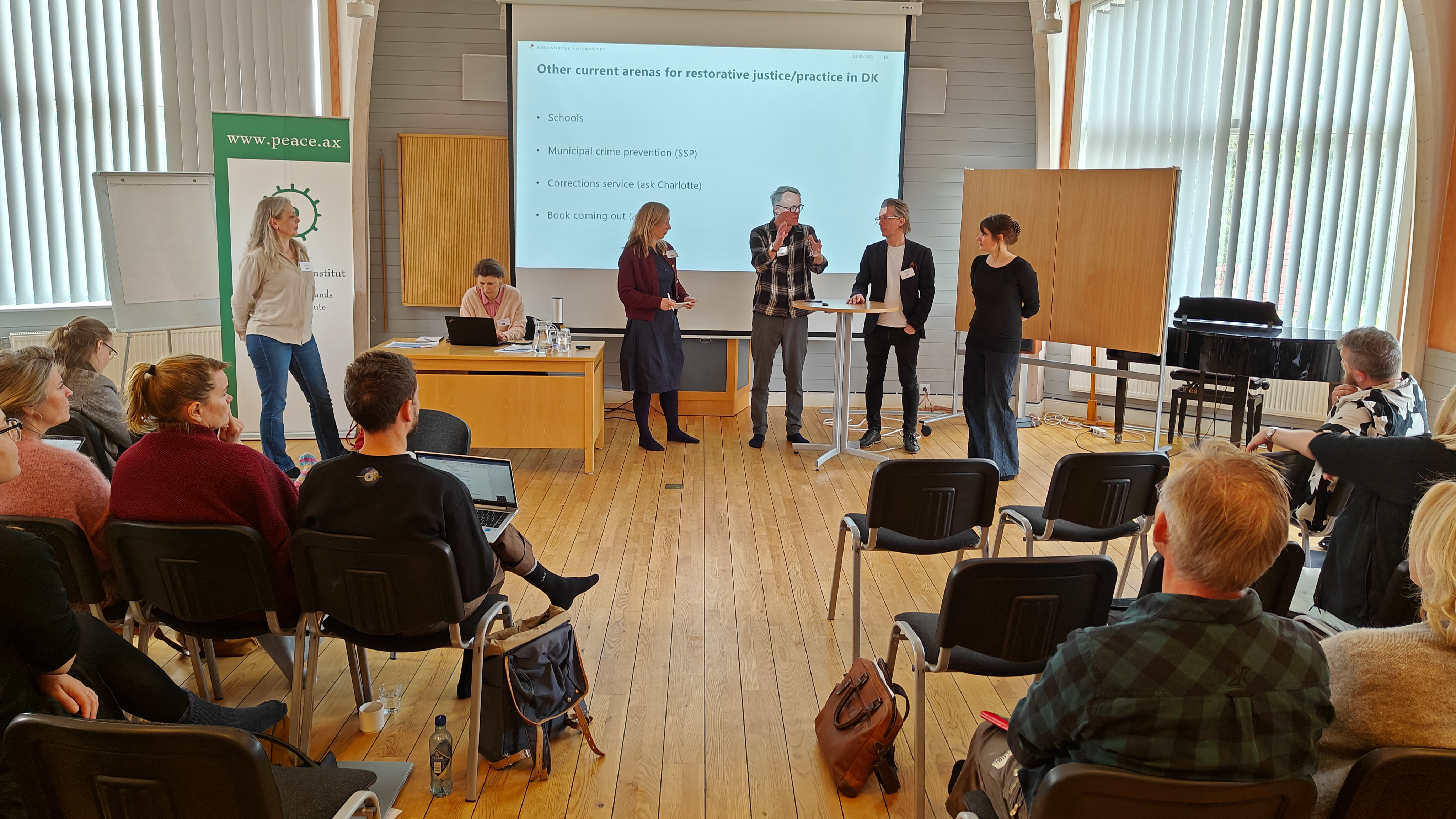
Commentators from Norway, Iceland, Finland and Denmark discuss contemporary societal trends.
Photo: Petra Granholm
Photo: Petra Granholm
In this session, speakers were asked to give an account of societal trends in their respective countries. They addressed questions such as: Is polarization becoming more prevalent? What are the current crime trends, are crime rates increasing or decreasing? Are there noticeable developments related to youth crime? In addition, the discussion included whether RJ strategies are in place and, if so, to what extent they are being implemented.
Professor Sakari Melander, University of Helsinki, Chair of the National Council for Crime Prevention (FIN)
Finland is a strong democracy with a stable, high-trust society. However, Finnish communities are increasingly affected by global challenges. Historically a relatively homogeneous nation, Finland is now experiencing significant demographic shifts. As diversity increases, growing societal polarization has become a matter of concern.
While overall crime rates have declined over the past two decades, a troubling rise in criminal activity among children, primarily boys under the age of 15 has emerged. Although most young people are doing well, a small group of recidivists is responsible for a disproportionate share of serious crimes. These are often rooted in socioeconomic disadvantage. Notably, children from immigrant backgrounds are statistically more likely than native Finns to be both victims and perpetrators of crime.
Professor Melander highlighted two recent phenomena in Finnish crime trends. Firstly, the increase of serious violent crime and secondly the rise in the number of the so-called street gangs. Approximately 30% of the first mentioned violent criminal acts are committed by individuals under the age of 18. As for the second trend, Helsinki police estimate that approximately ten active street gangs are operating in the city and surrounding areas, with indications of increasing organizational structure.
In 2024, Finland has implemented a government resolution and action plan for preventing and combatting youth and gang related crime. The action plan is not focused on but recognises mediation and RJ.
While some policymakers consider RJ as an effective and empathetic response to juvenile offending, others advocate for harsher punitive measures. The Finnish government, however, views RJ and mediation as a valuable approach for reducing recidivism and fostering accountability among young offenders. Current efforts include developing conferencing models that actively also involve families and communities in the process of mediation.
Professor Helgi Gunnlaugsson, University of Iceland (ICE)
Iceland shares many societal trends with Finland, including high levels of trust and stability. Ranked as the most peaceful country in the world by the Global Peace Index, Iceland has a low prison population and a variety of non-custodial sentences. These features suggest fertile ground for RJ, yet no RJ strategy has been implemented.
In recent years, however, concerning developments have occurred. Youth re-offending and serious crimes, such as aggravated assaults involving knives and even homicides, have triggered concerns within Icelandic society. Social polarization is also on the rise. Over the past 25 years, the percentage of foreign nationals in Iceland has grown substantially from 2% to 20%. No other nation has increased the number of foreigners so much in such a short time. While this diversity is broadly seen as positive, it brings certain challenges. This increase in immigration has not impacted the statistics on crime as such, but with the opening of borders come what is called “tourist crime” and instances of transnational offenses such as drug trafficking.
Currently, RJ in Iceland is rarely used and remains limited to cases by referral of state prosecutor. Although pilot projects have been conducted successfully, evaluated and met with general satisfaction, they have not translated into broader implementation. Resistance within the traditional criminal justice system remains a barrier.
Moreover, RJ is not widely accepted for handling gender-based violence or other serious crimes, which further restricts its application. In theory, stakeholders recognize its potential, but in practice, Iceland has yet to implement RJ as a systemic solution.
Edle Pallum, Head of Department, National Mediation Service (NO)
Norway has extensive experience with RJ which primarily consists of victim-offender mediation, but also larger meetings. Annually between 7–8,000 cases are referred to mediation. Mediation is possible at all stages of the criminal justice process. Approximately 60% of cases involve participants under the age of 25, many victims and offenders are minors.
Norway has enacted legislation on youth sentencing and follow-up programs that incorporate RJ approaches. This extended process can last up to three years and goes beyond traditional victim-offender mediation. Its aim is to foster safe, enduring connections that support young offenders in reintegrating into society.
A trend that is similar to Finland and Iceland is the rise of hate crimes and a smaller group of young persons under the age of 15 that commit serious crime like robberies and violent crimes. Radicalization, both Islamic and right wing, is on the rise. Risk factors are social exclusion, poverty, drug use and disengagement. Public reports highlight parental support as critical.
The benefits of RJ are recognized. However, an expert report concludes that there is untapped potential in this field. Strategic discussions emphasize the need for further development, particularly through enhanced cross-sectoral collaboration. Additionally, strengthening research on the impact of RJ is essential. The current societal trends pose challenges both to the criminal justice and RJ systems.
Katrine Barnekow Rasmussen, Assistant Professor, University of Copenhagen (DK)
Since the mid 1990s, crime rates in Denmark have been on a steady and substantial decline reaching a reduction by half in our decade. At the same time, the last decades’ penal politics have increasingly been characterised by a tough-on-crime approach, problematising (perceived) high crime levels and (perceived) lack of public safety and promoting harsher sentences, especially for crimes against a person.
Young individuals with immigrant and immigrant descendant backgrounds are overrepresented in the criminal justice system. Attempts to explain and problematise this overrepresentation remains a heated topic in public discussion and is linked to debates on immigration politics. However, it should be noted that research has consistently shown that these groups are subject to increased police attention; they are substantially more likely to be arrested and charged without it leading to a conviction and at large more likely to get caught if they have committed an offence. Also, overall the registered offending of these population groups is declining, following a curve parallel to that of ethnic majority Danes.
Furthermore, with the political shift towards harsher sentences, less sentences are conditional, even for less serious violent offences, and more include a prison sentence. As a consequence, Danish prisons are currently facing issues of overcrowding and understaffing, which has affected the availability of education programs and limited opportunities for inmate visitations.
In Denmark, victim offender mediation is based within the police. It is called ‘Konfliktråd’ like its Norwegian source of inspiration. Yet, based in the police and without a clear budget and clear prioritisation by the political and management level, this service is quite different in structure and capacity. There are notable differences between police districts and there has been a steady decline in number of cases referred to mediation. We are now at a level where the Norwegian Mediation Service has 20 times as many mediations as its Danish sister-in-name.
In 2019, the Youth Offending Boards were introduced in Denmark. Offenders aged 10 to 17 years can be referred to the boards, and if the offence is against a person, the referral is almost mandatory. The boards involve judges, police, and social workers and they can decide on various responses to avoid reoffending. As the age of criminal responsibility in Denmark is 15 years, offenders under 15 years will not receive a formal sentence, but the decisions of the boards are mandatory for the young offenders to follow whether they are over or under 15 years of age. There are two overall types of responses: Immediate reactions (fast responses related to the offence) and improvement programmes (e.g. rehabilitation or support initiatives). The immediate reactions are rarely used. However, when they are used, it is normally in the shape of victim-offender mediation or pre-meetings for this.
Concluding remarks
All Nordic countries are currently facing similar criminal trends, particularly involving youth and gang-related offenses. In addition, growing societal polarization is evident across the region. These issues were further highlighted during discussions following the presentations, where it became clear that Sweden is also experiencing these patterns. However, Sweden lacks a national strategy for mediation or RJ, as these responsibilities fall under the jurisdiction of individual municipalities.