Nordic Economic Policy Review 2025
Pattern bargaining as a means to coordinate wages in the Nordic countries
Lars Calmfors
Professor Emeritus, Research Institute of Industrial Economics and Institute for International Economic Studies, Stockholm University. Email: lars.calmfors@ifn.se. I am grateful for helpful comments from Torben Andersen, Essi Eerola, Steinar Holden, Petteri Juvonen, Antti Kauhanen, Mikkel Nørlem Hermansen, Roope Uusitalo, Irene Wennemo and participants in the Nordic Economic Policy Review Conference on Wage Formation in the Nordic Countries in Stockholm 24 October 2024 and for research assistance by Olof de Blanche.
Abstract
This article reviews the various forms of pattern bargaining under which manufacturing, as the representative of the tradables sector, sets the norm for wage increases in the Nordic countries. Such bargaining has been consistent with strong international competitiveness and has widespread support among practitioners based on informal analysis. However, using more formal modelling it is hard to build a convincing case for the idea that wage leadership by the tradables sector is particularly conducive to wage restraint. Rather, the conclusion is that norm setting per se, irrespective of the actors, promotes wage moderation. In the future, when changing demographics may motivate a reallocation of labour to welfare services and a worsened international security situation to the armed forces, a rigid application of international competitiveness norms might lead to an undesirable status-quo bias. More weight should probably be given to overall labour market conditions and more flexibility allowed in relative wages.
Keywords: Pattern bargaining, coordination of wage setting, the Scandinavian model, Stackelberg leadership, social norms, labour reallocation.
1 Introduction
The Nordic countries’ heavy dependence on trade explains why considerations of international competitiveness have always played an important role in wage setting. In the 1960s and early 1970s, this thinking was formalised in the Scandinavian model of wage formation. The basic idea was that price and productivity increases in the internationally competitive sector (henceforth the tradables sector) also determined the room for wage increases in the sector sheltered from international competition (henceforth the nontradables sector).
The tradables sector comprises both export and import-competing industries. Traditionally, tradables have been associated with manufacturing and nontradables with services. Today, however, many services are also traded. Unless stated otherwise, I do not include the public sector in the nontradables sector. Although the room (norm) for wage increases in effect also includes changes in costs for various employee benefits, I shall, for expositional convenience, refer to wages rather than wage costs except when I wish to emphasise the distinction.
When the model was formulated, wage bargaining in the Nordics involved the national peak organisations on both the employer and the trade union side. However, over time, peak-level bargaining has faded away, and industry-level bargaining has become dominant. This has not, however, meant the disappearance of coordinated wage formation. Instead, earlier centralised bargaining has been replaced by coordination through pattern bargaining, where manufacturing, as a representative of the tradables sector, concludes the first agreement, which determines a norm for wage increases for other sectors. At the same time, the scope for local bargaining has widened.
There is a strong belief among practitioners that the form of pattern bargaining that has developed contributes to wage moderation and good macroeconomic performance. However, there has also been critique, focusing on inflexible relative wages and the risk that it could impede a desirable reallocation of labour. This article reviews the arguments on the basis of existing research and discusses possible modifications to the system.
Section 2 describes bargaining coordination in the various Nordic countries. The Scandinavian model of wage formation is discussed in Section 3, whereas Section 4 surveys recent wage developments. Section 5 reviews the theoretical work on pattern bargaining. Risks that pattern setting could interfere with desirable relative-wage flexibility and reallocation of labour are highlighted in Section 6. Section 7 summarises the analysis and draws conclusions regarding what process of wage formation would be desirable in the future.
2 The Nordic systems for coordinating wage bargaining
Table 1 summarises the basic features of wage bargaining coordination in the Nordics. Although pattern setting by manufacturing takes place in all of the four large Nordic countries, there is considerable variation in how this is done. The transitions from the earlier centralised systems were characterised by oscillations between them and the new systems. They are most firmly established in Denmark, Norway and Sweden, whereas the transition seems still to be in progress in Finland.
Table 1. Features of pattern bargaining in the Nordic countries
Denmark | Finland | Norway | Sweden | |
Role of private-sector employers’ peak organisation | Concludes framework agreement before wage rounds on timetables and issues joint statements with the union counterpart on bargaining results. Approves industry-level agreements. Assists in formulating final mediation proposal. | Some coordination activities. Provides information on wage cost increases in various industry-level agreements. | Formulates the norm under industry-level bargaining after the conclusion of the manufacturing agreement. Sometimes still a party to centralised agreements. | Approves industry-level agreements. |
Role of union peak organisations | Peak union organisation concludes framework agreement before wage rounds on timetables, issues joint statements with the employer counterpart on bargaining results and assists in formulating final mediation proposal. | Some coordination activities. | Private-sector employers’ peak organisation formulates the norm in understanding with peak organisation for blue-collar workers (LO). Sometimes still parties to centralised agreements. | Coordination of wage demands within peak organisation for blue-collar workers (LO). |
Role of government and government institutions | Tripartite body provides wage statistics. Deliberations on public-sector wage structure in recent government commission comprising economic experts and representatives of labour market organisations. Occasional tripartite agreements. Conflicts are sometimes ended with legislation on wage increases. | Legal extension of collective agreements that are regarded as representative to all firms in an industry by a special board. | Tripartite bodies aimed at creating a common understanding of the economic situation. Consensus building in government commissions on the bargaining system. Occasional tripartite agreements. Conflicts are often ended with legislation on wage increases. | None. |
Role of mediation institution | Mediation proposals in line with the manufacturing norm. Power to link all agreements in common vote on both sides of the labour market. | Mediation proposal normally in line with the manufacturing norm. The plans of the right-wing government in 2023–24 to legislate such that mediation proposals could not exceed the norm were watered down to a more general formulation on securing overarching social objectives. | Mediation proposals normally in line with the manufacturing norm. Final mediation bid is usually followed if a conflict is terminated through legislation. | Mediators never exceed the manufacturing norm in their mediation proposals. |
Scope of norm | Total wage increases. | Total wage increases. | Total wage increases. | Wage increases in industry-level contracts but not wage drift. |
Public sector | Follows ex-ante norm. Ex-post adjustment if public-sector wage increases differ from private-sector ones. | Opposition from public-sector unions to norm setting by manufacturing. | Follows the norm. | Follows the norm. Principle inscribed into framework negotiation agreements. |
Synchronisation of wage contracts in time | Mostly. | Mostly. | Yes. | In the private sector, but contract periods are sometimes different in the public sector. |
Local bargaining | Very important for actual wage increases, especially in the private sector. | Still less important than in the other Nordic countries but increasing importance. | Very important for actual private-sector wage increases. | Very important for white-collar workers, especially in the public sector, but small wage drift for blue-collar workers in the private sector. |
2.1 DenmarkThe account is based on more detailed descriptions in Andersen et al. (2015), Ibsen (2016), Lønstrukturkomitéen (2023) and Holden IV-utvalget (2023).
The account is based on more detailed descriptions in Andersen et al. (2015), Ibsen (2016), Lønstrukturkomitéen (2023) and Holden IV-utvalget (2023).
Denmark was the frontrunner among the Nordic countries in moving to industry-level bargaining with pattern setting by manufacturing. This happened after the earlier system of centralised wage bargaining between economy-wide peak organisations broke down in the 1970s and 1980s, a process during which government policy focused on reducing (wage) inflation and restoring international cost competitiveness. This resulted in several tripartite income policy agreements between the peak organisations and the government in that period.
The incomes policy settlement, Fælleserklæringen (the Joint Declaration) in 1987, is seen as the starting point for the new form of coordination since it articulated the principle that the tradables (export) sector should determine the norm for wage increases in the whole economy, including the public sector, and that this norm should be based on international competitiveness considerations. Coordination according to these principles developed gradually in the 1990s, and since 2000 it has been codified in recurring framework agreements between the peak organisations before the wage rounds.
The first wage agreement in a bargaining round is concluded between the Confederation of Danish Industry (DI), by far the largest employers’ association in the Confederation of Danish Employers (DA), and a cartel of manufacturing trade unions (CO-industri) in the Danish Trade Union Confederation (FH). This agreement, which determines changes in minimum pay and other working conditions, establishes the norm for other private-sector agreements provided that it is approved by the DA executive committee (it typically is as DI holds half the votes there).
Minimum pay (mindstebetalingssats) is not a minimum wage in the usual sense, i.e., a wage applicable to inexperienced workers, but instead a common component of the total personal wage, which is determined in local bargaining and also depends on tasks, qualifications, individual performance, etc. (Dahl et al., 2013; FAOS, 2023).
The usual outcome is that settlements are not reached in some private-sector areas. Mediation is then compulsory. Mediators’ proposals typically conform to the norm established in the manufacturing agreement. If mediation fails, the mediation institution (Forligsinstitutionen) formulates a final proposal in cooperation with DA and FH that is in line with the norm. The mediation institution then links all bargaining areas – both those which have reached agreements and those which have not – into a common decision process. Rejection by the union side requires a majority in a national ballot of all the unions’ members. Otherwise, the mediation proposal becomes binding in all bargaining areas – provided that it is also approved by a majority of the DA executive committee.
Public-sector bargaining usually takes place after private-sector agreements are concluded. There is a consensus that average wage increases should be the same in the various public-sector bargaining areas as in the private sector. However, one difficulty is that actual wages in most of the private sector are determined locally. Hence, actual private-sector wage increases are not known when public-sector settlements are made. The latter, in contrast to private-sector agreements, usually contain provisions on actual wage increases: both central and local. There is a formalised system of ex-post regulation (efterregulering) of wages in the public sector. According to the 2024–26 collective agreements, if wages in a public-sector bargaining area have increased by less than in the private sector, 80% of the difference is added to the agreed increases; if wages have increased by more, 80% of the difference is deducted.
2.2 SwedenSee Calmfors (2018), Calmfors et al. (2019), Andersen (2023), Holden IV-utvalget (2023) and Bender (2024) for more detailed accounts.
See Calmfors (2018), Calmfors et al. (2019), Andersen (2023), Holden IV-utvalget (2023) and Bender (2024) for more detailed accounts.
During the 1980s and 1990s, a gradual transition occurred from economy-wide bargaining between peak organisations to industry-level bargaining. There were then some elements of tripartite bargaining, but much less so than in the other Nordic countries. A crucial step was when the Swedish Employers’ Federation (SAF) decided in 1990 to abandon central wage negotiations. Despite this, a government-appointed incomes policy commission managed to coordinate bargaining and achieve a strong deceleration of wage increases during the deep economic crisis of the early 1990s.
Uncoordinated industry-level agreements for 1995–97 led to wage rises generally regarded as too high, and in 1996 the government urged the labour market parties to reform the bargaining system. When the peak organisations failed to do this, manufacturing trade unions proposed negotiations to their employer counterparts. This resulted in a framework agreement, the Industry Agreement (Industriavtalet), in 1997, which – in revised form – still acts as the basis for wage bargaining.
The main signatories are on the union side IF Metall (blue-collar metal workers), Unionen (white-collar private-sector workers) and Sveriges Ingenjörer (Engineers of Sweden), and on the employer side Teknikföretagen (Technology Industries of Sweden) and Industriarbetsgivarna (Swedish Association of Industry Employers). IF Metall is the second largest union in the Swedish Confederation of Labour (LO) and Unionen the largest union in the Swedish Confederation of Professional Employees (TCO) and also in Sweden.
The Industry Agreement emphasises the importance of maintaining the manufacturing sector’s international competitiveness and stipulates that the signatories must seek to make wage increases in manufacturing the norm for wage increases elsewhere. In line with this, the manufacturing sector regularly concludes the first agreement in a bargaining round, and the wage increases in it constitute a cost mark (märke) which is followed in subsequent agreements in other parts of the economy.
The norm setting by manufacturing is upheld through several mechanisms. The strongest one is coordination within the Confederation of Swedish Enterprise (Svenskt Näringsliv), the peak organisation for private employers.
Svenskt Näringsliv replaced SAF as the peak organisation for private employers in 2001.
Within Unionen (see footnote 6), which organises private-sector white-collar workers both inside and outside manufacturing, the coordination is “automatic”, since the policy is only to conclude agreements that follow the manufacturing norm.
The National Mediation Office (Medlingsinstitutet) helps enforce the wage norm. According to the office’s remit, it should strive to uphold the existing consensus on the tradables sector’s norm-setting role. As a result, mediation proposals never comprise wage cost increases in excess of the manufacturing norm.
One difference, especially to Norway (see Section 2.3), is that Swedish norm setting refers to the wage increases in the industry agreements but does not incorporate additional local wage increases (wage drift). This may not have been considered necessary as drift has recently accounted for only a small part of wage increases (see, e.g., Medlingsinstitutet, 2024). A practice has developed whereby the agreement in retailing sets a second norm, not in percentage terms but in kronor, for employees in lower-wage nontradables (service) industries.
Public-sector white-collar workers tend to have figureless higher-level wage agreements, leaving the determination of all wage increases to the local level. But also for these groups, wage increases tend to be guided by the manufacturing norm, even though, at times, these agreements have allowed higher wage increases for groups of employees benefiting from labour shortages (Medlingsinstitutet, 2018; Calmfors et al., 2019). Karlson et al. (2014) also found that the manufacturing norm was often followed by private firms without collective agreements.
2.3 NorwayThe account is based on Andersen et al. (2015), Müller et al. (2019), Andersen (2023) and Holden IV-utvalget (2023).
The account is based on Andersen et al. (2015), Müller et al. (2019), Andersen (2023) and Holden IV-utvalget (2023).
The principle that international-competitiveness considerations should guide wage developments was articulated in the Aukrust (Scandinavian) model of wage formation (see Section 3) as far back as in the 1960s and has since formed the basis for wage bargaining. From the 1970s to the end of the 1990s, this thinking exerted its influence via economy-wide bargaining between peak organisations, often with participation by the government in comprehensive incomes policy settlements.
Elements of incomes policy have been less frequent after the turn of the millennium. Instead, wage bargaining has become more structured along lines designed to strengthen the influence of the tradables sector on wage setting. This has been, to a large extent, achieved through consensus building between labour market organisations in a series of government commissions (headed by and named after Professor Steinar Holden).
The commissions published their reports in 2000, 2003, 2013 and 2023.
So-called main agreements (hovedoppgjør) on wages and other issues are valid for two years. Bargaining is either at the industry or the peak level, although the former dominates. The first agreements at the industry level are concluded in manufacturing between the Federation of Norwegian Industries (Norsk Industri), the largest member of the private-sector peak organisation for employers (NHO) and two trade unions, Fellesforbundet (the second largest member of LO, the peak organisation for mainly blue-collar workers) and Parat (the largest member of the Confederation of Professional Unions, YS, the peak organisation for white-collar workers). Alternatively, the first main agreements are concluded between NHO and LO and between NHO and YS. Agreements between these parties (mellomoppgjør) – on wages only – are regularly concluded for the second year of a main agreement.
After the first agreement for the frontrunner (frontfaget, which may thus refer either to manufacturing or most of the private sector), NHO “in joint understanding” with LO, decides on the scope (rammen) for wage increases in manufacturing. This norm is typically followed in subsequent bargaining in the rest of the economy. The norm is a forecast for actual wage increases in manufacturing based on the frontrunner agreement and expected outcomes of subsequent local bargaining. Although a major part of actual wage increases in manufacturing is determined at the local level, the forecast has usually been quite accurate (Holden IV-utvalget, 2023). One reason for this is that NHO exerts strong pressure on firms to stick to the norm.
In the event of mediation, the National Mediator (Riksmekleren) usually adheres to the norm set in the frontrunner agreement. The same applies to the National Wages Board (Rikslønnsnemnda) if an industrial dispute is ended by legislated arbitration.
2.4 FinlandSee Müller et al. (2019), Jonker-Hoffrén (2019), Kauhanen (2024) and Kuuskoski (2024) for more details.
See Müller et al. (2019), Jonker-Hoffrén (2019), Kauhanen (2024) and Kuuskoski (2024) for more details.
In Finland, bargaining between economy-wide peak organisations continued for longer than in the other Nordic countries. It was usually conducted as tripartite bargaining, which also involved the government, often offering tax cuts or social reforms in exchange for wage restraint. Such centralised incomes policy agreements were common in the period 1968–2006, although they were occasionally replaced by industry-level agreements.
In 2007, the Confederation of Finnish Industries (EK), the peak organisation for private employers, decided it would no longer take part in centralised bargaining. The next two bargaining rounds were at the industry level. However, a combination of high wage increases and economic crises (the global financial crisis and a home-grown crisis associated with the collapse of Nokia, falling trade with Russia and stagnating demand for forest and steel products) triggered new centralised incomes policy agreements in 2011–16 designed to improve international cost competitiveness. At the same time, the leading employers’ associations in the export sector (technology, forest and chemical industries) campaigned for a transition to industry-level pattern bargaining where this sector would set the norm for economy-wide increases, with Denmark and Sweden as role models.
Somewhat illogically, the proposal has sometimes been labelled the Finnish model (Suomen malli).
In 2016, EK revised its statutes so that it could no longer negotiate binding agreements for member organisations. Subsequently, bargaining has occurred at the industry level, with the technology industry as the pattern setter. However, the system has not yet stabilised. The forest industry has turned to company-level bargaining since 2021 after the Finnish Forest Industries Federation (FFIF) abandoned industry-level bargaining. The Technology Industries of Finland (TT) allows member firms to choose between company-level and industry-level agreements, but – except for IT services – so many member firms have opted for the latter variant that it has become binding for all firms in the industry via the provisions of the extension legislation.
If the Board for the Ratification of Validity of Collective Agreements considers an agreement “representative” for an industry, usually meaning that it covers at least half the workforce, it becomes universally applicable to all firms in it.
Public-sector unions have opposed the idea that they should follow a norm set by the export sector. For the period 2023–27, municipal-sector unions, after a labour market conflict and mediation, negotiated a wage programme that will give them wage increases in excess of the general ones in the economy by as much as five percentage points (JHL, 2022).
The right-wing government that took office in 2023 has been pursuing an agenda to strengthen the export sector’s norm setting. The aim has been to achieve this through negotiations between the parties in the labour market. In addition, the government planned legislation according to which mediation proposals from the National Conciliator’s Office (Valtakunnansovittelijan toimisto) or a conciliation board could not exceed “the general level of wage increase” (Arbets- och näringsministeriet, 2024). In the final act passed, this was watered down to a formulation that “the mediator, in order to secure the overarching goal of society shall act so that wage formation works in the best possible way and that the functioning of the labour market is not endangered”.
Though not inscribed into the law, the government’s proposal to the parliament also stated that the mediator ”shall guide the parties in the labour conflict to find solutions that are well designed with respect to Finland’s competitiveness and a well-functioning wage formation” (Regeringens proposition RP 146/2024).
2.5 Summing-up
Pattern bargaining at the industry level, with manufacturing concluding its agreements first and determining the norm for wage increases in this way, has been firmly established in Denmark, Norway and Sweden since the end of the 1990s. This system is less established in Finland, where trade unions in the public sector oppose such norm setting. In all of the countries, support from the national peak organisations, in particular on the employers’ side, is important for adherence to the norm.
The role of government in pattern bargaining differs between the countries. In all of them, governments have played some role in initiating the systems either through threats of more government intervention (Sweden and, more recently, Finland) or through consensus building (Denmark and Norway). Sweden stands out with a clear principle that wage bargaining is the sole responsibility of the labour market parties and that this rules out government involvement.
Political involvement in bargaining between labour market parties is unusual in Sweden. A rare exception is the reform of employment protection and the simultaneous introduction of a support system for career transition for employees in 2022, which was based on intertwined negotiations between political parties and between labour market organisations (Regeringens proposition 2021/22:176).
The moves to pattern setting by the tradables sector in the Nordics have coincided with an increasing role for local bargaining on both the size of aggregate wage increases in individual workplaces and how they should be distributed among the employees. In Denmark and Norway, such organised decentralisation has gone the furthest in the private sector (where the bulk of wage increases are determined locally, especially for white-collar employees). In Sweden, this development has been much more pervasive for public-sector white-collar employees than private-sector ones. Finland has experimented with hardship clauses, allowing temporary wage cuts in firms in distress, provided that industry-level organisations grant their approval (Müller, 2018; Jonker-Hoffrén, 2019).
3 The Scandinavian model of wage formation
The idea that the tradables sector should determine wage increases in the whole economy is embodied in what is usually referred to as the Scandinavian model of wage formation. It first grew out of work by Statistics Norway (Statistisk sentralbyrå) in the early 1960s. The model was formulated in two reports from a government commission providing the basis for incomes policy settlements (Utredningsutvalget for inntektsoppgjørene, 1966, 1967). Somewhat later, similar ideas were formulated by the chief economists in the peak labour market organisations in Sweden (Edgren et al., 1973).
The reference is to the English version. The Swedish version was published in 1970. It is usually referred to as the EFO model after the initial letters of the authors’ surnames.
3.1 The positive interpretation
The original thinking behind the Scandinavian model was laid out in Aukrust (1977).
Odd Aukrust was director of research at Statistics Norway 1953–84 and chair of the government commission for the incomes policy settlements in 1966 and 1967.
First, there is a main course (hovedkurs) for wage increases in the tradables sector defined by the room for them, i.e., the sum of price increase (determined in the world market and thus exogenous to a small economy like Norway, which had a fixed exchange rate at the time) and productivity increase, resulting in a constant wage, and thus also profit, share in the long term. Wages can deviate from the main course in the short and medium term, but this triggers mechanisms that bring them back in line. Aukrust (1977) lists three such mechanisms: variations in the profit share (i) affect both union wage demands and employer resistance in collective bargaining; (ii) give rise to variations in labour demand that influence wage drift; and (iii) are associated with changes in the trade balance which may trigger changes in government demand policy.
Second, changes in unit labour costs are shifted onto prices in the nontradables sector, implying that the profit share in it remains more or less constant. Third, wage developments in the nontradables sector follow those in the tradables sector because the two sectors compete for labour, and unions keep an eye on the wage rises other unions negotiate.
Early research, such as Calmfors (1977, 1979), tried to integrate the Scandinavian model with Phillips curve analysis by postulating that wage increases in the tradables sector depend on labour market slack (unemployment) and expected price increases for tradables – not increases in the Consumer Price Index (CPI).
A more satisfactory way of modelling Aukrust’s original thinking arose with the development of cointegration theory in econometrics. The idea is that although variables such as wages, prices and productivity are non-stationary, i.e., follow stochastic trends, there is a stationary combination of them. In technical jargon, the variables are cointegrated. This means that there is a long-run relationship between the wage and the value added per unit of labour in the tradables sector towards which the economy strives. Models of this type are labelled error correction models. The assumption is that the larger the “error”, i.e., the difference between the actual wage and the wage given by the long-run relationship, the faster the adjustment to it.
Several studies have found support for such an error-correction interpretation of wage formation in Norwegian manufacturing, and some also in the other Nordic countries.
Early studies for Norway include Nymoen (1989, 1991), Langørgen (1993) and Johansen (1995). Calmfors & Nymoen (1990), Bårdsen et al. (2005) and Forslund et al. (2008) are early examples of studies of all four large Nordic countries.
In addition, it is well documented that wage increases over time in the Nordics have been similar across sectors (e.g., Brubakk & Hagelund, 2022; Holden IV-utvalget, 2023; Lønstrukturkomitéen, 2023; Ejrnæs & Würtz, 2024; Medlingsinstitutet, 2024).
3.2 The normative interpretation
There is a small step from the idea that deviations of wages from a main course trigger mechanisms which bring them in line with it again to a normative prescription that the labour market parties should try to set wages so that they follow this course. If an upward (downward) deviation from the room for wage increases causes unemployment (labour shortages) that lower (raise) wages again, there is a welfare gain from avoiding these fluctuations in economic activity by adhering to the main course in the first place (e.g., Facken inom industrin, 2015; Holden IV-utvalget, 2023). Often, wage increases in line with the main course are also seen as motivated in order to ensure a size of the tradables (export) sector allowing desired imports to be financed (e.g., Aukrust, 1977; Holden IV-utvalget, 2023). It has also been argued that if wages in the nontradables and public sectors follow those in the tradables sector, all sectors will be assured of labour supply and conflicts over relative-wage changes will be mitigated (e.g., Andersen, 2023; Holden IV-utvalget, 2023; Lønstrukturkomitéen, 2023).
Since productivity growth varies a great deal over the business cycle, wage increases would be very volatile if they adjusted to actual productivity growth in the short term. Therefore, it has become customary instead to base the Scandinavian-model wage norm on assessments of potential productivity growth, which is then taken as exogenous. This is, however, potentially problematic, as higher wage increases tend to raise productivity growth by increasing the capital-labour ratio in production.
Indeed, with a Cobb-Douglas production function, which implies a constant wage share, any wage change will equal the sum of price and productivity changes.
Another problem concerns the exchange rate system. The Scandinavian model was developed for a fixed exchange rate, which all the Nordic countries earlier tried to maintain (although there were devaluations from time to time). In those days, anticipated foreign price increases for tradables served as a good predictor of domestic-currency price increases for these goods. This is no longer the case with a flexible exchange rate. A norm aiming at a constant wage share in the tradables sector must take exchange rate changes into account. As a flexible exchange rate is difficult to predict, this implies much greater uncertainty regarding the room for wage increases than under a fixed exchange rate.
This uncertainty can be addressed in different ways. One is to base the assessment of the room for wage increases on a calculation of an equilibrium exchange rate and a projected path toward it. However, such computations are uncertain, and there can be substantial long-term deviations from calculated equilibrium values, as shown by the large and persistent depreciations of both the Norwegian and Swedish currencies in 2013–24. One alternative is to assume a random walk for the exchange rate, implying that the current exchange rate is also the most likely future one. A third possibility is to calculate the exchange rate compatible with the inflation target and use that to predict price changes for tradables in the domestic currency. Appendix A shows that under Scandinavian-model assumptions, this gives a room for wage increases equal to the sum of the inflation target and average productivity growth in the economy, so the latter could be a way of formulating the Scandinavian wage norm under inflation targeting. However, because of the erratic behaviour of exchange rates, large differences between the rate required to reach the inflation target and the actual rate are likely to emerge. Hence, large swings in the wage share in the tradables sector can arise under a flexible exchange rate.
Another perspective on a Scandinavian-model wage norm concerns the risk of wage-price spirals. Kolsrud & Nymoen (2023) analyse in a stylised model whether, after a series of shocks, there is a return to stable price and wage growth. They find that for a wide range of unemployment levels, there is indeed such a return if wage increases depend not only on unemployment and past consumer price increases (a version of the Phillips curve) but also (negatively) on the wage share in the tradables sector. The latter relationship is taken as a reflection of wage setters acting in line with a Scandinavian-model norm by trying to gradually adjust wages to the main course. With low unemployment, stability is attained at a high wage share, with high unemployment at a low wage share. If wage changes are determined in a pure Phillips curve fashion, such stability is obtained only at a specific rate of unemployment (the Non-Accelerating Inflation Rate of Unemployment, NAIRU).
Bjørnstad (2023) argues that with inflation targeting, wage formation as per the Scandinavian model by itself eliminates the risk of a bout of inflation abroad triggering a domestic wage-price spiral because when wages adjust to higher prices for tradables, there will be no further wage responses to the higher CPI level induced by subsequent increases in the prices of nontradables. In his view, an inflation shock abroad would not require interest hikes to stem additional domestic wage and price increases.
Bjørnstad’s reasoning has been criticised by Røisland (2023a) for implicitly assuming a fixed exchange rate.
A similar criticism could be directed against the Nymoen-Kolsrud (2023) analysis, as it assumes a random walk for the exchange rate.
3.3 The Scandinavian model and international capital mobility
The normative prescription that wage costs in the tradables sector should follow the room given by price and productivity increases there is sometimes motivated by concerns about relative profitability vis-à-vis other countries.
E.g., Holden IV-utvalget (2023), Section 3.3. See also Calmfors et al. (2019).
A constant wage share implies a constant gross profit share. The latter means a constant net return to capital if the capital-output ratio and the depreciation rate of capital are also constant.








(1) |
where \Delta s is the percentage change in the wage share, \Delta w the percentage change in the wage, \Delta p the percentage change in the product price, and \Delta q the percentage change in productivity. Subscript T denotes the tradables sector, and superscripts H and F home and foreign country, respectively. 





The equation states that the percentage change in the home and in the foreign wage share in the tradables sector should be (approximately) equal. As the percentage change in the wage share (approximately) equals the difference between the percentage wage change and the sum of percentage price and productivity changes, this difference must be the same at home and abroad.
Equation (1) can be rewritten:
(2) |
Equation (2) is a modified Scandinavian-model room for the wage increase, according to which it should (approximately) equal the sum of domestic price and productivity increases in the tradables sector augmented by the change in the wage share in the tradables sector abroad. Thus, to obtain a benchmark for the wage increase that maintains a constant relative rate of return vis-à-vis the rest of the world, the “traditional” room for wage increases, according to the Scandinavian model, should be adjusted for the change in the wage share abroad.
Alternatively, equation (2) can be written:
(3) |
or
(4) |
According to equation (3), the constant-relative-return benchmark for the wage increase would thus be the foreign wage increase plus the difference between the domestic and the foreign rooms for wage increases,\left(\Delta p_T^H+\Delta q_T^H\right)-\left(\Delta p_T^F+\Delta q_T^F\right). If these rooms are equal, the benchmark is that wage changes should be the same. Alternatively, the benchmark can be expressed as equation (4), which states that the change in the domestic unit labour cost should (approximately) equal the sum of the change in the foreign unit labour cost and the difference in price changes.



It does not matter for the comparison of changes in wage shares whether or not wage and price variables are measured in national currencies or in common currency.
4 Recent wage and wage cost developments in the Nordics
This section presents various measures of wage and wage cost developments in manufacturing (as a proxy for the tradables sector) in the Nordic countries.
4.1 Nominal wage cost and real wage changes
Figure 1a shows annual nominal wage cost changes in manufacturing in the Nordic countries and in the euro area in 2001–23. Among the Nordic countries, average increases were the highest in Norway, 4.1%, and the lowest in Finland and Denmark, 2.7% and 2.8% respectively, with Sweden, 3.1%, in between. The high wage cost increases in Norway occurred mainly in the first decade of the millennium. Denmark exhibits the most stable growth in wage costs, whereas it has been most volatile in Finland, where high increases in 2007–09 were followed by a fall in 2010. The years 2016–17 were also characterised by considerable wage restraint. In all countries, wage cost increases were lower in the decade preceding the 2020 pandemic than in 2001–10. Despite high consumer price increases in 2022–23, wage cost rises were modest.
Figure 1b shows changes in the real consumption wage (the nominal wage deflated by the CPI) in manufacturing. Since nominal wage increases stayed far below the high inflation in 2022–23, all the Nordic countries saw substantial falls in real wages at the time, the largest being in Denmark and Sweden.
4.2 Wage shares
Figures 2a and 2b show that there were no major long-term changes in the wage shares of the value added in manufacturing in Finland, Norway and Sweden between 2000 and 2021. This is in line with the Scandinavian model. However, in Finland, there was a substantial increase in the share in 2008–12, followed by a strong decline. Denmark deviates from the picture of a stable long-term wage share with a steady decline from 2010.
Structural shifts appear to be an important factor behind the trendwise fall in the wage share in Denmark: the relative importance of a small number of very large firms with low wage shares has increased at the same time as wage shares have fallen there. These firms have generated large and increasing revenues from merchanting and processing (foreign sales of goods produced or purchased abroad that never cross the Danish border). See, e.g., De Økonomiske Råd Formandskabet (2024).
Figure 1a. Annual nominal hourly wage cost change in manufacturing in the Nordic countries and the euro area, per cent
Sources: Eurostat (all countries except Norway), Statistics Norway (Norway).
Figure 1b. Annual hourly real wage change in manufacturing in the Nordic countries and the euro area, per cent
Note: Nominal wages have been deflated by the Harmonised Index of Consumer Prices (HICP).
Sources: Eurostat and national statistical offices.
Sources: Eurostat and national statistical offices.
Figure 2a. Wage share in manufacturing in the Nordic countries and the euro area, per cent of value added
Note: The wage share is the compensation of employees (wages, salaries, and employers’ social contributions) divided by value added.
Source: OECD.
Source: OECD.
Figure 2b. Wage share in manufacturing in the Nordic countries and the euro area, index
Note: The index is set to 1 in 2000. The diagram shows the log of the index. Hence, the value is 0 in 2000, and the slopes of the curves approximate relative changes. See also Figure 2a.
Source: Own calculations based on OECD data.
Source: Own calculations based on OECD data.
4.3 Wage cost levels
Figures 3a and 3b show the cumulative development of nominal wage costs in national currency and in euros, 2000–23. Wage costs rose far more in the national currencies in Norway and Sweden than they did in euros. The difference is due to the large depreciations of the two countries’ currencies since 2013. Wage costs in euros increased more in Denmark and Finland than in Norway and Sweden, as well as in the euro area.
Figure 3a. Nominal hourly wage cost in national currency in manufacturing in the Nordic countries and the euro area, index
Note: See Figure 2b.
Sources: Own calculations based on Eurostat (all countries except Norway) and Statistics Norway (Norway).
Sources: Own calculations based on Eurostat (all countries except Norway) and Statistics Norway (Norway).
Figure 3b. Nominal hourly wage cost in euros in manufacturing in the Nordic countries and the euro area, index
Note: See Figure 2b.
Sources: Own calculations based on Eurostat, Statistics Norway and the ECB.
Sources: Own calculations based on Eurostat, Statistics Norway and the ECB.
4.4 Unit labour cost levels
According to Figure 4a, the unit labour cost in manufacturing in the national currency fell over the 2000–23 period in Sweden and Denmark, reflecting strong productivity growth. Finnish unit labour costs increased in line with the euro area, whereas Norwegian costs rose more. Measured in euros, the fall in the Swedish unit labour cost is even more pronounced, and the Norwegian cost also decreased.
Figure 4a. Unit labour cost in national currency in manufacturing in the Nordic countries and the euro area, index
Note: See Figure 2b.
Source: Own calculations based on Eurostat.
Source: Own calculations based on Eurostat.
Figure 4b. Unit labour cost in euros in manufacturing in the Nordic countries and the euro area, index
Note: See Figure 2b.
Source: Own calculations based on Eurostat and ECB.
Source: Own calculations based on Eurostat and ECB.
4.5 Overall picture
The above diagrams show wage cost developments in line with unchanged, or even improved, international competitiveness over the last two and a half decades in the Nordic countries. There have only been limited fluctuations in the manufacturing wage share in Norway and Sweden. Finland exhibits more variability, with a large increase in 2008–12 followed by a decrease of approximately the same magnitude. The developments in those three countries thus conform to the Scandinavian model. In Denmark, however, there has been a trendwise decline in the wage share in manufacturing. In all four Nordic countries, wage costs did not keep up with price and productivity increases during the 2022–23 inflation period, reflecting substantial wage moderation resulting in large real wage declines, the largest being in Denmark and Sweden.
Over the whole period 2000–23, manufacturing wage costs in national currency rose faster in all the Nordic countries than in the euro area, and especially so in Norway. However, when measured in common currency, wage costs in Sweden and Norway fell relative to those in the euro area. This was a consequence of the large depreciations of the Swedish and Norwegian currencies. In terms of unit labour costs in common currency, there has been a huge fall relative to the euro area for Sweden, but also substantial falls for Denmark and Norway, depending partly on favourable productivity developments relative to the euro area.
In the Swedish discussion, a “European norm”, according to which domestic wage costs should increase at the same pace as wage costs in Europe, has sometimes been advocated (Edingruppen, 1995, was the original proposal). It has not always been clear whether the comparison should be made in national currencies or in common currency and whether the norm applies to hourly wage costs or unit labour costs (see Gottfries, 2018, for a critique).
The large trade surpluses since the turn of the millennium in Denmark, Norway and Sweden are further indications of strong international competitiveness, although the situation is, of course, special in Norway due to its large petroleum exports (see Table 2). Finland differs, with small trade deficits in recent years.
Table 2. Trade balance as a share of GDP in the Nordic countries, per cent
2000–09 | 2010–19 | 2020–23 | |
Denmark | 4.8 | 6.1 | 7.5 |
Finland | 5.7 | -0.6 | -0.7 |
Sweden | 6.1 | 3.7 | 3.9 |
Norway | 15.1 | 7.3 | 15.3 |
Sources: Eurostat, Statistics Denmark and Statistics Norway.
5 Pattern bargaining and wage restraint
Both informal and formal analyses of the argument that pattern setting by the tradables sector promotes wage moderation are reviewed below (see, e.g., Holden IV-utvalget, 2023; Lønstrukturkomitéen, 2023; Kuuskoski, 2024; Medlingsinstitutet, 2024 for various expositions of this argument).
5.1 Informal reasoning
The traditional argument for why wage leadership by the tradables sector is conducive to wage restraint is that the sector is the one hurt most by excessive wage increases (Aukrust, 1977). This reasoning was developed for the case of a fixed exchange rate. Since foreign competition makes it difficult to shift wage increases onto prices in the tradables sector, the incentive for wage moderation is strong as there would otherwise be large adverse effects on profits and employment. In contrast, the negative consequences for profits and employment of large wage rises are much smaller in the nontradables sector because prices there can be raised. Such price increases are likely to have strong adverse effects on the tradables sector, both directly by driving up its input prices and indirectly if employees press for higher wages to compensate for CPI increases.
The reasoning loses some of its strength when it comes to Nordic wage determination in the 1960s, 1970s and 1980s since the fixed exchange rates in Finland, Norway and Sweden were not really fixed at the time. Instead, there were repeated devaluations to restore international cost competitiveness after periods of high wage increases. If such exchange rate accommodation was anticipated, the wage restraint logic above did not apply except to the extent that there were long lags between the profit and employment falls and the devaluations. The argument is stronger when applied to the Danish credible exchange rate peg since 1979 and the Finnish eurozone membership since 1999.
How does the reasoning above translate to inflation targeting? It has been argued that there is then a double incentive for wage restraint in the tradables sector (e.g., Konjunkturinstitutet, 2012; Facken inom industrin, 2015; Holden IV-utvalget, 2023). The reason is that when high wage rises drive up price increases for nontradables, and thus also CPI inflation, the central bank raises the interest rate to defend the inflation target. This causes the currency to appreciate. The consequence is additional profit and employment reductions in the tradables sector compared to the fixed-exchange rate case.
One could, however, argue that under inflation targeting, the nontradables sector, too, has strong incentives for wage moderation (Calmfors, 2008). The reason is that demand for its products, and thus profits and employment in the sector, are negatively affected by interest rate rises aimed at counteracting deviations from the inflation target. This channel may be more certain than the exchange rate channel for the tradables sector discussed in the previous paragraph.
Gottfries (2010) argues that the negative demand effects of higher interest rates may take time to materialise and that demand for nontradables is likely to be stimulated by higher real wage increases in the short run.
According to standard interest rate parity theory, an interest hike causes the currency to appreciate relative to the expected future exchange rate. However, because inflation raises the price level, the expected future exchange rate will probably depreciate.
5.2 Formal analysis
Informal reasoning cannot capture more complex interactions between sectors. For example, since wages in the tradables sector affect output and incomes in it, demand for nontradables and their prices are influenced, which has repercussions for the purchasing power of wages and profits in the tradables sector. In addition, by affecting prices in the nontradables sector, wage rises there increase production costs in the tradables sector to the extent that it uses nontradables as inputs, which lowers the output of tradables and thus reduces the demand for nontradables.
In game-theoretical terms, one can conceive of three ways of analysing pattern bargaining:
Vartiainen (2010) makes similar distinctions.
Pattern bargaining as centralisation in disguise
Earlier centralised bargaining between peak labour organisations can be seen as a way of internalising externalities of wage setting, i.e., of caring about how wage changes in one area of the economy affect other areas. It is then assumed that negotiators in the peak organisations try to maximise welfare functions that assign weights to all the members they represent. Several negative externalities of high wages in an individual part of the economy have been identified (see, e.g., Calmfors, 1993). This explains why centralised bargaining is likely to lead to wage restraint.
Calmfors & Driffill (1988) focused on consumer price externalities: a wage rise in an industry pushes up prices in it, which reduces the purchasing power of incomes elsewhere. There are also fiscal externalities. A wage increase in one bargaining area, reducing output and employment there, could decrease the tax base to the detriment of other areas. If such a wage increase causes higher costs for unemployment benefits, these are mainly paid for by the rest of the economy. There are also unemployment (hiring) externalities because higher unemployment in one part of the economy makes it harder for unemployed workers elsewhere to find jobs.
Krusell & Rudanko (2016) is a recent paper stressing such hiring externalities. A positive demand externality arises if a wage increase in one part of the economy causes higher demand in another part because the goods produced are substitutes. Calmfors & Driffill (1988) argue that this is the case for different firms in the same industry. Hence, industry-level bargaining may imply higher wages than firm-level bargaining (the Calmfors-Driffill hump shape hypothesis).
This externality is internalised by centralised bargaining in an economy with its own currency, as the central bank responds to domestic inflation. In contrast, such internalisation occurs to a very small extent in an economy participating in a monetary union because monetary policy is then pursued by a common central bank, which reacts to union-wide inflation.
One possible hypothesis is that pattern setting by the tradables sector internalises wage externalities in a similar way as bargaining between peak organisations. Pattern bargaining would then work as centralisation in disguise, where bargaining has been delegated to the tradables sector (manufacturing). Thus, it bargains on behalf of all other sectors, which then follow the wage increases negotiated by it. One could conceive of the bargaining stance of the parties in the tradables sector as having been determined through informal negotiations with the other parties on the same side of the labour market in the rest of the economy, giving more or less the same results as formal decision-making within peak organisations. Alternatively, the tradables sector unions and employers’ associations could be taken to behave as if there had been such negotiations because they realise that the delegation of bargaining to them is conditional on their acting in the interest of all unions and all employers’ associations, respectively.
It makes sense to analyse bargaining as a repeated game. It is well-known that a cooperative solution may then be upheld if an individual participant’s short-term gain from deviating from this equilibrium is outweighed by the long-term loss if the consequence is a breakdown of future cooperation. This requires the effective discount factor, the factor by which future outcomes are discounted, to exceed a critical level, so that sufficient weight is given to them. Holden & Raaum (1991) provide such an analysis of bargaining cooperation.
In their analysis, if the bargaining power of industry unions is sufficiently strong, they may prefer a cooperative solution with lower wages than would be the outcome of uncoordinated industry level bargaining (this is also in the interest of employers). If some union defects from this cooperative equilibrium, future cooperation breaks down (and is replaced by uncoordinated industry level bargaining). A cooperative equilibrium is reestablished with an exogenously given probability in each period. Under certain conditions, the cooperative solution mimics the outcome with a centralised monopoly union deciding wages unilaterally.
It is an implicit assumption in many analyses that pattern bargaining and centralised bargaining achieve similar internalisation of externalities.
Holden IV-utvalget (2023) is one example. Another is Bhuller et al. (2022), who seem implicitly to assume that pattern bargaining implies internalisation of externalities. Barth et al. (2023) find that increased import competition from China caused decreases in manufacturing employment in European countries with low wage coordination but not in countries with pattern setting by the tradables sector. This is explained by more wage restraint in the non-tradables sector in the latter countries, holding down input prices of the tradables sector, because of internalisation of this externality.
According to the OECD’s terminology, the degree of centralisation refers to the level of bargaining in each part of the economy but may imply different degrees of coordination with other parts.
An obvious problem with the interpretation of pattern bargaining as centralisation in disguise is that the transition from formal centralisation is left unexplained. Why did moves from the earlier system to today’s one occur if they deliver similar outcomes?
Stackelberg solutions
Another interpretation of pattern bargaining is as a Stackelberg game. In this case, negotiators in the sector concluding the first agreement (the leader) are not concerned with welfare in other sectors (followers) per se. Instead, the agents in the leading sector try to maximise their welfare but, in doing so, consider the effect of the wage decision on follower wages and the subsequent repercussions on their own sector.
Calmfors & Seim (2013) analyse Stackelberg games between a tradables and a nontradables sector. The model is neoclassical with output and employment in each sector depending negatively on the real product wage (the ratio between the wage and the product price) there. In each sector, an employers’ association bargains with a union. The former tries to maximise real profits (nominal profits deflated by the CPI), and the latter a utility function that depends positively on the real consumption wage (the nominal wage deflated by the CPI) and employment. Stackelberg equilibria with either the tradables or the nontradables sector as a leader are compared with uncoordinated wage setting (a Nash equilibrium), where the two sectors determine their wages simultaneously, taking the wage in the other sector as given.
With membership of a monetary union (or a credible exchange rate peg), Calmfors & Seim find that leadership by the tradables sector implies higher real consumption wage there and lower aggregate employment than uncoordinated bargaining. The explanation has to do with the perceived trade-off in the tradables sector between, on the one hand, the gain in the real consumption wage for employees and, on the other hand, the losses in terms of employment and real profits from a nominal wage increase. The accompanying fall in the output of tradables, and hence in incomes in that sector, reduces demand for nontradables and, therefore, their price as well as the CPI. This reinforces the gain in the real consumption wage in the tradables sector (and also tends to raise the purchasing power of nominal profits there). The effect is boosted when the tradables sector is the wage leader because wage setters there then realise that the fall in demand for nontradables induces a decrease in the nontradables sector wage, which will cause a further fall in the price of nontradables and thus in the CPI. This provides a stronger incentive to choose a high wage in the tradables sector when it acts as Stackelberg leader than when bargaining is uncoordinated. In contrast, leadership by the nontradables sector promotes wage restraint. When that is the case, the real consumption wage in the nontradables sector is lower and aggregate employment higher than with uncoordinated bargaining and thus also than with tradables sector leadership. Hence, the outcomes are the exact opposite of the conclusions reached by informal analysis.
Under inflation targeting, Calmfors & Seim assume that the central bank pursues monetary policy so that the exchange rate adjusts in such a way that the target is met. As a result, wage leadership by any of the sectors and uncoordinated bargaining produce identical outcomes. This is because the real consumption wage in each sector turns out to be a constant mark-up over the (exogenous) income as unemployed. Hence, the nominal wage in a sector changes (equiproportionally) only when the CPI changes. However, if the central bank keeps the CPI fixed, this stops a wage change in one sector impacting on the wage in the other sector. Thus, the wage in the other sector is also taken as exogenous under wage leadership and the optimisation problem becomes the same as under uncoordinated bargaining.
Vartiainen (2010) analyses a similar model as Calmfors & Seim, although the assumption is that wages are set unilaterally by unions and not through bargaining. In his analysis, under inflation targeting, pattern setting by any of the sectors gives lower wages and higher employment than uncoordinated bargaining if tradables and nontradables are not easily substitutable for each other.
The condition is that this elasticity should be smaller than unity. Calmfors & Seim instead assume an elasticity of substitution equal to unity, i.e., a Cobb-Douglas utility function, resulting in constant expenditure shares for the two goods.
Juvonen (2023) uses a dynamic stochastic general equilibrium (DSGE) model with New Keynesian features, i.e., with slow adjustment of nominal prices. A tradables sector produces only export goods. Exporters are not price takers, as in the Calmfors-Seim and Vartiainen models, but monopolistically competitive firms with sales depending on the relative price vis-á-vis competitors abroad. Consumption comprises imported goods, with prices given from abroad, and nontradables. The latter are also used as inputs in the production of tradables. A union in each sector sets the wage by maximising the expected lifetime utility of a representative member with per-period utility that depends positively on consumption and leisure.
Like in most DSGE models, changes in employment take the form of changes in a representative worker’s amount of work, not in the number of employed persons.
Juvonen’s analysis is restricted to the case of a monetary union. Like Calmfors & Seim (2013), he finds that pattern setting by the tradables sector gives a higher wage there and lower aggregate employment than uncoordinated wage setting. Unlike in the Calmfors & Seim model, leadership by the nontradables sector results in a higher wage in it and lower aggregate employment than in the uncoordinated equilibrium. However, leadership by the tradables sector is associated with a more aggressive wage setting and lower international competitiveness (higher export prices) than leadership by the nontradables sector, as in Calmfors and Seim’s analysis.
Pattern bargaining as a social norm
A third approach is to assume that the agents in the leading sector set the wage there by maximising their own welfare, knowing that a social norm will make followers choose the same wage (increases). Vartiainen (2010) shows that such behaviour on the part of the follower, under inflation targeting, restrains the leader’s choice of wage strongly, more so than in the Stackelberg case. In the model, a fixed relative wage implies a fixed relative price between the sectors.
This follows from market clearing for nontradables and the assumption that all income is spent.
Let PT be the price of tradables, PN the price of nontradables, P the CPI, and c and k constants. If PN /PT = k and P = P(PN,PT) = c, it follows that both PN and PT must stay constant since then P = P(PN,PT) = P (kPT,PT) = P(PN,PN/k) = c.
Juvonen (2023) draws similar conclusions regarding the social-norm case as Vartiainen but for monetary-union membership. It is demonstrated that pattern setting with mimicking of the leader’s wage results in a lower tradables sector wage, a lower export price, higher aggregate employment and higher aggregate welfare than both uncoordinated bargaining and leadership in an ordinary Stackelberg game where both unions maximise their welfare functions. Again, it does not matter which sector is the leader and which is the follower.
In addition to long-run equilibria, Juvonen also analyses adjustment to shocks. In this instance, pattern setting by the tradables sector in the social-norm case leads to higher welfare for workers there than uncoordinated wage setting, but this effect is dominated by lower welfare for workers in the nontradables sector (which is the larger one),
This is in line with various assessments. For example, Sagelvmo et al. (2023) report that the tradables sector according to their classification accounts for only 30% of GDP and 14% of employment in Norway.
When referring to a social norm to explain why followers choose the same wage (increases) as the leader, it is desirable to explain why such a norm was established in the first place and why it is followed. The utility cost for the follower of deviating from it has to be so great that she chooses not to maximise her “ordinary” utility function (excluding this cost). It could be a loss of reputation because of shaming or punishment of the deviating union or employers’ association as well as their officials in other arenas than wage bargaining.
Calmfors (2021) reports conversations with seasoned Swedish wage bargainers (in the public sector) falling into tears when describing how they were bullied by their peers in the tradables sector when trying to deviate from the wage norm set by the latter.
However, to the best of my knowledge, a repeated game of this type has not been analysed formally.
Calmfors & Seim (2013) analyse why it may be in the interest of a follower to choose the same wage as the leader in an ordinary Stackelberg game without referring to an “exogenous” social norm as above. The explanation builds on (i) comparison thinking, i.e., that the utility of employees in the follower sector depends not only on the purchasing power of their wages but also on the wages relative to employees in the leader sector, and (ii) loss aversion, according to which a greater weight is attached to losses relative to a reference norm than to gains (Kahneman and Tversky, 1979). The utility of an employee in the follower sector is assumed only to depend on the real consumption wage if it is above that in the leader sector, but to depend on both the real consumption wage and the ratio between the own wage and that in the leading sector if the own wage is lower.
With this formulation of the utility function, it is in many cases optimal for the follower to choose the same wage as the leader; following the leader’s wage then functions as an “endogenous” social norm.
In this case, the marginal utility of the wage in the follower sector is greater when the wage is immediately below than immediately above that of the leading sector. In technical terms, the Stackelberg equilibria are corner solutions where the marginal utility of the follower’s wage is not zero as in a standard interior solution but positive immediately below the same wage as the leader’s and negative immediately above. Similar assumptions about relative-wage concerns and loss aversion have been used by e.g., Bhaskar (1990) and Driscoll & Holden (2004) to show that wages under uncoordinated equilibria may equal the expected wage level in the economy.
Summary of theoretical results
If the tradables sector pattern setting works as centralised bargaining in disguise, there is a strong theoretical case for wage-restraining effects. However, it is not clear why the parties in the labour market have dismantled one institutional structure and replaced it with another if the same bargaining outcomes are achieved. This is a strong argument for viewing pattern bargaining as a system distinct from centralised bargaining.
Table 2 summarises the main findings in the limited theoretical literature on wage leadership reviewed above. Assumptions of wage leadership in models without any relative-wage concerns and where the parties in the leading sector try to maximise their utility under the constraint that the parties in the follower sector will do the same (Stackelberg equilibria) lead to conclusions very much at odds with informal reasoning. Under such conditions, it is impossible to show that wage leadership by the tradables sector is conducive to wage restraint and high employment. Instead, in several cases, macroeconomic outcomes are less favourable than those achieved under uncoordinated bargaining. At the same time, some of the mechanisms behind these results, although logically consistent within the model frameworks, are counterintuitive and may reflect such complex interactions that practitioners are not likely to see through them.
For example, the mechanism under membership of a monetary union in the Calmfors-Seim model that a higher wage in the tradables sector via a lower output there, a lower demand for nontradables, a lower wage in that sector, a lower price for its product, a lower CPI, and thus a greater purchasing power of incomes in the tradables sector (see Section 5.1) would seem insufficiently salient for it to be taken into account by wage setters. Such a negative effect of a higher wage in one sector on the wage in another also conflicts with the common notion that wage rises in one part of the economy tend to induce wage rises in other parts.
The most plausible models are those where the other sector follows the wage set by the leader either because of adherence to an “exogenous” social norm or because the combination of relative-wage concerns and loss aversion produces an “endogenous” social norm. Such behaviour seems most consistent with what we actually observe. However, a striking result in the “exogenous” social-norm models is that it does not matter what sector is the pattern setter; it is the existence of pattern bargaining per se that is crucial for wage moderation. In the relative-wage concerns/loss aversion case, pattern setting by the smaller sector is conducive to wage restraint. In the real world, this means the tradables sector, but this conclusion has nothing to do with international competition as is the case in the informal reasoning.
Thus, there is strong dissonance between the conclusions from theoretical modelling and from informal reasoning. It cannot be ruled out that important aspects are missing in the theoretical models. One such factor could be employers having a stronger bargaining position in the tradables than in the nontradables sector because firms in the former sector have the option of moving production abroad. On the basis of anecdotal evidence, one might also hypothesise that perceptions of the effects of high wage increases could differ between unions in the tradables and in the nontradables sectors. The former may be more neoclassical in their outlook (with a greater focus on cost aspects) and the latter more Keynesian (with greater focus on the positive demand effects of higher wages). Pattern setting by the tradables sector (manufacturing) is also likely to have greater legitimacy because of higher rates of membership of unions and employers’ associations as well as higher coverage of collective agreements. Given the established role of the tradables (manufacturing) sector as the one responsible for pattern setting, it would probably take time to build up a similar operational capacity in the nontradables (service) sector.
Table 3. Theoretical model results on the effects of pattern bargaining
Calmfors & Seim (2013) | Vartiainen (2010) | Juvonen (2023) | |
Model | Neoclassical | Neoclassical | New Keynesian |
Stackelberg leadership by the tradables sector | Higher tradables sector wage and lower aggregate employment than with uncoordinated bargaining. | Higher tradables sector wage and lower aggregate employment than with uncoordinated bargaining. | |
Stackelberg leadership by the non-tradables sector | Lower nontradables sector wage and higher aggregate employment than with uncoordinated bargaining. | Higher nontradables sector wage and lower aggregate employment than with uncoordinated bargaining, but more wage restraint and higher aggregate employment than with Stackelberg leadership for the tradables sector. | |
Social-norm leadership by any of the sectors | Lower tradables sector wage, higher aggregate employment, and higher welfare than with uncoordinated bargaining and Stackelberg leadership. | ||
Social-norm leadership by the smaller sector | Lower wage in the leader sector and higher aggregate employment than in other equilibria. | ||
Stackelberg leadership by any of the sectors | Same wages and aggregate employment as with uncoordinated bargaining. | Lower wages and higher aggregate employment than with uncoordinated bargaining if goods are not easily substitutable. | |
Social-norm leadership by any of the sectors | Lower wages and higher aggregate employment than with uncoordinated bargaining and with Stackelberg leadership. | . | |
Social-norm leadership by the smaller sector | Lower wage in the leader sector and higher aggregate employment than in other equilibria. |
6 The size of the tradables sector and labour reallocation
Section 5 discussed whether wage leadership for the tradables sector promotes wage restraint and employment. Another common argument for why concerns about international competitiveness should determine wage increases is that it is a prerequisite for maintaining an appropriate size of tradables sector (e.g., Aukrust, 1977; Holden IV-utvalget, 2023). Obviously, consistent wage increases in excess of price and productivity increases in the tradables sector would cause an untenable continuous shrinking of the sector. However, there might be good reasons for changes in the size of the tradables sector from one level to another depending on structural shifts in the economic environment. In such a scenario, rigid pattern setting might decrease welfare.
An important challenge facing all Nordic countries is their ageing populations. Fiscal sustainability analyses have identified this as a threat to the long-run viability of public finances, but potentially problematic labour market implications have also been pointed out (e.g., Konjunkturinstitutet, 2020; Holden IV-utvalget, 2023; Andersen, 2024). Demand for labour in the health and care sector will probably rise strongly as the aggregate labour supply stagnates. In addition, projected increases in defence expenditure are likely to imply higher demand for personnel in the armed forces. This may require the reallocation of labour from the tradables sector to the public and nontradables sectors. One question is how such a development squares with pattern setting by the tradables sector.
Appendix B features a stylised model of the impact of changing demographics on the allocation of labour under different assumptions about wage formation. The basic assumption is that an older population implies two fundamental structural changes: (i) lower savings and higher domestic aggregate demand – synonymous with a weakening of the trade balance – which in turn increases demand for labour in the nontradables and public sectors; and (ii) a shift in the composition of domestic aggregate demand from tradables to nontradables and government-provided services, which also raise labour demand in the latter sectors.
A weakening of the trade balance is most plausible for Denmark, Norway and Sweden, which currently all run large surpluses (see Section 4.5). It may not happen in Finland, where the consequence would be larger trade (and government budget) deficits., which policy makers might want to prevent by raising taxes or reducing government transfers. But on the other hand, as the old-age dependency ratio is projected to rise much more in this country (Calmfors 2020), the composition effect may be stronger. Debt-financed increases in defence expenditure will also tend to weaken the trade balance.
The natural market reaction to these changes would be a rise in the real product wage, i.e., the wage relative to the product price, in the tradables sector, so that labour is freed in it and moved to the nontradables sector (where the real product wage falls) and the public sector, which are both willing to pay more than before. The tradables sector shrinks, and the other sectors expand. This would be a desirable reallocation of resources because the composition of the population has changed.
Pattern setting by the tradables sector, with the wage set to keep the size of the sector unchanged, would prevent the reallocation of labour. Market forces would not be allowed to operate. Instead, a situation of excess labour demand in the nontradables and public sectors would arise. Pattern setting by the tradables sector would not allow the other sectors to bid up the wage so that they can recruit the labour they need.
The analysis points to a possible conflict between socially efficient resource allocation on the one hand, and high employment and output on the other. It might be the case that labour shortages in the nontradables and public sectors arising from the pattern setting by the tradable sector helps draw more labour into employment. Reasons for this could be that discouraged workers find it worthwhile looking for jobs because employers in the nontradables and public sectors lower their qualification demands and provide the appropriate training of recruits, because governments expand regular school education or because more labour migration is stimulated.
An important question is whether, and if so, to what extent, a reallocation of labour requires changes to relative wages. Holden IV-utvalget (2023) argues that this does not need to be the case and shows that there is no relationship between wage and employment growth in various industries in Norway over the periods 1970–2000 and 2000–22. In contrast, long-term fiscal-sustainability analyses in Sweden have included scenarios in which a projected increase in the share of employment in welfare services is associated with substantial increases to the relative wage in the country.
E.g., Långtidsutredningen (2019) and Konjunkturinstitutet (2020).
Labour supply to various sectors is, of course, more elastic with respect to relative wages in the long run, when labour market entrants can choose their education, than in the short and medium run, when workers with jobs and a given education and experience would have to move. It seems safe to conclude at least that changes to relative wages would facilitate labour reallocation to welfare services. Hence, if wage leadership by the tradables sector rules out such changes to relative wages, it could serve as an impediment to efficient labour reallocation from the tradables sector to welfare services in the public and nontradables sectors. The severity of this problem will, however, depend on to the extent to which labour can be reallocated within the latter sectors.
7 Conclusions and suggestions
Pattern bargaining, with manufacturing as a representative of the tradables sector determining a norm for wage increases in the rest of the economy as well, has become the dominant form of wage bargaining in Denmark, Norway and Sweden since the end of the 1990s. At the same time, a process of organised decentralisation involving a larger role for local bargaining has taken place. Change has come later to Finland, although there have recently been moves in the direction of similar pattern bargaining and greater emphasis on the local level.
The pattern setting by the manufacturing sector has been guided by international-competitivness concerns. Especially in Norway and Sweden, they have been embodied in the Scandinavian model of wage formation, according to which wage increases should follow a room given by the sum of price and productivity increases in the tradables sector. Although developed for a fixed-exchange rate situation, the Scandinavian model has also continued to be a benchmark in the more challenging environment of flexible exchange rates in Norway and Sweden, which makes it more difficult to predict price developments for tradables.
Wage developments from the early 2000s have been in line with the Scandinavian model in Finland, Norway and Sweden. The two latter countries have exhibited rather small variations in the wage share in manufacturing except for the falls in 2021–23, which were associated with unexpectedly high international inflation and major exchange rate depreciations. In Finland there was a substantial increase in 2008–12 followed by a decline of a similar magnitude. In Denmark, there has been a trendwise decline in the wage share in manufacturing. In all four Nordic countries, pattern bargaining delivered moderate wage increases during the high inflation period of 2022–23, which helped prevent price-wage spirals.
The large trade balance surpluses in Denmark, Norway and Sweden can also be taken as indications that wage formation in these countries has been consistent with strong international competitiveness. In contrast, the trade balance in Finland has recently shown small deficits.
There is a strong consensus among practitioners in all the Nordic countries on the merits of pattern setting by the tradables (manufacturing) sector. Therefore, it is noteworthy that theoretical research has not been able to build a convincing case that wage leadership by the tradables sector is especially conducive to wage moderation. Rather, the few existing analyses suggest that it is pattern bargaining per se – not that the pattern setter is the tradables sector – that is important. The mechanism is that the knowledge that other bargaining areas will mimic the wage increases by the pattern setter, with repercussions on themselves, exerts a moderating influence on wage determination.
Wage formation guided by concerns about international competitiveness tends to preserve the status quo. This could come into conflict with demands for labour reallocation. Ageing populations in all the Nordic countries will imply a stagnating labour supply at the same time as labour requirements in welfare services will rise. In addition, higher defence expenditure is likely to increase demand for military personnel. This could make it desirable to reallocate labour from the tradables to the public and nontradables sectors. Wage increases guided by the ability of the tradables sector to pay may counteract the desired adjustment.
The above considerations could motivate more flexible norm setting. This may apply to both the determination of the norm to be followed in most bargaining areas and how binding this norm should be, i.e., the degree of flexibility in relative wages.
In a situation with demand shifting from tradables to nontradables and government-provided services, thus raising the relative price of nontradables (in addition to the rise following differential productivity growth) as discussed in Section 6 and Appendix B, it might be appropriate to base the norm for wage increases not only on price (and productivity) increases in the tradables sector but to factor in, to some extent, price developments for nontradables as well. This may be particularly relevant under the monetary regimes in Norway and Sweden, where the inflation target serves as a nominal anchor, preventing price-level-raising interactions between wage increases and price increases for nontradables. Such an approach to the wage norm is taken by the National Institute of Economic Research (Konjunkturinstitutet) in Sweden, which has a government remit to publish an annual report on wage formation. The institute calculates a benchmark for wage increases by adding the anticipated rise in potential productivity in the whole business sector and the increase in the value-added price in it assessed to be compatible with the inflation target (see, e.g., Konjunkturinstitutet, 2024).
Such broader norm setting considerations could, in principle, be taken into account by the manufacturing sector itself based on a consensus among both unions and employers’ associations that the sector should have such a remit. Alternatively, the bargaining area acting as the pattern setter could be extended to include areas encompassing nontradables (for example, a large area such as retailing).
Both these approaches have been proposed in Sweden by Arbetsmarknadsekonomiska rådet (2017), Calmfors (2018) and Calmfors et al. (2019). In Norway, a widening of the pattern-setting bargaining area (frontfaget) by also including other tradables industries, was discussed, but not proposed, in Holden III-utvalget (2013) and Holden IV-utvalget (2023).
Reallocations of labour could also be facilitated if norm setting allowed greater flexibility for relative wages. In the Swedish discussion, Calmfors (2018) and Calmfors et al. (2019) proposed that the bargaining parties should adopt a principle that deviations from the norm – upwards or downwards – should be allowed in the case of major imbalances between labour supply and demand in individual bargaining areas. The establishment was also proposed of an independent advisory expert council, which could express a non-binding opinion on this if requested to do so by a union or an employers’ association. Mediation institutions might take such an opinion into account, allowing them more flexibility to deviate from the norm than at present.
Labour shortage problems in welfare services also raise questions about the government’s role. On the one hand, the government has a responsibility to provide welfare services to citizens, which may require the use of wage instruments to secure a sufficient labour supply. On the other hand, government interventions in wage bargaining could destabilise pattern setting and increase the risk that bargaining becomes uncoordinated and results in excessive wage increases. This danger would be particularly great if government interventions were dominated by political short-termism.
A recent example of government intervention is a tripartite agreement in Denmark in 2023, when the government provided local governments with an extra budget appropriation (of around 0.25% of GDP) to be used mainly for wage increases in excess of the ordinary collective agreement rises in 2024–26 with the aim of making work in welfare services more attractive (Regeringen 2023). The intervention was presented as a one-off measure, but whether or not this will be the case remains to be seen.
In Sweden, this did not happen when the government in 2013 and 2016 made special budget appropriations in order to raise teacher salaries (Grönqvist et al., 2023), but a reason could be that the target group was relatively small.
To sum up, by coordinating wage increases across the economy, pattern setting by the manufacturing sector in Denmark, Norway, and Sweden over the last decades has contributed to international cost competitiveness, keeping inflation in check and promoting high employment. Changing demographics and an expansion of the armed forces may, however, entail great challenges, as a rigid interpretation of competitiveness norms could imply a bias towards the status quo and counteract shifts in relative sector sizes. Norm setting by the tradables sector and an unchanged size for it are not ends in themselves but have served as useful intermediate goals in the past. In the future, a more flexible approach may be warranted to facilitate the desired reallocation of labour between sectors.
References
Andersen, T. (2023). Nordiske erfaringer og perspektiver på den offentlige løndannelse. Baggrundsrapport til Lønstrukturkomitéen. Copenhagen.
Andersen, T. (2024). Fiscal Policy Challenges in the Nordic Countries. In L. Calmfors and N. Sánchez Gassen (Eds). Economic Policy beyond the Pandemic in the Nordic Countries, Nordregio. Stockholm.
Andersen, S.K., Ibsen, C.L., Alsos, K., Nergaard, K., & Sauramo, P. (2015). Changes in Wage Policy and Collective Bargaining in the Nordic Countries: Comparison of Denmark, Finland, Norway and Sweden. In G. van Gyes & T. Schulten (Eds), Wage Bargaining under the New European Economic Governance (139-168). Brussels: ETUI.
Arbets- och näringsministeriet (2024). Den trepartsarbetsgrupp som bereder arbetsmarknadsmodellen har inlett sitt arbete. Pressmeddelande, 12 February. Helsingfors.
Arbetsmarknadsekonomiska rådet (2017). Tudelningarna på arbetsmarknaden. Stockholm.
Aukrust, O. (1977). Inflation in the Open Economy: A Norwegian Model. In L.B. Krause & W.S. Salant (Eds). Worldwide Inflation. Washington: Brookings Institution.
Barth, E., Finseraas, H., Kjelsrud, A., & Moene, K.O. (2023). Hit by the Silk Road: How Wage Coordination in Europe Mitigates the China Shock. Scandinavian Journal of Economics, 125(1), 32-72.
Bhaskar, V. (1990). Wage Relativities and the Natural Range of Unemployment. Economic Journal, 100, 60-66.
Bender, G. (2024). Organizing the Labor Market. Doctoral dissertation. Stockholm School of Economics.
Bhuller, M., Moene, K.O., Mogstad, M. & Vestad, O.L. (2022). Facts and Fantasies about Wage Setting and Collective Bargaining. Journal of Economic Perspectives, 36(4), 29-52.
Bjørnstad, R. (2023). Nei, importert inflasjon trenger ikke gi økte renter, Dagens Næringsliv, 3 August.
Brubakk, L. & Hagelund, K. (2022). Frontfagets betydning for lønnsdannelsen i private tjenestenæringer. Staff Memo 5/2022. Oslo: Norges Bank.
Calmfors, L. (1977). Inflation in Sweden. In L.B. Krause & W.S. Salant (Eds). Worldwide Inflation. Washington: Brookings Institution.
Calmfors, L. (1979). Real Wages, Inflation and Unemployment in the Open Economy. In A. Lindbeck (Ed). Inflation and Employment in Open Economies, Amsterdam: North-Holland.
Calmfors, L. (1993). Centralisation of Wage Bargaining and Macroeconomic Performance – A Survey, OECD Economic Studies, 21, 159-191.
Calmfors, L. (2008). Kris i det svenska avtalssystemet. Ekonomisk Debatt, 36(8), 6–19.
Calmfors, L. (2018). Industrins lönenormering kan och bör reformeras. Lönebildning för jämlikhet – nr 4. Stockholm: 6F – Fackförbund i samverkan.
Calmfors, L. (2020). Fiscal Frameworks and Fiscal Sustainability in the Nordics. Copenhagen: Nordic Council of Ministers.
Calmfors, L. (2021). Mellan forskning och politik – 50 år av samhällsdebatt. Stockholm: Ekerlids förlag.
Calmfors, L., Ek, S., Kolm, A.-S. & Skedinger, P. (2019). Kollektivavtal och lönebildning i en ny tid. Stockholm: Dialogos.
Calmfors, L. & Driffill, J. (1988). Bargaining Structure, Corporatism and Macroeconomic Performance. Economic Policy, 3(6), 13-61.
Calmfors, L. & Nymoen, R. (1990). Real Wage Adjustment and Employment Policies in the Nordic Countries. Economic Policy, 5(2), 397-448.
Calmfors, L. & Seim, A.L. (2013). Pattern Bargaining and Wage Leadership in a Small Open Economy. Scandinavian Journal of Economics, 115(1), 109-140.
Calmfors, L. & Viotti, S. (1982). Wage Indexation, the Scandinavian Model and Macroeconomic Stability in the Open Economy. Oxford Economic Papers, 34(3), 546-566.
Dahl, C.M., Le Maire, D. & Munch, J.R. (2013). Wage Dispersion and Decentralization of Wage Bargaining. Journal of Labor Economics, 31(3), 501-533.
Dalnoki, S. (2020). Empirisk modellering av systemet for norsk lønnsdannelse. Samfunnsøkonomen, 134(3), 58-69.
De Økonomiske Råd Formandskabet. (2024). Produktivitet. Copenhagen.
Driscoll, J.C. & Holden, S. (2004). Fairness and Inflation Persistence. Journal of the European Economic Association, 2(2-3), 240-251.
Edgren, G., Faxén, K.O. & Odhner, C.E. (1973). Wage Formation and the Economy. London: Allen and Unwin.
Edingruppen (1995). I takt med Europa: samhällsekonomiska aspekter på lönebildningen. Stockholm: LO.
Ejrnæs, M. & Würtz, A. (2025), Public-sector wages. Nordic Economic Policy Review.
Facken inom industrin (2015). Bästa möjliga – om lönebildning och samhällsekonomi. Retrieved from www.fackeninomindustrin.se.
FAOS (2023). Fakta Mindstebetaling og normalløn. Retrieved from https://faos.ku.dk/temasider/ok-forhandlinger/ok-2023/fakta_ok23/Mindstebetaling_og_normall_n_OK23.pdf.
Forslund, A., Gottfries N., & Westermark, A. (2008), Prices, Productivity, and Wage Bargaining in Open Economies. Scandinavian Journal of Economics, 110(1), 169-195,
Gjelsvik, M., Nymoen, R., & Sparrman, V. (2020). Cointegration and Structure in Norwegian Wage-Price-Dynamics. Econometrics, 8(3), 1-15.
Gottfries, N. (2010). Fungerar den svenska lönebildningen? Bilaga till Att skapa arbeten – löner, anställningsskydd och konkurrens, SOU 2010:93, Stockholm.
Gottfries, N. (2018). Europanormen saknar relevans. Lönebildning för jämlikhet – nr 7. Stockholm: 6F – Fackförbund i samverkan.
Grönqvist, E., Hensvik, L., & Thoresson, A. (2023). Effekter av förstelärarreformen. SNS Analys 96. Stockholm.
Holden, S. & Raaum, O. (1991). Wage Moderation and Union Structure. Oxford Economic Papers, 43(3), 409-423.
Holden III-utvalget (2013). Lønnsdannelsen og utfordringer for norsk økonomi. NOU 2013: 13. Oslo.
Holden IV-utvalget (2023). Utfordringer for lønnsdannelsen og norsk økonomi. NOU 2023:30. Oslo.
Ibsen, C.L. (2016). The Role of Mediation Institutions in Sweden and Denmark after Centralized Bargaining. British Journal of Industrial Relations, 54(2), 285-310.
JHL (2022). Så här ser kommunsektorns treåriga lösning och det kommande löneprogrammet ut. Fackförbundet JHL. Retrieved from https://www.jhl.fi/sv/nyheter/sa-har-ser-kommunsektorns-treariga-losning-och-det-kommande-loneprogrammet-ut/
Johansen, K. (1995). Norwegian Wage Curves. Oxford Bulletin of Economics and Statistics, 57(2), 229-242.
Jonker-Hoffrén, P. (2019). Finland: Goodbye Centralised Bargaining? The Emergence of a New Industrial Bargaining Regime. In T. Müller, K. Vandaele & J. Waddington (Eds). Collective Bargaining in Europe: towards an Endgame, Volume I (197-216). Brussels: ETUI.
Juvonen, P. (2023). Wage-setting Coordination in a Small Open Economy. Scandinavian Journal of Economics, 125(1), 253-286.
Kahneman, D. & Tversky, A. (1979). Prospect Theory: An Analysis of Decision under Risk. Econometrica, 47, 263-291.
Karlson, N., Malm Lindberg, H., Stern, L., Lundqvist, T., & Larsson, A.-S. (2014). Lönebildning i verkligheten. Lund: Studentlitteratur.
Kauhanen, A. (2024). The Effects of the Decentralization of Collective Bargaining on Wages and Wage Dispersion: Evidence from the Finnish Forest and IT Industries. British Journal of Industrial Relations, 62, 319-334.
Kolsrud, D. & Nymoen, R. (2023). Lønns- og prisdannelsen som stabiliseringsmekanisme i en frontfagsmodell. Oslo: Statistisk sentralbyrå.
Krusell, P. & Rudanko, L. (2016). Unions in a Frictional Labor Market. Journal of Monetary Economics, 80(C), 35-50.
Konjunkturinstitutet (2012). Lönebildningsrapporten. Stockholm.
Konjunkturinstitutet (2020). Hållbarhetsrapport för de offentliga finanserna. Stockholm.
Konjunkturinstitutet (2024), Lönebildningsrapporten. Stockholm.
Kuuskoski, K. (2024). From Income Policy to the Finnish Model. Master’s Thesis. University of Helsinki.
Langørgen, A. (1993). En økonometrisk analyse av lønnsdannelsen i Norge. Rapport 5. Oslo: Statistisk sentralbyrå.
Långtidsutredningen (2019). Huvudbetänkande. SOU 2019:65. Stockholm.
Lønstrukturkomitéen (2023). Hovedrapport. Copenhagen.
Medlingsinstitutet (2018). Yrke, lön och kön: En kartläggning av löneläget för 383 yrken mellan 2014 och 2017 – ett jämställdhetsperspektiv. Stockholm.
Medlingsinstitutet (2024). Avtalsrörelsen och lönebildningen 2023. Årsrapport. Stockholm.
Müller, T., Dølvik, J.E., Ibsen, C., & Schulten, T. (2018). The Manufacturing Sector: Still an Anchor for Pattern Bargaining within and across Countries? European Journal of Industrial Relations, 24(4), 357-372.
Nymoen, R. (1989). Modelling Wages in the Small Open Economy: An Error-Correction Model of Norwegian Manufacturing Wages. Oxford Bulletin of Economics and Statistics, 51, 239-258.
Nymoen, R. (1991). A Small Linear Model of Wage and Price Inflation in the Norwegian Economy. Journal of Applied Econometrics, 6, 255-269.
OECD (2018). Employment Outlook. Paris.
Regeringen (2023). Regeringen, FH, KL, Danske Regioner og Akademikerne er enige om udmøntningen af en ekstraordinær ramme til løn og arbejdsvilkår på 6,8 mia. kr. i 2026. København: Finansministeriet.
Regeringens proposition 2021/22:176, Stockholm.
Regeringens proposition RP 146/2024, Helsingfors.
Rose, A.K., Supaat, S. & Baude, J. (2009). Fertility and the Real Exchange Rate. Canadian Journal of Economics, 42(2), 496-518.
Røisland, Ø. (2023a). Når kan lønns-prisspiraler oppstå? Om samspillet mellom pengepolitikken og lønnsdannelsen. Samfunnsøkonomen, 3, 45-56.
Røisland, Ø. (2023b). Frontfagsmodellen og importert inflasjon. Samfunnsøkonomen, 6.
Soskice, D. & Iversen, T. (2000). The Non-Neutrality of Monetary Policy with Large Price or Wage Setters. Quarterly Journal of Economics, 115(1), 265-284.
Utredningsutvalget for inntektsoppgjørene (1966), Instilling avgitt 22 januar 1966. Oslo: Prime Minister’s Office.
Utredningsutvalget for inntektsoppgjørene (1967), Instilling II avgiftt 20 oktober 1966. Oslo: Prime Minister’s Office.
Sagelvmo, I., Slettebø, O. & Strøm, B. (2023). Konkurranseutsatte næringer i Norge. Oslo: Statistisk sentralbyrå.
Vartiainen, J. (2010). Interpreting Wage Bargaining Norms. Working Paper 116. Stockholm: National Institute of Economic Research.
Appendix A: The Scandinavian-model wage norm under inflation targeting
The Scandinavian model of wage formation can be summarised by the following five equations:
(A.1) | |
(A.2) | |
(A.3) | |
(A.4) | |
(A.5) |
where \[
\Delta w_T^H
\] is the percentage change in the tradables sector wage, \[
\Delta p_T^H
\] the percentage change in the domestic-currency price of tradables, \[
\Delta q_T^H
\] the percentage change in the tradables sector productivity, \[
\Delta p_T^F
\] the percentage change in the foreign-currency price of tradables, \Delta v the percentage exchange rate depreciation, \[
\Delta w_N^H
\] the percentage change in the non-tradables sector wage, \[
\Delta p_N^H
\] the percentage change in the price of nontradables, \[
\Delta q_N^H
\] the percentage change in the nontradables sector productivity, \[
\Delta p^H
\] the percentage change in the CPI, α the weight of tradables in the CPI, and \[
(1 - \alpha)
\] the weight of nontradables in the CPI.
Combining the five equations gives:
(A.6) |
Hence, to reach an inflation target \Delta p_{Target}^{H} there must be an exchange rate depreciation of:
(A.7) |
Inserting equations (A.2) and (A.7) into equation (A.1), one arrives at:
(A.8) |
Thus, if the exchange rate adjusts so that the inflation target is met (and the price- and wage-setting assumptions of the Scandinavian model hold), wage increases equal to the sum of the inflation target and average productivity growth in the economy imply that the norm of wage increases given by the sum of price and productivity increases in the tradables sector is followed.
Equation (A.7) has to be modified if price increases differ between domestically produced and imported tradables (see e.g., Holden III-utvalget, 2013, vedlegg 1). Other modifications have to be done if there is not full pass-through of exchange rate changes onto the domestic-currency price of tradables or if the price increase of nontradables deviate form the increase in the unit labour cost (the difference between the wage and the productivity increase).
Appendix B. A stylised model of the effects of ageing
The model builds on Calmfors et al. (2019), who adapted an analysis by Rose et al. (2007). The population consists of three overlapping generations: children, workers and pensioners. Workers accumulate savings which finance consumption after retirement. There is a tradables and a nontradables sector. No distinction is made between the private nontradables sector and the public sector. Care for the elderly is provided through purchases of nontradables irrespective of whether financing is private or public. Labour is homogeneous and can move between the sectors. Labour demand and output in each sector depend on the real product wage in them.
Figure 5 illustrates the probable consequences of changing demographics. It is first assumed that the wage is determined so that demand for labour equates (a fixed) supply. The axes show output and consumption of the two goods. The curve is a production possibility frontier, giving the combinations of tradables and nontradables that can be produced.
Figure 5. Changing demographics and sector sizes
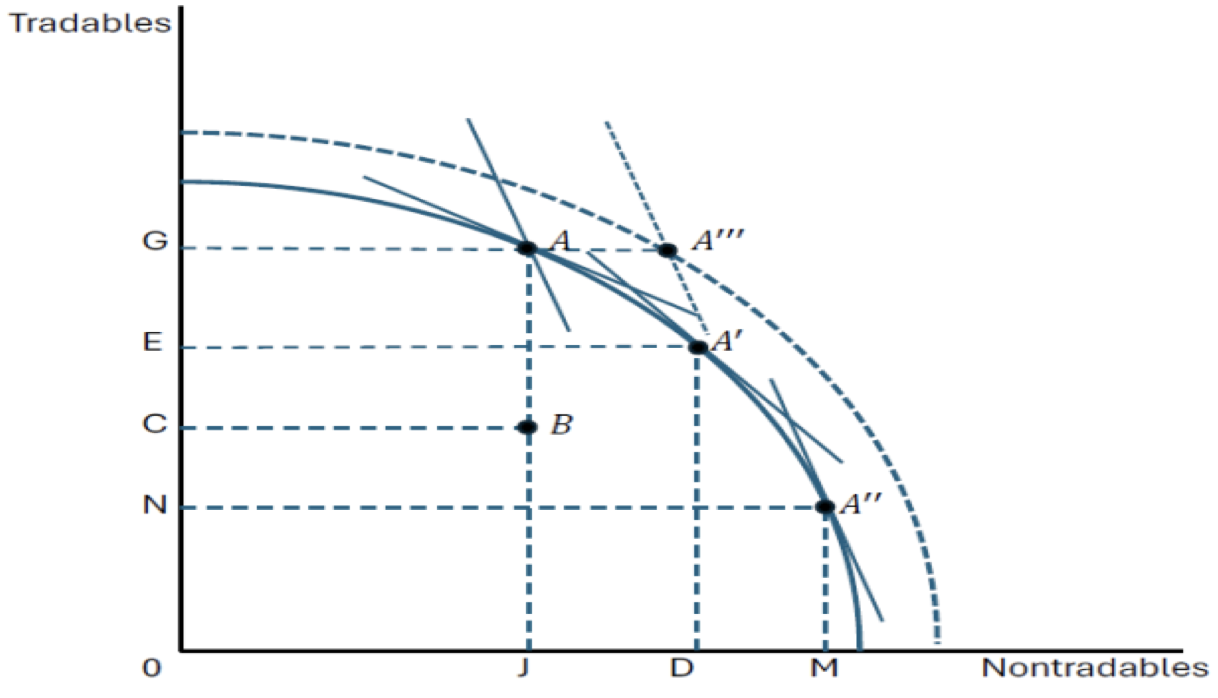
Initially production is at A. Output of tradables is OG and of nontradables OJ. The slope of the line that is tangent to the frontier at A measures the initial relative price between the goods. The steeper the slope, the higher the relative price of nontradables. The tangency between the production possibility curve and the price line implies both profit maximisation by firms and a socially efficient labour allocation.
If PT is the price of tradables, MPN the price of nontradables, MPT the marginal product of labour in the tradables sector, MPN the marginal product of labour in the nontradables sector and W the wage, profit maximisation implies PT x MPT = W = PN x MPN . As the value of the marginal product is the same in both sectors, the value of production cannot be increased by labour reallocation. Hence, the allocation is efficient. The equality also says that PN / PT = MPT/MPN. PN/ PT is the slope of the price line and MPT/MPN the slope of the production possibility frontier. Thus, the tangency point between the price line and the production possibility frontier represents both profit maximisation and social efficiency.
When the number of pensioners rises, total saving in the economy falls and consumption demand rises. The consequences are easiest to illustrate under a fixed exchange rate. In that case, the price of tradables is unchanged because it is determined abroad. However, the price of non-tradables rises. The price line becomes steeper. Production moves to A’. Output of nontradables rises to OD and output of tradables falls to OE. If the fall in saving is so large that the trade surplus disappears, A’ also shows consumption. In addition, the composition of consumption tilts towards nontradables, as more is spent on them with more pensioners.
The decrease in saving and the composition shift in product demand are the combined effect of individual and government decisions.
With inflation targeting, the central bank does not allow a rise in the relative price of non-tradables to increase the general price level (more than is consistent with the target). Hence, monetary policy induces an exchange rate appreciation. This lowers both the domestic-currency price of tradables and the price of non-tradables relative to the fixed-exchange rate case but does not otherwise change the analysis. The same increase in PN / PT causes the same increase in the real product wage WT / PT in the tradables sector and the same decrease in the real product wage WN in the non-tradables sector as under a fixed exchange rate.
The demographic change thus causes output of nontradables to increase at the expense of output of tradables. The adjustment takes place because the nontradables sector bids up the wage when its product price rises. Hence, labour is reallocated to the nontradables sector. This is socially efficient as the demographic change has increased consumers’ relative evaluation of nontradables.
What happens if instead of clearing the labour market, the wage is linked to the price of tradables because of pattern setting by the tradables sector? Then, when the (relative) price of nontradables rises, the wage cannot respond to the increase in labour demand from the nontradables sector. Consequently, no labour reallocation occurs. Production remains at A and there is excess demand for labour in the nontradables sector (this is captured by the price line cutting the production possibility frontier instead of being a tangent to it). Pattern bargaining is then socially inefficient as the marginal value of tradables output is smaller than the marginal value of non-tradables output.
If PN / PT = MPT/MPN in A, an increase in PN / PT implies that PN / PT > MPT/MPN if the economy stays there. This is inefficient as then PN x MPN > PT x MPT, which implies that the total value of production would be larger if labour was reallocated.
Calmfors & Viotti (1982) and Arbetsmarknadsekonomiska rådet (2017) show that a change in the relative price would result in unchanged total labour demand, and thus unchanged total employment if the weights are the sectors’ shares of total employment weighted by their labour demand elasticities.
In the stylised model above, labour supply (equilibrium employment) is fixed. It may be realistic to assume that in a situation with labour shortages in the nontradables sector due to the wage norm, more labour would be drawn into the effective labour force. If so, the production possibility frontier is shifted outwards, so that production could move to a point A’’’. This suggests a possible conflict between the goals of high output (employment) and efficient sectoral allocation of labour.