07 Honkasuon Aarreaitat
07 Honkasuon Aarreaitat, Finland
Building use | Terraced house | Stories above ground | 2 |
Location | Haapaperhosentie 27, Helsinki | Basement area | — |
Client | Asunto Oy Haapaperhosen Aarre | Structural system | Massive log construction |
LCA consultant | GreenCons Oy | Façade type | Massive log façade |
Year of completion | 2023 | Roof type | Gable roof |
Reference area | 830 m2 (Heated floor area) | Heat demand /source | Heat pumps |
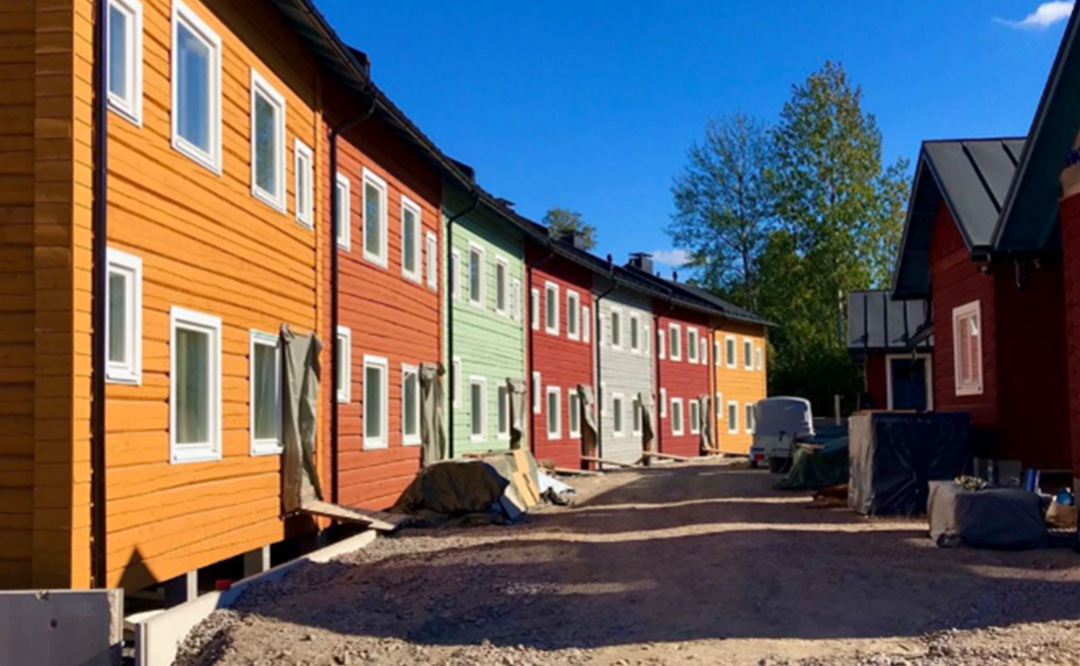
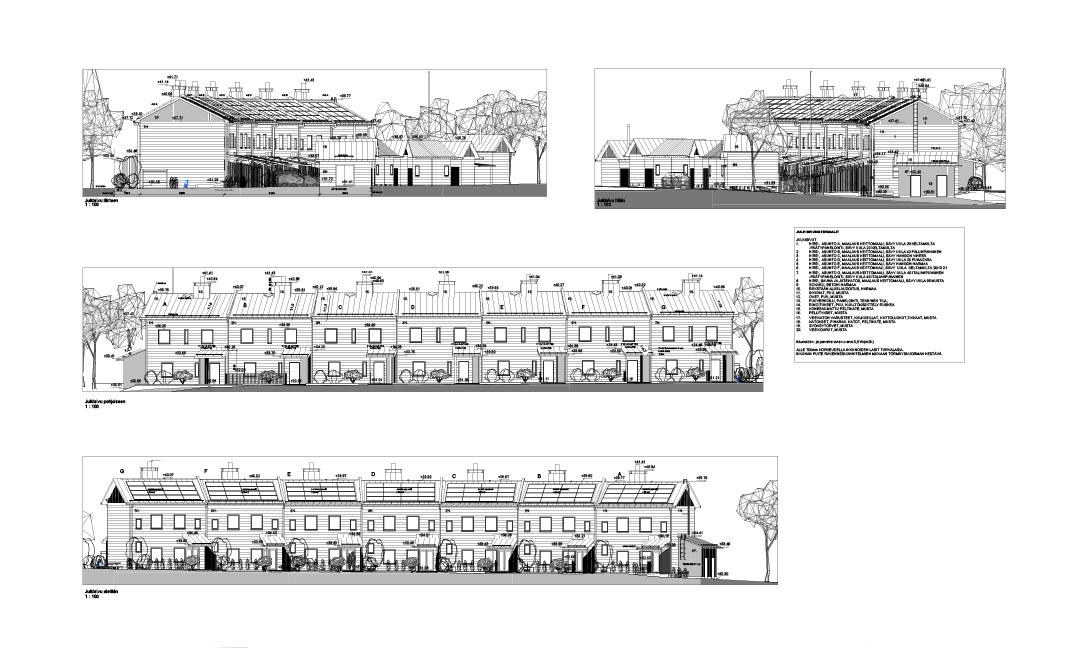
The project consists of seven terraced two-storey homes, located in Helsinki, Finland. The main goal was to build a project that has a Carbon Handprint that is bigger than its carbon footprint. This was achieved better than expected, the CO2 handprint is almost double compared to the CO2 footprint. The second sustainability goal was cultural: we wanted to show the advantages of the traditional Nordic massive log construction in finding solutions to the urgent problems of modern day building and sustainable forest use. The specific sustainability measures implemented in this project were maximising the carbon storage, minimising technology and energy use and maximising photovoltaic power and heat pumps. The whole project is based on circularity principles: the bearing log frames, floors, ceilings, insulations, clay renderings, windows, doors, fixtures etc. are all designed and built for deconstruction and reuse. The spaces are multifunctional, and the log frames can be converted to other uses or relocated whole or in parts if necessary. The innovations in this project are based on local materials and ancient local tradition and handcrafts and applying those in innovative ways. The project’s LCA was first conducted in the concept phase, then in the design phase and a third time after construction. It gave an insight to how the ambitious sustainability goals were met and facilitated discussions with the building officials. The most significant result was that it is possible to build regeneratively. We are in close contact with the end users/residents and monitor how everything works and how satisfied the users are with their homes.
Assessment method
LCA scheme compliance | Method for the whole-life carbon assessment of buildings (Finnish Ministry of the Environment) |
LCA tool version | One Click LCA |
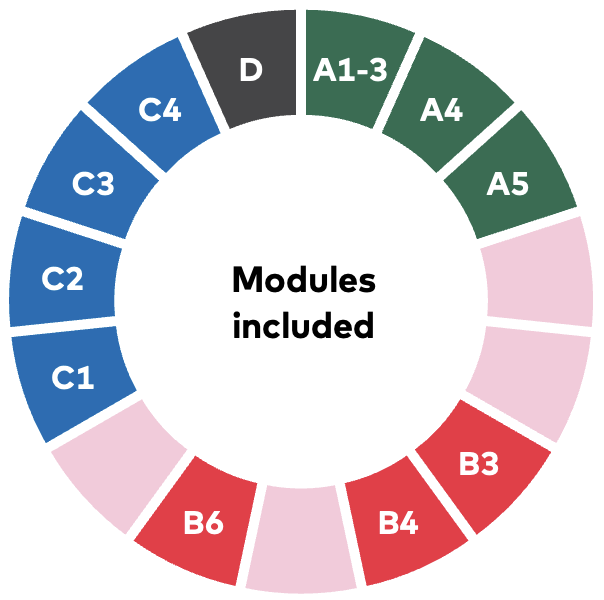
Life cycle stages included | A1-A5, B3, B4, B6, C1-C4, D |
Material emission data | Generic Finnish database, EPDs |
Material decarbonisation scenario | — |
Energy calculation method | Energy Performance Certificate (Finnish) |
Energy, dynamic scenario | Energy decarbonisation scenario according to the Finnish method; (most likely) benefit-sharing method |
LCA results: Life cycle modules
[kgCO2e/m2 reference area * year]
%
[kgCO2e/m2 reference area * year]
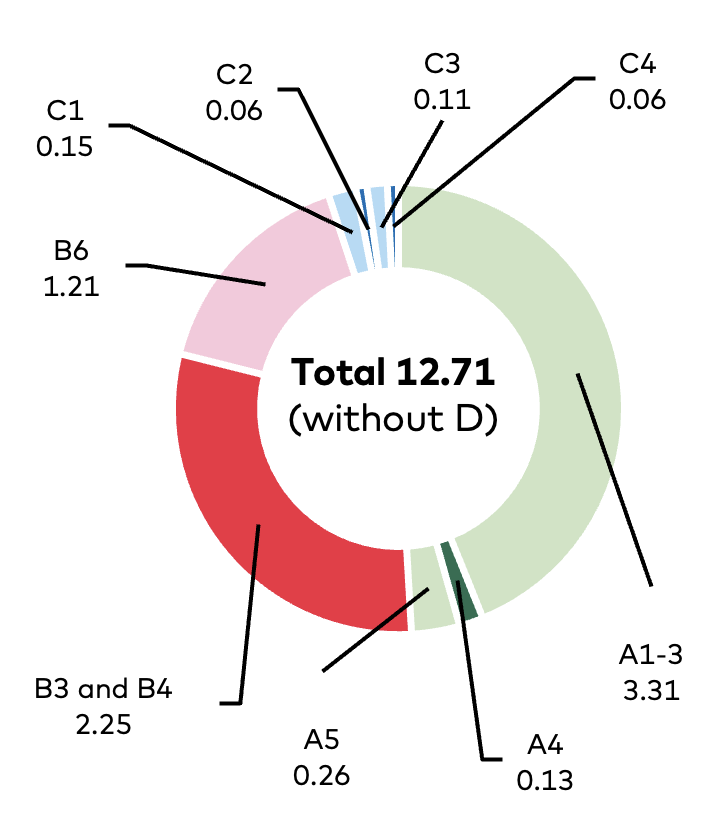
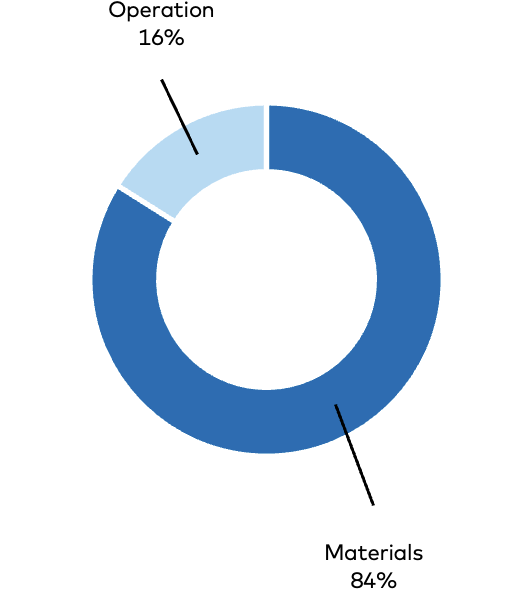
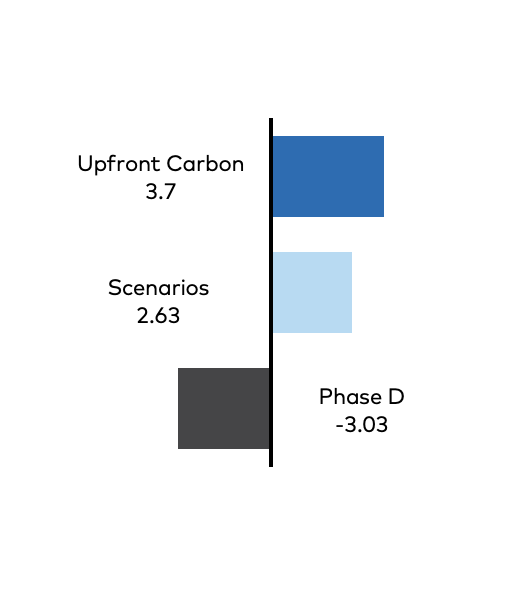
The system boundary covers almost all life cycle modules, where the product stage is dominating the overall impacts, followed by repairs and replacements. Beyond the building materials, the assessment also includes building energy systems/installations such as electrical cables, HVAC, water pipes, sewage pipes, heating systems (heat pump) as well as solar PV panels.
In the sesond figure, Operation includes B6, while materials include A1-A5, B3-B4, C1-C4.
In the third figure, Upfront includes A1-A5, scenarios include B3-B4, C1-C4, and D is shown separately.
In the sesond figure, Operation includes B6, while materials include A1-A5, B3-B4, C1-C4.
In the third figure, Upfront includes A1-A5, scenarios include B3-B4, C1-C4, and D is shown separately.
LCA results: Building elements
GWP / reference area [kgCO2e/m2 reference area]
Material inventory: All materials
Life cycle modules: A1-A5, B3-B5, C1-C4
Life cycle modules: A1-A5, B3-B5, C1-C4
Strip foundations and massive wood log frame dominate the building element GWP. External and internal walls as well as piling are also relevant, while the roof has a relatively low impact for low-rise constructions.All the technical components and piping for electricity, water etc. were included in the estimation, with a combined impact of 115 kgCO2e/m2 reference area (not included in the figure).
Building element quantity / reference area [kg building element / m2 reference area]
GWP of building element / building element quantity [kgCO2e / kg building element]
Material inventory: All materials
Life cycle modules: A1-A5, B3-4, C1-C4
Life cycle modules: A1-A5, B3-4, C1-C4
Building element quantity per building reference area is a measure for the material intensity, while element impacts per element quantity is a measure for the elements’ carbon intensity relative to their weight.
LCA results: Products
Product quantity / reference area [kg product / m2 reference area]
GWP of product / reference area [kgCO2e/m2 reference area]
Material inventory: Top 10 products with the highest impacts
Life cycle modules: A1-A5, B3-5, C1-C4
Life cycle modules: A1-A5, B3-5, C1-C4
Construction product quantity per building reference area is a measure for the material intensity, while product impacts per building reference area is a measure for carbon intensity.
The use of solar cells is also reflected in the material impacts, while most other products are ranging well below. Here, the timber logs used for the walls are followed by the steel pile foundations and concrete for the foundation.