2.4 Young People's Critical Assessment of Media Content
Algorithms customise the content on social media and in search engines and have significant influence over the information that each individual user is exposed to. When evaluating or critically scrutinising the search result, or question why something appears in the social media feed or in the online news page, some knowledge about algorithms can be helpful.
Assessing Online Content
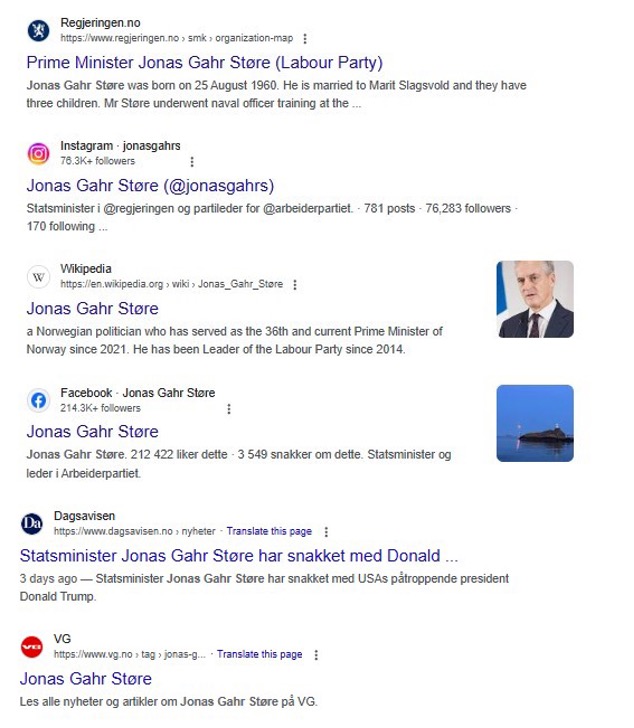
To survey skills in evaluating content in practice, the respondents were shown images of online search results and media content where they had to identify different elements. The images were the same screen shots of online search results as in the adult survey, one for a down jacket and one search on the current prime minister's name. A third question showed a mock-up screen shot of a well-known online news site, separate images for each country in each country's language. Different elements in the images had reference numbers to connect to the survey question. For reason of space, only one country's image will be included as an example to illustrate the tests.
Ranking of Online Search Results
A majority of the 9 to 15 age group, on average 59 percent, correctly stated that the search order of results is determined by someone having paid to have their jacket listed at the top. Many respondents answer that they don’t know, between 11 and 20 percent, which may indicate both uncertainty and that they never reflected on how search results are ranked.

Categorising search results
Categorising the search results by type of source in a web search on the current prime minister’s name is mostly correctly identified by youth, especially results of social media content, news content and from a reference publication. It should be noted here that for all countries, the reply option 'don’t know' is often relatively high.
Assessing news media content
A third image test showed a mock-up news site. Editorial and commercial content was generally correctly identified by youth respondents in all countries. However, discerning content and categorising different sections of the newspaper website (news or other editorial content) was more difficult. This may be explained by young people being unaccustomed to reading newspapers. Here also, the reply option “don’t know” is often relatively high.

Key insights
Most young people are aware of how the ranking of online search results are determined but understanding is partial. A majority correctly identified that paid content ends up at the top of search results. Yet significant shares of the respondents fail to understand product search result rankings, for example by thinking that the most popular or best product is shown first, or by answering that they don’t know. The result may indicate both uncertainty and that they never reflected on how search results are ranked. How algorithms work and how they are used both in search engines and in social media could be relevant in media literacy training.Young people struggle to distinguish news from other editorial sections on (mock) news sites; uncertainty likely reflects limited newspaper use. Many young people use social media to stay up to date with the news and are unaccustomed to reading newspapers and using their websites. Being able to separate news from ads or commercials and categorise different editorial content may be relevant to address in media literacy training to increase perceived value.