Three dimensions of a human-centric public sector
We note that while a human-centric approach can mean many different things, it has some key core meanings that can be applied to various areas. To summarise the concept, we take a closer look at and deepen a model developed within the collaborative project Nordic DigiGov Lab. The model has three dimensions, Human-centric governance, Human-centric public services and Innovation.
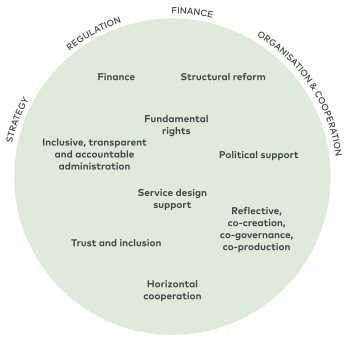
Based on the framework for defining a human-centric approach presented earlier, Figure 1 presents three dimensions of human-centredness.
Figures 1 to 4 were developed in cooperation with Marie Berntsen at the Norwegian Digitaliseringsdirektoratet (DigDir) within the Nordic DigiGov Lab project.

Figure 1 Three dimensions of human-centredness, developed in the Nordic DigiGov Lab project.
Dimension I – Human-centric governance
The governance dimension is inspired by the OECD's “The E-Leaders Handbook on the Governance of Digital Government” .
In Figure 2, we deal with a broad range of aspects. Political support, for example, is clearly reflected in certain digitalisation strategies and funding initiatives aimed at achieving human-centredness. Norway's latest strategy explicitly expresses a human-centric ambition in the preface and is signed by both the Prime Minister and the Minister for Digitalisation and Public Administration.
In Denmark, the preface to the strategy with its collective commitments, is signed by the government.
National Strategy for Digitalisation - together in the digital development (accessed 2025-05-15).
Programme to promote life event based digitalisation - Valtiovarainministeriö (accessed 2025-02-06).
Within the Nordic DigiGov Lab project, the importance of integrating general administrative reforms with a human-centric approach and digitalisation is clear. Regarding fundamental rights and principles, it is important that these are clearly articulated as reasons for human-centric governance. For example, the Swedish National Financial Management Authority (ESV) points out that the foundation for needs-driven development in the public sector can be justified from the perspective of the Swedish form of government.
Från behovsdriven utveckling till nyttorealisering – en översikt - ESV Forum (accessed 2025-02-06).
In Denmark, the preface to the strategy with its collective commitments, is signed by the government.
Governance dimension
Get politics on board first?
Start with the big flows – how, who, when, quantity and quality.
Get things done first, think later? Think slow, then act fast?
Cooperation and culture, funding meaningful goals.
How do we make the services nobody asked for?
How to find long-term financing based on holistic needs?
Figure 2 Dimension I: Human-centric governance, developed in the Nordic DigiGov Lab project.
Governance can also take the form of principles, guidelines, and standards for the design and delivery of public digital services, something that is currently lacking in Sweden. This leads to different public actors working in various ways, which, as pointed out by the Swedish National Audit Office, results in inefficiency. This, in turn, impacts the accessibility of public digital services.
Governing towards human-centredness can pose many challenges. Administrative systems are generally hierarchical and vertical, making it difficult to create seamless and holistic experiences of public services. Therefore, a certain degree of collaboration and horizontal governance from the central level is required. As mentioned earlier, Norway has initiated such an organisational model at the central level to promote life event-based services.
Other challenges may relate to the ability to prioritise efforts from a human-centric perspective. On the one hand, there may be a desire to prioritise areas where a high proportion of people come into contact with the public sector, thus justifying human-centric efforts from a quantitative perspective, where “demand is highest.” On the other hand, there may be strong qualitative benefits in areas where the volume is not as large, but where efforts should be prioritised based on acting relationally and reflectively. This could involve reducing digital exclusion, or promoting equal access to digital services regardless of whereabouts in the country people are located.
From a human-centric perspective, it may also be important to act on the understanding that the answers are not predetermined but need to be explored and understood with empathy and sensitivity. This requires the ability to work with an open mind and a and a respectful yet assertive approach, and with various qualitative methods. A prerequisite is to allow for more actors to participate in the governance, but also the ability to work iteratively and develop solutions over time.
In Sweden, needs-driven development within the public sector can be justified based on the Swedish form of government.
Dimension II – Human-centric public services
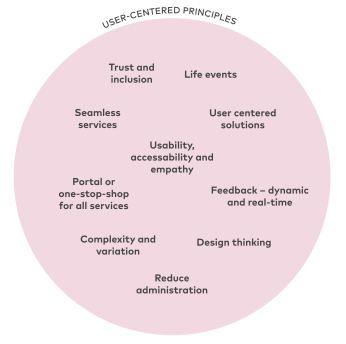
In the next dimension, as seen in Figure 3, we are inspired by the OECD's principles for human-centric public services, their Digital Government Index, as well as the EU's Interoperability Framework (EIF), which includes principles around user-centredness and inclusion.
The European Interoperability Framework in detail | Interoperable Europe Portal (accessed 2025-02-06).
In the autumn of 2024, the OECD published a recommendation for human-centric public services.
OECD Legal Instruments (accessed 2025-05-15).
The recommendation calls for the administration's ability to capture, understand, and incorporate citizens' needs and opinions in its daily work.
Human-centric public services dimension
How to create user-journeys across the system of different public administration actors?
How to define and prioritise life-events?
How to measure peoples' needs — quantity and quality, empathy, transactions.
How to handle complex as well as complicated life situations (variations in predictability)?
How do we initiate and develop cross-border services?
Understanding the relational character of services?
Figure 3 Dimension II: Human-centred public services, developed in the Nordic DigiGov Lab project.
As with the previous dimension, here too we encounter a range of aspects to consider. The “design thinking” approach for creating services involves focusing on the user perspective through structured methods, in collaboration with various actors, infrastructure, and digital technologies
Från behovsdriven utveckling till nyttorealisering – en översikt - ESV Forum (accessed 2025-02-06).
The previously mentioned researcher Christian Bason writes in his dissertation about how design thinking has been adopted in the public sector and has become a “global movement”.
Bason, Christian, Leading Public Design How Managers Engage with Design to Transform Public Governance, 2017, Copenhagen Business School [PhD]. PhD serier No. 21.2017,Christian_Bason.pdf (accessed 2025-02-03).
The dimension of human-centric services can, therefore, focus on how services should be developed in close collaboration with people and businesses to capture their experiences and needs. The ability to co-create has also been highlighted as an important tool not only for developing new services but also for addressing and handling new societal challenges, as shown in an extensive study of public administration in European cities.
Public-Innovation-building-capacity-in-Europes-city-governments.pdf (accessed 2025-05-15).
Another area shown in Figure 3 is “reducing the administrative burden” for individuals in their interactions with public administration. This ambition is a classic within Swedish public administration. For example, the Swedish Bureaucracy Inquiry expressed as early as 1979:
https://lagen.nu/sou/1979:31 (accessed 2025-05-15).
Through cooperation between authorities in data collection, the public's need to provide information could, in certain cases, be simplified. Some data collections should be designed so that future use of data by other authorities is facilitated. [...] The individual's role could change to checking and approving data.
This is an early example of the desire to ease the burden on individuals from having to submit information – often the same information – to multiple public actors who have not managed to coordinate with each other, thereby aiming to focus on what is essential. The goal is to first confirm what is correct and accurate, in order to efficiently and clearly access obligations and rights, rather than creating more administration and bureaucracy.
The individual's role could change to checking and approving data.
This is about ensuring that people and businesses only need to provide certain standard information once (“the once-only principle”). After that, the data should be shared between relevant authorities, so that it does not need to be provided again for each new case or contact with an authority. This saves time and resources and ensures that the data used is of high quality and retrieved directly from the source.
To return to the concept of relational, we can ask how this might manifest in practice in public services. Here, several potentially conflicting interests must meet and be managed. The administration's need for transparency and rule of law are core values that the public sector must uphold to protect a democratic society.
These values can conflict with the needs of a specific target group or commercial interests that may not desire transparency or openness. Similarly, excessive collaboration with a particular target group or need may risk creating unfair priority over other groups. Another example of a challenge concerns how and whether services are followed up after implementation to ensure relevance, quality, and efficiency in relation to needs and original goals. Here too, qualitative and quantitative measures may need to interact when decisions are made about future development or discontinuation.
Seamless and holistic services, in turn, require that various public – and private – actors collaborate to achieve practical results. This can become a difficult balancing act when public actors are not monitored or funded based on the collective benefit.
The administration's need for transparency and rule of law are core values that must be maintained to protect a democratic society.
Dimension III – Innovation and reform
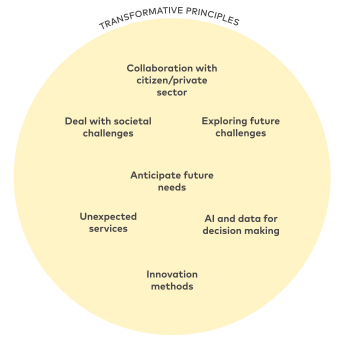
The innovation dimension is illustrated in Figure 4 and focuses on the ability to think entirely anew, both for new and existing problems. Unlike improvements, or entirely new services based on traditional logic, digital transformation fundamentally changes how public administration works across various areas: in its internal processes, in how new legislation is developed, and in how it interacts with people and businesses.
https://www.sciencedirect.com/science/article/pii/S0740624X18304131 (accessed 2025-05-15).
There are at least four different types of innovation areas for public administration. These can involve changing internal work processes, creating new services or products, governing in new ways, or enabling other and new ways of viewing old problems through the use of new opportunities.
Public-Innovation-building-capacity-in-Europes-city-governments.pdf (accessed 2025-05-15).
The innovation dimension has many touchpoints with the other two dimensions in that it, in certain respects, requires active governance and open conditions to succeed. It also needs to address, to a great extent, the identified problems and ambitions within the service dimension, such as reducing administrative burdens or increasing trust and inclusion. There are several potential “methods” to capture new trends in the environment, but also to understand and predict societal challenges and needs. In line with Broomfield's reasoning, the ability to use data analysis – with the support of technologies such as AI – can help us identify areas that can be reformed or where innovation can bring significant benefits.
Transformative solutions dimension
How do we enable cognitive leaps in creating new types of public services?
What role can digital technology play in enabling new types of services?
How do we balance key vales of public administration and the need for stabiluty with the need for innovative reform?
How do we make the services nobody asked for?
How do we create space for innovation in a highly regulated sector?
Figure 4 Dimension III: Innovation, developed in the Nordic DigiGov Lab project.
Descriptive analysis provides answers to questions such as “What has happened?” both over time (historically/timeline) and in the present (current overview). A descriptive analysis may involve grouping and reporting key metrics related to specific areas or years, and can also contribute answers to questions about why something has happened.
Predictive analysis answers questions such as “What will happen?” and can be based on earlier analysis questions such as “Why has something happened?” Various methods or algorithms can support the analysis of relationships between different variables to explain specific outcomes, patterns, and/or clusters in a dataset. This can, in turn, be used to formulate expectations for future events or assess risks based on different scenarios.
Prescriptive analysis is about answering questions such as “What should happen?” This type of analysis can be based on norms within areas such as information security, efficiency, law, or ethics. Using these norms, a dataset is analysed to generate alternatives, rankings, or proposals for different courses of action.
Appropriate data management can provide direct feedback on how an organisation conducts its work. Automated feedback loops can give real-time information on how digital services are performing, and subsequent analyses can help identify the need for business development. Other inputs for the need to change operations may come from external environment monitoring with strategic foresight.
The ability to use data analysis can help us identify areas that can be reformed or where innovation can bring significant benefits.
As in the other two dimensions, we face challenges here as well, such as the need to constructively balance public core values and principles with the need to reform and do things in new ways to meet new types of societal challenges while maintaining democracy, accountability, and transparency.
The starting point for innovation or transformation should be tactical and strategic reasoning to understand where and when people need physical interaction and support, or when citizen involvement is not required at all, such as through automated approaches. An example could be that certain types of rights are granted automatically without an application being made. Here, various tools and spaces may need to be created to allow new ways of thinking to emerge. This could be achieved through regulatory sandboxes or by creating a culture that is open to new ideas in collaboration with people and businesses.
An example could be that certain types of rights are granted automatically without an application being made.