Photos: iStock
Updated analysis of the national e-health / digital health policies
Introduction
The healthcare systems in the Nordic countries rank among the best in providing equitable, safe and effective care. Cooperation between the governments is achieved through the Nordic Council of Ministers (NCM)
The Nordic Council of ministers. THE NORDICS – a sustainable and integrated region? Baseline report for Our Vision 2030 [Internet]. 2021 [cited 2024 Mar 18]. Available from: https://www.norden.org/en/publication/nordics-sustainable-and-integrated-region-baseline-report-our-vision-2030
Eriksen J, Monkman H, Adler-Milstein J, Tornbjerg Eriksen K, Nöhr C. Citizens’ Access to Online Health Information – An International Survey of IMIA Member Countries. In: MEDINFO 2023 — The Future Is Accessible [Internet]. IOS Press; 2024 [cited 2024 Mar 18]. p. 1297–301. Available from: https://ebooks.iospress.nl/doi/10.3233/SHTI231174
Despite Nordic cooperation and the use of international standards, each country’s e-health solutions have largely had a national scope. This is now beginning to change as the European Union has begun its work on the regulatory framework for an European health data space (EHDS). In the foreseeable future, patients will be able to bring along with them their electronic prescriptions when they travel. The development pipeline also includes a summary of care records. This development might ultimately end in a unified European care provision space. There is also a budding commercial marked for video consultations on demand and other digital-first healthcare services.
An e-Health / Digital health policy is a macro-level instrument to shape the development within a healthcare system. It must build on what has been achieved when it comes to existing services and existing digital health infrastructure. It must also aspire to leverage the potential in enabling technologies while keeping risk at acceptable levels. As a sector-specific policy it will also have to comply with generic national policies on digitalisation (e.g. on national policies on the use of machine learning and AI) as well as with relevant supranational policies from the United Nations, EU and NCM.
The objective of this policy analysis is to assess and compare the scope, ambitions and extent of accountability in national-level digital health policies in the Nordic countries. By scope we mean what the policy intends to change when it comes to a) infrastructure development (i.e. regulatory groundwork, standardisation activities, work on the technical infrastructure and on the infrastructure to maintain cybersecurity) and b) business support (to include preventive care, healthcare delivery, knowledge development, building a competent workforce). By ambition we mean the value of the stated policy outcomes if achieved, and (implicit), the degree of risk taken. By extent of accountability we mean the extent to which the underlying assumptions also are described in the policy documents and the extent to which the descriptions of the intended outcomes are so that their achievement, and hence the fulfilment of the policy objectives can be accounted for in the future.
Materials (policy documents)
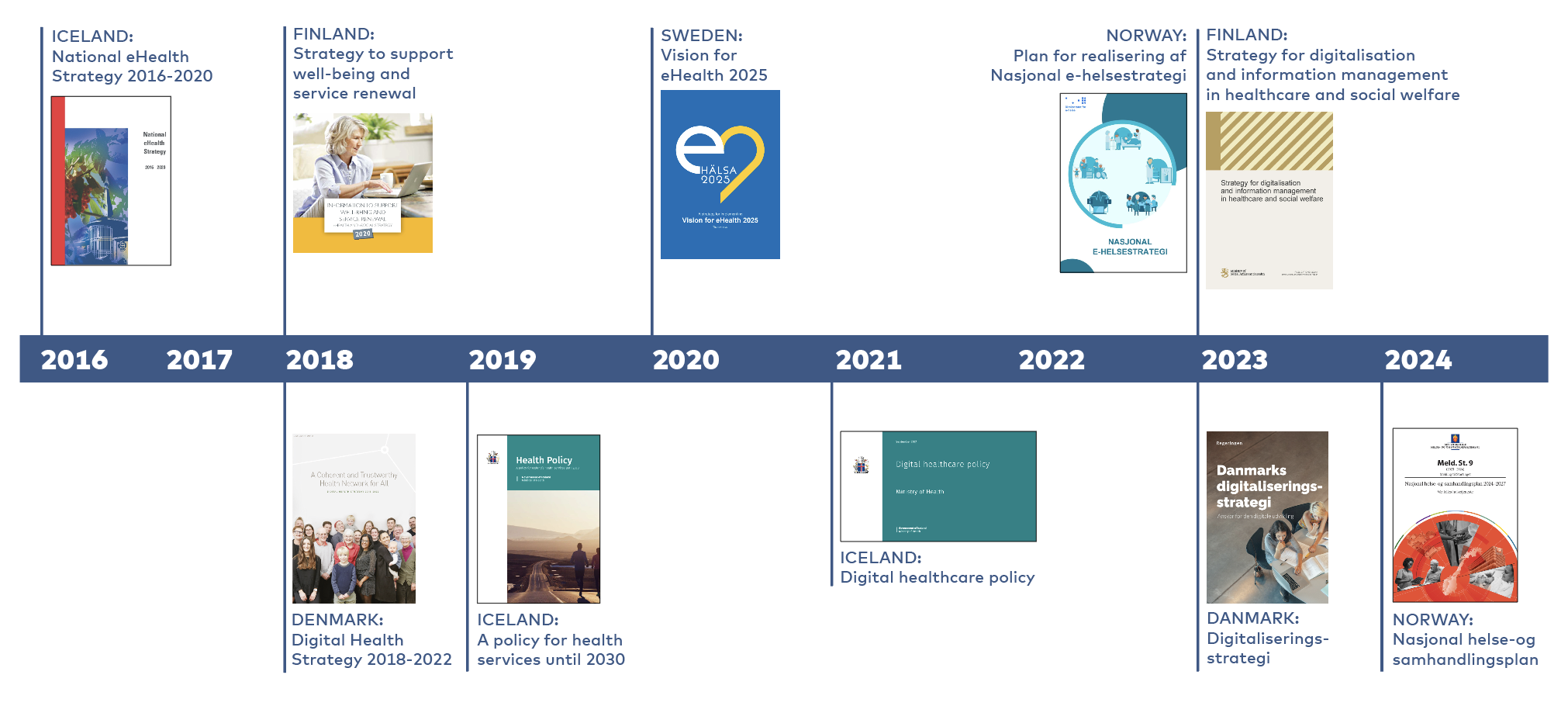
The policy documents that were to be included in the policy analysis were obtained from the e-health groups and from the members of NeRN research network. Table 4 enlists the policy documents that were included. Their front pages are illustrated in Figure 1.
Country | Policy document |
Denmark | Sundhedsdatastyrelsen: A Coherent and Trustworthy Health Network for All. Digital health strategy 2018-2022 (2018). Available from sundhedsdatastyrelsen.dk The Danish Government: Denmark’s digitisation strategy (2023) (in Danish). Available from digmin.dk |
Finland | Ministry of Social affairs and Health: Strategy for digitalisation and information management in healthcare and social welfare (2024) urn.fi/URN:ISBN:978-952-00-5404-5. Available from stm.fi Ministry of Social affairs and Health: Information to support well-being and service renewal. eHealth and eSocial strategy (2020) urn.fi/URN:ISBN:978-952-00-3575-4. Available from julkaisut.valtioneuvosto.fi |
Iceland | Directorate of health: National eHealth strategy 2016-2020. Ministry of Health: Health Policy, A policy for Iceland’s health services until 2030 (2019). Available from: stjornarradid.is Ministry of health: Digital healthcare policy (2021). Available from government.is |
Norway | Directorate of eHealth: National eHealth strategy (2023). Available from ehealthresearch.no Ministry of health: National Health and collaboration reform 2024-2027 (2024) (In Norwegian). Available from regjeringen.no |
Sweden | Ministry of Health and Social Affairs: A strategy for implementing Vision for eHealth 2025 (2020). Available from: ehalsa2025.se E-hälsomyndigheten: Genomförandeplan 2020–2022 Bilaga till Strategidokument Vision e-hälsa 2025 Available from: ehalsa2025.se |
Table 4. National e-Health policies included in the analysis.
Figure 4: Front pages of the national e-health and healthcare policies to be analysed.
Methods
The policy analysis was carried out by means of document analysis
Prior L. Researching Documents. Emergent Methods. In: Hesse-Biber SN, Leavy P, editors. Handbook of Emergent Methods. Guilford Press; 2010. p. 111–26.
Results
Scope and objectives of the policies
The scope of the policies from the five countries were largely centred around a) empowering and activating citizens; b) a shift towards prevention and digital first; c) supporting health operations; d) doing the groundwork; e) making health data more available in research and innovation workflows and f) supporting health personnel.
Empowering and activating citizens: All countries have established portals through which patients can view their own health records and carry out self-service tasks such as asking for prescription renewals and schedule appointments. Most countries envision an even more active patient role:
“To support patients and their relatives in taking greater ownership of their own illness in their daily lives and enabling them to actively participate in their own treatment”
(Denmark).
(Denmark).
“Self-management services will include clinical decision-making support for the use of citizens, risk tests, self-assessment methods as concerns the need for assistance required in referral to treatment, online health checks and reminder and calendar solutions to support self-management” (Finland)
Shifting towards prevention and digital first: Building on the assumption that digital health tools can make patients more empowered and activated, most countries envision the patient to do more when it comes to taking preventive measures and using the digital portal as the preferred gateway into the healthcare system. The emphasis on this was most prominent in the policies from Iceland and Finland, where a relatively large proportion of citizens live in rural areas. The Icelandic policy was perhaps the most crisp and clear:
“By 2030 citizens of Iceland in Iceland will be in a position to improve and maintain their own health through the use of digital solutions in a safe and integrated care environment” (Iceland)
The policy from Finland is also ambitious in this regard. They aim to transform their health system by means of digitisation:
“In all wellbeing services counties, digital channels are the primary choice whenever appropriate or for customers that are able to use digital services (Finland)
Supporting health operations: Health operations is about how to deliver high-quality care in a consistent, efficient manner. Health operations include capacity planning, workflow support (e.g. care coordination, digital care pathways, order sets, clinical decision-support, documentation support), quality and safety monitoring. Strengthening the digital support of health operations is an important objective of e-health policies in all countries. Both patient safety, quality of care and continuity of care are highlighted as they always have been. Increasingly, workflow management, digital care pathways, clinical decision-support and other means of distributing knowledge to point of care are being mentioned. Sweden shall have a “National knowledge-support”. According to the Norwegian e-health policy.
“Health personnel shall have access to user-friendly digital tools that [..] provides good decision-support and support their workflows” (Norway)
Likewise, an entire section of the Danish policy is entitled “Knowledge on time”. Decision support for patients in the portals such as support for citizens making preventive care decisions also relates to the empowering and activating citizens theme.
Doing the groundwork: All countries leverage achievements from the past while continuing to do work on digital infrastructures, standardisation, cybersecurity, other information security and legislation work.
Making health data more available in research and innovation workflows: By research and innovation workflows we mean activities that aim to develop new knowledge, medicinal products, medical devices or other health-related technologies. Such activities are motivated by unsolved problems in the healthcare value chain, and are informed by data from the domain and are carried out by public institutions as well as by privately owned companies.
The policy analysis revealed that all countries have become more aware of the potential value of their health data sets. The Danish policy simply states that:
“The digital development is supported by the world’s best health data for research and innovation i.e. through the “Vision for better use of health data” (Denmark)
Iceland states that:
“Databases and biobanks in the health services will be open to those with the requisite licences to carry out scientific work” (Iceland)
Whereas Norway wants more research as well as innovation and service development:
“ .. systematic cooperation between the [healthcare] sector, commercial Companies and research to exploit health data for service development, Innovation and development of commercial products.” (Norway)
Supporting health personnel: Healthcare institutions are obliged to keep a record of the care that their clinician employees provide. This has to do with the legal function of the health record: Health personnel have an individual responsibility for the care they provide, and the health record can be used to hold them accountable. At the same time, the health record system is a tool for its clinician users - it is a means to achieve clinical tasks. The health record system is also turning into a tool for the institution. It is used by non-clinician users to develop reimbursement claims and for the mandatory reporting for management and administrative purposes. Clinicians increasingly talk about the burden of documentation, and about the impact of documentation work on physician burnout.
The Finnish policy states that it wants to ease the workload of health personnel:
“The workload of healthcare and social welfare personnel has been eased by making better use of information and by introducing advanced technological solutions” (Finland)
This is also a focus in the Norwegian policies. Both countries also seem aware that health information systems have usability issues.
This is also a focus in the Norwegian policies. Both countries also seem aware that health information systems have usability issues.
In sum, the e-health policies from the Nordic countries between 2018 and 2024 are wider in scope in that they now seek to engage, empower and activate the patient / citizen to take a greater responsibility for their health including preventive measures. The policies are also wider in scope in that they now encompass research and innovation workflows. There is greater concern of the impact of IT-systems on the work life of the health professionals. Work on regulations, information security, standardisation and cybersecurity are prioritized as before. All policies are ambitious, but the Finnish and Icelandic e-health policies more than the others as they put patient portals and other national e-health systems front and centre in their healthcare reforms. Compared to the policy analyses this research network has carried out before (e.g.
Hyppönen H, Faxvaag A, Gilstad H, Audur Hardardottir G, Jerlvall L, Kangas M, et al. Nordic eHealth Indicators : Organisation of research, first results and the plan for the future (2013) [Internet]. Nordic Council of Ministers; 2013 [cited 2023 Aug 17]. Available from: https://urn.kb.se/resolve?urn=urn:nbn:se:norden:org:diva-675
Hyppönen H, Koch S, Faxvaag A, Gilstad H, Nohr C, Hardardottir GA, et al. Nordic eHealth benchmarking : From piloting towards established practice (2017) [Internet]. Nordisk Ministerråd; 2017 [cited 2023 Aug 17]. Available from: https://urn.kb.se/resolve?urn=urn:nbn:se:norden:org:diva-4840
References
Eriksen J, Monkman H, Adler-Milstein J, Tornbjerg Eriksen K, Nöhr C. Citizens’ Access to Online Health Information – An International Survey of IMIA Member Countries. In: MEDINFO 2023 — The Future Is Accessible [Internet]. IOS Press; 2024 [cited 2024 Mar 18]. p. 1297–301. Available from: https://ebooks.iospress.nl/doi/10.3233/SHTI231174
Hyppönen H, Faxvaag A, Gilstad H, Audur Hardardottir G, Jerlvall L, Kangas M, et al. Nordic eHealth Indicators : Organisation of research, first results and the plan for the future (2013) [Internet]. Nordic Council of Ministers; 2013 [cited 2023 Aug 17]. Available from: https://urn.kb.se/resolve?urn=urn:nbn:se:norden:org:diva-675
Hyppönen H, Koch S, Faxvaag A, Gilstad H, Nohr C, Hardardottir GA, et al. Nordic eHealth benchmarking : From piloting towards established practice (2017) [Internet]. Nordisk Ministerråd; 2017 [cited 2023 Aug 17]. Available from: https://urn.kb.se/resolve?urn=urn:nbn:se:norden:org:diva-4840
The Nordic Council of ministers. THE NORDICS – a sustainable and integrated region? Baseline report for Our Vision 2030 [Internet]. 2021 [cited 2024 Mar 18]. Available from: https://www.norden.org/en/publication/nordics-sustainable-and-integrated-region-baseline-report-our-vision-2030
Prior L. Researching Documents. Emergent Methods. In: Hesse-Biber SN, Leavy P, editors. Handbook of Emergent Methods. Guilford Press; 2010. p. 111–26.