5. Classifying occupations
To compare work and pay at the national level, the concepts of ‘work’ and ‘pay’ need to be defined. At the national level, calculations and descriptions of gender pay gaps are often related to the classification of occupations provided by national statistical authorities. While a number of trade unions have their own pay databases, journalists and researchers, for example, often rely on data from the statistical authorities in each country. A statement such as ‘male teachers are paid x% more than female teachers’ is based on an understanding of teachers’ pay and genders. To make such comparisons, work tasks across the population need to be categorised into different occupations. A categorisation of occupations is needed when comparing the pay levels of work dominated by men and work dominated by women.
The starting point for comparisons of equal pay for work of equal value can be derived from the occupational classifications that exist in each country (cf. Harriman et al., 2023). These classifications are linked to the International Standard Classification of Occupations (ISCO), created by the ILO. By classifying work by occupation at the national level in relation to an international standard, international comparisons and reporting are made possible. However, each country can make adjustments to the international occupational classification to better reflect national labour market conditions. This standardised national occupational classification is not in itself designed to provide a basis for identifying equal jobs on the basis of knowledge and skills, responsibility, effort and working conditions. There are several areas of application and thus different requirements and expectations of the occupational classification, and in that regard the classification represents a compromise between the needs of different users (SSYK 2012).
What the methodology for conducting job evaluations at the national level based on the occupational classification should be is far from clear. Nor is it clear which actors could take or be assigned responsibility for carrying out job evaluations of occupations to assess equivalence at the national level. This is an issue that is also beyond the scope of this report (see also Harriman et al., 2023; Stüber, 2024; Hoen et al., 2024).
As the occupational classification provides a basis for job evaluation and comparison of jobs in which work of equal value is performed, it is necessary that it reflects occupations present in the labour market as accurately as possible. Understanding the structure of the classification, the information it contains and the problems of using existing occupational classifications for the evaluation of work of equal value is fundamental to analysing pay differences at the national level. A description is therefore provided, although for the purposes of this report we have chosen to base it on an already conducted job evaluation (Harriman et al., 2023).
Description of the occupational classification system
The latest version of the ILO’s occupational classification is ISCO-08. This in turn has led to revisions in the national occupational classifications of the Nordic countries. The occupational classifications in the Nordic countries are AML2010 (Classification of Occupations, produced by Statistics Finland) in Finland, STYRK-08 (Classification of Occupations, produced by a working group with participants from Statistics Norway and Nav, the Norwegian Labour and Welfare Service) in Norway and SSYK 2012 (Swedish Standard Classification of Occupations, produced by Statistics Sweden and the Swedish Public Employment Service) in Sweden. The equivalents in Denmark are DISCO-08, and in Iceland Ístarf21 (but in the Icelandic statistical database Ístarf95 is used). The description below is mainly based on the Swedish Standard Classification of Occupations SSYK 2012.
The classification system defines ten broad occupational fields for the purposes of categorisation:
Managers Occupations requiring advanced level of higher education Occupations requiring higher education qualifications or equivalent Administration and customer service clerks Service, care, and shop sale workers Agricultural, horicultural, forestry, and fishery workers Building and manufacturing workers Mechanical manufacturing and transport workers, etc. Elementary occupations Armed forces
Under the SSYK 2012 classification, every occupation is associated with a four-digit code, with each digit corresponding with specific information:
Major group/One-digit level Sub-major group/Two-digit level Minor group/Three-digit level Unit group/Four-digit level
The occupational groups at the four-digit level define the occupations.
Each level includes a description of job content, with increasing degrees of specialisation. Below are examples from two sub-major groups with varied gender compositions, from Major group 5 Service, care and shop sales workers, which is dominated by women. Major group 5 covers a wide range of jobs: ensuring the safety of travellers and checking tickets; providing guide services; preparing and serving food and drinks; providing hair and beauty treatments; supervising, planning and coordinating cleaning work; supervising, managing and maintaining buildings; arranging funerals; managing and planning the operation and day-to-day running of a shop; demonstrating, selling and hiring out goods; caring for children, disabled people, patients and the elderly, etc. Thus, the major care occupations, for example, will be included in Major group 5, among several other smaller occupational groups.
Sub-major group 51, Service, care and safety work encompasses some of the tasks in Major group 5: ensuring the safety of travellers; checking tickets and providing guide services; preparing and serving food and drink; providing hair and beauty treatments; supervising, planning and coordinating cleaning work; supervising, managing and maintaining buildings; arranging funerals. It includes 15 different occupations, such as bartenders, within minor group of waiters and bartenders.
51 Service, care and safety work, gender balanced 513 Waiters and bartenders, dominated by women 5132 Bartenders, gender balanced
Sub-major group 52, Sales workers, etc. includes another group of tasks within Major group 5: managing and planning the operation and day-to-day activities of a retail store, selling goods in grocery and specialised stores, selling goods and services over the telephone, demonstrating goods to potential customers, renting vehicles, etc. It includes 9 different occupations, such as rental salespersons, which are part of the minor group Shop staff occupation group.
52 Sales workers, slightly weighted towards women 522 Shop staff, slightly weighted towards women 5226 Rental salespersons, dominated by men
Each minor group and occupational group, i.e. occupation, also has a short description similar to those given here for the main groups. In ISCO-08, the descriptions are long and detailed, with bulleted lists of typical tasks that may be included. The Finnish and Norwegian systems are also relatively detailed and provide bulleted lists, while the descriptions in the Swedish SSYK are much shorter and summarised.
As shown in the example above, the gender distribution may be different at the four-digit level to the three- or two-digit levels. Therefore, it is important that the assessment of whether occupations are equal for gender pay gap analyses based on national occupational classifications is conducted at the four-digit level, where possible.
National differences in occupational classification
The national classifications differ in how closely they correspond to ISCO-08. There are also differences in how occupations are classified in each Nordic country, as well as the number of levels in the classification. In Finland and Denmark, a fifth digit (five-digit level) is sometimes used. The Finnish classification follows ISCO-08 most closely. The Swedish classification sometimes follows ISCO-08 relatively loosely, diverging and creating new groups. For example, the occupation ‘rental salesperson’ is included in SSYK but not in ISCO-08 or the classifications of Nordic countries.
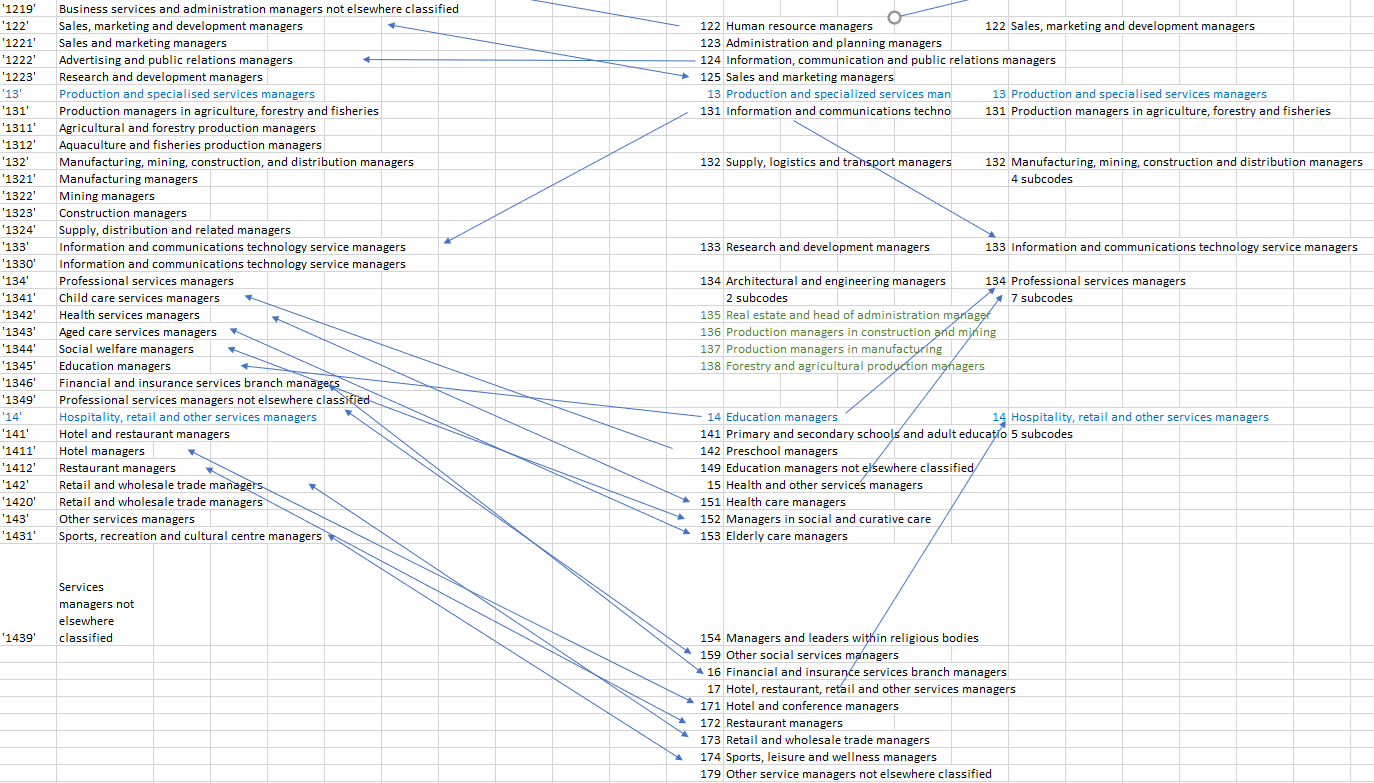
By way of example, the figure below shows the differences in classification among a selection of managerial occupations (Major group 1: Managers) in Finland, Sweden and Norway. It is clear that comparisons between these three countries are not easily drawn. When groups are moved or new groups created, the content of included occupations may also change. When not defined as a separate group, ‘rental salesperson’, to cite the previous example, must be classified within another group, which thus changes its content slightly. Another example is police officers: ISCO-08 has two different groups for police officers, 3355 and 5412. In addition, police chief constables and police commissioners are categorised in two different occupational groups within Major group 1: Managers. While the Finnish occupational classification follows ISCO-08, the Swedish classification has only one occupational group, 3360, as does the Norwegian classification, 3355. When comparing pay with equal occupations dominated by women, i.e. occupations with equal requirements, the outcome differs depending on if the comparison is made between a single occupational group of police officers or two different occupational groups.
Extract from the classification of managerial occupations in AML2010, SSYK 2012, STYRK-08
Level of detail and gender in the classification of occupations
It is essential to know the gender distribution of occupations to make comparisons of the pay situation between occupations dominated by women, those dominated by men or those that are gender-balanced and can be considered work of equal value. National statistics in the Nordic countries do not always contain easily accessible information on the gender distribution of occupations at the four-digit level. In Finland, for example, the information is provided by sector, which means that the gender balance needs to be calculated from three different tables. Table 1 summarises the gender composition at the three-digit level.
Table 1: Percentage of male-dominated, female-dominated and gender-balanced minor groups in Finland, Norway, Sweden. Source: National statistical authorities.
Finland | Norway | Sweden | |
Male-dominated occupations | 46% | 51% | 43% |
Female-dominated occupations | 34% | 24% | 32% |
Gender-balanced 40/60 | 20% | 25% | 25% |
Total minor groups (three-digit level) | 128 | 121 | 114 |
The information in Table 1 does not indicate the number of people who work in a particular occupation, but since there are roughly equal numbers of men and women in the labour market and jobs dominated by men are divided into a greater number of groups, the implication is that groups dominated by women generally contain more individuals (for example, personal care workers in health services are the largest group in Sweden). Thus, there is a risk that these occupations are specified with a lower degree of detail and specialisation than the occupations predominantly held by men.
Evidence of a tendency to divide occupations dominated by men into more and smaller categories can be found in previous research (Acker, 1989; Salminen-Karlsson et al., 2015). A report by the Swedish expert group Lönelotsarna on structural pay differences (Harriman et al., 2023) highlights that this is also a problem in SSYK. The report exemplifies this with the male-dominated operator occupations, which at the four-digit level are divided into 24 occupations according to industry or the material handled, while there is a single unit code at the four-digit level for assistant nurses, in home care and in homes for the elderly, an occupation which is dominated by women, despite differences in conditions for assistant nurses working in homes for the elderly (nursing homes) compared to home care.
Another example of male-dominated occupations being divided into more categories is found in the Danish classification of lorry drivers, occupational group (8332) within major group 8, ‘Operator, assembly and transport work’. In the Danish occupational classification DISCO-08, lorry drivers are presented according to different job functions at the six-digit level, providing a high level of detail across six subgroups:
In the case of lorry drivers, DISCO-08 differs somewhat from ISCO-08, which classifies all lorry drivers under code 8332. Meanwhile, in the case of the nursing profession, SSYK goes counter to the tendency to categorise male-dominated occupations more finely than female-dominated ones; while ISCO-08 has only two codes for nurses and midwives, professions dominated by women, SSYK has 14 different codes.
Table 2: Professional classification of nurses in Finland (AML2010), Norway (STYRK-08), Sweden (SSYK 2012).
Finland | Norway | Sweden |
32211 Nurses | 2221 Nursing professionals | 2221 Professional nurses |
32212 Public health nurses | 2222 Midwifery professionals | 2222 Professional midwives |
3222 Midwifery associate professionals | 2223 Nurses | 2223 Anaesthesia nurses |
2224 Social educators | 2224 District nurses | |
2225 Psychiatric nurses | ||
2226 Nurses – ambulance | ||
2227 Nurses – geriatric | ||
2228 Nurses – intensive care | ||
2231 Nurses – operation | ||
2232 Nurses – children | ||
2233 Nurses – school | ||
2234 Company nurses | ||
2235 Nurses – radiology | ||
2239 Other specialist nurses |
Job content can differ significantly between different areas of work (a midwife has different tasks to an company nurse), and degrees of specialisation can also be accompanied by different gender distributions, which can also co-vary with pay. For example, pay varies across different nursing professions in Sweden (see Figure 1), partly but not exclusively, according to the proportion of men within the specialisation.
Figure 1: Pay in nursing occupations, Sweden.
This section of the report focussed on the level of detail and gender in the classification of occupations and its implications for pay comparisons between occupations in which work of equal value is performed. The next section further explores the use of different levels of occupational classification and pay.
Classification detail and pay
Occupational classifications at the four-digit level (occupational group) and three-digit level (minor group) provide different levels of detail on occupations, but the choice of starting point between the four-digit or three-digit level can also provide different statistical information and reveal certain patterns for those interested in gender distribution within occupations and the pay gap.
An example is presented from the Finnish national statistics for minor group 132 ‘Manufacturing, mining, construction and distribution managers’, examining the proportion of women within the minor group (three-digit level) and the included occupational group (four-digit level), as well as the pay gap for the different groups.
Table 3: Percentage of women and the gender pay gap within minor group 132 and its four-digit levels, Finland.
Percentage of women (%) | Gender pay gap | |
132 Manufacturing, mining, construction and distribution managers | 14% | 10% |
1323 Construction managers | 9% | 11% |
1321 Manufacturing managers | 15% | 3% |
1324 Supply, distribution and related managers. | 19% | 20% |
The proportion of women within the different occupational groups (four-digit level) varies from 9% to 19%. The gender pay gap between the occupational groups varies from 3% to 20% – some women working within minor group 132 are thus subject to a gender pay gap several times larger than the group as a whole.
The Swedish statistical database includes the minor group 335, ‘Tax and related government associate professionals’. This contains the occupational groups 3351, ‘Customs and coastguard officers’; 3352, ‘Tax officials’; 3353, ‘Government social benefits officials’; 3355, ‘Fire and building inspectors.’ and 3359, ‘Administrative secretaries and related associate professionals’. (3354, ‘Safety and quality inspectors’, is not included in the statistical database.) This example is not concerned with the pay gap within the occupational groups (as in Table 3) and instead provides a comparison of the average pay of the occupational groups with the average pay across minor group 335 as a whole. This comparison reveals clear, gendered differences.
Table 4: Percentage of women and pay in minor group 335, Swedish data.
Percentage of women | Pay as % of occupational group pay | Average pay | |
335 Tax and related government associate professionals | 61% | 35,800 | |
3353 Government social benefits officials | 79% | 90% | 32,100 |
3359 Administrative secretaries and related associate professionals | 72% | 101% | 36,100 |
3352 Tax officials | 70% | 96% | 34,400 |
3351 Customs and coastguard officers | 41% | 107% | 38,300 |
3355 Fire and building inspectors. | 35% | 116% | 41,600 |
In two of the three occupations in which women are the majority, the average pay is lower than for the group as a whole, while it is higher in the occupations in which men are in the majority. This is clearly illustrated in the figure below. Thus, it can be seen that pay comparisons conducted at the three-digit level rather the four-digit level obscure significant pay differences (between government social benefits officials and fire and building inspectors these amount to SEK 9,500 per month) and varied requirements between occupations within the group. (According to Harriman et al.’s, 2023, valuation, occupational groups 3351 and 3359 have lower requirements than the other occupations.)
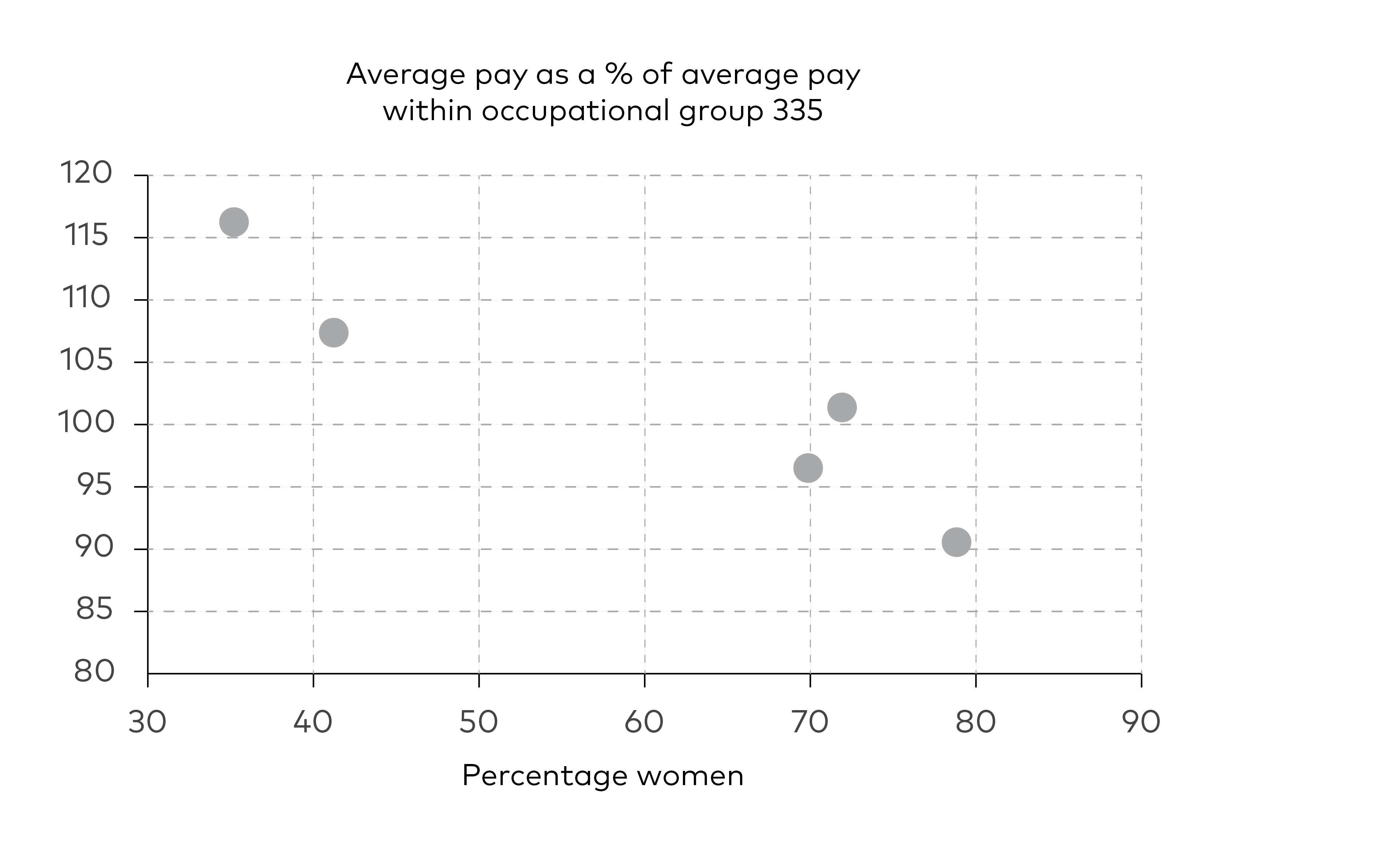
Figure 2: Average pay of occupational groups compared to the average pay of minor group 335, Swedish data.
Comparisons at the four-digit level are thus preferable. However, there is a trade-off in the case of small labour markets, such as Iceland, where a four-digit code would often cover too few workers to enable meaningful statistical comparisons and may also raise privacy concerns.