Introduction
The background of the project
A strong presence in the fishing industry is common to the Nordic countries, making them among the leading fishing nations globally. Fishing practices in the region are varied, encompassing both large, technologically advanced vessels and traditional, low-tech fishing methods. Of the 25 largest producers of wild marine fish worldwide, only four European countries are on the list: Russia, Norway, Iceland, and Spain. Two Nordic countries, Norway and Iceland, account for just under 5% of the global catch, contributing 3.1% and 1.8%, respectively (FAO, 2024). On the other hand, when considering the catch of marine fish per capita, the Faroe Islands are by far the world’s largest nation when it comes to fisheries and aquaculture. In 2019, Faroese fish exports equated to approximately 11.6 tonnes per inhabitant (www.faroeseseafood.com). While specific per capita figures for Greenland are not readily available, it is noted that Greenland, along with the Faroe Islands and Iceland, also has a high fish landing rate per capita. While some fishing traditions have persisted in northern regions for thousands of years, with some techniques remaining largely unchanged, one significant aspect has undergone a universal transformation. Like elsewhere in the world, fishing gear has predominantly transitioned to being composed of synthetic materials. The advent of plastics just over a century ago revolutionised the production of ropes and nets, which are now primarily manufactured from these synthetic materials. While modern fishing gear is designed to be durable and resilient, it still requires regular maintenance and, when in use, frequently encounters unforeseen events that lead to loss, either in part or in its entirety. As a result, fragments of fishing gear are commonly found along Arctic coastlines, even in remote areas far from human settlements.
While plastic pollution is primarily attributed to land-use sources, the Nordic countries likely exhibit more plastic pollution from fishing gear in their marine environments than many other regions; they are even stated to have more plastic from fisheries and aquaculture than anywhere else in the world (Eurofish, 2022). Fishers in the Nordic countries generally possess a heightened level of awareness regarding this issue. Generally speaking, completely preventing the loss or disposal of fishing gear into the sea using various means can pose a challenge in any fishery and fishing community. Consequently, the act of cleaning beaches and collecting lost fishing gear at fishing grounds has been looked at as a necessary action (Langedal, G. et al., 2020). Additionally, the seafood industry is progressively becoming more involved in combating plastic pollution associated with fishing gear. Some companies and even fishery associations have embarked on implementing measures such as collecting used and EOLFG and facilitating its recycling or appropriate disposal.
Objective of the project
This project aims to provide a comprehensive overview of the circular economy of fishing gear, specifically identifying areas of concern and determining key optimisation factors. Furthermore, the study aims to identify regions where challenges are most prominent and assess whether any of the Nordic countries have viable solutions in progress or are prepared to adopt solution-oriented approaches for minimising fishing gear loss and maximising plastic reuse.
A comprehensive understanding of the challenges associated with ALDFG requires a thorough examination of its entire lifecycle, from production and usage to disposal and potential recovery. By involving each stage of the economic cycle, a comprehensive overview can be obtained, highlighting areas requiring improvement and uncovering the root causes of the issues. This research project has dissected the cycle into five principal components, each addressing a distinct aspect. An analysis is conducted within each component, identifying noteworthy examples that exemplify the current state of affairs within that particular value chain segment. After examining each component, recommendations are made to address the identified issues.
The circular economy of fishing gear comprises five key components:
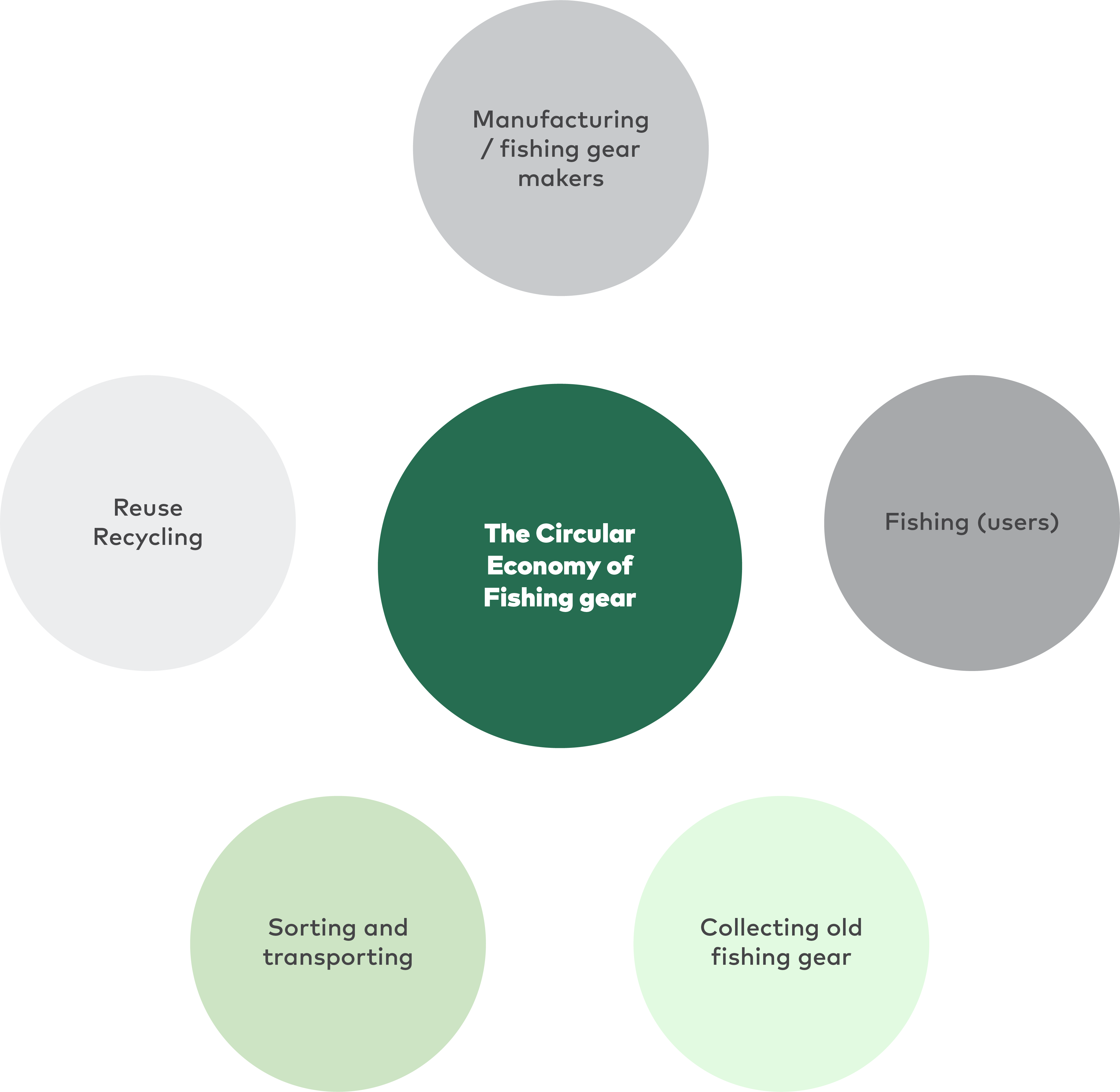
Fishing activities
This stage covers how fishers operate their gear. While traditional practices dominate, there are opportunities to optimise techniques, such as adopting new methods or technologies, to reduce gear loss.
Collection of used gear
Once fishing gear reaches the end of its useful life, having accessible and well-organised disposal options is essential. Fishers need proper facilities and a straightforward system to return or discard nonfunctional gear without unnecessary obstacles. This requires establishing clear responsibilities for collection, ensuring the availability of drop-off points, and providing adequate facilities for disassembling, cleaning, and sorting various gear components. By making disposal both convenient and efficient, participation in recycling and recovery initiatives can be significantly improved, reducing the likelihood of gear being abandoned, lost, or even discarded at sea.
Sorting and transporting
The collected gear must be efficiently sorted and transported to recycling or disposal facilities. This step requires that logistical challenges be addressed, particularly in isolated or small fishery communities that lack proper waste disposal facilities. In such areas, EOLFG may accumulate over long periods due to limited collection options, making transportation less cost-effective.
Reuse, repurpose, and recycle
Lastly, it is essential to evaluate whether used fishing gear is effectively recycled and how much of the recycled material finds its way into new products. The efficiency and sustainability of the recycling process need to be examined, along with opportunities for repurposing or reusing components of old fishing gear.
By focusing on these five key components, this project will provide a holistic view of the circular economy surrounding fishing gear, identify current challenges, and recommend solutions to reduce gear loss and enhance recycling efforts.
The project committee held two separate meetings, one in Iceland and the other in Greenland, and gathered information not only from available various publications but also through visits to key stakeholders, including net lofts, sorting stations, and waste incineration facilities, as well as interviews with fishers and management representatives. These engagements provided valuable information on existing workflows, logistical challenges, and emerging trends in fishing gear management. By synthesising these findings, this study offers practical recommendations for enhancing the circular economy of fishing gear, reducing environmental impact, and supporting more sustainable fisheries across the Nordic region.