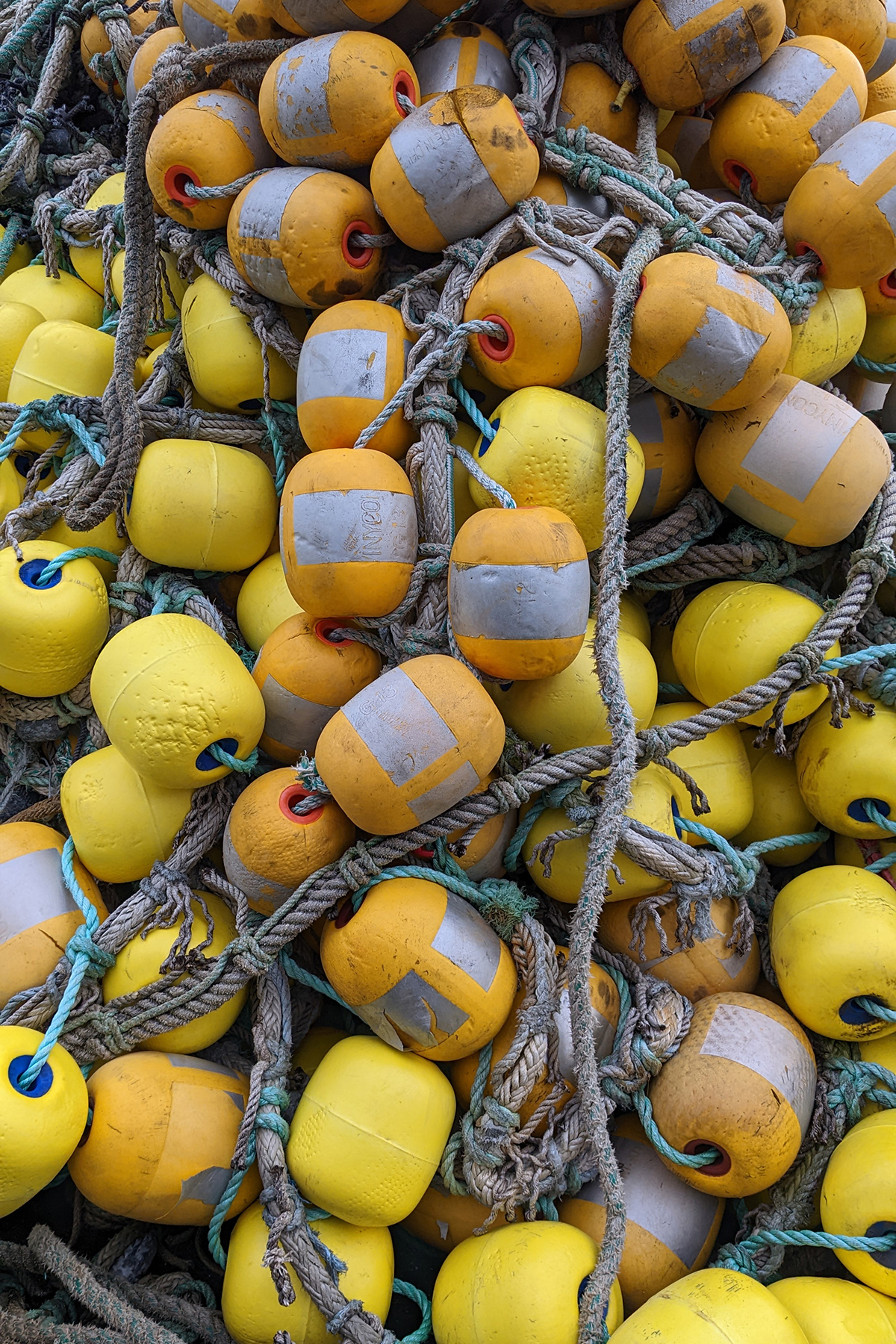
Collecting and transporting end-of-life fishing gear
The collection of end-of-life fishing gear (EOLFG) was the part of the circular process that the report authors received the most information about through visits and interviews with stakeholders and fishers. Evidently, this aspect of the circular economy is very significant and was one of the main areas lacking in the past. However, all the Nordic countries have made substantial improvements in this regard, bringing the process to a better state. While Greenland, Iceland, the Faroe Islands, and Norway engage in similar types of fishing in terms of target species and methods, the challenges related to the collection of used fishing gear differ significantly between the countries.
Greenland is an extremely large and sparsely populated country, with vast distances between coastal settlements. Supplies are delivered to some locations only a few times per year. Despite these logistical challenges, Greenland has established an effective system for collecting used fishing gear. Empty containers are utilised for return trips from small fishing villages, where they are brought for sorting, either at a waste incineration facility in Nuuk or at a netloft. In addition, Greenland has invested in modern incineration facilities, including one in Nuuk and another under construction in Sisimiut, to improve waste management. After sorting, suitable material categories are shipped to Denmark for recycling, while other fractions, such as iron scrap, trawls, and nets, are directed toward appropriate waste processing or recycling initiatives. However, this is not considered a permanent solution.
Although transporting fishing gear between remote locations in Iceland and the Faroe Islands does not pose the same challenges as in Greenland or Norway, nearly all materials destined for recycling are shipped abroad, as no local companies specialise in such services.
The development of fisheries’ gear recycling in Iceland has followed a unique path. In 2005, the Federation of Icelandic Fishing Vessel Owners agreed with the Waste Management Authority, known as the “Recycling Fund” to independently manage the recycling of synthetic materials from used fishing gear. This agreement exempted fishing gear from a special fee imposed in 2006 on the entire industry to cover proper waste disposal costs. Instead, the federation negotiated with third-party facilities to accept and recycle used gear. Initially, fishers were required to dismantle, clean, and pack the gear for transportation, receiving compensation for their efforts. Those returning unclean or undismantled gear had to pay a fee. Over time, the process has evolved, and fishing gear manufacturers now take care of the disassembly and packaging of gear for onward shipment to recycling facilities. While most fishing gear collected is recycled, some material is still sent to landfill. Despite ongoing challenges with recycling certain materials, Icelandic fishing gear manufacturers are actively addressing these issues. With continued efforts, all materials used in fishing gear are expected to become fully recyclable in the near future. Notably, Iceland’s largest fishing gear manufacturers, which also operate branches in nearby countries, have begun implementing these practices abroad.
In the Faroe Islands, the collection and transportation of EOLFG is similar to the system in Iceland, although the shorter distances simplify logistics. Netlofts are crucial in dismantling old trawls and preparing them for shipment to recycling facilities, primarily in Denmark and the Netherlands.
Norway faces distinct challenges in collecting EOLFG due to its extensive coastline and complex network of inshore systems, including fishing ports of varying sizes across the country. Additionally, the popularity of recreational fishing in Norway complicates the collection of smaller fishing gear, as it is often dispersed and more difficult to retrieve. However, EOLFG is now collected and transported to and from all regions in Norway for dismantling and recycling. Moreover, Norwegian environmental authorities are working on implementing a nationwide system that will enable all Norwegian fishers to deliver fishing gear to any fishing port. However, the details of this system are still under development.
Many of those interviewed by the project group mentioned that much of the fishing gear currently being collected is old or even very old. Efforts are underway to clear harbour areas and storage sites of unusable gear. The volume of collected gear is anticipated to decrease over time or stabilise once these cleanup activities are completed.
Estimating the amount of fishing gear disposed sent to landfill or incinerated
As mentioned above, none of the Nordic countries maintain accurate records of the total volume of fishing gear in use at any given time. No registration system tracks fishing gear from its initial use to its end-of-life stage, whether lost, dismantled, or recycled. However, when fishing gear enters the system through manufacturers, waste facilities, or incineration plants, it is recorded in terms of quantity and disposal method. This allows for partial data collection on material flows into various recycling pathways.
Despite this, a significant portion of EOLFG bypasses formal waste management systems. Some gear is disposed of in landfill without being registered as fishing gear, while other gear is incinerated under inadequate conditions and, in some cases, illegally. The extent of this unregulated disposal is difficult to quantify and varies by region and over time. Overall, there is no comprehensive system for tracking the total amount of discarded fishing gear. While some records exist for materials deemed unsuitable for recycling and sent to landfill, the unregistered portion remains unknown, potentially representing a substantial share of all discarded fishing gear.
In all the Nordic countries, many volunteers are actively involved in beach-cleaning activities. These activities often collect a large quantity of EOLFG of varying ages and states. Recycling these materials is often impossible as there is too much dirt and biomaterial in the plastic fibres, making it difficult or impossible to clean out. In some cases, this material does not go through any registration process but ends up directly in landfill.