1. Introduction
The emissions of ammonia (NH3), other reactive nitrogen (Nr) species and methane (CH4) from the agricultural sector have been identified as significant contributors to both air pollution and climate change.
Sutton, Howard, Mason, Brownlie, & Cordovil, 2022
Naturvårdsverket, 2024
European Commission, 2024e
European Commission, 2024a
Environmental issues are complex, ranging from climate change and biodiversity loss to resource depletion and pollution. These issues link to sustainable development; biodiversity; food systems; international environmental cooperation; environmental impact assessment and public participation; implementation, enforcement and monitoring.
European Parliament, 2024
EEA, 2024
The policies and measures adopted to mitigate climate change and reduce pollution are inevitably characterised by synergies and trade-offs.
EEA, 2024
Leip, et al., 2023
Sweden | Norway | Finland | Denmark | Iceland | |
|---|---|---|---|---|---|
NH3 | 45 982 | 28 000 | 28 000 | 71 000 | 4 320 |
N2O | 10 751 | 6 400 | 12 038 | 17 321* | 796 |
CH4 | 130 179 | 100 600 | 93 929 | 257 464* | 17 321 |
NOX | 13 320 | 7 414 | 9 750 | 19 000 | 940 |
Table 1. Emissions of NH3, N2O, CH4 and NOx from the agricultural sector 2022 (tones)
UNFCCC & LRTAP
The Nordic countries have committed to reducing their emissions in line with international conventions and agreements. In addition, there are national and international commitments to reduce nitrate (NO3-) leaching that effect ground-, fresh- and coastal waters. Figure 1 illustrates the nitrogen cascade and losses of CH4 from agriculture.
The existing national action strategies predominantly focus on mitigating negative environmental impacts in isolation, without considering the interconnected or holistic effects on several areas. Consequently, mitigation measures being targeted to reduce climate change can have negative effects on air pollution, by increasing emissions and vice versa. Looking at several areas at the same time would bring a greater overall environmental benefit and reduce the risk of implementing measures that solve one problem but worsen another. It is common to describe the complex interactions of nitrogen as the nitrogen cascade
Galloway, et al., 2003
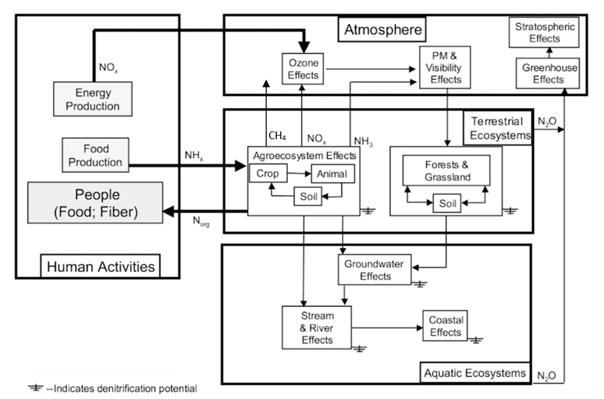
Figure 1. The nitrogen cascade and CH4 emissions from agriculture. Modified from
Galloway, et al., 2003
Developing integrated strategies for climate and air pollution in the agricultural sector focusing on measures reducing NH3, CH4, and N2O and considering NO3- leaching and N use efficiency would help the Nordic countries to work for multiple national goals as well as towards their commitments under several international conventions and agreements. An integrated strategy in this context is a comprehensive plan containing a mix of measures designed to simultaneously reduce more pollutants without increasing other environmental problems.
1.1 Background
For air pollution, all Nordic countries are Parties to the UNECE Convention on Long Range Transboundary Air Pollution (CLRTAP)
Directive (EU) 2016/2284 of the European Parliament and of the Council of 14 December 2016 on the reduction of national emissions of certain atmospheric pollutants, amending Directive 2003/35/EC and repealing Directive 2001/81/EC
Decision 2023/5, 2023
The EU directive on National Emissions Ceilings (NEC) (2016/2284/EU) is another key legislation for air pollution and is closely aligned with the Gothenburg Protocol. It sets national Emissions Reduction Commitments (ERCs) for the same air pollutants (NOx, NMVOCs, SO2, NH3 and PM2.5). The ERCs agreed for the year of 2030, are designed to reduce the health impacts of air pollution by half compared with 2005 levels. In addition, air pollutants are also regulated under the Ambient Air Quality Directives (AAQD), which set air quality standards for 12 pollutants including NOx, based on recommendations from the World Health Organisation (WHO). The standards in the AAQD were under revision, and in October 2024 the amended directive was adopted, with updated air quality standards for pollutants to be reached by 2030.
European Council, 2024
European Commission, 2024c
The Paris Agreement, adopted in 2015, is an international binding agreement aimed at mitigating climate change. All Nordic countries have committed to the Paris agreement. On an EU level the Effort Sharing Regulation (ESR) sector is designed to manage greenhouse gas emissions from agriculture as well as other sectors not included in the EU Emissions Trading System (EU ETS) or the Land Use, Land Use Change, and Forestry (LULUCF) Regulation. The ESR sector thus includes the agricultural sector as well as domestic transport (excluding aviation), buildings, small industry and waste. Together the ESR sector stand for almost 60 percent of the total domestic EU emissions.
European Commission, 2024d
The Global Methane Pledge (GMP) commits members to a collective goal of reducing CH4 emissions by at least 30 per cent by 2030, compared with 2020 levels. All Nordic countries are participating in the GMP and have submitted an EU Methane Action Plan, and developed national action plans.
Efficient incentives mechanisms will be needed for the agriculture to contribute to the decided goals on air pollution and climate. The Nordic countries use different policy measures today and have somewhat different plans for the way forward. For the counties that are members in the EU, a large common incentive structure is EU’s common agricultural policy (CAP). The current program period is 2023–2027 and the next will start from year 2028.
1.2 Purpose
This project's main goal is to present and evaluate existing mitigation measures of NH3, other forms of Nr and CH4 in the agricultural sector for the Nordic countries. The report primarily focuses on emissions affecting air quality and climate; however, other aspects of reactive nitrogen are also considered. The project will identify and propose measures and science-based policies of integrated strategies for emission reductions for the above-mentioned pollutants. By doing so, this project demonstrates how to simultaneously mitigate negative impacts on both climate change and air quality, and what measures can help the Nordic countries to meet targets under international agreements and commitments.
1.2.1 Delimitation
This project addresses the current state of knowledge through literature review on measure effectiveness on CH4, NH3 and Nr in the Nordic countries and mainly the European Union. The project has not performed new measurements or analysis on measure effectiveness beyond the literature review. Another restriction is that this report does not address metrics related to dietary change and consumption patterns because there have been numerous studies on this topic and the applicability of those measures are difficult to apply, although they are efficient in theory.
1.3 Earlier studies
There have been earlier studies on co-benefits and trade-offs between mitigation measures for air pollution and climate in agriculture, also earlier studies funded by the Nordic Council of Ministers.
Antman, et al., 2015; Hellsten, et al., 2017
The project ‘Nordic agriculture air and climate, Baseline and system analysis report’
Antman, et al., 2015
The Nordic Council and the Nordic Council of Ministers, 2024
Antman, et al., 2015
A subsequent project on ‘Nordic nitrogen and agriculture, policy, measures and recommendations to reduce environmental impact’
Hellsten, et al., 2017
It was concluded that Nr, if not taken up by crops, may contribute to several environmental problems, affecting ecosystems, climate and human health. It was further concluded that the Nordic countries have, during the last 20 years (prior to 2017), introduced efficient measures to reduce N losses to the environment. But still, N losses are relatively high as compared to the policy targets set, despite the regulatory framework applicable to the agricultural sector at EU and national levels. It was further concluded that the Nordic countries are at very different stages regarding N abatement. The project gave no firm conclusions on climate interactions.
The considered environmental effects included:
- N leaching in soil and groundwater.
- Eutrophication and acidification of terrestrial ecosystems.
- Eutrophication of marine ecosystems.
- Global warming (N2O emissions and other effects of Nr).
- Effects of N on human health (particulate matter and tropospheric ozone formation).
- Nr effects on the carbon cycle, and on global-scale effects on atmospheric fluxes of carbon dioxide (CO2) and CH4.
A later study from the Norwegian Research Institution NIVIO (Rivedal et al., 2019) estimated the potential for NH₃ reduction of measures linked to livestock manure and mineral fertiliser, and the social and private economic costs of introducing the measures.
Reduction of N2O and CH4 emissions, as a result of NH3-reducing measures, was also estimated. It was found that various measures linked to the spreading of livestock manure on meadows have the greatest potential for NH3 reduction.
The effect of livestock manure measures on emissions of NH3 and N2O (N2O) was estimated using the "nitrogen model for livestock manure" used in the national emissions calculation. Changes in CH4 emissions as a result of NH₃-reducing measures were estimated using the "Methane Model for Livestock Manure". Although these earlier studies address the issue of co-mitigation, the starting point has been from one side, looking at co-benefits on air or climate.