Marine ecosystem responses to cumulative anthropogenic pressures
The state of the marine environment relates negatively to increasing cumulative impacts, as assesed using different cumulative impact assessment (CIA) models. The CIAs made for the Baltic Sea,
Korpinen et al. (2012) Human pressures and their potential impact on the Baltic Sea ecosystem. Ecological Indicators 15:105–114.
Hammar et al. (2020) Cumulative impact assessment for ecosystem-based marine spatial planning. Science of the Total Environment 734: 139024.
HELCOM (2023): HELCOM Thematic assessment of spatial distribution of pressures and impacts 2016–2021. Baltic Sea Environment Proceedings No. 189.
Andersen et al. (2020) Relative impacts of multiple human stressors in estuaries and coastal waters in the North Sea-Baltic Sea transition zone. Science of The Total Environment 704, https://doi.org/10.1016/j.scitotenv.2019.135316
Lonsdale et al. (2020) A novel approach for cumulative impacts assessment for marine spatial planning. Environmental Science & Policy 106:125–135.
Piet et al. (2023) SCAIRM: A spatial cumulative assessment of impact risk for management. Ecological Indicators 157: 111157
Korpinen et al. (2021) Combined effects of human pressures on Europe’s marine ecosystems. Ambio 50:1325–1336, https://doi.org/10.1007/s13280-020-01482-x
OSPAR (2023) Quality Status Report 2023. https://oap.ospar.org/en/ospar-assessments/quality-status-reports/qsr-2023/
HELCOM (2023) HELCOM Thematic assessment of spatial distribution of pressures and impacts 2016–2021. Baltic Sea Environment Proceedings No. 189.
Laamanen et al. (2021) Impacts on seabed: Approaches for assessment as step towards successful measures. HELCOM ACTION report. Available at: https://helcom.fi/helcom-at-work/projects/action/
There is strong evidence of the power of the CIAs to predict the state of the marine environment (Figure 1). European Environment Agency’s Marine Messages II report assessed the state of Europe’s seas by the integrated assessment tool BEAT+ and cumulative impacts exerted by 14 anthropogenic pressures on 31 ecosystem components.
Reker et al. (2019) Marine messages II – Navigating the course towards clean, healthy and productive seas through implementation of an ecosystem‑based approach. EEA Report No 17/2019.
Herkül & Martin (2017) Cross-comparison of environmental assessments and pressures. Task 4.2.3 Report of the HELCOM SPICE project. Available at: https://helcom.fi/helcom-at-work/projects/spice/
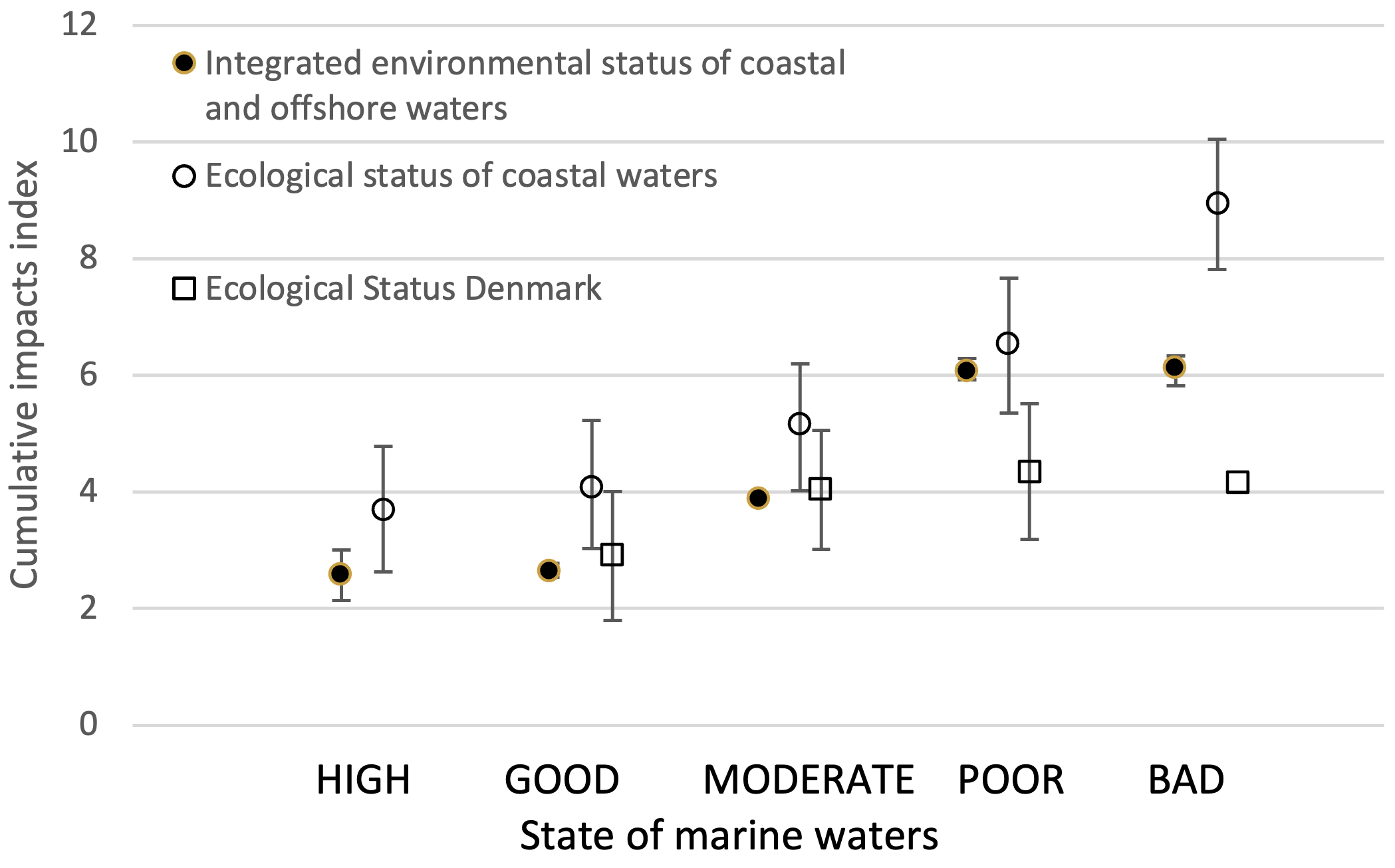
Figure 1. Relationship between cumulative pressures and the state of marine environment. The state classifications follow the ecological status of coastal waters by the EU Water Framework Directive (empty circles for the whole EU and empty squares for Denmark; data source: WISE Freshwater) and the marine assessment by European Environment Agency in 2019 (filled circles). The definition of coastal waters follows EU Water Framework Directive, and the outer boundaries of offshore waters are defined by European Environment Agency. The cumulative impacts index includes 14 anthropogenic pressures impacting the marine ecosystem, as listed in EU Marine Strategy Framework Directive (Annex III). Source: Reker et al. 2019 and COMA project.