Photo Visit Faroe Islands. Daniel Rasmussen/Copenhagen Capacity. Johan Nilsson/Øresundsbron/Visit Denmark.
Intersectoral priorities
The 2026 Presidency will adopt an intersectoral focus to enhancing societal security and the role of the Nordic Region in the world.
Greater societal security
The Presidency will focus on enhancing societal security, building on the important steps taken by the Nordic Council of Ministers during Finland and Åland’s Presidency in 2025, which prioritised societal security and preparedness.
The Nordic Region needs to be more resilient in the face of future crises and hybrid attacks. To facilitate this, all eight Nordic countries need to integrate more closely and be part of the work. This applies to resilience and to agency in all areas of responsibility. The 11 councils of ministers will focus on how to develop their policy areas to enhance overall societal security in the Nordic Region. The Presidency will also continue the positive interaction between the work of the councils of ministers and other Nordic efforts to promote societal security, see Figure 1.
Nordic co-operation on societal security and preparedness to make the Nordic Region more resilient to future crises and hybrid threats
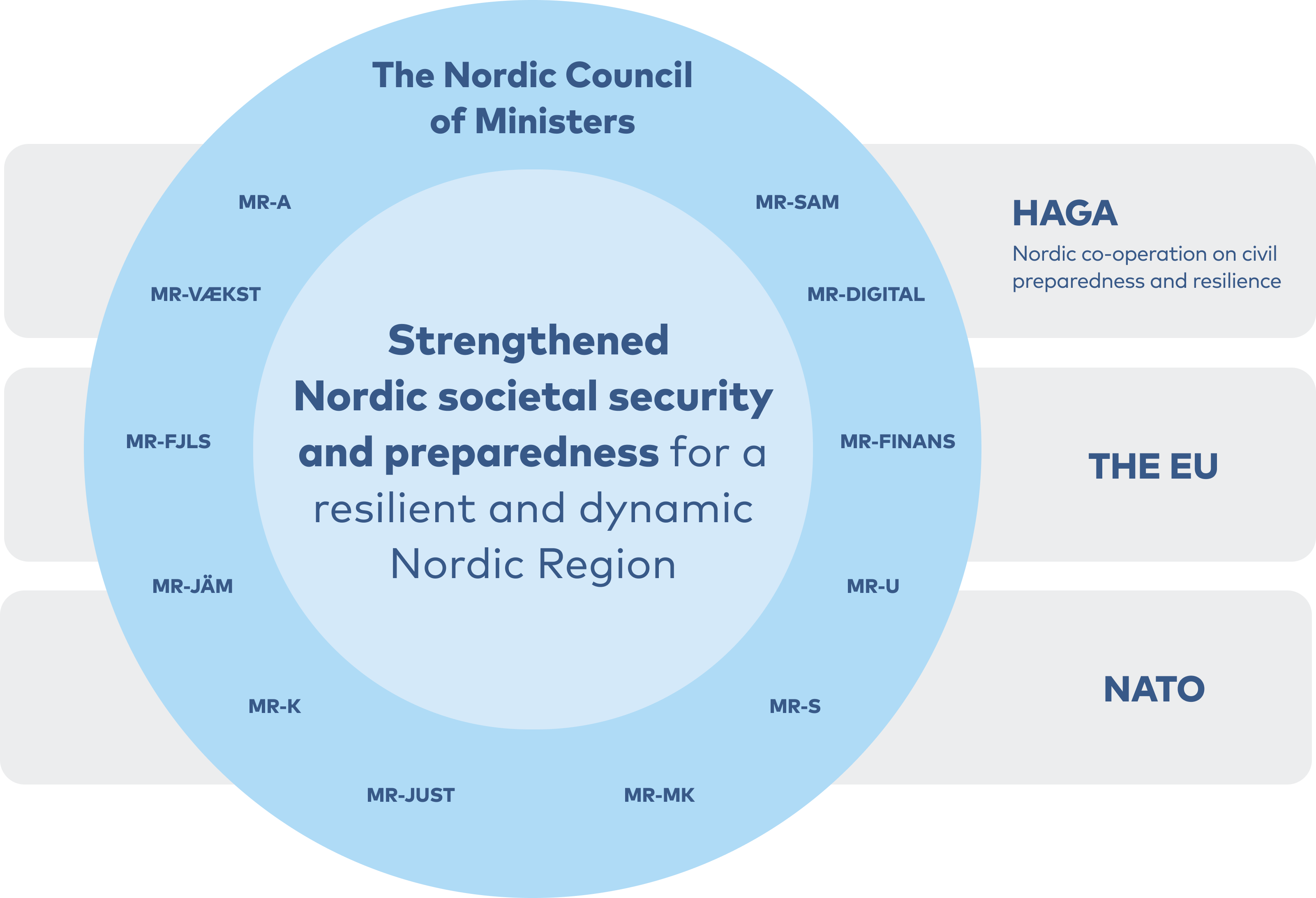
Figure 1 Societal security is a priority for all sectors of the Nordic Council of Ministers and a joint responsibility for all of the ministerial councils within the overall framework established by the EU, NATO and HAGA, and taking into account national security interests.
Improving security of supply in the Nordic Region
Security of supply is essential for maintaining the stability of vital functions and is a key element in improving societal security. The Danish and Faroese Presidency will prioritise security of supply to help guarantee access to socio-economically critical resources.
By prioritising closer co-operation on security of supply, the Presidency will help to ensure that the region is strong, adaptable and united in the event of any future supply crises. To this end, we will consolidate the new Nordic network for security of supply, the remit of which includes discussing relevant new areas of co-operation to promote security of supply throughout the Nordic Region. This will include sharing knowledge and experience of analytical methods and resilience strategies to give the Nordic authorities greater capacity to deal with supply chain disruptions, by sharing knowledge and experience of guaranteeing access to critical resources and preventing and mitigating supply crises.
Efforts to enhance Nordic co-operation on security of supply will target complementing, not duplicating, efforts in other international forums.
Multiple official agencies and private actors depend on the same resources. Assessments by the agencies involved in the sector concerned can generate value, security and co-operation on the procurement of critical resources, e.g., via joint procurement processes, shared warehouses, renting and borrowing from each other, etc.
Making Nordic industry more robust links into the Nordic business ministers’ declaration on a joint Nordic industrial partnership and will contribute to the Vision 2030 goal of a competitive Nordic Region.
Antimicrobial resistance and pharmaceutical co-operation
We need to do more to ensure our countries are equipped to deal with health threats now and in the future. The increasing prevalence of antimicrobial resistance calls for action. Antibiotics have saved countless lives, but more and more bacteria are becoming resistant to them. We need to encourage the Nordic countries to share knowledge and experience on how antimicrobial resistance develops. At international level, more and more inter-sectoral work is being done on the issue by integrating work on human, veterinary, plant and environmental health in order to generate better results together. Nordic co-operation should also be increasingly inter-sectoral. The Presidency will encourage joint procurement to ensure antibiotics are available throughout the Nordic Region.
Contingency planning for vulnerable and at-risk citizens
The Presidency will launch a project under the auspices of official Nordic co-operation on social and senior affairs to support knowledge sharing about good ways to incorporate thinking about the needs of vulnerable and at-risk groups in contingency planning. The project will include mapping national work on contingency planning, with a focus on support needs of senior citizens, people with disabilities and socially vulnerable citizens (e.g., homeless people) – both current needs and any that may emerge as a result of various crises. We expect to present the results of the survey in late 2026.
A Strong Nordic Region in the World
The Nordic Region must play an even stronger role in the world. In changing times, it is crucial that we work closely with our allies and forge even stronger ties with our neighbours.
The Nordic Region in the Arctic
The Arctic makes up a significant proportion of the Nordic Region. Since 1996, the Nordic Council of Ministers’ Arctic Co-operation Programme has generated positive results by focusing on the environment and climate, social conditions, economic development and promoting partnerships. The programme celebrates its 30th anniversary in 2026. Throughout the year, the Presidency will focus on Nordic achievements in the Arctic over the last three decades. The main priorities of the Nordic Arctic Programme are resilience and strong civil societies in the Arctic, which will be promoted through Nordic co-operation and partnerships in the Arctic.
Geopolitical tensions, including in areas close to the Nordic Region, are having an adverse effect on international and multilateral co-operation in the Arctic, pose significant challenges to the international rule of law and put pressure on the longstanding policy of keeping tension low in the Arctic. The Nordic Region must continue to do its utmost to maintain stability and sustainable growth in the Arctic. In the world of today, sustainability is also about resilience in the face of a changing world and global tensions.
The Nordic Arctic Programme 2025–2027 focuses on an Arctic that is resilient in economic, social, climate and environmental terms, priorities that are linked to the Nordic Council of Ministers’ Vision to create a socially sustainable, green and competitive Nordic Region. Arctic co-operation focuses on developing resilient local communities, supporting local business, encouraging sustainable economic growth and promoting the green transition. The Presidency will strive to promote synergies with the Kingdom of Denmark’s chairmanship of the Arctic Council.
The Nordic Region and its neighbours to the West
One important objective of co-operation with our neighbours to the West is to help forge new contacts, build networks, encourage greater mobility and the exchange of knowledge, research and culture across the Nordic Region, USA, Canada, the UK and Ireland. The Presidency will focus on three main priorities:
- Encouraging the exchange of ideas and knowledge through closer co-operation between the Nordic Region and partners in the US, Canada, the UK and Ireland, with the focus on promoting innovative solutions to shared challenges.
- Encouraging North-to-North co-operation across the Nordic and North American parts of the Arctic, with the focus on greater mobility, networking and exchange programmes for young people, civil society and researchers.
- Working to establish a representative presence in Canada, either virtually or by appointing an office manager to enhance co-operation with our neighbours to the West.
The Baltic and Nordic countries
The Baltic and Nordic countries have a great deal in common, including democracy, human rights and the rule of law, and our co-operation grows closer all the time. Demographic changes and increasingly complex needs place new demands on the Nordic and Baltic welfare systems. There is great potential for the Nordic and Baltic countries to work together to bolster overall resilience, innovation and sustainability. The value of such partnerships is already visible in current collaborations like the Nordic-Baltic network on work-related crime, which combats exploitation and activities that distort competition in the labour market. Due to the global security situation and tensions in the Baltic Sea region, the Nordic Council of Ministers is working increasingly closely with the Baltic states of Estonia, Latvia and Lithuania, as well as with civil society in Ukraine and the dissident movement in Belarus. The Baltic countries have also been invited to be an integral part of the work of the Nordic Council of Ministers for Digitalisation (MR-DIGITAL), which addresses political and operational issues and joint opportunities and challenges in the digital field. The Presidency will also work with the Baltic countries in the Nordic Council of Ministers for Culture (MR-CULTURE) to improve contingency planning in the cultural sphere. It will also seek to increase the number of equal partnerships with the Baltic states and offer participation in more parts of the Nordic Council of Ministers.
The Nordic Region in the EU
The Nordic Region is a pioneer in many areas and a strong player in Europe, particularly in digitalisation and the green transition, both of which contribute to Nordic competitiveness and sustainability. The Presidency will build on the experiences and initiatives that Denmark made during its Presidency of the EU in autumn 2025. In particular, the Presidency will continue to focus on a safe, competitive and green Europe.

