Global Industry Landscape
The global mining and metals industry is undergoing a profound transformation driven by the energy transition, electrification, and digitalisation. Demand patterns are shifting rapidly as CRMs replace traditional bulk commodities at the centre of industrial growth. This evolution is creating new opportunities – but also exposing structural vulnerabilities in supply chains, intensifying geopolitical risks, and challenging established business models.
Global demand for CRMs is rising due to energy transition technologies, while supply chain concentration in few regions poses a major risk to European manufacturing.
Global demand for CRMs is rising due to energy transition technologies, while supply chain concentration in few regions poses a major risk to European manufacturing.
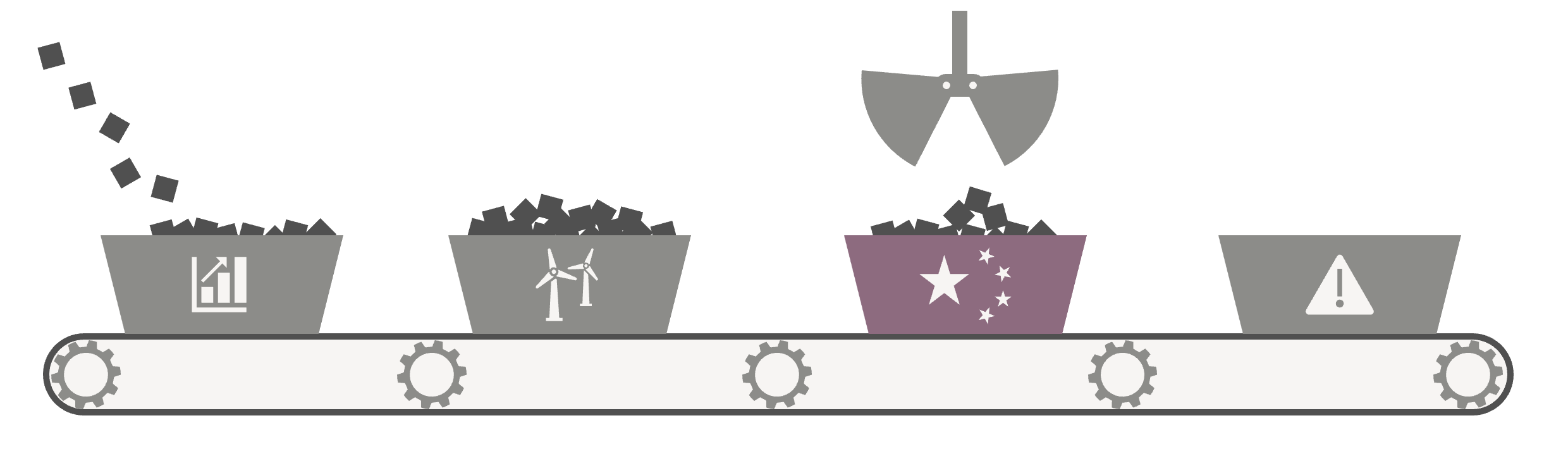 | |||
Global development | Rising CRM demand | Chinese dominance | Severe supply risk |
Global metals & mining revenues grew with a CAGR of 7% between 2000–2024 to USD 3 trillion Five key materials represent 87% of total revenues | Mineral demand projections to 2035 are strong, especially for materials critical to energy transition technologies Lithium demand is projected to more than triple and demand for REEs is set to nearly double | Global mineral supply chains are geographically concentrated Processing is significantly more concentrated, with China accounting for most of the capacity | China’s dominance is a severe supply risk for EU manufacturing USA–China trade war is directly affecting EU companies because of the role of American intermediaries |
Key takeaways | |||
| |||
Accelerating Global Demand for CRMs
The ongoing energy transition is fuelling a global shift away from traditional industrial materials and toward CRMs. The rapid adoption of energy transition technologies – such as EVs and renewable energy technologies – is driving exponential growth in demand for specific minerals. Notably, lithium demand is projected to more than triple by 2035, while demand for REEs is set to nearly double. Graphite demand is also expected to double, primarily due to its essential role in lithium-ion battery anodes. Copper demand will rise significantly (+40%), driven by electrification and power grid expansion. In contrast, demand for platinum group metals (PGMs) and iron ore is expected to decline as technologies evolve and markets mature.
Notes: Data shown covers key materials only and does not include all critical minerals.
REE = Rare earth elements; includes dysprosium, neodymium, praseodymium, and terbium.
Source: McKinsey & Company – Global Materials Perspective 2025. IEA’s Global EV Outlook 2024.
REE = Rare earth elements; includes dysprosium, neodymium, praseodymium, and terbium.
Source: McKinsey & Company – Global Materials Perspective 2025. IEA’s Global EV Outlook 2024.
Shifting Global Metals & Mining Revenues
Between 2000 and 2024, global metals and mining revenues grew at a compound annual growth rate (CAGR) of 7% reaching USD 3 trillion in 2024 from USD 0.6 trillion in 2000 – peaking at USD 4 trillion in 2021. Five key materials represent 87% of total revenues – dominated by steel, accounting for 38% of revenues in 2024. However, the share of steel is gradually decreasing, especially in China, while battery-related materials such as lithium, nickel, cobalt, and copper are showing the strongest growth outlook. This signals a structural shift away from traditional bulk commodities towards minerals critical for electrification and decarbonisation. Despite long-term stable growth, global revenues decreased by nearly 25% 2021-2024, reflecting market volatility and weaker demand.
Ibid.
Fragile and Concentrated Global Supply Chains
Global supply chains for CRMs are structurally imbalanced. While mining activities are regionally diversified – with Latin America, Oceania, and Sub-Saharan Africa playing key roles in supplying lithium (Australia), cobalt (Democratic Republic of the Congo), nickel (Indonesia), and manganese (South Africa) – processing capacity is highly concentrated. China is the dominant processor for 14 out of 15 key materials, creating severe vulnerabilities for downstream manufacturing
Ibid.
China’s Strategic Dominance and Supply Risks for Europe
Chinese dominance in CRM processing translates directly into geopolitical leverage. Strategic industrial policy, sustained investment, and infrastructure support have positioned China at the centre of global CRM supply chains. Europe’s reliance on Chinese REE exports for example, exposes its manufacturing sectors – especially automotive – to significant supply risks. Recent Chinese export restrictions on REEs and magnets have already led to production line and plant closures in Europe.
Even when European or American companies source finished goods from non-Chinese suppliers, these often depend on raw materials ultimately originating from China. For example, the United States obtains about 80% of its REEs from China. Any disruption in Chinese exports would have cascading effects, impacting both American and European manufacturing due to the interconnectedness of global supply chains.
The concentration of CRM supply chains in China is reinforced by several factors. Aggressive domestic state subsidies and export incentives as well as stricter environmental and social standards outside China make relocating processing expensive and slow. Additionally, developing countries rich in critical minerals like cobalt, copper, gold, and lithium are working to increase control over their own natural resources and thereby reducing diversification options.
Policy Response: The EU’s Critical Raw Materials Act (CRMA)
To address these vulnerabilities, the EU has enacted the Critical Raw Materials Act (CRMA), which identified 34 CRMs – 17 of which are considered strategic. By 2030, the CRMA sets targets for at least 10% of EU CRM demand to be met by domestic extraction and 25% from recycling, and that EU processing capacities should meet 40% of demand. The Act also seeks to limit reliance on any single non-EU country to 65%. These measures are designed to secure supply, boost circularity, and drive resource efficiency, ultimately reducing Europe’s exposure to external risks and supporting the transition to a low-carbon economy.
On 25 March 2025, the European Commission approved 47 strategic projects under the CRMA to boost domestic supply and reduce dependence on single-country imports by 2030. The Nordic region plays a pivotal role, hosting 11 of these projects – accounting for roughly one-fifth of all CRMA flagships.