Why problems matter more than solutions
The true challenge of any innovation process isn’t about jumping to ideas – it’s about finding the right or the better problem to solve. When we rush into solution mode, we risk developing ideas, designing products or services based on assumptions rather than actual needs.
“If I had an hour to solve a problem, I'd spend 55 minutes thinking about the problem and five minutes thinking about solutions”,
as Albert Einstein supposedly said
“If I had an hour to solve a problem, I'd spend 55 minutes thinking about the problem and five minutes thinking about solutions”,
as Albert Einstein supposedly said
This chapter explores the Problem Mapping phase of XNTC, addressing the problem of finding the right problems, checking your own assumptions, and the very human reluctance to stay with the problem and instead jump to ideas and solutions.
As you read this chapter, are you also looking to understand the real problems to solve?
If so, this chapter will guide you in how to 1) reframe and rephrase your problem multiple times, 2) question your assumptions that go into phrasing the problem, and 3) stay with the problem just a little longer…
This chapter is all about slowing down in order to dig deeper into the problem. The key takeaway is this: Staying with the problem, even to the point of discomfort and impatience, is well worth it.
QUICK OVERVIEW: XNTC Problem Mapping & Looking for Trouble
A quick overview of the XNTC activities as part of the problem mapping within four key categories of activity to ensure different perspective across the Nordic tourism landscape:
6 Problem Mapping Workshops across Denmark, Norway, Sweden, the Faroe Islands, Iceland, and Finland, with 152 stakeholders from various parts of the tourism industry and sector. The workshops centered around collaboratively identifying key issues and problems – with a new, gamified and engaging mapping tool.
18 Qualitative Interviews: In-depth interviews to gain understanding of tourism industry representatives’ views on core challenges facing Nordic tourism in the coming 5-10 years. Insights from interviews further qualified problems identified in workshops.
Cross-Nordic Survey of Tourism Businesses: 140 responses from across the Nordic region, diving into top industry challenges. The survey was distributed in partnerships with destination organisations and industry associations.
Academic Panel: 6 Nordic experts from diverse fields of academia discussed findings and added further depth and context to findings from workshops, interviews and survey in two online meetings.
REFRAMING & REPHRASING THE PROBLEM
Problems are everywhere: from media headlines of climate change to everyday complaints and inefficiencies. So, why is it so difficult to find the right or the better problem to solve?
This is a challenge not only recognised by genius thinkers like Albert Einstein, but also by business leaders around the world.
In an article by Thomas Wedell-Wedellsborg in Harvard Business Review (January – February 2017), titled “Are You Solving the Right Problems?”, the author references his research of 106 C-suit executives, representing companies from 17 countries. He finds that 85% of these business leaders agree that their organisations were bad at diagnosing problems, and 87% agree that this organisational weakness came with serious costs
Wedell-Wedellsborg, Thomas (2017). “Are You Solving the Right Problems?”. Harvard Business Review (Magazine January – February 2017): https://hbr.org/2017/01/are-you-solving-the-right-problems
85% of business leaders across 17 countries agree that their organisations were bad at diagnosing problems.
T. Wedell-Wedellsborg. "Are You Solving the Right Problems?” (Harvard Business Review 2017)
Now, Thomas Wedell-Wedellsborg also makes the point that reframing your problem is not so much about finding the ‘real problem’, but rather to find out if there is a better problem to solve. In most cases, there isn’t just one single root problem. Many problems are multicausal and can be addressed in many ways.

The Example of The Slow Elevator
Thomas Wedell-Wedellsborg uses the example of the slow elevator. People living in a building complain about the elevator – that it’s old and slow, and they all spend a lot of time waiting.
Now, people then quickly jump to solutions based on the framing of the problem: the elevator is too slow and it’s bothering people. So, the solution becomes: Make the elevator faster.
However, if the problem is instead rephrased to shift focus slightly, the problem becomes more related to the fact that people are annoyed or get bored while waiting for the elevator. And this reframing opens to a myriad of new solutions: Adding mirrors, music or even a screen with media display, posters with events in the neighborhood – all of which can make the waiting time more enjoyable and less frustrating.
CHALLENGE YOUR ASSUMPTIONS
In framing your problems, the initial problem statement and approach will often reflect your assumptions about what is wrong. And, like most industries, the Nordic tourism industry also holds a lot of assumptions about what’s wrong with tourism today.
Assumptions are like shortcuts our minds take to simplify complexity — but they can lead us astray at a potentially high cost, especially when trying to understand problems of today and tomorrow. For example, a tour operator might assume a lack of customer interest in eco-tours means people don’t care about sustainability, when the issue could simply be poor communication of the benefits and experiences involved.

Focus on Your Critical Assumptions
Not all assumptions need to be tested equally, it often suffices to focus on your critical assumptions only.
What makes a critical assumption about your problems? A critical assumption about a problem is an assumption that fundamentally shapes your understanding of the problem at hand. If this assumption later turns out to be false, you may be solving the wrong problem – in the wrong way.
Consider the following when checking your assumptions about the problem:
☑ Is this assumption shaping how you see or understand the problem?
☑ How big is the risk? If this assumption is wrong, how much impact could it have?
☑ Does it shape your approach and solutions?
☑ Is it based on evidence?
☑ Are you making assumptions about urgency?
Focus on Your Critical Assumptions
Not all assumptions need to be tested equally, it often suffices to focus on your critical assumptions only.
What makes a critical assumption about your problems? A critical assumption about a problem is an assumption that fundamentally shapes your understanding of the problem at hand. If this assumption later turns out to be false, you may be solving the wrong problem – in the wrong way.
Consider the following when checking your assumptions about the problem:
☑ Is this assumption shaping how you see or understand the problem?
☑ How big is the risk? If this assumption is wrong, how much impact could it have?
☑ Does it shape your approach and solutions?
☑ Is it based on evidence?
☑ Are you making assumptions about urgency?
Critical Assumptions About Urgency
The last item on the checklist has become more important to XNTC than expected: It is crucial to check the assumptions about the urgency of a problem: for example, a manager might assume the problem can wait, but it might be necessary to address it before it escalates. Similarly, a manager might assume it's more urgent than it actually is, thereby potentially distracting from more immediate priorities.
XNTC lesson: Assumptions about the urgency of problems can lead to ignoring risks that need proactive attention before they escalate. Cybersecurity has been a clear example: While workshops highlighted it as a problem, some Nordic tourism businesses dismissed it in practice, assuming it was a concern only for larger companies or high-risk industries. However, as the digital landscape evolves, even small tourism businesses are becoming increasingly vulnerable to data breaches and fraud. Failing to address these risks now could result in significant losses in the future.
Initially, it was tough. Many tourism SMEs view cybersecurity as something for larger companies or high-risk industries. A common mindset was: “Why would anyone target us? We’re just a small hotel or tour operator.
… in conversation with Eskil Sørensen, CEO & Founder, Cybercue. Read the full interview here.
STAYING IN THE PROBLEM (WITHOUT LOSING ENERGY)
It is not easy to stay with the problem, spending time trying to rephrase, reframe and checking your assumptions. It is only human to want to jump to the much nicer and more comfortable space of fixing stuff: Coming up with ideas and solutions to address the problems. It can frankly be draining to focus for so long on what is wrong without any forward momentum.
And if you need to identify problems as a collective, in an engaging way with multiple stakeholders, there is a real concern that your workshop or mapping exercise risks losing energy and direction, getting lost and stuck in problems and the negativity of the seemingly insolvable.
In the XNTC Problem Workshops, the energy was kept high by three simple techniques:
- Establish momentum: Demonstrate to participants how their input is valuable and will be used to inform future solutions.
- Inspire thinking: Use the moment to give participants inspiration for new thinking – introducing them to examples from other destinations and introducing them to new methodologies.
- Turning problem mapping into play: Using interactive tools to make problem mapping both collaborative and engaging; with multiple steps that keep the process fresh and motivate people to move forward towards the next step.
To turn problem mapping into play, XNTC and Group NAO joined forces with change agency Workz to develop a gamified workshop tool to engage participants in collaboratively mapping problems, reframing and questioning the causes, effects and whether they were diving into the better problem.
The Power of Playful Formats & Serious Games – According to Workz
Games aren’t just for fun—they’re for figuring stuff out
Serious games take tricky ideas and make them easier to get. They turn big challenges – or finding problems - into something you can actually play with and maybe even enjoy.
Serious games take tricky ideas and make them easier to get. They turn big challenges – or finding problems - into something you can actually play with and maybe even enjoy.
Games are Safe Places to Test Your Ideas
Games are like a test run for your ideas. You can try, fail, and tweak your approach - all without breaking anything real.
New Angles, Fresh Ideas
Sometimes it’s hard to see the bigger picture. Games let you switch roles - maybe you’re the visitor, the hotel, or the local resident. It’s a quick way to see things differently.
Bottom line: Serious games make hard stuff less hard. They get people talking, thinking, and collaborating - all while keeping it fun. In the XNTC workshop, it was all about testing the multiple different aspects of the big tourism problems of the Nordics - and sorting symptoms from effects and root causes.

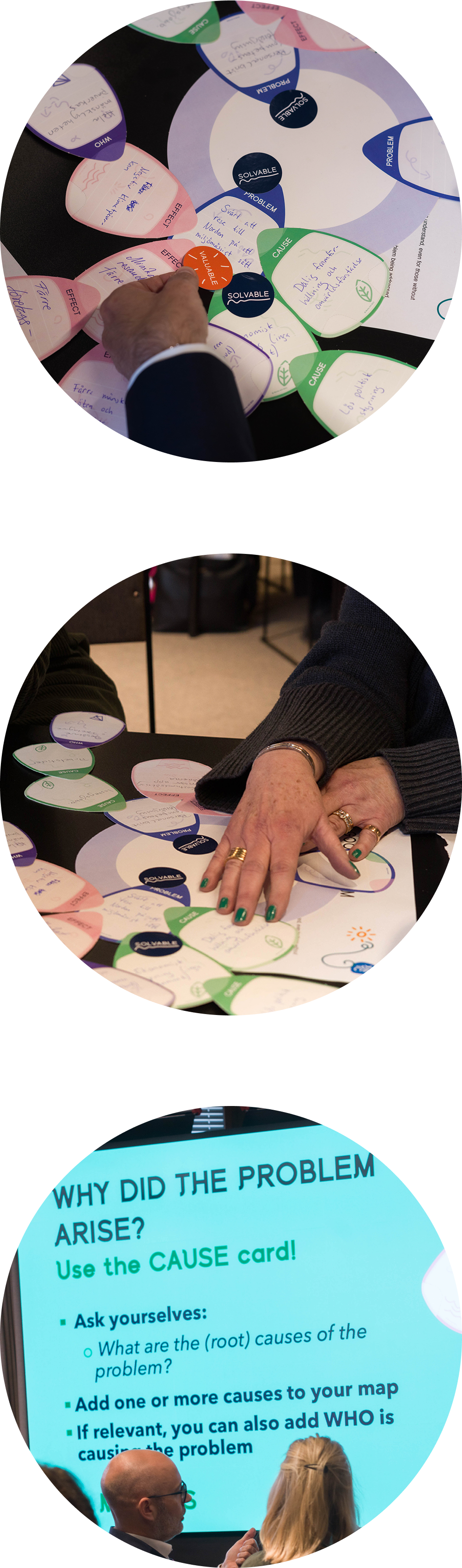
TURNING PROBLEM INTO PLAY
In the following, we have unfolded the gamified workshop tool that turned problem mapping rather fun – and highly collaborative. Each step was revealed to participants along the way with strict time frames for each step, which let participants experience a continuous sense of progress, as well as a certain time pressure which can help drive discussions and collaboration forward and avoid getting stuck in the problems.

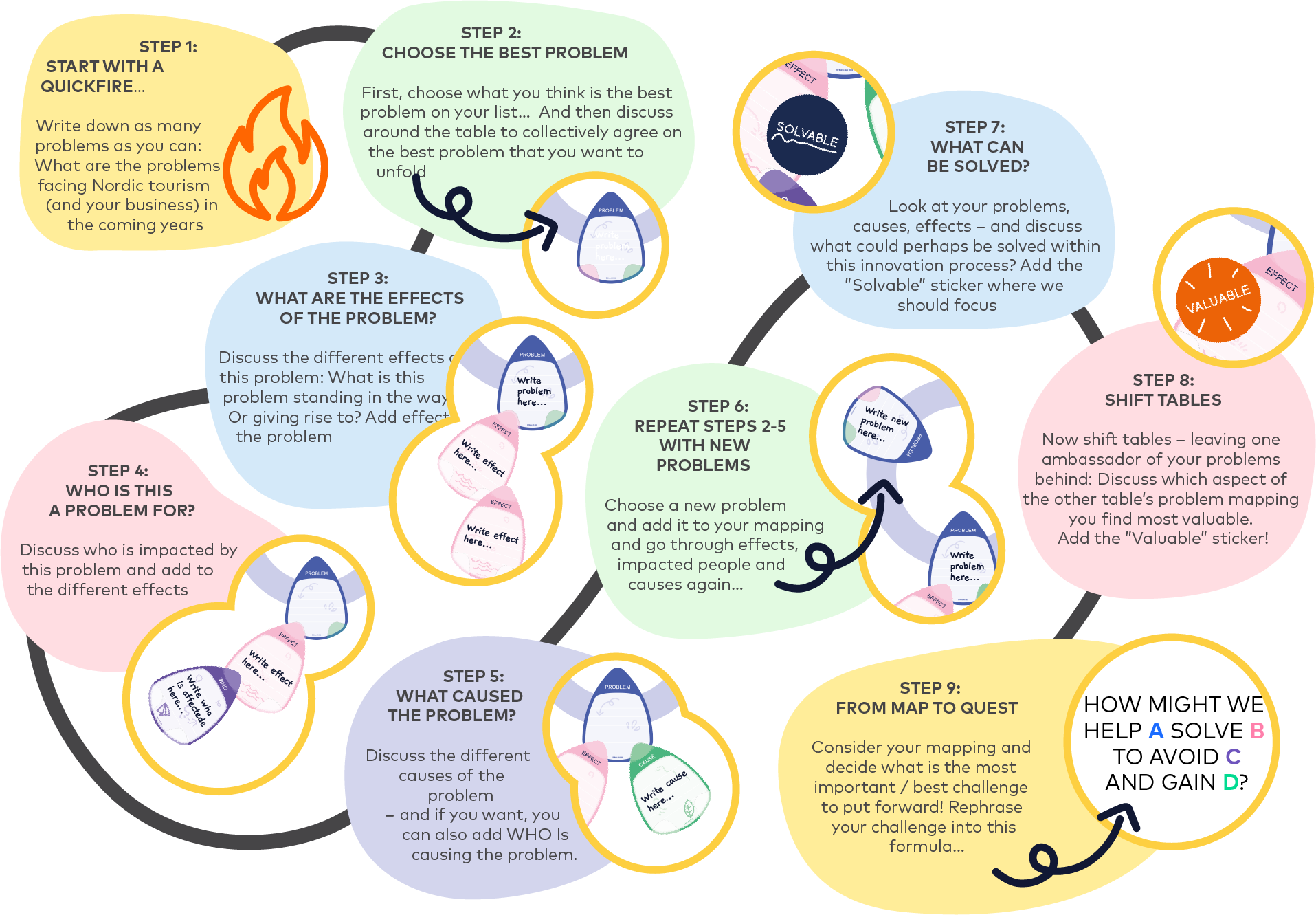
The XNTC Problem Mapping tool was developed in collaboration with Workz (https://workzchange.com/)
SUMMARISING THE PROBLEMS
Across workshops, interviews, the survey and expert panel, XNTC summarised all findings in the XNTC Opportunity Catalogue – with country-by-country findings and the top 10 list of core problems and challenges that stand in the way of a long-term sustainable and competitive Nordic tourism industry.
SO, WHAT WAS THE PROBLEM WITH THE PROBLEMS?
A good problem is both specific and relevant over time. And while the opportunity Catalogue gave great insights into the key issues and problems both experienced and anticipated among Nordic tourism industry representatives, we still had a few problems with the problems…
Missing specificity:
To bridge the problems into concrete searches for solutions, the problems needed to be defined in more specificity.
To bridge the problems into concrete searches for solutions, the problems needed to be defined in more specificity.
Lacking future perspective:
To make sure that it would be worthwhile for startups or entrepreneurs to develop solutions to these problems, the problems had to have a future perspective. If this will be solved by itself within 1-2 years, then it doesn’t make sense for a start-up to invest time and resources into it.
To make sure that it would be worthwhile for startups or entrepreneurs to develop solutions to these problems, the problems had to have a future perspective. If this will be solved by itself within 1-2 years, then it doesn’t make sense for a start-up to invest time and resources into it.
No business case:
To make sure that the problem has a viable market recipient and doesn’t create solutions that will depend on public funding in the long run to survive.
To make sure that the problem has a viable market recipient and doesn’t create solutions that will depend on public funding in the long run to survive.
Before starting to look for solutions and later match solutions with industry, the problems were firstly prioritised according to cross-Nordic potential and priority, and then further specified and future- proofed with three concrete questions:
- Will this also be a problem in 5-10 years from now, unless we come up with new solutions?
- Is this a generic headline, or does it represent an actual specified problem and challenge of the industry?
- Is this already a crowded space of tourism solutions – or are we diving into problems where XNTC can add value in creating space and focus for new solutions to existing and future problems that will impact the sustainability and competitiveness of the Nordic tourism industry?