Image: Catena
10 Logistikposition Söderåsen
Country | Sweden |
Typology | Logistics |
Area | Approx. 30,000 m² |
Building phase | Early design |
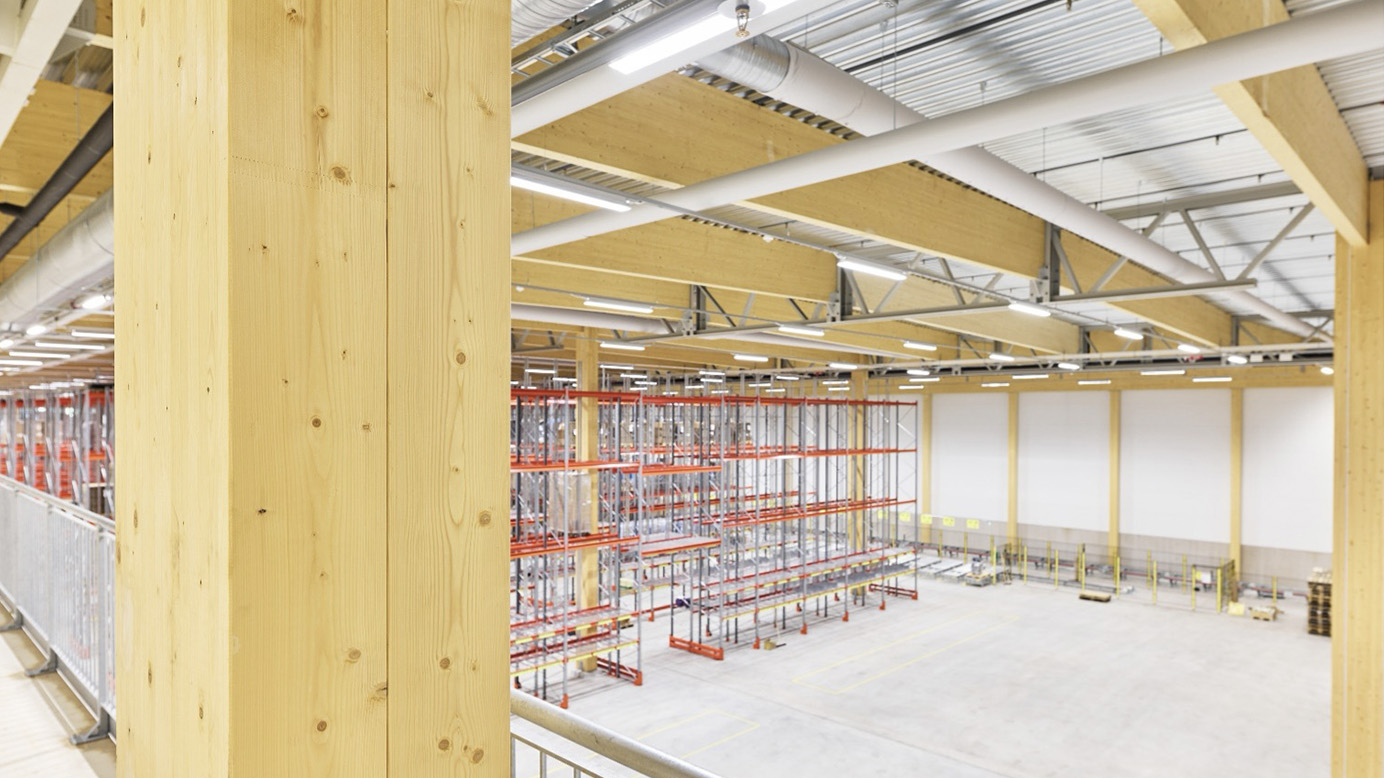
The Söderåsen project by Catena is a significant development in Bjuv municipality. The project is strategically positioned near the E4 and E6 highways. This logistics hub is anticipated to enhance the logistics network supporting Scandinavia, benefitting not just Bjuv, but the entire region. The building is characterised by an open floor plan with an optimised ceiling height to maximise storage capacity. The design includes strategically placed entrances and loading gates to support efficient logistics flows and enable future redevelopment.
The material description for the load-bearing structure, façade and internal surfaces has not been specified at this stage.
The project is committed to sustainability goals, aiming for a BREEAM-SE rating of excellent, certification with the Swedish climate certification NollCO2 and alignment with the EU taxonomy 7.1. The Catena climate budget (limit value) for A1-A5 is set at 204 kgCO2-eq/m2.
The clinic
Client | Catena |
Type of client | Building owner and construction management |
Facilitator | Anna Joelsson (Sweco SWE) Inga Sjöberg (Sweco SWE) |
Participants | Sustainability manager Sustainability coordinator Project managers |
Preliminary discussions
Catena has a sustainability programme which all new developments should follow. It is aligned with both BREEAM and EU taxonomy. It includes climate limit values for A1-A5 for all projects, and the limit values are progressive over the coming years, to ensure improvement.
The client expressed a wish to discuss complex LCA issues, such as different definitions of net-zero, climate compensation, the effects of various certification schemes, and different LCA methods. A report from a similar project exploring construction and material choices in connection to climate optimisation was reviewed in advance, and its findings were discussed during the workshop. Additionally, climate cards by Sweco were used to facilitate interactive discussions.
Key workshop findings
Several initiatives and methods for reducing the carbon footprint were identified. These included setting a climate budget (limit value) for all projects, analysing different construction methods to compare climate impact, cost and technical challenges, and implementing systems and strategies that have a real effect on the atmosphere, rather than merely appearing favourable in certain certification schemes. Catena has achieved a couple of projects with low climate impact, even though their buildings are classified as industrial and thereby not included in the Swedish climate declaration regulation.
Findings include Catena’s process where they work based on a strong awareness of the need to meet climate challenges. Through company goals, continuous discussions and experience feedback they integrate climate not all parts of the projects. Carbon budgets with limit values are an important tool and they carry out preliminary LCA calculations in the early stages to identify material replacement needs. Catena test different materials and methods and in some recently completed projects, for example, they have built large-scale frames entirely from wood or steel with a high degree of recycling. Since they specialise in logistics buildings, which are relatively generic in their design, they can effectively evaluate and build on solutions from previous projects.
The workshop also focused on developing an effective climate strategy, optimising processes and refining calculation guidelines. A hotspot analysis from a similar development project was used to provide insights and suggest improvements for the Catena case.
Key workshop challenges
One significant challenge is the variation in LCA methodologies used by different environmental certification schemes such as BREEAM, Swedish national legislation and NollCO2. Additionally, local initiatives as LFM30, Uppsala klimatprotokoll, Stockholm Klimatarena and municipal schemes are emerging defining their own methods and limit values give rise to a plethora of methods to relate to for a company having projects all over Sweden.
Another challenge is the difficulty in finding alternative façade materials with lower climate impact that are as easy to build with as traditional sandwich panels. Furthermore, logistics buildings are not included in the legislation of climate declaration, and can also earn less credits within the Swedish BREEAM adaptation compared to other buildings which limits incentives for improvement. Lastly, the energy demands in the Swedish Building Code could be more differentiated for different building types to better address specific needs.
Follow-up consultation
A follow-up was conducted one week after the workshop. During this follow-up, the client was appreciative of the discussion and hotspot analysis of the material and construction investigation report. It can give new realisations to discuss results thoroughly and plans were made to implement the discussions of the results in upcoming projects. The knowledge gained on the differences between various certification schemes will be utilised in the client’s future development projects.