Image: OBOS Bostadsutveckling
11 Rosenspira
Country | Sweden |
Typology | Row houses |
Area | Net area: approximately 128 m² per apartment Gross area: approximately 148 m² per apartment |
Building phase | Detailed design |
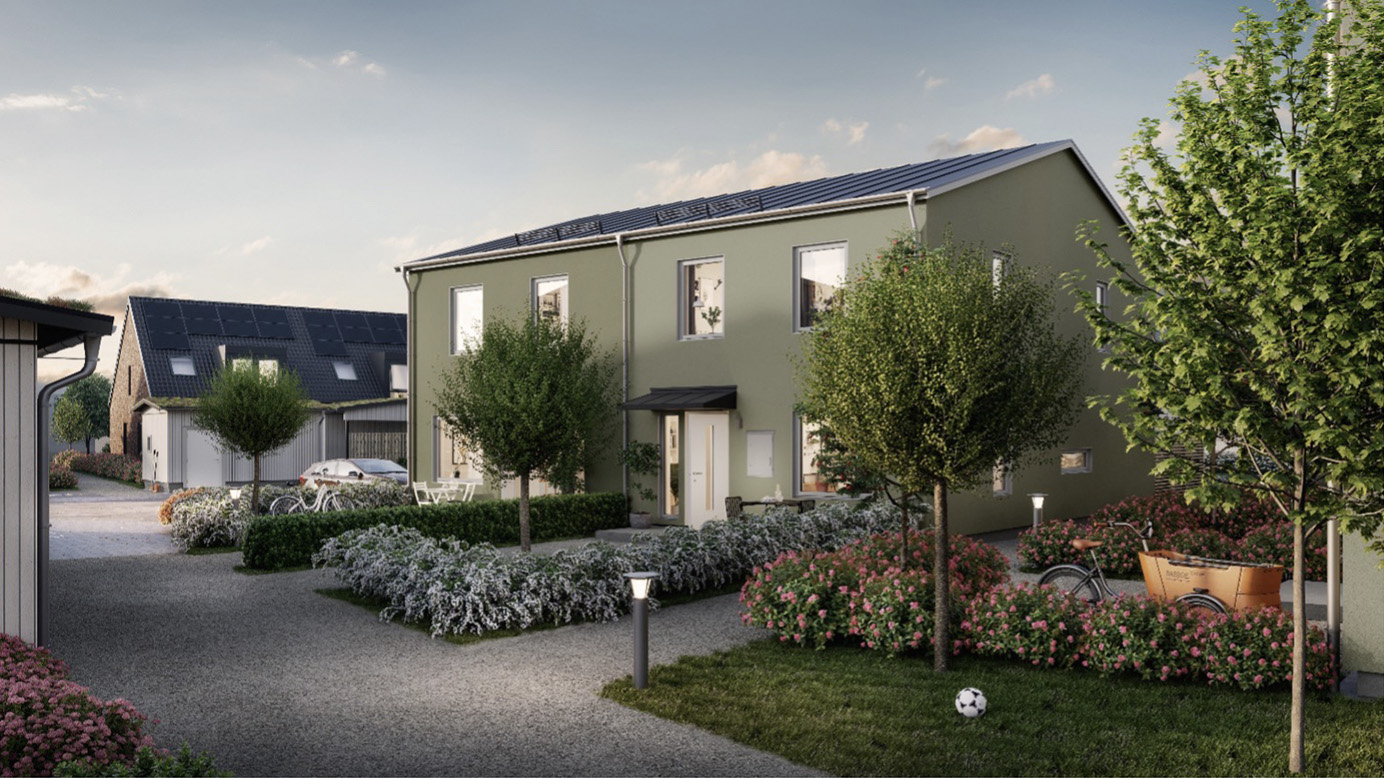
The Rosenspira neighbourhood is situated near a planned park with lush greenery. The rowhouses are designed to be two-story buildings. The buildings feature plaster façades in three earthy colours – two shades of green and a warm grey – along with silver windows. The buildings have black tar roofs and green roofs on the storage units.
The homes offer natural light throughout. The downstairs has ample space for socialising in the open kitchen and living room, while the bedrooms are upstairs. There are two bathrooms, and all residences come with parking spaces, either in a shared area or on their own driveway. Each residence also has a standalone storage unit, either by the deck in the back or on the driveway.
Most homes come with a grass lawn and a terrace. The terraces are enclosed with wooden fences, and the property boundaries are marked by hedges.
The load-bearing structure of the rowhouses consists of a wooden frame in flat elements, and the façade is plastered. The heating system includes an exhaust air heat pump with an extra supply air module and low-temperature radiators to reduce power peaks.
In terms of sustainability, the project aims to align with the LFM 30 scheme with a climate goal of 171 kgCO2-eq/m2. From early calculations, it looks like the project will achieve 140 kgCO2-eq/m2).
The clinic
Client | OBOS Bostadsutveckling |
Type of client | Construction management / Developer (building owner before they are sold) |
Facilitator | Anna Joelsson (Sweco SWE) Sofie Hansen (Sweco SWE) |
Participants | Project manager Sustainability manager Sustainability coordinators |
Preliminary discussions
OBOS has a goal of working with climate budgets with progressing limit values over the years in all projects where it is possible due to the conditions. The implementation of the limit values starts now and some projects are chosen as pilots to work with climate budgets to quality-assure the method before broad implementation.
The client had specific requirements and wishes for the workshop agenda. They wanted to discuss tricky LCA issues such as different definitions of net-zero, climate compensation, effects outside the building system boundary (D-module) from renewable energy and value chains of wooden buildings, effects from different certification schemes, and different methods of LCA, particularly the effects on the choice of energy supply system. A climate calculation of the project was received in advance, and a hotspot analysis was shown at the workshop.
Key workshop findings
The workshop provided an opportunity to thoroughly discuss and understand complicated concepts related to climate impact and LCA. The discussions emphasised the importance of understanding different methodologies for calculating climate impact and the variations in results due to different life cycle phases, building components, and emission factors. Identified important methodological choices that will affect the result of a climate calculation are:
- The purpose of the calculation – do we need an attributional or consequential LCA?
- The system boundaries of life cycle stages and buildings parts
- Do we include effects outside the system boundaries of the building, as new renewable electricity replacing other electricity, design for reuse after buildings lifetime or the use of wood residues along the production chains when building houses with wood frame?
- The difference in climate effects of accounting for using or producing electricity in an attributional or consequential way
- Quality of data
- Choice of LCA software
- Calculation method for comparing fossil materials to renewable (biogenic) materials.
The hotspot analysis identified the concrete type in the slab and the choice of façade as the building parts and materials that needed further improvement.
Key workshop challenges
Several challenges and support needs were identified during the workshop, including how to choose measures that have a real impact versus the ones that give credit in the certification schemes. The rules of certain certification schemes complicate the implementation of energy measures. For example, the Swedish environmental certification scheme Miljöbyggnad only give credit for renewable electricity produced on-site, whereas renewable electricity produced elsewhere is equally beneficial to the atmosphere. Additionally, some schemes assume that new renewable electricity, for example from solar cells within the project, replaces the Swedish production electricity mix, while others assume that it replaces European marginal electricity. This gives huge differences towards a net-zero goal.
Another challenge is that municipal detailed development plans sometimes restrict the use of reused materials or the selection of materials with the lowest climate impact due to specific requirements for façade materials and colours. The municipalities have a responsibility here to make it easier to choose from a climate perspective.
Follow-up consultation
The follow-up was held one week after the workshop, making it difficult to assess specific implementations. However, the insights gained from the workshop fostered a renewed motivation from the client to focus on climate impact reduction.