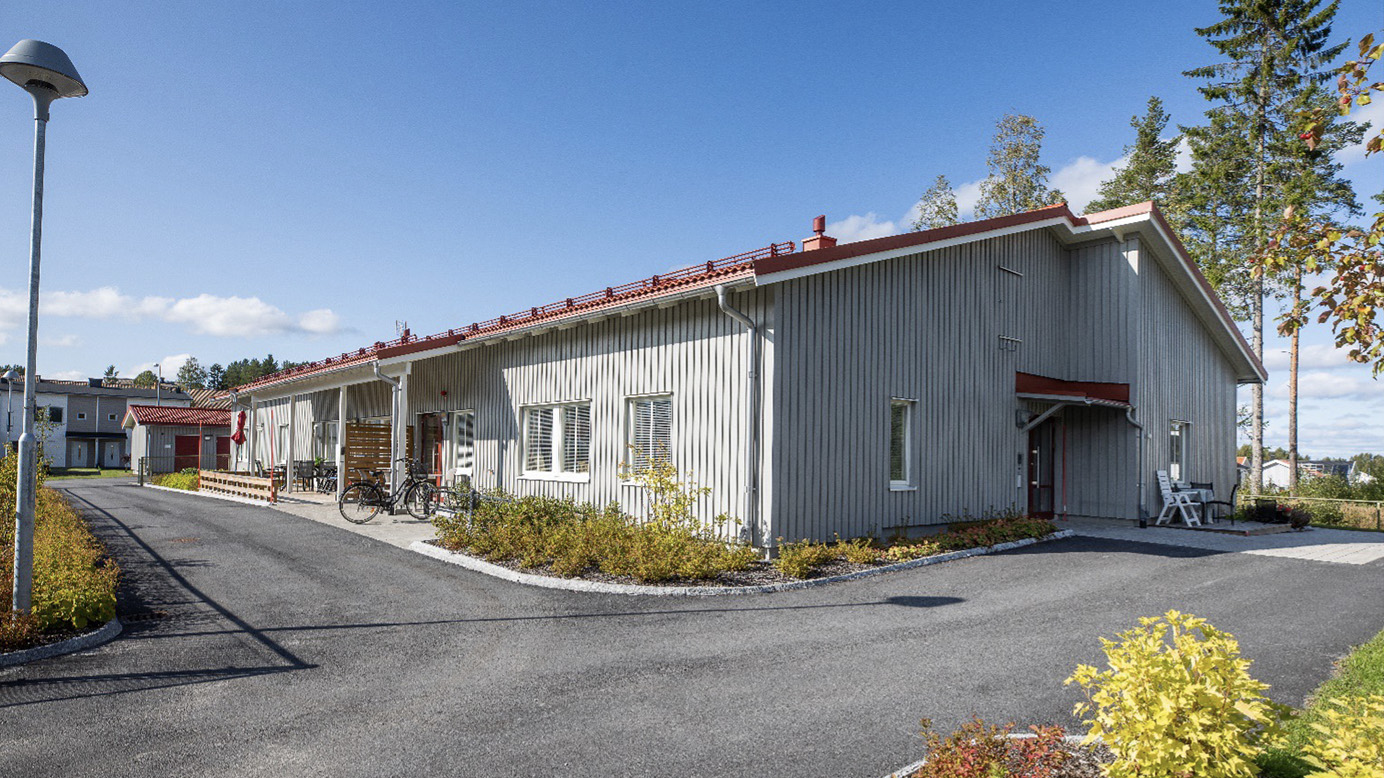
Image: Umeå Municipality
09 Concept for Group Home
Country | Sweden |
Typology | Group home (residential facilities for the elderly, for individuals with disabilities etc.) |
Area | 450 m² |
Building phase | Strategy/early design |
The project involves the construction of group homes, which are currently mostly found in a single level. In the future, two-level group homes are likely to become the most common type of building in new constructions of group homes. These homes must always follow Umeå Municipality’s room function programme. The room function programme should be seen as a basis for planning housing according to the municipality’s mandate, but it can also be used as a basis for planning other types of housing for individuals who need support.
The apartments should generally be integrated into the community’s other housing stock. They should have the same functions and standards as regular housing. In addition, there are higher requirements for accessibility, safety and overview and occasionally individual adaptations based on the occupants needs.
The current standard for single-level group homes is that the load-bearing structure consists of a wooden frame and a concrete slab on the ground. In the future, a standard for two-level group homes will also be developed. The load-bearing structure for this type has not been determined, but the developer is open to try different solutions based on the LCA to lower the climate impact in A1-A5. The materials for the façade is in several projects determined by or described in the detailed development plan. This means that the decision is not up to the developer to choose at all times.
The clinic
Client | Umeå Municipality |
Type of client | Building owner and developer |
Facilitator | Anna Joelsson (Sweco SWE) Inga Sjöberg (Sweco SWE) |
Participants | Project Managers Energy and Maintenance Engineers Environmental Engineers Head of Construction and Property Engineering Warranty Coordinator |
Preliminary discussions
Umeå Municipality has demonstrated a strong commitment to sustainability practices. Their ambition is to adhere to the Miljöbyggnad Silver requirements during the design phase, but without pursuing certification. Furthermore, they aim to reduce the climate impact from A1-A5 by 30% compared to Boverket’s suggested limit values.
The workshop was tailored to meet specific requirements and wishes expressed by the client. These included discussions on the process of climate calculations, the reuse of materials and installations and the development of the group home concept, particularly the transition from single-floor to two-floor buildings. Additionally, the workshop considered the Swedish NollCO2 certification system. Existing presentations and knowledge were utilised, and Sweco climate cards were employed for interactive discussions. PowerPoint slides on the reuse of installations were prepared using materials from previous projects.
Key workshop findings
The workshop attracted significant interest with many individuals from the client eager to participate. Participants found it intriguing to explore various methodologies for calculating climate impact, and noted the significant differences in results. Understanding the reasons behind these differences, such as life cycle phases, building components, emission factors on electricity and the impact of produced electricity from solar panels, was important. The environmental engineer expressed satisfaction that the information she had previously shared with her colleagues aligned with the workshop presentations. This alignment reassured her that they were on the right track, reinforcing the credibility of her prior communication.
Several initiatives were discussed to reduce the carbon footprint in the municipality’s building projects:
- Material selection: Opting for building materials with lower climate impact.
- Material reuse: Encouraging the reuse of materials to minimise waste.
- Flexible use of buildings: Promoting the flexible use of buildings and facilities to optimise their utilisation and prevent them from standing empty at any time during the year or day.
- Client advisories: Advising clients to implement systems and strategies that have a tangible effect on the atmosphere, rather than merely appearing beneficial on paper in a certain certification scheme.
Key workshop challenges
Several challenges were discussed during the workshop. Effectively reusing materials involves establishing a systematic approach and clear communication about the practices and benefits. How climate impact is considered in repair, conversion and extension projects. Clear communication to citizens and municipal employees about climate initiatives is challenging, but helps to build awareness and support. Given that projects are funded by tax money, it is important to use these funds wisely and fairly, balancing citizen expectations with ambitious climate goals. Utilising BIM models efficiently in climate work is also a great challenge and involves systematic integration and proper management of these models through a building’s lifecycle, ensuring they are maintained and utilised effectively by property management post-construction. Learning from others' best practices in this area can also provide valuable insights.
Follow-up consultation
A follow-up was conducted one week after the workshop. It was noted that it was too early to observe specific implementations of the knowledge gained. However, the workshop emphasised the importance of reducing climate impact and influenced the operational planning for 2025, incorporating aspects of the discussions. During the follow-up the client expressed how valuable it was to gather all the participants to immerse in the climate aspects, devote several hours to it and lay the foundation with a common language and understanding. It strengthened the ongoing commitment to sustainability and the potential long-term impact of the workshop on future projects.