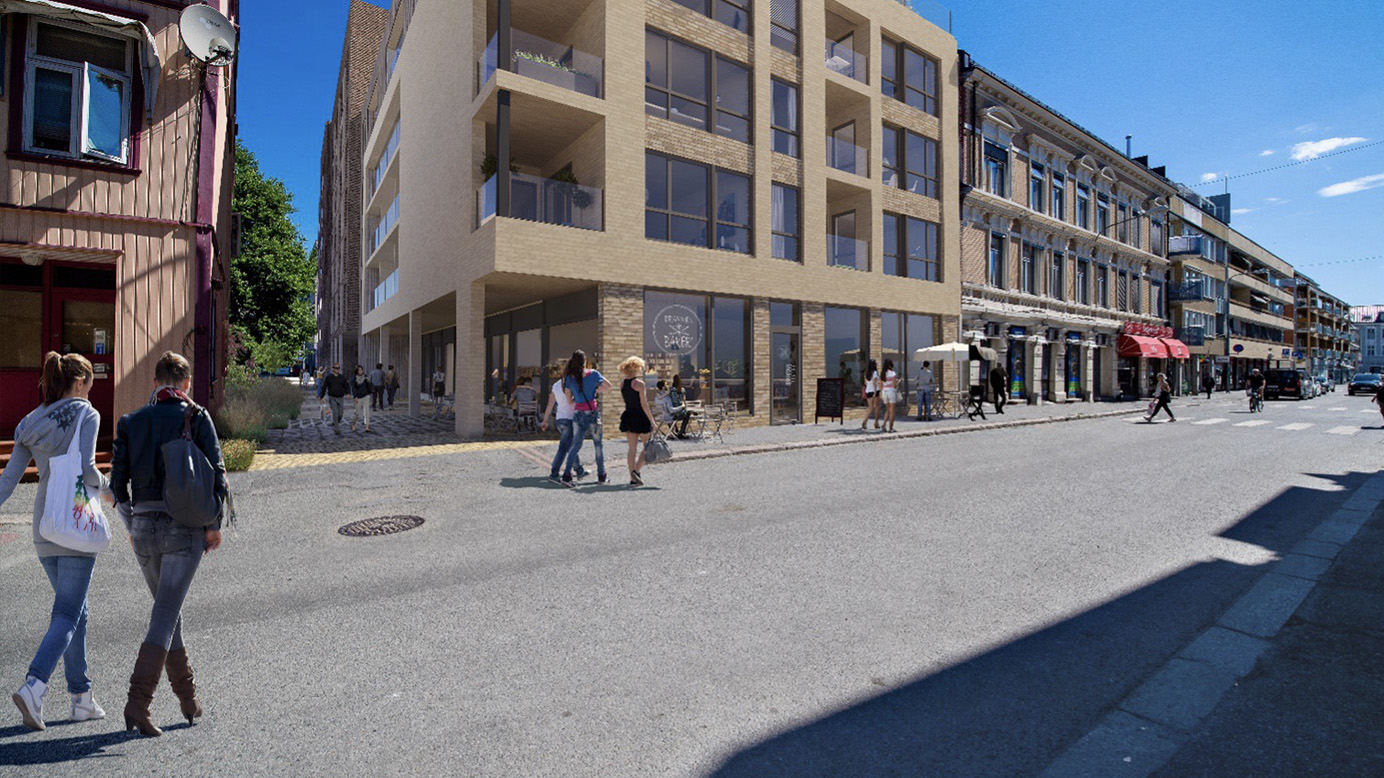
Image: Vestaksen Real Estate AS
08 Engebredden
Country | Norway |
Typology | Apartment building |
Area | 6,263 m² |
Building phase | Early to detailed design |
The project involves the construction of a new residential project right by Strømsø square in Drammen. Engebredden will feature 46 new apartments ranging in size from 45 m2, with proximity to city life and station.
The load-bearing structure is planned with steel columns and concrete walls, with façade cladding as brick tiles combined with timber and façade panels. Internal floor surfaces are likely to be wood or laminated wood, with gypsum walls and no ceiling plates. The foundations are planned with 16-metre-deep steel pile walls around the perimeter of the building and a 1-metre-thick concrete slab at the basement floor for stability due to difficult geotechnical conditions.
The project aims to align with the EU taxonomy. There is no specific certification scheme, but the client wishes to investigate various carbon emission mitigation measures.
The clinic
Client | Vestaksen Real Estate AS |
Type of client | Building owner |
Facilitator | Karin Cochard (Sweco NOR) Marie Kyllingstad (Sweco NOR) |
Participants | Building owner (2 participants) Contractor with construction and geotechnical expertise Architect |
Preliminary discussions
The client has a sustainability framework outlined for their projects. With regards to environmental and energy measures they emphasise investment in solar cell technology, reuse and use of materials that reduce emissions and energy consumption.
Drawings of the building, along with energy and geotechnical studies, were submitted to the workshop facilitators prior to the workshop. The workshop facilitators utilised the carbon designer feature in OneClickLCA to create a reference building that replicates the geometry of the project building while incorporating generic designs for building elements and material selections. This reference building will be employed during the workshop to highlight the material and building element hotspots and provide a preliminary overview of the potential effects of various mitigation measures. Additionally, an assessment was conducted to evaluate the impact of alternative energy supply options.
Key workshop findings
The workshop produced several key findings. Alternative assessments of geotechnical solutions demonstrated the advantage of the planned solution over steel core piles, highlighting the importance of planning height and weight for total greenhouse gas (GHG) emissions from foundations. The use of glulam or CLT wood in bearing columns and stairs/shafts was identified as a significant measure to reduce emissions. Discussions also included the use of low-carbon concrete and avoiding steel beams by utilising internal walls for bearing. Additionally, the possibility of using air-water heat pumps as a baseload and district heating as a peak load was explored, with a need for further cost analysis.
The facilitator has provided alternative assessments for the geotechnical solutions that showed the large advantage of the planned solution instead of steel core piles (as expected). If the building had added several floors and thus weight, it would have increased the risk for needing steel piling. This shows how important the planning of height and weight (above and below ground) is for the total GHG emissions from foundations.
The facilitator investigated the impact of using glulam or CLT wood in the bearing columns and in the stairs/shafts. Shifting from steel columns to glulam columns would contribute significantly to emissions reductions. The steel columns contribute with approximately 6% of total emissions. These emissions could potentially be cut by around 90-95% by shifting to glulam.
Concrete has a very large contribution to total emissions, both in the ground floor slab, in walls and in the hollow core slabs. In situ cast concrete contribute with about 25% of total emissions which can be reduced by about 50% if choosing low-carbon concrete. Also, hollow decks can reduce emissions by using the best available low-carbon class.
Steel beams contribute in the reference building with around 11% of the emissions. Beams may not be necessary if using internal walls as bearing. The total concept of bearing must be further developed but this suggests a large benefit by using internal walls for bearing and avoiding beams.
More hotspots were identified, in particular mortar used for slab levelling and bricks in the façade. These calculations can easily be used for looking at the relative contribution from each building element and material, and to compare with alternative materials, providing information on possible emission reduction from each mitigation measure.
Key workshop challenges
Using CLT and glulam wood in slabs and load-bearing systems comes with challenges. It is still recommended to investigate possibilities related to glulam columns. A study of the implications for area demand in the apartments is needed. When the concepts have been selected there is still a large potential for emission reductions related to product selection. As a result of very high emissions from steel sheets, concrete and steel columns, the mitigation measures moving forward in the detailed design should be to look at the possibility of choosing a lower-carbon concrete and to compare EPDs before choosing steel columns and steel sheets.
Follow-up consultation
The client expressed interest in using the workshop findings to assess further measures regarding the selection of bearing element concepts and product selections. The calculations from the workshop will serve as a basis for future assessments and design optimisations.