Image: Nordic Office of Architecture
07 East Pier
Country | Iceland |
Typology | Airport expansion |
Area | 60,385 m² |
Building phase | Early design |
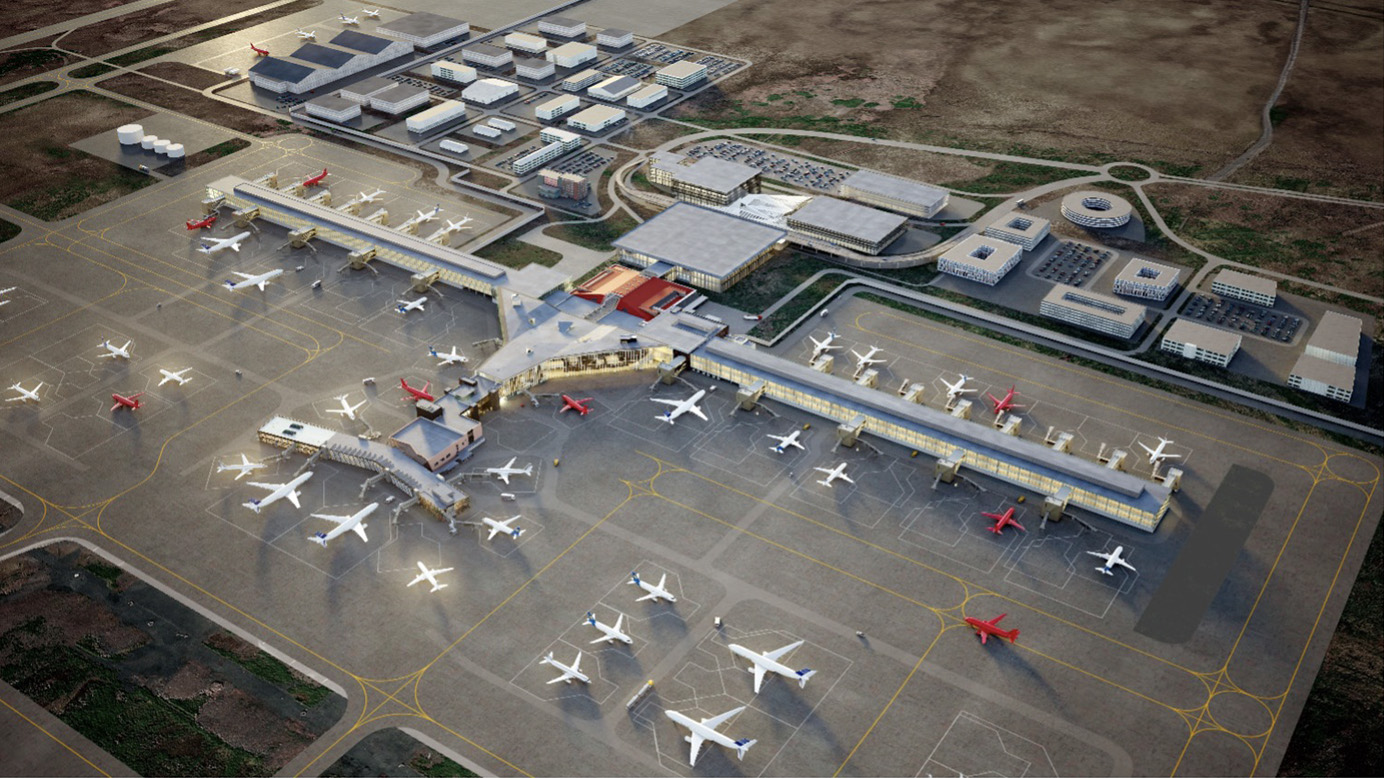
The East Pier is part of the expansion of Keflavík Airport. It will feature a new baggage handling system in the basement and on the first floor, along with up to 20 gate areas for contact stands on the second and third floors. The East Pier will connect to the East Wing of the airport and will consist of 3 to 4 floors, including a basement.
The East Pier will be a steel-frame building with a glass curtain wall façade.
The project aims to achieve the BREEAM rating ‘Very Good’ as a minimum, with aspirations to achieve the ‘Excellent’ rating. The project furthermore aims to meet the client’s Sustainability Framework goal of 350-450 kg CO2-eq/m2.
The clinic
Client | Isavia |
Type of client | Building owner |
Facilitator | Alexandra Kjeld (EFLA) Sigurður Loftur Thorlacius (EFLA) Björgvin Brynjarsson (EFLA) |
Participants | Sustainability manager Architects |
Preliminary discussions
The client aims to achieve net zero by 2030, supported by an extensive sustainability framework that all construction projects must follow.
There were no specific requirements or wishes from the client for the workshop agenda. The workshop was designed to cover the current main requirements in Iceland and included ‘benchmark’ life cycle assessment (LCA) studies for other buildings to highlight important aspects and hot spots. No documentation was shared beforehand, but some LCA material for respective buildings had been reviewed to a limited extent in prior meetings. The workshop agenda included a comprehensive overview of the project background, environmental impacts of the construction sector, examples from the sector, a comparison of different materials and a discussion on challenges and potential improvements.
Key workshop findings
Based on results from previous construction projects at Keflavik Airport, recommendations were made to support the client’s sustainability goals for the East Pier. The analysis identified concrete and steel as the primary contributors to the carbon footprint, with structural steel being the main emissions driver. To address this, the potential for significant carbon footprint reduction by using recycled steel and low-carbon concrete was presented. Additionally, the impacts of using low-carbon concrete, aluminium with nearly 100% recycled content, lower-emission structural steel and shorter transport distances were explored. A comparative analysis of cladding materials showed that fibre cement cladding performed better than aluminium cladding, and a comparison of glass curtain wall façades indicated that unitised panels minimised waste and construction time, while stick-on façades allowed for more compact transportation and thus lower emissions.
During the discussion, the client expressed interest in substituting aluminium cladding with fibre cement cladding and exploring lower-carbon cement, despite potential time constraints. They emphasised the need for lower-carbon steel to meet specific quality and strength requirements and highlighted the importance of focusing on the overall carbon footprint rather than solely on recycled content. The client also noted challenges in sourcing recycled aluminium and introduced the idea of incorporating wooden floors as an alternative to tiles. The workshop provided valuable insights and practical recommendations for reducing emissions in the construction of the East Pier.
Key workshop challenges
The main challenges identified by the client were multifaceted. They highlighted the difficulties in sourcing recycled aluminium, noting that it often lacks the natural finish and has visual defects due to impurities. Additionally, obtaining the necessary strength alloy required for the building was challenging. Part of the discussions focused on how a ‘recycled material content’ requirement can be counterproductive, as recycled materials such as steel and aluminium are not in limitless supply. Instead, the emphasis could be placed on ‘low-carbon’ materials, leaving it to the suppliers or original manufacturers to determine how this is achieved.
The client also mentioned the difficulty in meeting BREEAM weather requirements and ensuring that materials can withstand the winds in Keflavik. They stressed the importance of selecting materials that will last for the entire lifetime of the building, rather than those that may degrade due to weather conditions. Additionally, the seismic activity in the area influenced the choices of materials, further complicating the selection process.
Follow-up consultation
The client expressed interest in the cladding and glazing discussion which could reduce the embodied carbon significantly together with low-carbon steel and low-carbon concrete. Both concrete suppliers are taking significant steps to reduce the carbon content of the concrete mix. The calculations from the workshop will serve as a basis for future assessments and design optimisations.