Image: Basalt Architects
06 Visitor Centre in Þjórsárdalur
Country | Iceland |
Typology | Commercial |
Area | 2,145 m² |
Building phase | Early design |
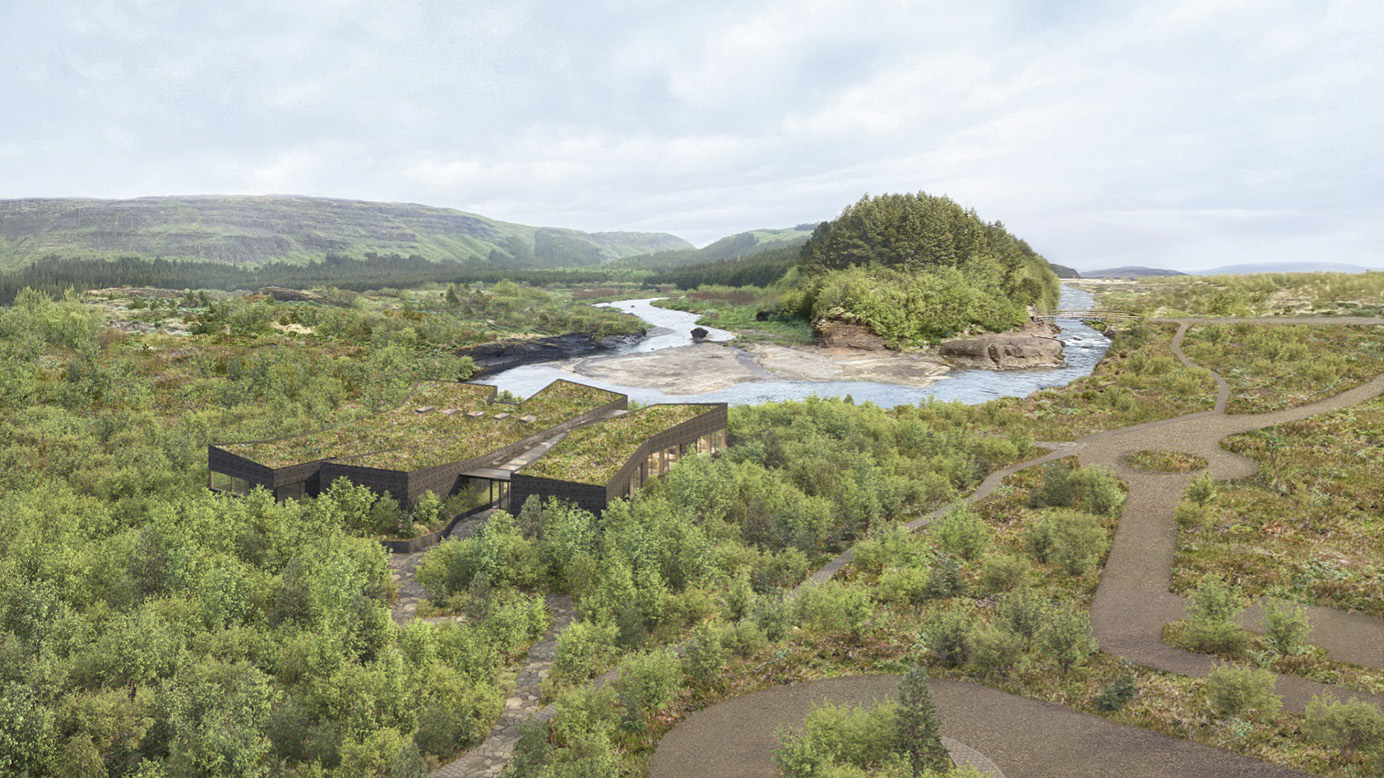
The visitor centre in Þjórsárdalur, Iceland, will serve as a reception for hotel and bath guests of the Mountain Retreat in Þjórsárdalur. It will also function as an information centre, exhibition space, shops and restaurants, as well as staff facilities. The building is designed on one floor with a basement. Most activities will take place on the ground floor, with technical spaces, storage spaces and staff changing facilities located in the basement.
The building is supported by a load-bearing pad with cast-in-place plinths and a base slab. The basement is also cast in place. On the first floor, load-bearing walls consist of timber on one side and reinforced concrete on the other. The roof is primarily made of traditional wooden beams or glulam, reinforced with steel in some areas. Vertical loads are supported by glulam columns and concrete walls, while horizontal loads are managed by wooden boards in the roof, transferring the load to the foundations through concrete walls or steel braces. The façade will mainly consist of burnt timber cladding, and the interior walls will be clad with timber cladding, plaster, or tiles in wet spaces.
The building is supported by a load-bearing pad with cast-in-place plinths and a base slab. The basement is also cast in place. On the first floor, load-bearing walls consist of timber on one side and reinforced concrete on the other. The roof is primarily made of traditional wooden beams or glulam, reinforced with steel in some areas. Vertical loads are supported by glulam columns and concrete walls, while horizontal loads are managed by wooden boards in the roof, transferring the load to the foundations through concrete walls or steel braces. The façade will mainly consist of burnt timber cladding, and the interior walls will be clad with timber cladding, plaster, or tiles in wet spaces.
For the visitor centre the project has the goal of undergoing BREEAM certification with a rating of Excellent. Their goal is to reduce the carbon footprint of the project as much as they can during the development stage, and they aim to offset emissions from operations via their own forestry project.
The clinic
Client | Rauðukambar ehf. |
Type of client | Building owner |
Facilitator | Alexandra Kjeld (EFLA) Sigurður Loftur Thorlacius (EFLA) |
Participants | Project owner Architect |
Preliminary discussions
The parent company Bláa lónið of the client (owner of Rauðukambar ehf) has defined a goal of BREEAM certification for all their building projects in development.
There were no specific requirements or wishes from the client to the workshop agenda. The agenda included a presentation of the requirements in Iceland (roadmap and new LCA requirements) and some ‘benchmark’ LCA studies for other buildings that have highlighted hot spots (e.g. concrete, steel and use of hot water). No documentation was shared beforehand, but some of the LCA material for respective buildings had been reviewed to a limited extent in prior meetings. To prepare for the meeting, OneClick was used to compare the benchmark projects from the client with current early designs.
Key workshop findings
The workshop revealed several key findings. Firstly, the significant restrictions posed by Icelandic conditions when designing sustainable buildings were highlighted. Initially, the visitor centre was planned to be constructed from timber, but because of all the steel that had to be used to reinforce the timber, mainly due to seismic activity in the area, the client settled on using concrete to reduce project costs. Significant resources have been made to minimise the carbon footprint, including an optimisation of the concrete used in the project. First the amount of concrete has been minimised and then strength classes was optimised, resulting in the use of nine different strength classes of concrete for the visitor centre. This has further decreased the environmental impact. All water and energy heating are sourced from the client’s boreholes, monitored by ÍSOR, Iceland Geosurvey. The feasibility of an on-site concrete plant is being investigated to reduce transportation costs and emissions. The client has also planted 30,000 trees to offset carbon emissions, and plans to certify the forest for carbon credits. Additionally, the potential for better allocation of time and costs associated with the certification process to more impactful sustainability measures was identified.
Key workshop challenges
Several challenges were identified during the workshop. The cost of sustainable materials was found to impact the design of eco-friendly buildings. Geological conditions in Iceland, especially in earthquake-prone zones, limit material choices due to the need for structural strength. Weather conditions necessitate the use of tried-and-tested materials. Furthermore, the sustainability certification process, particularly BREEAM, is time-consuming and requires extensive paperwork, which can be restrictive given the limited time in projects. The costs associated with certification could be better allocated towards sourcing lower-carbon materials.
Follow-up consultation
The client expressed interest in the capacity of LCA to promote continual improvement, but also to communicate a story of improvements since the conceptual design. The calculations from the workshop will serve as a basis for future assessments and design optimisations, and the client intends to update calculations.